

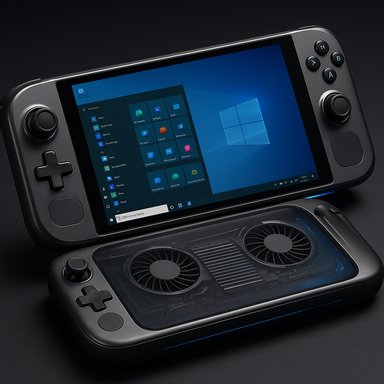
Ayaneo’s Next II has re-emerged as a deliberately ambitious flagship: the company’s latest redesign teases high-end controls, an 8‑inch (or larger) premium display, and internal engineering aimed at housing AMD’s most powerful mobile APUs — all while the firm continues to withhold firm pricing and a ship date. Early details show TMR-style joysticks, Hall‑effect triggers, an 8‑way floating D‑pad, dual trackpads and what Ayaneo calls a “customised top‑tier screen”, positioning the Next II as a large‑screen Windows handheld meant to compete directly with the likes of GPD, OneXPlayer and other boutique handheld manufacturers.
Ayaneo first hinted at the Next II during its strategy livestreams and official product teases, positioning the device as the company’s next flagship after the original Next and as a cousin to its larger 8.4‑inch Kun preview. The company has signalled a deliberate shift toward more powerful silicon and more ambitious thermal designs to accommodate APUs previously thought too large for true handheld form factors. That narrative is supported both by Ayaneo’s own product messaging and independent industry coverage showing the device as a next‑generation entry rather than a minor refresh. Ayaneo’s messaging is confident but sparse: the manufacturer claims breakthroughs in battery life and thermal design for the Next II while confirming premium input hardware and a larger display — yet it has not published final screen specs, SKU pricing, or a firm launch date. Readers should treat the current public claims as manufacturer previews and road‑map pledges, not final retail specifications.
What to expect from a “top‑tier” handset display in 2025:
For enthusiasts and power users, the Next II is worth monitoring closely. For most buyers, the sensible course is to wait for Ayaneo to publish final specifications and for independent reviewers to validate sustained performance, display measurements and real‑world battery life. If Ayaneo can deliver on its claims without sacrificing usability or thermal comfort, the Next II could be a defining flagship for Windows handheld gaming — but until verified, a healthy dose of skepticism remains justified.
Source: Notebookcheck Ayaneo Next II revealed in latest redesign as new flagship Windows gaming handheld to beat
 Background / Overview
Ayaneo first hinted at the Next II during its strategy livestreams and official product teases, positioning the device as the company’s next flagship after the original Next and as a cousin to its larger 8.4‑inch Kun preview. The company has signalled a deliberate shift toward more powerful silicon and more ambitious thermal designs to accommodate APUs previously thought too large for true handheld form factors. That narrative is supported both by Ayaneo’s own product messaging and independent industry coverage showing the device as a next‑generation entry rather than a minor refresh. Ayaneo’s messaging is confident but sparse: the manufacturer claims breakthroughs in battery life and thermal design for the Next II while confirming premium input hardware and a larger display — yet it has not published final screen specs, SKU pricing, or a firm launch date. Readers should treat the current public claims as manufacturer previews and road‑map pledges, not final retail specifications. Design and Controls: a control‑first handheld
Premium input stack
Ayaneo’s focus on physical controls is a clear strength of the Next II preview. The company confirmed:- TMR joysticks (magnetoresistive sensing) to reduce stick drift and increase longevity.
- Hall‑effect triggers for linear, non‑contact trigger sensing.
- An 8‑way floating D‑pad intended for tighter directional control.
- Dual trackpads beneath the analog sticks, mirroring the Steam Deck’s approach for more precise non‑controller inputs.
- Linear motors and advanced haptics inherited from Ayaneo’s MASTER controller design language.
Ergonomics and industrial design
Based on Ayaneo’s images and prototype footage, the Next II pushes toward a larger candy‑bar form factor — likely heavier and less pocketable than 7‑inch handhelds but offering more display real estate and full‑sized controls. This tradeoff is intentional: the device is being positioned as a handheld that leans into desktop‑like performance rather than ultimate portability. Expect a weight and balance profile that favors long sessions with two‑hand grip comfort over ultra‑light commuting use.Screen and display: “customised top‑tier” — what that likely means
Ayaneo describes the Next II’s screen as a “customised top‑tier screen” and has previously indicated a display size of at least 8 inches. Several independent leaks and regional reports reinforce an ~8‑inch panel choice; some early coverage references IPS panels, while other outlets speculate OLED — the final choice will materially affect brightness, battery life, and HDR behavior. At present, Ayaneo has not published resolution, refresh rate, color gamut, panel supplier or HDR certification. Treat any pixel counts or refresh numbers in public rumors as provisional until Ayaneo posts final specs.What to expect from a “top‑tier” handset display in 2025:
- Native resolution in the WUXGA–WQXGA class (e.g., 1920×1200 or similar) to balance battery draw and image clarity.
- A high‑quality IPS or OLED panel with at least 500 nits peak brightness to remain usable outdoors.
- Variable refresh (VRR) in the 60–120 Hz range for smoother motion with adaptive power saving.
- Good color coverage (100% sRGB minimum, P3/TrueColor marketing on premium units).
Hardware: APUs, memory and configuration options
AMD Ryzen AI Max family in reach
Industry coverage and Ayaneo’s own roadmap indicate the Next II will support very high‑end AMD APUs — notably the Ryzen AI Max 385 and Ryzen AI Max+ 395 family that are already appearing in flagship handheld efforts from other OEMs. These Strix Halo‑class parts combine many CPU cores and RDNA 3.5‑class integrated graphics, pushing performance beyond the Z‑series handheld chips and into territory previously dominated by discrete laptop GPUs. Multiple independent outlets have linked Next II concepts to these APUs and suggested Ayaneo will offer multiple SKUs with significant RAM ceilings (32 GB to 128 GB in rumor streams). However, Ayaneo has not yet published exact SKU pairings or final memory options for the Next II. Key implications of using Ryzen AI Max‑class APUs:- Much higher sustained power and heat generation compared with Z‑series handheld APUs, necessitating larger heat sinks and more robust power delivery.
- Potential for discrete‑class integrated GPU performance (40 CUs / RDNA 3.5 on some 395 variants), enabling higher frame‑rates at handheld resolutions — if thermal and power constraints are managed.
- Larger memory configurations to support both gaming and AI workloads — a differentiator for users who want local model inference or heavy multitasking.
Memory, storage and I/O (rumored)
Multiple vendor comparisons and comparable flagship handhelds suggest Ayaneo may offer:- RAM options up to 32–128 GB LPDDR5/LPDDR5X on the highest SKUs.
- NVMe M.2 storage (potentially 2242/2280) with expandable options.
- Modern I/O like USB‑C with DisplayPort alt mode, microSD expansion and a high‑wattage PD charger.
Thermal design and battery: the engineering tradeoffs
Ayaneo’s public discussion highlights “breakthroughs in both battery life and thermal design”, an essential claim if the Next II is to house Ryzen AI Max parts without external power bricks or backpacks. Independent previews of similar designs — including other makers squeezing Strix Halo APUs into handhelds — point to the following engineering choices:- Dual‑fan systems and larger vapor‑chamber style PCBs to increase heat spread.
- 12‑phase or beefier VRM designs to support high, sustained current draw.
- Larger internal batteries (internal, not removable for many Next variants) to maintain usable runtimes under heavier loads.
- In some competing units, manufacturers are exploring external cooling accessories or “docked” modes for full TDP operation; Ayaneo’s claim of improved battery life should be validated in real‑world tests.
Software, drivers and ecosystem
Ayaneo will ship the Next II as a Windows 11 handheld, a platform decision that preserves full PC flexibility but brings the well‑known Windows tradeoffs: background services, driver complexity and the need for careful OEM tuning to achieve console‑like usability. Microsoft’s handheld initiative (Xbox full‑screen experience and Handheld Compatibility Program) is reshaping expectations for small‑screen Windows devices, but broad parity depends on Microsoft, OEMs and developers aligning on optimizations. A well‑tuned early OS image from Ayaneo will be important to deliver the controller‑first experience buyers expect. Driver maturity: Intel and AMD driver stacks for novel form factors and new integrated GPU architectures have improved — but driver stability, shader compilations and power governors remain a failure mode in early handheld launches. Ayaneo’s ability to ship and maintain frequent firmware and driver updates will be a key determinant of long‑term user satisfaction.Where the Next II fits in the competitive landscape
Ayaneo’s Next II is aiming squarely at the high end of the boutique handheld market. Benchmarks and positioning should be viewed relative to several peers:- GPD Win 5 — one of the early Strix Halo / Max family adopters. GPD’s design choices to accept a backpack or external power have provided a different set of tradeoffs in thermal headroom.
- OneXPlayer OneXFly Apex — a flagship that already leverages Ryzen AI Max+ 395 and up to 128 GB RAM, with aggressive TDP tuning and liquid/silent cooling concepts; a clear direct competitor if those offerings ship as advertised.
- ROG Xbox Ally family / Lenovo Legion Go 2 / MSI Claw 8 — ecosystem and form‑factor competitors that take different approaches to UX (Microsoft’s Xbox full‑screen shell, detachable controllers, or OLED panels). These devices illustrate the broader market choices: smaller 7‑inch premium designs vs. larger 8–8.8‑inch displays focusing on media and multitasking.
Strengths: what Ayaneo is doing right
- Control quality: TMR joysticks and Hall triggers are now the gold standard for drift mitigation and long‑term durability; Ayaneo’s embrace of these parts is a clear user experience win.
- Bigger display: an 8‑inch+ panel gives more workspace for PC UI, makes single‑player AAA games visually richer, and reduces the need for small UI scaling workarounds common on 7‑inch handhelds.
- Ambitious thermal engineering: if Ayaneo achieves the promised thermal improvements without excessive noise or heat on hands, that’s a meaningful engineering accomplishment and would unlock stronger sustained performance.
- Potential high‑end SKUs: access to Ryzen AI Max family APUs would set Ayaneo apart for users wanting near‑laptop performance in a handheld package.
Risks and unanswered questions
- Release timing and pricing: Ayaneo has given a “coming soon” timeline but no launch date or official MSRP; without price anchors, prospective buyers can only compare on rumored specs. Major competitive devices in this space often carry premium pricing.
- Battery life vs. peak performance: high‑TDP APUs require either large batteries or external power to sustain peak clocks; buyers should expect battery life to drop quickly under heavy loads. Verify independent runtime tests before committing.
- Thermal management tradeoffs: sustaining Strix Halo‑class performance in a handheld increases the risk of throttling, elevated surface temperatures and louder fans — all of which can degrade the user experience despite strong peak numbers.
- Driver and software maturity: Windows handhelds require careful OS tuning; early units from other OEMs showed uneven driver and OS behavior until subsequent updates. Ayaneo must prioritize driver/firmware stability to avoid negative first impressions.
- Unverified or speculative claims: certain features circulating in localized press (exact display panel tech, concrete TDP ceilings, and memory configurability) remain unconfirmed by Ayaneo and should be treated with caution until the company posts formal specifications or independent labs publish measurements.
Practical guidance for buyers and enthusiasts
- If you need a handheld within the next 30–90 days and want the most polished, supported experience, consider shipping devices with firm launch dates and retail availability; don’t bank on unannounced features.
- If you value future‑proof performance and local AI workloads, the Next II’s apparent direction (Max‑class APUs, high RAM options) is promising — but wait for independent thermal and runtime tests.
- If battery life and pocket portability are your top priorities, a smaller 7‑inch Z‑series handheld may still be the better practical choice.
- For early adopters who accept potential firmware updates and driver teething issues: preorders can be attractive for securing rare SKUs, but protect yourself with flexible return policies.
- Watch for official Ayaneo spec sheets and first independent reviews (lab display testing, sustained thermal benches, battery drain tests) before making large financial commitments.
What to watch next (timeline and verification checkpoints)
- A formal Ayaneo specs page or updated product page listing exact display model, resolutions, refresh rate, and confirmed SKUs.
- Independent hands‑on reviews that publish sustained thermal results (e.g., 30‑minute stress runs), measured peak brightness and color gamut, and battery life in real workloads.
- Driver and firmware update cadence after retail units ship — an active update schedule is a strong signal Ayaneo is committed to refinement.
- Retail pricing and SKU variants across regions; flagship handhelds often have wide price spreads and special bundles that affect value.
Conclusion
The Ayaneo Next II preview is an important signal of how far boutique Windows handheld makers are willing to push performance and input fidelity. Its promise — premium controls (TMR joysticks, Hall triggers), a large high‑quality screen, and the ability to host powerhouse APUs like the Ryzen AI Max family — places it among the most ambitious handhelds announced so far. That ambition brings engineering and market risk: thermal and battery tradeoffs, driver maturity and an unresolved pricing story.For enthusiasts and power users, the Next II is worth monitoring closely. For most buyers, the sensible course is to wait for Ayaneo to publish final specifications and for independent reviewers to validate sustained performance, display measurements and real‑world battery life. If Ayaneo can deliver on its claims without sacrificing usability or thermal comfort, the Next II could be a defining flagship for Windows handheld gaming — but until verified, a healthy dose of skepticism remains justified.
Source: Notebookcheck Ayaneo Next II revealed in latest redesign as new flagship Windows gaming handheld to beat
