

Preparing for AZ-400 and AZ-500 is no longer just about collecting another badge for a résumé. These exams sit at the intersection of modern cloud operations, automation, identity, and security, which is exactly where many enterprise hiring decisions are now being made. Microsoft’s own certification pages show that AZ-400 targets DevOps engineering across continuous delivery, source control, automation, monitoring, and feedback, while AZ-500 focuses on identity, networking, compute, storage, databases, and security operations in Azure and hybrid environments. The real story is that successful candidates are not simply memorizing features; they are learning to think like platform engineers and security engineers at the same time. zure certification market has matured into a signal employers actually recognize, but the signal only matters when it reflects current platform expectations. That is especially true for AZ-400: Designing and Implementing Microsoft DevOps Solutions, which Microsoft positions as an expert-level exam for professionals who already understand Azure administration or development and can apply DevOps practices in real work. Microsoft also notes that the English-language version of AZ-400 will be updated on April 24, 2026, a reminder that exam prep must track the live blueprint rather than stale blog posts or recycled dumps.
AZ-500 sits in a different but increasingly overlapping discipline. Microsoft describes it as an intermediate, role-based exam for Azure security engineers who implement and monitor security controls, manage posture, and remediate vulnerabilities across Azure, multi-cloud, and hybrid environments. The current study guide lists the major skills as secure identity and access, secure networking, secure compute, storage, and databases, and secure Azure using Microsoft Defender for Cloud and Microsoft Sentinel. That makes the exam more operational than theoretical, because candidates must show they can protect actual workloads rather than merely define security concepts.
The pairing of AZ-400 and AZ-500 is not accidental. DevOps and security are no longer separate lanes in enterprise IT; they are increasingly fused into one operating model often described as DevSecOps. Microsoft’s own AZ-400 description emphasizes continuous security alongside integration, testing, delivery, deployment, monitoring, and feedback, which shows how far the exam has moved beyond simple pipeline mechanics. For candidates, that means preparation now requires a broader mental model than “build, ship, and hope.”
What the original Onrec article gets right is the basic proposition: these certifications matter because cloud jobs increasingly demand both delivery discipline and security awareness. What it understates is how q skills measured have evolved, and how much more important official Microsoft guidance has become than third-party shortcut culture. The strongest preparation strategy now starts with the exam blueprints, not with a pile of memorized answers.
There is also a practical labor-market reason these certifications remain relevant. Microsoft frames DevOps engineers as professionals who work across developers, site reliability engineers, Azure administrators, and security engineers, while Azure security engineers are expected to collaborate across identity, network, compute, storage, and operations teams. That cross-functional reality is exactly why the credentials still carry weight: they validate people who can connect the moving parts rather than just describe them.
AZ-400 is not a trivia test about Azure Pipelines. It is a practical exam about whether a candidate understands the mechanics of modern software delivery inside Microsoft’s ecosystem. Microsoft says the exam measures design and implementation of processes and communications, source control strategy, build and release pipelines, security and compliance planning, and instrumentation strategy. The largest share of the exam remains build and release pipelines, which tells you exactly where the center of gravity still sits.
That weighting matters because pipeline work is where DevOps theory becomes organizational reality. It is not enough to know what a pipeline is; candidates need to understand artifact flow, approvals, environments, branching, release gates, and how all of that affects delivery risk. In other words, the exam wants proof that you can help teams ship safely, repeatably, and fast.
The most useful way to study AZ-400 is yourself. Create a branching model, wire up a build pipeline, enforce approvals, publish artifacts, and simulate a release across stages. Then break something on purpose and trace the failure back through the pipeline. That sort of repetition turns abstract knowledge into muscle memory, which is much closer to the exam’s design. Surface familiarity is not enough.
A candidate who can explain the follobetter position:
The biggest conceptual shift is that AZ-500 expects candidates to think like defenders inside a cloud platform. That means understanding how to reduce attack surface, control privilege, monitor activity, and respond to issues before they escalate. The security story is also explicitly hybrid, with Microsoft calling out Azure, multi-cloud, and hybrid environments as part of the role.
The practical challenge is that many candidates already know the terminology. They knoditional access, and they know what a security group is. But the exam asks whether you can combine those concepts into a coherent security posture without breaking the workload. That is a different kind of thinking, and it is exactly where many otherwise experienced engineers get caught.
A useful way to frame AZ-500 is as a series of defensive decisions:
The original article’s mention of third-party resources like ExamLabs reflects a common temptation in certification prep: the desire to shorten the path with “dumps” or memorized question sets. The problem is that those approaches age badly and often train the wrong instincts. A candidate can look prepared on paper and still fail the moment the exam presents a scenario that differs from the memorized pattern. That is not preparation; that is gambling.
In practical terms, the best prep stack usually includes:
The key point is not that practice questions are useless. They are useful when treated as diagnostics, not as substitutes for understanding. If a question bank is marketed as a shortcut around actual study, that is a warning sign, not a feature.
This overlap matters because modern cloud failures are rarely isolated. A weak permission model can undermine a release pipeline. A careless pipeline can expose secrets. A misconfigured network boundary can create both delivery delays and security gaps. In a real organi are interconnected whether teams admit it or not.
This also explains why employers often value AZ-400 and AZ-500 together. They are not simply looking for one more certification badge. They want engineers who can reduce friction between engineering, operations, and security without creating new risk. That makes the certification combination especially attractive for DevSecOps-oriented rolates a useful professional advantage:
Start with the skills measured, not with random videos. Then map each objective to a lab exercise, a Microsoft Learn module, and a practice assessment. If a topic is weak, rebuild the workflow from scratch until it stops feeling fragile. That is the shortest path that is not a shortcut.
The exam’s update cycle adds another reason to stay close to official content. The English AZ-400 exam update on April 24, 2026 means older prep material can drift out of alignment quickly. If your practice set predates the blueprint, treat it carefully.
The temptation with security exams is to memorize service names and hope the details stick. That usually backfires because Azure security is about interplay, not isolated features. The better approach is to design secure environments, inspect the controls, and then intentionally try to break them. Security is easiest to learn when something goes wrong on purpose.
Frequent problem areas include:
The current AZ-500 guide Microsoft expects practical experience with Azure and hybrid environments. That means studying only from slides or flashcards is a poor substitute for actually configuring security controls. Even basic familiarity with Entra ID, compute, network, and storage becomes more valuable when it is paired with hands-onicrosoft.com]
A strong candidate uses practice tests to measure pacing, identify weak domains, and learn how Microsoft words scenariodidate uses them as a memory game. One leads to durable understanding; the other leads to false confidence.
The most effective rhythm is to study first, test secto the lab for a corrective pass. That final pass matters because it converts theory into behavior. Without that final step, practice remains incomplete.
There is also a psychological benefit. Timed practice reduces test anxiety because it makes the exam format feel less foreign. That does not replace content mastery, but it does improve performance under pressure, which is often the differd a near miss.
For individuals, the value is more personal but just as real. These certifications can sharpen a career story, especially for professionals moving from support into cloud operations, from administration into platform engineering, or from general IT into security specialization. They also give candidates a vocabulary that helps in interviews, project discussions, and internal career planning.
The catch is that certification value depends on how it is paired with real work. A badge without projects is weaker than a badge plus a portfolio, and a badge plus a portfolio is still best when it is backed by actual troubleshooting experience. The c door; the evidence keeps it open.
That is why the smartest candidates do not chaation. They use the certification path as a framework for builce that can be demonstrated later, especially in interviews conversations.
Another majo of study material. Third-party dump culture can create a false sense of confidence, and stale prep can become actively misleading after a blueprint update. That is especially relevant now because both AZ-400 and AZ-500 have current Microsoft-guided changes that candidates need to respect.
The practical takeaway is simple: candidates who stay close to Microsoft Learn, keep their labs current, and practice under time pressure will have a much better experience than candidates who chase shortcuts. The market now rewards people who can connect cloud delivery with cloud security, and these exams are designed to measure exactly that. The old model of memorizing your way through an exam is fading fast.
Source: Onrec Mastering Azure DevOps and Security Certifications with Proven Preparation Methods | Onrec
AZ-500 sits in a different but increasingly overlapping discipline. Microsoft describes it as an intermediate, role-based exam for Azure security engineers who implement and monitor security controls, manage posture, and remediate vulnerabilities across Azure, multi-cloud, and hybrid environments. The current study guide lists the major skills as secure identity and access, secure networking, secure compute, storage, and databases, and secure Azure using Microsoft Defender for Cloud and Microsoft Sentinel. That makes the exam more operational than theoretical, because candidates must show they can protect actual workloads rather than merely define security concepts.
The pairing of AZ-400 and AZ-500 is not accidental. DevOps and security are no longer separate lanes in enterprise IT; they are increasingly fused into one operating model often described as DevSecOps. Microsoft’s own AZ-400 description emphasizes continuous security alongside integration, testing, delivery, deployment, monitoring, and feedback, which shows how far the exam has moved beyond simple pipeline mechanics. For candidates, that means preparation now requires a broader mental model than “build, ship, and hope.”
What the original Onrec article gets right is the basic proposition: these certifications matter because cloud jobs increasingly demand both delivery discipline and security awareness. What it understates is how q skills measured have evolved, and how much more important official Microsoft guidance has become than third-party shortcut culture. The strongest preparation strategy now starts with the exam blueprints, not with a pile of memorized answers.
There is also a practical labor-market reason these certifications remain relevant. Microsoft frames DevOps engineers as professionals who work across developers, site reliability engineers, Azure administrators, and security engineers, while Azure security engineers are expected to collaborate across identity, network, compute, storage, and operations teams. That cross-functional reality is exactly why the credentials still carry weight: they validate people who can connect the moving parts rather than just describe them.
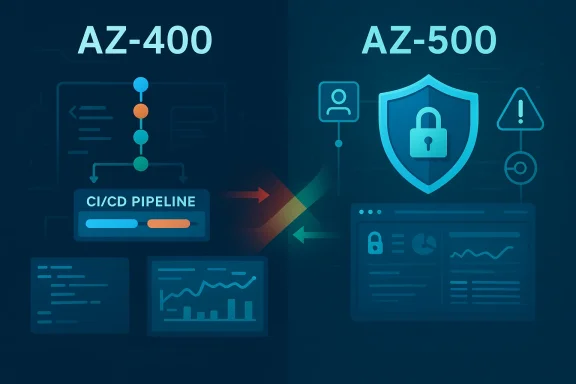 What AZ-400 Really Measures
AZ-400 is not a trivia test about Azure Pipelines. It is a practical exam about whether a candidate understands the mechanics of modern software delivery inside Microsoft’s ecosystem. Microsoft says the exam measures design and implementation of processes and communications, source control strategy, build and release pipelines, security and compliance planning, and instrumentation strategy. The largest share of the exam remains build and release pipelines, which tells you exactly where the center of gravity still sits.That weighting matters because pipeline work is where DevOps theory becomes organizational reality. It is not enough to know what a pipeline is; candidates need to understand artifact flow, approvals, environments, branching, release gates, and how all of that affects delivery risk. In other words, the exam wants proof that you can help teams ship safely, repeatably, and fast.
The practical workflow
A strong AZ-400 candidate should be source control policies shape delivery quality, how build validation catches regressions early, and how deployment patterns reduce operational risk. The exam is especially interested in the relationships between tooling decisions and business outcomes, not just individual features. That is why a candidate who only knows Git commands or only knows Azure DevOps menus will still struggle.The most useful way to study AZ-400 is yourself. Create a branching model, wire up a build pipeline, enforce approvals, publish artifacts, and simulate a release across stages. Then break something on purpose and trace the failure back through the pipeline. That sort of repetition turns abstract knowledge into muscle memory, which is much closer to the exam’s design. Surface familiarity is not enough.
A candidate who can explain the follobetter position:
- CI/CD flow from commit to deployment
- Source control strategy for mixed release cadences
- Artifact management and versioning
- Release approvals and environment checks
- Basic observability and feedback loops
What AZ-500 Really Measures
AZ-500 is often misunderstood as an identity exam, but Microsoft’s current blueprint makes that far too narrow. The current study guide emphasizes secure identity and access, secure networking, secure compute, storage, and databases, and secure Azure using Microsoft Defender for Cloud and Microsoft Sentinel. That blend makes the exam feel less like a product tour and more like a security architecture exercise.The biggest conceptual shift is that AZ-500 expects candidates to think like defenders inside a cloud platform. That means understanding how to reduce attack surface, control privilege, monitor activity, and respond to issues before they escalate. The security story is also explicitly hybrid, with Microsoft calling out Azure, multi-cloud, and hybrid environments as part of the role.
Identity is the control plane
Identity is the foundation of the exam because identity is the foundation of cloud security. If you get privileges wrong, every other control becomes harder to trosoft emphasizes access governance, identity controls, and secure administration across the Azure environment.The practical challenge is that many candidates already know the terminology. They knoditional access, and they know what a security group is. But the exam asks whether you can combine those concepts into a coherent security posture without breaking the workload. That is a different kind of thinking, and it is exactly where many otherwise experienced engineers get caught.
A useful way to frame AZ-500 is as a series of defensive decisions:
- Who should have access?
- What should they be allowed to do?
- How do we detect misuse?
- How do we reduce the blast radius?
- How do we prove the controls are working?
Why Official Microsoft Materials Matter More Than Ever
One of the clearest lessons from the current certification landscape is that official Microsoft materials now matter more than ever. Microsoft publishes exam pages, study guides, practice assessments, and exam-readiness content that aligns to the current skills measured. That is the safest baseline when thevely evolving, especially around the April 2026 AZ-400 update and the January 2026 AZ-500 blueprint refresh.The original article’s mention of third-party resources like ExamLabs reflects a common temptation in certification prep: the desire to shorten the path with “dumps” or memorized question sets. The problem is that those approaches age badly and often train the wrong instincts. A candidate can look prepared on paper and still fail the moment the exam presents a scenario that differs from the memorized pattern. That is not preparation; that is gambling.
Better study materials, better outcomes
Microsoft’s current pages make it easier to study the rigt order. They identify the skills measured, link to practice assessments, and highlight exam-readiness content for the exact role. That means candidates can build a study plan around the official blueprint rather than around a generic cloud certifiearn.microsoft.com]In practical terms, the best prep stack usually includes:
- Microsoft Learn modules
- Official study guides
- Hands-on labs
- Practice assessments
- Exam-readiness videos
- Rebuild-from-memory exercises
The key point is not that practice questions are useless. They are useful when treated as diagnostics, not as substitutes for understanding. If a question bank is marketed as a shortcut around actual study, that is a warning sign, not a feature.
The DevOps-Security Overlap
A major reason these two cerently discussed together is that DevOps and security now overlap heavily in real enterprise environments. Microsoft explicitly includes security and compliance planning in AZ-400, while AZ-500 makes security the entire job. The result is a natural DevSecOps bridge for professionals who need to understand both delivery speed and risk reduction.This overlap matters because modern cloud failures are rarely isolated. A weak permission model can undermine a release pipeline. A careless pipeline can expose secrets. A misconfigured network boundary can create both delivery delays and security gaps. In a real organi are interconnected whether teams admit it or not.
Shared competencies that pay off
There are several skills that help on both exams and on the job. Least privilege, secret handling, monitoring, policy enforcement, and approval workflows all sit in the overlap zone. Candidates who understand these topics are more likely to reason correctly in scenario are not treating cloud systems as isolated silos.This also explains why employers often value AZ-400 and AZ-500 together. They are not simply looking for one more certification badge. They want engineers who can reduce friction between engineering, operations, and security without creating new risk. That makes the certification combination especially attractive for DevSecOps-oriented rolates a useful professional advantage:
- Better communication with security teams
- Stronger release governance
- Fewer avoidable pipeline mistakes
- More credible cloud architecture discussions
- Improved incident response awareness
How to Build a Realistic AZ-400 Study Plan
The strongest AZ-400 preparation model is a cycle of reading, building, testing, and rebuilding. That sequence is repetitive by design, because repetition is what turns scattered knowledge into operational confidence. Microsoft’s own materials and role expectations reward candidates who can reason through workflow, not just recite terms.Start with the skills measured, not with random videos. Then map each objective to a lab exercise, a Microsoft Learn module, and a practice assessment. If a topic is weak, rebuild the workflow from scratch until it stops feeling fragile. That is the shortest path that is not a shortcut.
A practical AZ-400 sequence
A sensible preparation plan could look like this:- Read the official skills outline and note every domain.
- Build a small Azure DevOps or GitHub workflow in a lab.
- Add a pipeline with tests, artifacts, and approval steps.
- Review Microsoft Learn material for the weak spots.
- Take a timed practice assessment.
- Rebuild the workflow from memory and compare results.
The exam’s update cycle adds another reason to stay close to official content. The English AZ-400 exam update on April 24, 2026 means older prep material can drift out of alignment quickly. If your practice set predates the blueprint, treat it carefully.
stic AZ-500 Study Plan
AZ-500 rewards structured security thinking. Candidates should study the exam in layers: identity first, then networking, then compute/storage/data, and finally detection and response. That mirrors Microsoft’s current skill weighting and helps learnee controls matter more than others in scenario-based questions.The temptation with security exams is to memorize service names and hope the details stick. That usually backfires because Azure security is about interplay, not isolated features. The better approach is to design secure environments, inspect the controls, and then intentionally try to break them. Security is easiest to learn when something goes wrong on purpose.
Where candidates usually struggle
The most common weak points are not obscure. They are the places where practical thinking matters most. Many candidates can name the controls, but they have not practiced how those controls behave when multiple requirements collide.Frequent problem areas include:
- Confusing identity governance with access provisioning
- Treating network security as a checklist
- Overlooking backup and recovery in the security model
- Not understanding the role of Defender for Cloud
- Underestimating Sentinel’s operational role
The current AZ-500 guide Microsoft expects practical experience with Azure and hybrid environments. That means studying only from slides or flashcards is a poor substitute for actually configuring security controls. Even basic familiarity with Entra ID, compute, network, and storage becomes more valuable when it is paired with hands-onicrosoft.com]
The Role of Practice Tests
Practice tests are useful, but only when they are used the right way. They su do not know, not make you feel as though you have already learned it. The difference is subtle, but it is one of the biggest predictors of exam readiness.A strong candidate uses practice tests to measure pacing, identify weak domains, and learn how Microsoft words scenariodidate uses them as a memory game. One leads to durable understanding; the other leads to false confidence.
What good practice looks like
Good practice tests are current, detailed, and aligned to the latest exam objectives. They should expose knowledge gaps, not merely repeat familiar phrasing. Candidates should review every missed question and then return to the documentation or lab that explains the concept.The most effective rhythm is to study first, test secto the lab for a corrective pass. That final pass matters because it converts theory into behavior. Without that final step, practice remains incomplete.
There is also a psychological benefit. Timed practice reduces test anxiety because it makes the exam format feel less foreign. That does not replace content mastery, but it does improve performance under pressure, which is often the differd a near miss.
Enterprise Impact vs. Individual Career Impact
For enterprises, AZ-400 and AZ-500 matter because they help standardize the skill baseline for teams that are already expected to ship and secure cloud systems. Hiring managers like clear signals, and Microsoft certifications remain useful because they reduce unceing and internal promotions. The certifications do not replace real experience, but they do make the experience easier to evaluate.For individuals, the value is more personal but just as real. These certifications can sharpen a career story, especially for professionals moving from support into cloud operations, from administration into platform engineering, or from general IT into security specialization. They also give candidates a vocabulary that helps in interviews, project discussions, and internal career planning.
Why employers still care
Employers care because these exams ied knowledge. A certified candidate is expected to understand delivery flow, security controls, and platform operations in a way that reduces onboarding time. In a market where teams are asked to do more with less, that reduction in risk matters.The catch is that certification value depends on how it is paired with real work. A badge without projects is weaker than a badge plus a portfolio, and a badge plus a portfolio is still best when it is backed by actual troubleshooting experience. The c door; the evidence keeps it open.
That is why the smartest candidates do not chaation. They use the certification path as a framework for builce that can be demonstrated later, especially in interviews conversations.
Strengths and Opportunities
The biggest0 and AZ-500 pairing is that both certifications map closely to how modern cloud teams actually operate. They sit at the seam between delivery, security, and governance, which is exactly where employers are feeling pressure in 2026. That makes them more durable than fashionable, and more useful than badge collecting for its own sake.- Clear role alignment with real job responsibilities.
- Strong enterprise relevance across platform, security, and operations teams.
- Useful career signaling for promotions and interviews.
- Hands-on applicability that transfers to daily work.
- Good complementarity for DevSecOps-oriented professionals.
- Official Microsoft study resources that are current and structured. ([learn.microsoft.com](Study guide for Exam AZ-400: Designing and Implementing Microsoft DevOps Solutions update mechanisms** that keep the content fresh.
Risks and Concerns
The main rimistaking familiarity for readiness. Azure services can look intuitive, but the iven and deliberately designed to expose shallow understanding. If you rely on memorization instead of implementation, the exam will likely punish you for it.Another majo of study material. Third-party dump culture can create a false sense of confidence, and stale prep can become actively misleading after a blueprint update. That is especially relevant now because both AZ-400 and AZ-500 have current Microsoft-guided changes that candidates need to respect.
- Outdated study materials may not reflect current skills measured.
- Dump-based prep encourages memorization over understanding.
- Narrow lab exposure can leave candidates unready for scenario questions.
- Ignoring official updates is risky around revision dates.
- Overfocusing on one tool can leave important domains underdeveloped.
- Confusing certification with competence can hurt long-term career growth.
- Renewal requirements mean knowledge must be maintained, not just acquired.
Looking Ahead
The future of AZ-400 and AZ-500 will likely be shaped by faster platform change, deeper security integration, and more demand for engineers who can bridge disciplines. Microsoft’s update cadence already shows that these exams arplatform behavior, not remain frozen snapshots. That is good news for t demanding for candidates.The practical takeaway is simple: candidates who stay close to Microsoft Learn, keep their labs current, and practice under time pressure will have a much better experience than candidates who chase shortcuts. The market now rewards people who can connect cloud delivery with cloud security, and these exams are designed to measure exactly that. The old model of memorizing your way through an exam is fading fast.
What to watch next
- AZ-400 blueprint changes after the April 24, 2026 update.
- AZ-500 skills-measured adjustments as Microsoft continues to refine the security role.
- Greater emphasis on Defender for Cloud and Sentinel in security-focused career paths.
- More employer demand for DevSecOps fluency across cloud teams.
- Stronger preference for hands-on proof over badge-only résumés.
Source: Onrec Mastering Azure DevOps and Security Certifications with Proven Preparation Methods | Onrec
