
Cloud certification choices in 2026 matter less because one vendor “wins” and more because your first badge shapes the trade-offs you’ll carry into your career: portability, technical depth, hiring signals, and time-to-impact. For many, the real decision is not “AZ-900 or AWS?” but “how do I use a vendor credential as a bridge to demonstrable, pay‑generating skills?” This feature unpacks that choice in practical, evidence‑backed detail and gives a clear pathway to make the right certification decision for your goals in 2026.
Cloud computing remains the bedrock of modern IT — powering mobile apps, enterprise platforms, analytics, AI, and digital services. Market research from Canalys and Synergy consistently shows the hyperscalers (AWS, Microsoft Azure, Google Cloud) control the majority of infrastructure spend; AWS retains the largest share, while Azure has been closing the gap thanks to enterprise and hybrid strength. These market dynamics directly influence hiring demand, salary bands, and the kinds of skills employers prize.
Two common entry points into cloud careers are the Microsoft Certified: Azure Fundamentals (AZ‑900) and AWS’s Foundational track (AWS Certified Cloud Practitioner). They represent different philosophies: AZ‑900 is a concise, concept-first fundamentals badge aligned with Microsoft’s ecosystem; AWS’s catalog is tiered and intentionally progressive, scaling from an accessible foundational exam to rigorous professional and specialty tracks that require hands‑on, scenario-driven knowledge. The rest of this article compares those paths, validates key claims with official and independent sources, and gives an actionable roadmap for beginners and technical practitioners alike.
This feature has drawn on vendor documentation (Microsoft Learn, AWS Certification pages), independent market trackers (Canalys/Synergy reporting cited above), and community roadmaps and synthesis from late‑2024 through early‑2026 to present a balanced, actionable decision framework. If you want a personalized path (target job ads reviewed and a tailored 12‑week study plan), the next step is to take three real job postings you’d apply to and map their exact requirements — that simple activity will immediately reveal which cert moves the needle for you.
Source: TechBullion AZ-900 Certification vs AWS Certification: Which Cloud Path Should You Choose in 2026?
 Background / Overview
Cloud computing remains the bedrock of modern IT — powering mobile apps, enterprise platforms, analytics, AI, and digital services. Market research from Canalys and Synergy consistently shows the hyperscalers (AWS, Microsoft Azure, Google Cloud) control the majority of infrastructure spend; AWS retains the largest share, while Azure has been closing the gap thanks to enterprise and hybrid strength. These market dynamics directly influence hiring demand, salary bands, and the kinds of skills employers prize. Two common entry points into cloud careers are the Microsoft Certified: Azure Fundamentals (AZ‑900) and AWS’s Foundational track (AWS Certified Cloud Practitioner). They represent different philosophies: AZ‑900 is a concise, concept-first fundamentals badge aligned with Microsoft’s ecosystem; AWS’s catalog is tiered and intentionally progressive, scaling from an accessible foundational exam to rigorous professional and specialty tracks that require hands‑on, scenario-driven knowledge. The rest of this article compares those paths, validates key claims with official and independent sources, and gives an actionable roadmap for beginners and technical practitioners alike.
What AZ‑900 Actually Tests (and What It Doesn’t)
The exam at a glance
- Purpose: Validate foundational cloud knowledge and how Azure implements core concepts.
- Focus areas: cloud concepts (IaaS/PaaS/SaaS), core Azure services (compute, storage, networking), identity & security basics, governance & compliance concepts, and Azure pricing/support models.
- Format: Mostly multiple‑choice (single and multiple response), drag‑and‑drop and knowledge questions; no deep hands‑on labs or code required.
- Cost and availability: Pricing varies by country/region; typical U.S. list price is commonly reported around US$99, though Microsoft’s scheduling pages note price is region-dependent and may include tax. Microsoft also runs many free/discounted training events (Virtual Training Days) that can grant exam vouchers.
Strengths of AZ‑900
- Low barrier to entry. Great for people transitioning from business, finance, sales, or project roles who need cloud literacy rather than engineering skills.
- Fast preparation time. Many learners can prepare in weeks using Microsoft Learn modules and practice tests.
- Microsoft ecosystem fit. If you or your employer heavily use Microsoft products (Entra ID/Active Directory, Office/365, Windows Server), AZ‑900 gives immediately relevant conceptual knowledge.
What AZ‑900 is not
- Not a technical credential for engineers: it does not assess coding, real deployments, or detailed architecture decision-making.
- Not typically sufficient on its own for entry to purely technical cloud jobs — it’s best viewed as a gateway credential before role‑based Azure certifications.
What AWS Certification Means in 2026
Structure and exam pricing (official guidance)
AWS certifications are tiered: Foundational, Associate, Professional, and Specialty. Official AWS guidance sets a clear price ladder: Foundational exams about US$100, Associate exams about US$150, and Professional/Specialty around US$300 (local taxes and currency adjustments may apply). The AWS Certified Cloud Practitioner (Foundational) and the Associate tracks (SAA, DVA, SOA) are the common early‑career targets; Professional and Specialty exams demand scenario-based reasoning, experience, and hands‑on familiarity with AWS services.What differentiates AWS’s pathways
- Depth and scenario emphasis. From the Associate level onward, AWS exams test how you design, run, and troubleshoot systems under real-world constraints — cost, reliability, security, and trade-offs.
- Breadth of services. AWS’s vast service catalog (compute, storage, analytics, ML, managed databases, observability, and more) means architects and specialists must learn many vendor-specific options and patterns.
- Career scalability. Completing AWS Associate to Professional/specialty certifications maps cleanly to job levels: cloud engineer → platform/DevOps or solutions architect → senior architect or specialist.
Cost and ROI considerations
- Entry-level investment is modest relative to long-term upside: the Foundational exam is inexpensive, while advanced exams carry higher upfront costs but frequently unlock positions with materially higher compensation in cloud‑native and AI/ML roles. Independent course aggregators and AWS’s own pricing pages corroborate this pricing model.
Head-to‑Head: Difficulty, Preparation, and Technical Requirements
Difficulty & exam readiness
- AZ‑900: Conceptual — little to no hands‑on lab work; considered easy for motivated beginners with some IT awareness.
- AWS Foundation → Professional: Progressive intensity — Cloud Practitioner is accessible, but Associate → Professional requires hands‑on labs, architecture exercises, and scenario practice. Practice exams and official training help, but real‑world experience accelerates readiness.
Practical preparations (what employers expect)
Employers increasingly expect certifications to be accompanied by real artifacts: small projects, IaC templates (Terraform, Bicep, CloudFormation/CDK), a Git repo with a deployed microservice, or demonstrable cost‑optimization case studies. Forum analyses and community guides in late 2025–2026 strongly emphasize pairing certs with portfolio work to convert a certificate into an interview win.Market Demand and Where Jobs Actually Are (2026 snapshot)
Market share and platform trends
- Canalys and Synergy reporting for 2024–2025 shows AWS leading global infrastructure share (low 30s percentage range) with Microsoft Azure in the low‑ to mid‑20s; growth in 2024–2025 was driven by AI investment and new region expansions. These market trends influence where hiring surges occur: AWS remains the broadest playground, Azure dominates enterprise/hybrid Microsoft shops, and Google Cloud is focused on data/ML workloads. Use market share as directional guidance — region and industry matter.
Hiring signals
- If job ads in your target market list a vendor explicitly (Azure/AZ‑204, AZ‑305 or AWS SAA, SAP), prioritize that vendor.
- AWS certifications historically unlock a broader set of cloud‑native startup and platform roles; Azure fundamentals resonate strongly with enterprise, regulated, and Microsoft‑centric organizations. Forum research and consultancy reports confirm the enterprise tilt for Azure and the startup/scale emphasis for AWS.
Salary and ROI caveats
Broad salary studies show certified cloud architecture, security, and AI/ML production badges deliver the largest uplifts — but variability is huge. Geography, hiring demand, experience, and demonstrable outcomes (cost savings, uptime improvements, model deployments) are decisive. Treat salary “averages” as directional, not guaranteed.Career Pathways: Typical Progressions and Role Matches
AZ‑900-led paths (best for non‑technical or Microsoft-aligned careers)
- Start: AZ‑900 (Azure Fundamentals)
- Next steps: AZ‑104 (Azure Administrator), AZ‑204 (Azure Developer), AZ‑305 (Azure Solutions Architect)
- Role fits: Cloud-aware business roles, hybrid infra teams, Microsoft enterprise operations, junior cloud support/analyst roles. AZ‑900 helps get your resume past HR filters, but technical roles will require follow-up certs or projects.
AWS-led paths (best for engineers, DevOps, platform and data roles)
- Start: AWS Certified Cloud Practitioner (optional) → AWS Certified Solutions Architect – Associate (SAA‑C03) or Developer Associate (DVA‑C02)
- Progression: Solutions Architect Professional (SAP‑C02), DevOps Engineer Professional, and Specialty tracks (Security, ML, Networking).
- Role fits: Cloud engineers, DevOps/SRE, solutions architects, data engineers, and AI/ML platform engineers. AWS’s progressive structure supports long-term, technical career growth.
Practical Decision Guide: Which Path Should You Pick in 2026?
Use this short decision checklist:- Where do your target jobs sit? If 70%+ of them require Azure, lean AZ‑900 → AZ‑104/AZ‑305. If they mention AWS prominently or are cloud‑native roles, start with AWS associate tracks. (Map three real job ads before you invest.)
- Are you technical and hands‑on? If yes, prefer AWS (or jump straight into Azure role-based certs like AZ‑104/AZ‑204). If you’re non‑technical, AZ‑900 is a low‑risk entry.
- Plan to be multi‑cloud? Start with one fundamentals cert (AZ‑900 or CLF) and then pick the other vendor’s associate cert within 12–18 months — the multi‑cloud premium remains meaningful. Independent marketplace analyses report a 15–30% premium for multi‑cloud architects.
- Budget and time: AZ‑900 is cheap and quick (commonly ~US$99 and weeks of prep). AWS associate track costs more overall when you include advanced exams, but it often yields a higher long‑term ROI for technical roles. Use vendor official pricing pages to budget.
Common Missteps and How to Avoid Them
- Mistake: Treating AZ‑900 as a terminal credential. Reality: It’s introductory; employers expect follow‑up credentials or demonstrable work.
- Mistake: Memorizing practice‑test answers. Reality: Many AWS and Azure exams test scenario reasoning; practice with real architectures and labs.
- Mistake: Ignoring vendor exam status changes. Reality: Vendors retire or redesign exams; always verify exam availability on official sites before paying. Examples of paused or retired specialty tracks are documented across vendor advisories and community posts.
- Mistake: Neglecting cost‑of‑learning (cloud bills, lab costs). Reality: Budget $50–$300 extra for practical labs and practice exams; use vendor free tiers and sandbox credits where available.
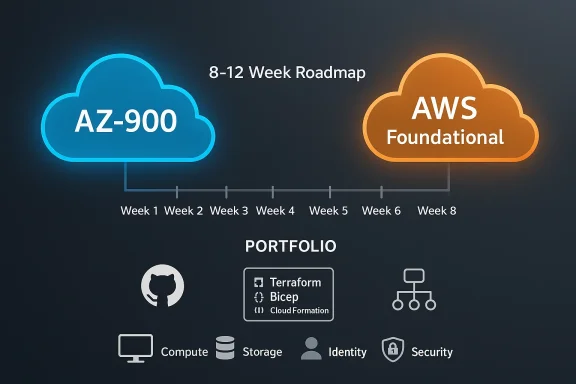
A Tactical 8–12 Week Roadmap (Actionable)
This study plan is vendor-agnostic and maps to either AZ‑900 or the AWS Foundational/Associate route. Follow it literally if you want to reach exam readiness in ~2–3 months.- Week 1 — Role audit and materials
- Pick three real job adverts you will apply to and extract required skills.
- Download the official exam guide and identify objective domains.
- Weeks 2–5 — Core learning and labs
- Complete vendor official learning paths (Microsoft Learn or AWS Skill Builder).
- Do at least one hands‑on lab per objective (deploy a VM, configure identity, set up cost alerts). Use free tiers and sandbox credits.
- Weeks 6–8 — Capstone project
- Build a small end‑to‑end demo: a microservice with IaC (Terraform/Bicep/CloudFormation), CI/CD pipeline, and basic monitoring. Document it in a README and record a short demo. This project will beat any number of low‑effort badges in interviews.
- Weeks 9–12 — Practice exams and readiness
- Take timed practice exams under proctored conditions, identify weak areas, re‑lab and revise.
- Book the exam only after achieving consistent practice scores above the passing threshold.
Risks, Trade‑Offs, and Longer‑Term Considerations
- Vendor lock‑in: Deep platform training reduces portability. Mitigation: learn cloud‑agnostic design patterns, master Terraform, and do at least one porting exercise between cloud providers. Independent forum consensus places Terraform as a market default for multi‑cloud portability.
- Program changes and exam retirements: Vendors change exam formats and content; verify on official pages before paying. Microsoft’s fundamentals currently do not expire, but role-based certs have renewal/expiry rules you must monitor.
- False signaling: Stacking many low‑effort badges without projects often underperforms a smaller portfolio of demonstrable work. The community guidance in late 2025–2026 consistently emphasizes two polished projects + one primary certification as the optimal signal.
Evidence and Verification (Short Technical Fact-Checks)
- AWS exam tiers and prices: Official AWS Certification FAQ and exam pages document Foundational = US$100, Associate = US$150, Professional/Specialty = US$300. Use the AWS Certification pages when budgeting; local taxes/currency adjustments may apply.
- AZ‑900 scope and regional pricing: Microsoft Learn confirms AZ‑900 is the Azure Fundamentals exam; pricing is region dependent (commonly reported ~US$99 in the U.S.), and fundamentals certifications do not expire. Check Microsoft’s certification pages for up‑to‑date scheduling and price in your country.
- Market share context: Canalys and Synergy reporting through 2024–Q1 2025 show AWS with the largest global share (around 30%+ in several quarters) and Azure in the low‑ to mid‑20% range — directionally confirmed by multiple industry trackers. Regional and quarterly variation is significant; use the latest research when making strategic decisions.
Final Verdict — Which Path to Choose in 2026?
- Choose AZ‑900 if:
- You are brand‑new to cloud and need conceptual grounding quickly and cheaply.
- You work in or target Microsoft‑centric enterprise environments.
- You are non‑technical and need a credible, low‑risk credential for internal mobility or sales/pre‑sales roles.
- Choose AWS (start with the Cloud Practitioner and move to Associate) if:
- You are technical or intend to become hands‑on (DevOps, platform, data, or cloud engineering).
- You want the widest set of cloud‑native job opportunities and a clearer technical ladder to senior architect/specialist roles.
- You plan to work in startups, cloud‑native companies, or consultancies that demand practical, scenario-based skills.
- The pragmatic hybrid approach (recommended for long-term mobility):
- Start with AZ‑900 to learn cloud fundamentals quickly or AWS Cloud Practitioner if you prefer the AWS flavor.
- Build one small, demonstrable project that maps to the certification objectives.
- Progress to a role‑based associate cert on the vendor most represented in your target job ads.
- Add the other vendor’s associate cert or Terraform skill for portability and the multi‑cloud premium. This multi‑step route captures the short-term practicality of AZ‑900 and the long-term technical leverage of AWS.
Closing — A Practical, No‑Nonsense Recommendation
Certifications remain powerful signals in 2026 — but only when used as amplifiers for demonstrable results. If you want speed and low cost: pass AZ‑900, ship a small Azure‑centric demo, and apply to Microsoft/enterprise roles. If you want long-term technical upside: budget for AWS Associate → Professional/Specialty study, complete hands‑on labs, and build two portfolio projects that prove you can design, automate, and operate real systems. Either way, treat any badge as one component in a three‑part package: certification + reproducible projects + clear business outcomes. Employers hire outcomes; certificates get you the interview.This feature has drawn on vendor documentation (Microsoft Learn, AWS Certification pages), independent market trackers (Canalys/Synergy reporting cited above), and community roadmaps and synthesis from late‑2024 through early‑2026 to present a balanced, actionable decision framework. If you want a personalized path (target job ads reviewed and a tailored 12‑week study plan), the next step is to take three real job postings you’d apply to and map their exact requirements — that simple activity will immediately reveal which cert moves the needle for you.
Source: TechBullion AZ-900 Certification vs AWS Certification: Which Cloud Path Should You Choose in 2026?
