

Microsoft’s Azure and Collective Artists Network’s Galleri5 have announced a strategic collaboration that places cloud-scale AI at the center of a new production playbook for Indian filmmaking and serialized storytelling, with the partnership explicitly tying Galleri5’s creator‑tech studio to Azure AI Foundry and an ambitious slate of AI‑enabled projects, including a theatrical feature, an episodic Mahabharata reinterpretation, and dozens of micro‑dramas.
CAN’s public slate attached to the partnership includes:
That promise comes with caveats that cannot be deferred: dataset provenance, editorial governance, labor and crediting frameworks, and cost governance must be resolved publicly if AI‑enabled storytelling is to earn trust from audiences, regulators and creative professionals. The path forward is one of pragmatic optimism — harness the clear productivity and creative benefits, but insist on transparency, human stewardship and contractual clarity before AI becomes the dominant engine of cultural expression.
Source: Indian Broadcasting World Microsoft Azure, Galleri5 join hands to redefine AI-driven filmmaking in India, IBW News: English News, Breaking News in English, ताज़ा हिदी समाचार
 Background
What was announced
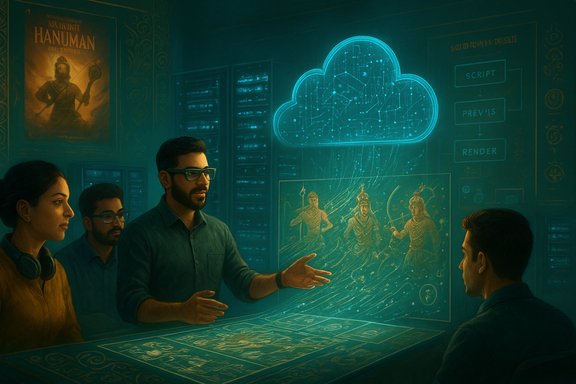
Microsoft and Collective Artists Network (CAN) — via CAN’s in‑house tech studio Galleri5 — have publicly positioned Azure as the foundational platform for Galleri5 AI’s production pipelines. The announced scope spans previsualization, asset generation, voice and localization tooling, and dataset creation focused on mythology and culture, with Microsoft framing Azure AI Foundry as the enterprise surface that will host model catalogs, governance controls, compute, and MLOps needed for production‑grade generative workflows.CAN’s public slate attached to the partnership includes:
- A feature titled Chiranjeevi Hanuman – The Eternal, targeted for a global theatrical release in 2026.
- An episodic reinterpretation titled Mahabharat: Ek Dharmayudh aimed at broadcast and OTT outlets.
- A reported slate of more than 40 AI‑enabled micro‑dramas for TV and digital platforms.
Who the players are
- Microsoft Azure — providing the cloud backbone, Azure AI Foundry (a platform surface that catalogs multimodal models, offers governance and deployment pipelines), high‑performance GPU compute, identity and security controls, and Copilot/agent orchestration capabilities.
- Collective Artists Network (CAN) — the talent, IP and production group that owns Galleri5 and multiple creative properties; CAN has already experimented publicly with AI‑native acts.
- Galleri5 — positioned as CAN’s technology and creative studio, responsible for dataset curation, fine‑tuning experiments, creative MLOps, and the integration of AI tooling into editorial and VFX pipelines.
Technical anatomy: what Azure AI Foundry brings to film production
Enterprise model catalog and governance
Azure AI Foundry is described as a centralized surface to discover, evaluate and provision multimodal models (text, image, audio, video) while wrapping model use in enterprise governance features: role‑based access, content safety filters, provenance logging, and tenant isolation. For studios and broadcasters, these are not optional — they are operational prerequisites when production must satisfy legal, distributor and regulatory requirements.Fine‑tuning, MLOps and compute
The partnership emphasizes the need to fine‑tune models on proprietary, mythology‑ and culture‑specific datasets to achieve stylistic consistency across franchises and to create stable voice/character profiles. Azure’s MLOps pipelines, model registries and high‑performance GPU instances (including H100‑class acceleration in typical vendor stacks) are the components CAN expects to leverage for training, inference and production rendering at scale.Text‑to‑video and agent orchestration
Recent industry previews integrated into Foundry’s catalog include advanced text‑to‑video models (reported to include options like Sora 2 in preview). These models accelerate previsualization and short‑form prototyping by generating synchronized audio and imagery for concept review. Agent frameworks and Copilot integrations are planned to automate multi‑step workflows (e.g., script → previs → human review → VFX handoff) and reduce friction across editorial teams.Practical production gains
- Rapid previsualization: concept art, animatics and scene prototypes in hours rather than days.
- Scalable asset pipelines: generative models supplying background plates, crowd sims, and texture variations that can be versioned in asset management systems.
- Localization at scale: automated dubbing, lip‑sync, subtitling and cultural variants for fast market rollouts.
Why this matters for Indian film and global studios
Speed and cost efficiency
AI‑assisted workflows materially reduce marginal costs for iterations and localization, enabling studios to produce many market‑specific variants of the same asset at scale. For advertising and short‑form content, this reduces time‑to‑market and increases the ability to test creative variants quickly.New IP models and revenue streams
CAN’s prior experiments — an AI band called Trilok and virtual influencers such as Kavya, Radhika, and Kabir — show how AI‑native acts can create persistent, licenseable IP. These virtual acts enable monetization beyond box‑office receipts: streaming, branded content, merchandise, virtual events, and cross‑platform storytelling. Azure’s identity, storage and rights management help treat these virtual properties as managed assets.Regional leadership and talent development
Microsoft frames this as part of a broader push to make India a hub for AI‑first creative workflows. The partnership creates demand for hybrid roles — prompt engineers, data curators, model trainers and creative technologists — and Microsoft’s regional training commitments are positioned to grow that talent pipeline.Anchoring projects: what’s public and what’s provisional
Chiranjeevi Hanuman – The Eternal
Public materials list this as an AI‑assisted feature with a target worldwide theatrical release in 2026. Industry reporting positions it as one of India’s early high‑profile films to foreground AI in production workflows, but timelines and distribution specifics are still promotional and should be treated as targets rather than fixed commitments.Mahabharat: Ek Dharmayudh
An episodic reimagining drawn from the Mahabharata is part of the announced slate, signaling CAN’s intent to apply AI tools to culturally weighty narratives. Public disclosures do not yet include episode counts, budgets, or finalized distributor agreements.Micro‑dramas and branded content
CAN has publicly promised a slate of 40+ AI‑enabled micro‑dramas for TV and OTT platforms. These shorter productions are logical early use cases: lower risk, faster cycles, and direct monetization through digital platforms and brand partnerships.Critical analysis — strengths and opportunities
Strengths
- Enterprise reliability and governance: Azure brings the compliance, identity and auditability that broadcasters and global distributors require when handling IP and culturally sensitive material. This reduces one class of operational risk for large studios.
- Speed to market and iteration flexibility: Text‑to‑video and multimodal models cut prototyping time dramatically, enabling creative teams to explore alternatives rapidly and cheaply.
- Localized storytelling at scale: Building mythology‑ and culture‑specific datasets allows for nuanced, localized outputs that generic models struggle to produce without fine‑tuning.
- New commercial formats: Virtual talent and AI‑native acts open recurring, licenseable revenue streams beyond single productions.
Strategic upside for Microsoft
For Microsoft, the CAN partnership validates Azure AI Foundry in a demanding vertical: media and entertainment produce high volumes of IP, require traceability, and operate across strict distributor constraints. Demonstrating Foundry in large‑scale cinematic contexts strengthens Azure’s enterprise narrative.Risks, unanswered questions and ethical concerns
1. Dataset provenance and copyright exposure (highest legal risk)
CAN has stated it will create mythology and culture datasets to train style and voice models, but public disclosures do not include dataset ledgers or model cards. Without documented provenance and licensing, both legal and reputational risks are elevated when outputs reach public distribution — especially if training data incorporates copyrighted text, art, music or voice likenesses. This gap is explicitly highlighted in industry briefings and should be treated as an unresolved risk until CAN publishes dataset documentation.2. Cultural sensitivity and editorial stewardship
Reworking sacred narratives and cultural heritage (e.g., Ramayana/Mahabharata) through generative models amplifies the risk of perceived misrepresentation. Projects touching religious themes require transparent editorial processes, expert councils and explicit human authorship credits to maintain legitimacy and avoid public backlash. CAN’s stated approach references cultural datasets, but explicit editorial governance frameworks have not been published.3. Attribution, crediting and labor displacement
Generative workflows can automate tasks historically performed by entry‑level artists and editors. If studios do not invest in reskilling or formal crediting systems that recognize human contributors, the industry risks hollowing out training pipelines and sparking labor disputes with creative unions. The industry analysis emphasizes the need for reskilling funds and structured crediting.4. Hallucination and factual integrity
Generative dialogue and video models remain susceptible to hallucination — producing plausible but false details. For historical or mythological narratives, preventing anachronisms and factual drift requires robust human review and verification steps in the pipeline.5. Cost governance at scale
Preview pricing figures reported in industry writeups (for example, indicative Sora 2 preview pricing reported in the files) underscore that per‑second generation costs can scale quickly when used for long‑form content. Studios must separate prototyping budgets from final-render costs and confirm enterprise pricing and quotas directly in Azure contracts.6. Platform acceptance and labeling requirements
Streaming platforms and broadcasters are developing policies around AI‑assisted or AI‑origin content. Distribution agreements may require disclosure, rights documentation, and proof of training data licensing before carriage. Early coordination with distributors is essential.Practical recommendations and a phased roadmap for studios
- Pilot (0–3 months)
- Run small, tightly scoped pilots on non‑sensitive scenes to test model behavior, cost profiles, and tooling integrations.
- Require basic provenance logs and a demoed human‑in‑the‑loop editorial checkpoint.
- Govern (3–6 months)
- Publish model cards, dataset ledgers and editorial policies.
- Establish a provenance ledger for any third‑party training data and secure written licenses where required.
- Integrate (6–12 months)
- Integrate AI renders with MAM (media asset management), VFX handoffs, and final rendering pipelines.
- Negotiate distribution clauses that specify AI disclosure and crediting metadata for streamers/broadcasters.
- Scale (>12 months)
- Move into larger content commitments only after distributor agreements, legal signoffs, and documented ROI metrics are established.
- Fund reskilling programs and create transparent crediting schemas for human contributors.
Practical technical checklist for studio IT and CTOs
- Confirm Azure region availability and compliance requirements for content storage and model training.
- Validate compute SKU choices (GPU types, scaling limits) and run cost simulations for prototyping vs. final renders.
- Create a model registry and versioned dataset ledger that logs training sources, licensing status and any fine‑tuning steps.
- Implement robust role‑based access controls, content safety filters, and audit trails for all generative runs destined for public release.
- Bake human editorial signoffs into the publishing pipeline with immutable logging for disputes.
Commercial and legal considerations
- Contracts: Negotiate explicit clauses with AI vendors and studios for dataset provenance, downstream licensing, and audit rights.
- Distribution: Early engagement with streamers and broadcasters to align on labeling, metadata and acceptance criteria for AI‑assisted content.
- Talent agreements: Update talent and crew contracts to clarify rights around AI‑generated likenesses, voice cloning, and derivative content; allocate royalties or flat fees as appropriate.
What still needs public confirmation (caveats)
- The precise composition of Galleri5’s mythology and culture datasets remains undisclosed; there is no publicly available dataset ledger or model card at the time of the announcement. This is a material gap for legal and reputational risk assessment.
- Exact model footprints (which third‑party models, or custom proprietary models) and per‑project pricing commitments are not yet public. Organizations planning heavy usage should verify model availability and enterprise pricing directly within their Azure Foundry tenancy.
- Announced release years (notably the 2026 target for Chiranjeevi Hanuman – The Eternal) should be treated as promotional targets; tech‑heavy productions often shift timelines.
Conclusion
The Microsoft–Galleri5 collaboration is a credible, ambitious experiment at the intersection of cloud compute, multimodal generative models and mainstream storytelling. It telegraphs a pragmatic industry shift: studios and IP owners will increasingly treat AI as a production multiplier rather than merely a creative novelty. Azure AI Foundry supplies the enterprise controls and compute that make scaled generative pipelines operationally plausible, while Galleri5 supplies creative IP, cultural intent and a production sensibility.That promise comes with caveats that cannot be deferred: dataset provenance, editorial governance, labor and crediting frameworks, and cost governance must be resolved publicly if AI‑enabled storytelling is to earn trust from audiences, regulators and creative professionals. The path forward is one of pragmatic optimism — harness the clear productivity and creative benefits, but insist on transparency, human stewardship and contractual clarity before AI becomes the dominant engine of cultural expression.
Source: Indian Broadcasting World Microsoft Azure, Galleri5 join hands to redefine AI-driven filmmaking in India, IBW News: English News, Breaking News in English, ताज़ा हिदी समाचार
