

Microsoft Azure is moving from being a cloud platform that hosts entertainment workloads to being a more visible engine for content creation itself, and Jio Studios’ AI-native teaser for Krishna is a striking sign of that shift. The collaboration between Jio Studios, Collective Studios, and Galleri5 suggests a production model where AI is not just used for isolated tasks but woven into the full creative pipeline, with director control emphasized as a core principle. That matters because it places Azure inside the storytelling process, not merely around it, and it does so at a moment when the media AI market is expanding quickly and cloud vendors are fighting for influence across the creative stack. Microsoft’s broader enterprise AI messaging also fits this move: value comes from embedding intelligence into workflows, preserving control, and making AI operational rather than ornamental
AI in media and entertainment has moved through several distinct phases, and the current moment is more serious than the early “look what the model can generate” era. First came experimentation with image generation, dubbing, tagging, and search. Then came workflow augmentation, where AI helped with metadata, rough cuts, cataloging, and recommendation engines. Now the industry is inching toward AI-native production, where the technology participates in the creation process itself rather than only in support functions. That is the backdrop for Krishna, which is being positioned less as a novelty and more as a proof point for a new production architecture.
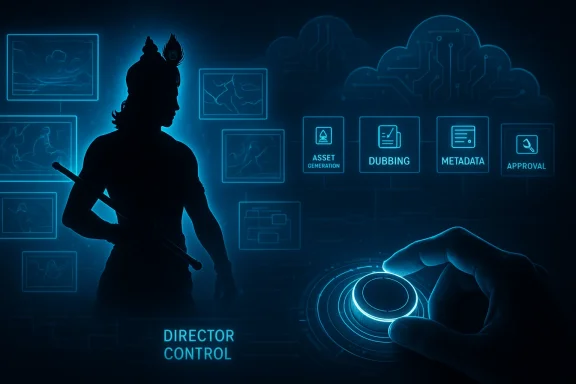
The reason this matters is that film and television have always been labor-intensive industries with heavy coordination costs. Every reduction in friction, whether in previs, asset iteration, or post-production cleanup, can change what gets made and how fast it can be delivered. The Whalesbook report argues that Galleri5, built on Microsoft Azure, is being used as an end-to-end AI production system for the project, with director control remaining central to the workflow. That framing is important because it signals a deliberate attempt to keep creativity human-led while using AI to compress the most expensive and repetitive stages of production
Microsoft’s role is not accidental. Azure has been pushing deeper into industry-specific AI, and Microsoft’s broader enterprise narrative is that the real advantage comes when intelligence sits close to the workload, the telemetry, and the control plane. In entertainment terms, that means keeping AI close to the content pipeline, the asset store, the review loop, and the approval process. The same logic that underpins Microsoft’s operator, data, and productivity messaging also applies here: native intelligence is more durable than bolt-on tooling because it preserves context and governance
There is also a strategic branding angle. For Microsoft, each successful creative deployment becomes evidence that Azure can support more than enterprise databases and software development. It can also support visual storytelling, marketing content, and media workflows that are highly visible and emotionally resonant. For Jio Studios and Collective Studios, the opportunity is equally clear: if AI can help accelerate Indian storytelling without flattening its distinctiveness, the result could travel well beyond the domestic market.
The bigger picture is that this announcement sits at the intersection of cloud economics, media production, and national-scale digital ambition. India’s entertainment sector has enormous volume and a global diaspora audience, but it has often faced cost and scale constraints when competing with Hollywood and other global production ecosystems. If an AI-native pipeline can lower the cost of iteration while maintaining creative direction, the competitive balance changes in ways that extend far beyond a single teaser.
The emphasis on director control is equally important. A common fear about AI in creative work is that it displaces authorship or makes outputs feel generic. By contrast, this project appears to be selling the opposite idea: AI can expand a director’s reach if the human remains in command of tone, pacing, and vision.
At the same time, film is not software. The emotional and cultural stakes are higher, and audiences are often unforgiving when visuals feel synthetic or story logic feels manipulated by technology rather than served by it. That is why the report’s insistence on director control is so central. It acknowledges that AI can accelerate the craft, but it cannot replace judgment, taste, or narrative discipline.
Microsoft benefits from this framing because it positions Azure as an infrastructure partner for creative industries that are searching for practical AI, not just flashy demos. The company has spent the last several years expanding its AI stack across cloud services, models, and productivity tools. In this context, a film production collaboration is a highly visible way to prove that the same infrastructure can support both enterprise and media workloads
The commercial logic is straightforward. If one studio can build a credible AI-native pipeline on Azure, others may see a path to similar efficiency gains. That does not mean all studios will rush to fully automated creative systems. It does mean cloud vendors now have a clearer story to tell: AI can be embedded in production, not merely appended to it.
A production stack built on Azure gives Microsoft several advantages. It allows the company to sell compute, storage, workflow integration, and AI services as a combined platform story. It also lets Microsoft point to a live, public use case when arguing that Azure is ready for demanding creative workloads. That matters in a cloud market where differentiation can be difficult and where every proof point helps.
This is also why the Galleri5 angle is interesting. The report describes it as an AI production system built on Microsoft Azure, which suggests a more productized workflow than a one-off prototype. If that is accurate, Microsoft gets a showcase for how AI can be operationalized in media instead of merely tested.
The most important question is whether Galleri5 helps preserve the director’s intent while making production faster. If it does, it could become a blueprint for future studio deployments. If it does not, the project risks becoming a showcase for technology that looks impressive but is awkward in real-world use.
A practical AI production stack also has to reconcile automation with human review. Film production is full of subjective decisions, and those decisions often depend on nuance that models do not capture well. That is why a good AI system in this context should probably behave less like an autonomous creator and more like a highly capable assistant that accelerates drafting, visualization, and iteration.
Possible strengths include:
That is where AI-native production becomes strategically interesting. If studios can produce more iterations, more languages, and more campaign assets without linearly increasing cost, they gain flexibility. They can test more ideas, localize more aggressively, and move faster on market response. For a company like Jio Studios, that can create a meaningful advantage in a crowded content market.
Reliance Industries’ broader digital posture also matters here. The company has long shown a willingness to invest in infrastructure and platforms, not just content businesses. An AI-assisted film pipeline fits that pattern because it treats creative output as a technology-enabled operating capability rather than a purely artisanal process.
That is a hard test for any production system. AI can help with speed and scale, but it can also blur the edges of distinctiveness if the output is too generic. The question is whether this pipeline will preserve local identity while still making the film attractive to global viewers.
A recurring theme in Microsoft’s recent AI messaging is that intelligence must be embedded where the work happens. In enterprise, that means within identity, data, and workflow systems. In media, that means inside the production pipeline. The logic is the same: if AI is native to the workflow, it becomes harder to dislodge and easier to justify commercially
This also reinforces Microsoft’s competitive posture against Amazon Web Services and other infrastructure rivals. AWS may still lead in cloud share, but Microsoft has been especially effective at turning AI into a platform narrative that reaches from consumer surfaces to enterprise systems. The entertainment vertical gives that story emotional visibility.
It also provides a sales conversation starter. A compelling public project can open doors with studios, agencies, advertising firms, and post-production vendors that might otherwise treat cloud AI as abstract. In other words, the film becomes both a product and a case study.
Studios are likely to remain cautious because the economics and reputational risks are real. Creative workers worry about displacement, while rights holders worry about training data, derivative output, and ownership. These concerns do not disappear just because a production system is efficient. If anything, they become more visible when AI moves closer to the finished film.
The best near-term use cases are therefore likely to be those that increase capacity without calling attention to themselves. AI can support ideation, rough drafts, background generation, scheduling, cataloging, and revisions. Once it starts shaping the look and feel of the final product, scrutiny rises sharply.
The opportunity is especially attractive in a market like India, where scale matters and where content demand is enormous. If AI can improve throughput without flattening distinctiveness, it could be a genuine force multiplier.
That does not mean the technology should be rejected outright. It does mean the industry will need a transition plan, not just a technology plan. Without that, the conversation will quickly shift from innovation to displacement.
There is also a broader strategic question around how much of this pipeline remains transparent. Studios may be more willing to talk about AI in marketing than in creative specifics, especially if the output attracts scrutiny. That means the real test may come in the finished film, not the teaser.
For Microsoft, the value is equally strategic. Every credible creative deployment strengthens Azure’s claim to be a platform for serious, production-grade AI across industries. For Jio Studios, the upside is the chance to pair cultural ambition with technological leverage. The important thing now is whether the project proves that efficiency and artistry can coexist rather than compete.
What happens next will tell us a great deal about the future of entertainment AI. If the pipeline produces quality work, it may encourage a broader shift toward AI-assisted but human-led film production. If it stumbles, the industry may still adopt AI, but more cautiously and with tighter limits on how far the technology is allowed to shape the final image.
Source: Whalesbook Jio Studios Taps Azure AI for AI-Native 'Krishna' Film Production
 Background
AI in media and entertainment has moved through several distinct phases, and the current moment is more serious than the early “look what the model can generate” era. First came experimentation with image generation, dubbing, tagging, and search. Then came workflow augmentation, where AI helped with metadata, rough cuts, cataloging, and recommendation engines. Now the industry is inching toward AI-native production, where the technology participates in the creation process itself rather than only in support functions. That is the backdrop for Krishna, which is being positioned less as a novelty and more as a proof point for a new production architecture.The reason this matters is that film and television have always been labor-intensive industries with heavy coordination costs. Every reduction in friction, whether in previs, asset iteration, or post-production cleanup, can change what gets made and how fast it can be delivered. The Whalesbook report argues that Galleri5, built on Microsoft Azure, is being used as an end-to-end AI production system for the project, with director control remaining central to the workflow. That framing is important because it signals a deliberate attempt to keep creativity human-led while using AI to compress the most expensive and repetitive stages of production
Microsoft’s role is not accidental. Azure has been pushing deeper into industry-specific AI, and Microsoft’s broader enterprise narrative is that the real advantage comes when intelligence sits close to the workload, the telemetry, and the control plane. In entertainment terms, that means keeping AI close to the content pipeline, the asset store, the review loop, and the approval process. The same logic that underpins Microsoft’s operator, data, and productivity messaging also applies here: native intelligence is more durable than bolt-on tooling because it preserves context and governance
There is also a strategic branding angle. For Microsoft, each successful creative deployment becomes evidence that Azure can support more than enterprise databases and software development. It can also support visual storytelling, marketing content, and media workflows that are highly visible and emotionally resonant. For Jio Studios and Collective Studios, the opportunity is equally clear: if AI can help accelerate Indian storytelling without flattening its distinctiveness, the result could travel well beyond the domestic market.
The bigger picture is that this announcement sits at the intersection of cloud economics, media production, and national-scale digital ambition. India’s entertainment sector has enormous volume and a global diaspora audience, but it has often faced cost and scale constraints when competing with Hollywood and other global production ecosystems. If an AI-native pipeline can lower the cost of iteration while maintaining creative direction, the competitive balance changes in ways that extend far beyond a single teaser.
Why this announcement is different
The most notable aspect of Krishna is not that AI was used, but that AI appears to have been used from start to finish. That distinction matters because it suggests a production philosophy rather than a single tool choice. When AI is embedded across pre-production, asset generation, and post workflows, the economics of filmmaking start to shift in meaningful ways.The emphasis on director control is equally important. A common fear about AI in creative work is that it displaces authorship or makes outputs feel generic. By contrast, this project appears to be selling the opposite idea: AI can expand a director’s reach if the human remains in command of tone, pacing, and vision.
- AI is being framed as a production layer, not just a visual gimmick.
- Director-led control is presented as a safeguard against creative drift.
- The teaser is being used as a public proof point rather than a behind-the-scenes test.
- The Azure connection turns a film project into a cloud platform demonstration.
- The model could become a template for future productions if quality holds.
Overview
The most useful way to understand Krishna is as a pilot for a broader production model. Studios have long used digital tools to replace manual steps, but AI changes the speed and scale of experimentation. A scene that once took multiple specialist passes can now be iterated more quickly, which means more options, faster approval cycles, and potentially lower costs. That does not automatically produce better cinema, but it does alter the production math.At the same time, film is not software. The emotional and cultural stakes are higher, and audiences are often unforgiving when visuals feel synthetic or story logic feels manipulated by technology rather than served by it. That is why the report’s insistence on director control is so central. It acknowledges that AI can accelerate the craft, but it cannot replace judgment, taste, or narrative discipline.
Microsoft benefits from this framing because it positions Azure as an infrastructure partner for creative industries that are searching for practical AI, not just flashy demos. The company has spent the last several years expanding its AI stack across cloud services, models, and productivity tools. In this context, a film production collaboration is a highly visible way to prove that the same infrastructure can support both enterprise and media workloads
The commercial logic is straightforward. If one studio can build a credible AI-native pipeline on Azure, others may see a path to similar efficiency gains. That does not mean all studios will rush to fully automated creative systems. It does mean cloud vendors now have a clearer story to tell: AI can be embedded in production, not merely appended to it.
The market context
The Whalesbook piece claims the media and entertainment AI market is growing rapidly, and even if the exact estimates vary by source, the direction of travel is obvious. Production companies, post houses, and streaming-adjacent vendors are all under pressure to do more with less. That pressure opens the door for cloud-based AI systems that promise speed, consistency, and repeatability.- Studios want shorter turnaround times.
- Producers want fewer costly revisions.
- Marketing teams want more content variants.
- Distribution platforms want better metadata and personalization.
- Cloud vendors want a path from infrastructure to creative workflows.
Why Azure Matters Here
Azure’s role in this story is bigger than hosting. It represents a broader strategy of making Microsoft’s cloud the place where high-value AI workloads live. In enterprise markets, Microsoft has repeatedly shown that it can win by making complex technology feel familiar, governed, and procurement-friendly. The same playbook could work in media, where studios need stable pipelines and clear accountability.A production stack built on Azure gives Microsoft several advantages. It allows the company to sell compute, storage, workflow integration, and AI services as a combined platform story. It also lets Microsoft point to a live, public use case when arguing that Azure is ready for demanding creative workloads. That matters in a cloud market where differentiation can be difficult and where every proof point helps.
Platform, not just infrastructure
What makes Azure strategically powerful is that it can function as a platform layer across multiple creative tools. A studio does not just need model access; it needs asset management, orchestration, security, versioning, and possibly distribution-ready outputs. Azure can sit underneath all of that, which means Microsoft can monetize more of the stack.This is also why the Galleri5 angle is interesting. The report describes it as an AI production system built on Microsoft Azure, which suggests a more productized workflow than a one-off prototype. If that is accurate, Microsoft gets a showcase for how AI can be operationalized in media instead of merely tested.
- Azure can bundle compute and workflow services.
- Production systems are stickier than isolated tools.
- End-to-end deployments create stronger switching costs.
- Creative teams need governance as much as generation.
- Platform credibility is built through visible success stories.
Galleri5 and the Production Stack
Galleri5 appears to be the connective tissue in this story, translating Azure’s infrastructure into a usable filmmaking workflow. That translation layer is where many AI projects succeed or fail. Raw model access is not enough; studios need tools that map to actual production realities, such as revisions, approvals, asset tracking, and output consistency.The most important question is whether Galleri5 helps preserve the director’s intent while making production faster. If it does, it could become a blueprint for future studio deployments. If it does not, the project risks becoming a showcase for technology that looks impressive but is awkward in real-world use.
A practical AI production stack also has to reconcile automation with human review. Film production is full of subjective decisions, and those decisions often depend on nuance that models do not capture well. That is why a good AI system in this context should probably behave less like an autonomous creator and more like a highly capable assistant that accelerates drafting, visualization, and iteration.
Where AI likely helps most
The Whalesbook report notes that research points to the biggest immediate gains coming in pre- and post-production. That is a sensible place to start. These are the stages where efficiency gains are easiest to justify, and where AI can reduce repetitive labor without directly replacing the artistic center of the work.Possible strengths include:
- faster concept development,
- quicker scene visualization,
- easier asset variation,
- faster review cycles,
- less manual cleanup in post.
Bollywood, India, and Global Reach
The Krishna project also sits inside a larger conversation about Indian cinema and global distribution. India already has one of the world’s most dynamic content ecosystems, but competing globally requires more than volume. It requires the ability to deliver visually ambitious projects efficiently, at a scale that supports both domestic and international audiences.That is where AI-native production becomes strategically interesting. If studios can produce more iterations, more languages, and more campaign assets without linearly increasing cost, they gain flexibility. They can test more ideas, localize more aggressively, and move faster on market response. For a company like Jio Studios, that can create a meaningful advantage in a crowded content market.
Reliance Industries’ broader digital posture also matters here. The company has long shown a willingness to invest in infrastructure and platforms, not just content businesses. An AI-assisted film pipeline fits that pattern because it treats creative output as a technology-enabled operating capability rather than a purely artisanal process.
Cultural positioning
There is also a cultural dimension. A project named Krishna has obvious mythological resonance, and that creates both opportunity and sensitivity. Indian audiences often expect familiarity, dignity, and emotional texture when traditional or spiritual material is involved. An AI-native workflow must therefore do more than create attractive visuals; it must respect tone, iconography, and cultural specificity.That is a hard test for any production system. AI can help with speed and scale, but it can also blur the edges of distinctiveness if the output is too generic. The question is whether this pipeline will preserve local identity while still making the film attractive to global viewers.
- Indian mythological content carries high cultural expectations.
- Global audiences expect polish, clarity, and spectacle.
- AI can speed multilingual and multi-format production.
- Local specificity is a competitive advantage, not a burden.
- The best outcome is scale without cultural dilution.
Microsoft’s Broader AI Strategy
The Krishna teaser should be read alongside Microsoft’s wider AI strategy, which increasingly emphasizes ownership, integration, and monetization across the stack. Microsoft has been deepening its model portfolio, expanding Azure’s AI capabilities, and positioning itself as the platform that can support both enterprise and creative AI use cases. That makes this announcement feel less like a one-off and more like part of a pattern.A recurring theme in Microsoft’s recent AI messaging is that intelligence must be embedded where the work happens. In enterprise, that means within identity, data, and workflow systems. In media, that means inside the production pipeline. The logic is the same: if AI is native to the workflow, it becomes harder to dislodge and easier to justify commercially
This also reinforces Microsoft’s competitive posture against Amazon Web Services and other infrastructure rivals. AWS may still lead in cloud share, but Microsoft has been especially effective at turning AI into a platform narrative that reaches from consumer surfaces to enterprise systems. The entertainment vertical gives that story emotional visibility.
Why this matters commercially
For Microsoft, creative workloads are valuable because they broaden the company’s addressable market. Azure is no longer only about enterprise IT modernization. It is also about the production of media, content, and digital experiences. That diversification strengthens the company’s claim that its AI layer is useful across industries.It also provides a sales conversation starter. A compelling public project can open doors with studios, agencies, advertising firms, and post-production vendors that might otherwise treat cloud AI as abstract. In other words, the film becomes both a product and a case study.
- Azure gains visibility beyond traditional IT buyers.
- Creative use cases strengthen the platform story.
- Public proofs of concept support enterprise sales.
- Media workflows can generate recurring cloud demand.
- Cross-industry AI credibility is a strategic moat.
AI in Entertainment: Efficiency Versus Authenticity
The central tension in AI filmmaking is obvious: the technology promises efficiency, but audiences care about authenticity. That tension will shape how projects like Krishna are judged. If the film feels more inventive, more polished, and more emotionally coherent, the AI label will become a strength. If it feels generic or over-processed, the same label will become a liability.Studios are likely to remain cautious because the economics and reputational risks are real. Creative workers worry about displacement, while rights holders worry about training data, derivative output, and ownership. These concerns do not disappear just because a production system is efficient. If anything, they become more visible when AI moves closer to the finished film.
The best near-term use cases are therefore likely to be those that increase capacity without calling attention to themselves. AI can support ideation, rough drafts, background generation, scheduling, cataloging, and revisions. Once it starts shaping the look and feel of the final product, scrutiny rises sharply.
What audiences may tolerate
Audience tolerance will probably depend on category. Spectacle-driven projects may benefit from AI-enhanced visuals if the story remains strong. More intimate dramas may be judged more harshly because viewers can sense when a film has lost its human texture.- Spectacle can mask some AI involvement.
- Emotional stories require stronger human authorship.
- Mythological content raises expectations for reverence.
- VFX-heavy work may benefit most from AI acceleration.
- Transparency will matter more as public awareness increases.
Strengths and Opportunities
The biggest strength of this project is that it gives Microsoft and Jio Studios a concrete, high-profile example of AI-native production rather than a vague promise. It also gives the broader entertainment industry a live test case for how far cloud-based creative systems can go without compromising artistic direction. If the result works, the upside is significant.- Azure gains a compelling creative-industry proof point.
- Jio Studios can test faster iteration without fully surrendering control.
- Galleri5 may become a reusable production framework.
- Indian storytelling gets a potentially more scalable digital pipeline.
- The model could support multilingual and global distribution goals.
- Studios may unlock cheaper experimentation in pre-production.
- Microsoft can market end-to-end AI rather than isolated features.
Where the upside is strongest
The most realistic near-term gains are likely to be operational rather than purely artistic. Faster asset development, lower revision overhead, and more efficient planning could all matter even if the final film still relies heavily on human craft. That is often how major workflow shifts start: quietly, in the margins, before they reshape the center.The opportunity is especially attractive in a market like India, where scale matters and where content demand is enormous. If AI can improve throughput without flattening distinctiveness, it could be a genuine force multiplier.
Risks and Concerns
The risks are just as real as the upside. AI in filmmaking raises questions about labor displacement, authorship, copyright, and long-term creative quality. Even if a project like Krishna succeeds technically, it may still face skepticism from artists, unions, rights holders, and audiences who worry that efficiency will come at the expense of originality.- Creative workers may see AI as a threat to jobs and bargaining power.
- Training-data and copyright questions remain unresolved in many jurisdictions.
- AI-generated visuals can feel sterile if overused.
- A production pipeline may become dependent on a single vendor stack.
- Cultural authenticity could be diluted if the system leans too generic.
- Studios may overestimate short-term savings and underestimate change management.
- Public backlash could grow if AI is seen as replacing human creativity.
The labor question
The most politically sensitive issue is employment. Even if AI initially reduces repetitive work rather than eliminating core artistic roles, the downstream effect can still be disruptive. Assistant editors, concept artists, previsualization teams, and other production specialists may face pressure as tools become more capable.That does not mean the technology should be rejected outright. It does mean the industry will need a transition plan, not just a technology plan. Without that, the conversation will quickly shift from innovation to displacement.
What to Watch Next
The next few months will tell us whether Krishna is a one-off publicity moment or the beginning of a repeatable workflow. The most important thing to watch is not just the teaser itself, but whether the studio can maintain quality, speed, and creative coherence across a full production cycle. If it can, the market will take notice.There is also a broader strategic question around how much of this pipeline remains transparent. Studios may be more willing to talk about AI in marketing than in creative specifics, especially if the output attracts scrutiny. That means the real test may come in the finished film, not the teaser.
Key signals to monitor
- Whether additional Jio or Reliance projects adopt the same pipeline.
- Whether Microsoft publicizes more entertainment customers on Azure.
- Whether Galleri5 becomes a named platform beyond this film.
- Whether the final Krishna project receives praise for quality, not just novelty.
- Whether industry discussion shifts from if AI belongs in production to how it should be governed.
- Whether other studios in India or abroad pursue similar AI-native workflows.
- Whether talent and rights conversations intensify as adoption spreads.
Looking Ahead
If Krishna succeeds, it could become a reference point for a new kind of production economics in Indian cinema. The real breakthrough would not be AI replacing filmmakers, but AI helping them move faster, test more ideas, and reach larger audiences without losing authorship. That would be a more defensible and more believable future than the hype cycle usually promises.For Microsoft, the value is equally strategic. Every credible creative deployment strengthens Azure’s claim to be a platform for serious, production-grade AI across industries. For Jio Studios, the upside is the chance to pair cultural ambition with technological leverage. The important thing now is whether the project proves that efficiency and artistry can coexist rather than compete.
What happens next will tell us a great deal about the future of entertainment AI. If the pipeline produces quality work, it may encourage a broader shift toward AI-assisted but human-led film production. If it stumbles, the industry may still adopt AI, but more cautiously and with tighter limits on how far the technology is allowed to shape the final image.
Source: Whalesbook Jio Studios Taps Azure AI for AI-Native 'Krishna' Film Production
