

Microsoft’s view of the cloud is changing from “virtual machines on demand” to a tightly integrated stack of custom silicon, high‑bandwidth datacenter networks, and managed agentic software — and those changes are already reshaping how IT teams will design, migrate, and operate critical workloads in Azure over the next several years. The infrastructure message that Azure CTO Mark Russinovich delivered at Ignite is clear: expect new hardware primitives (first‑party chips, DPUs, integrated HSMs), denser and purpose‑built datacenter campuses, and platform services that make agentic automation, resilience, and data grounding first‑class citizens — but also expect fresh tradeoffs around portability, governance, and procurement complexity.
IT leaders and architects should embrace the possibilities while insisting on proof: run targeted POCs, demand clear contractual guarantees, and update governance models for agents and hardware‑integrated key management. The coming years will reward teams that balance curiosity with discipline — the hyperscale clouds are becoming more powerful, but they are also becoming more opinionated about how you should run your workloads.
Source: InfoWorld What’s next for Azure infrastructure
 Background
Why the infrastructure layer matters now
For a decade cloud vendors could hide hardware changes under virtualization and APIs. That mask is lifting. New AI workloads — long‑context training, large model inference, and agentic fleets — stress bandwidth, determinism, and energy far more than traditional web-scale workloads. Hyperscalers respond by redesigning silicon, network fabrics, racks, and datacenters as a single system. Microsoft’s recent announcements and engineering previews make that shift explicit: Azure is optimizing the physical layer to deliver higher throughput, lower power per workload, and new security primitives that were previously only achievable with on‑prem hardware.What Russinovich and Ignite emphasized
Mark Russinovich framed the work as “invisible but foundational”: upgrades that won’t require application rewrites but will create new options — and new constraints — for cloud architects. The keynote and technical sessions concentrated on three coordinated themes: custom silicon and DPUs to offload infrastructure work, datacenter designs for AI density, and platform services that embed agentic automation, observability, and policy controls into the cloud control plane. Those themes are reflected across Microsoft’s blog posts and third‑party reporting of Ignite’s product previews.Hardware: custom silicon and offload engines
Azure Maia and Azure Cobalt — first‑party silicon at scale
Microsoft’s Maia AI accelerator and the Cobalt Arm‑based CPU family are no longer experimental side projects; they are productionized pillars of Azure’s infrastructure roadmap. Maia is described as a purpose‑built accelerator tuned for model training and inference while Cobalt targets efficient general compute for cloud services. These chips are intended to reduce dependence on third‑party accelerators for certain workloads and to improve energy efficiency and total cost of ownership for Microsoft at hyperscale. Microsoft’s engineering posts and independent industry coverage document the Maia/Cobalt designs and early deployment pattern. Why this matters for customers: Maia and Cobalt let Microsoft optimize racks and cooling around the chips, increasing utilization for demanding AI jobs. For workload owners this can mean lower latency and potentially lower costs for model inference if Microsoft routes traffic to Maia‑backed VM SKUs — but it also introduces a new dimension of SKU and region choice to manage.Azure Boost DPU — moving infrastructure work off the CPU
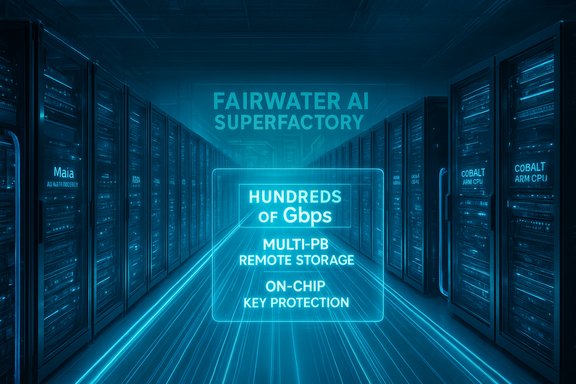
Azure Boost is Microsoft’s DPU (Data Processing Unit) effort: a programmable SoC that absorbs networking, storage path, and virtualization tasks that historically consumed CPU cycles on hosts. Microsoft positions Azure Boost to deliver significantly higher remote storage throughput, dramatically higher IOPS ceilings, and much larger per‑host networking headroom. Preview figures discussed publicly include host network bandwidth into the hundreds of gigabits and remote storage throughput in the multi‑GB/s range — numbers that materially change architecture choices for disaggregated storage and distributed training. Independent reporting and Azure technical writeups converge on the claim that DPU‑equipped servers can deliver meaningful efficiency gains (Microsoft cites up to ~4x storage performance with ~3x lower power in early messaging). Practical implications:- High‑IOPS and high‑bandwidth remote disks change how databases and HPC workloads scale in the cloud.
- Architectures that relied on colocating large state on the host may be re‑evaluated in favor of disaggregated, high‑throughput storage fabrics.
- Expect new VM SKUs and size families: some VM sizes will be “DPU‑accelerated” while others remain traditional.
Azure Integrated HSM — hardware key protection
Microsoft’s move to an Azure Integrated HSM (hardware security module) embeds cryptographic key protection directly into server hardware. This is a significant step for confidential computing and key management, reducing the attack surface exposed by networked or hosted HSM appliances. Microsoft presents this as a way to maintain in‑use key protection at datacenter scale while preserving low latency for cryptographic operations. For regulated industries this is a welcome capability — but it also raises questions about attestation, key custodianship, and the lifecycle management of on‑chip keys.Datacenter design: Fairwater, cooling, and power delivery
Fairwater and the AI superfactory model
Microsoft is building what it calls Fairwater — purpose‑built AI campuses that combine extreme rack density, liquid cooling, and optical fabric to treat multiple sites as a logically synchronous training domain. The Fairwater design focuses on minimizing intra‑system latencies while enabling massive scale, and Microsoft’s operational blog describes the combination of liquid cooling, rack‑level power distribution, and high‑density accelerator farms used in these sites. For customers running large model training, Fairwater can offer better aggregate throughput because it optimizes the physical constraints that training jobs care about most.Cooling and power innovations
To support rack densities in the hundreds of kilowatts per rack rows, Microsoft is deploying closed‑loop liquid cooling “sidekick” racks and disaggregated DC power architectures. Those innovations allow denser packing of GPUs/accelerators and higher efficiency but require planning around deployment regions, availability, and sustainability metrics. Microsoft has also shared Open Compute Project specifications for some rack and power designs, signaling an intent to standardize at industry level.Networking and Storage: the new throughput assumptions
What Azure Boost changes for networking and storage
Azure Boost’s preview figures — reported by Microsoft and corroborated in independent technical reporting — include:- Host network bandwidth targets in the hundreds of gigabits per second (up to ~400 Gbps in some preview messaging).
- Remote storage throughput into the tens of gigabytes per second for the largest VM sizes, and IOPS ceilings that approach the 800k–1,000,000 IOPS range in preview scenarios.
Disaggregated storage and RDMA
The combination of DPUs and high‑speed fabrics makes disaggregated storage (remote NVMe) much more viable for latency‑sensitive workloads. Expect Microsoft to push more RDMA and erasure‑coded storage across fabrics as first‑class features; architects should evaluate whether the new remote‑storage performance makes it feasible to consolidate storage and simplify fleet management.The software layer: agents, Foundry, and data grounding
Agentic operations: Azure Copilot and Microsoft Agent Factory
Azure Copilot is now positioned as an agent orchestration plane for cloud operations, with specialized agents for migration, deployment, observability, resiliency, optimization, and troubleshooting. Microsoft’s commercial messaging and technical blog posts emphasize RBAC‑integrated agents, audit trails, and tenant control over retention and storage of agent artifacts. The aim is to let agent fleets perform repeatable ops tasks while being subject to the same governance and identity controls as human users. This is consequential because agents move beyond chat interfaces into automated change‑making: that requires treating them as first‑class principals (identities), with lifecycles, versioning, and incident response plans. Microsoft’s previews include Agent management and a Microsoft Agent Factory program to help enterprises build and govern fleets.Foundry, Fabric IQ, and Foundry IQ — grounding agents in enterprise data
A persistent problem for agentic systems is context quality: agents hallucinate or make unsafe choices when retrieval pipelines and knowledge grounding are brittle. Microsoft addresses this with Fabric IQ (semantic entity unification on OneLake) and Foundry IQ (permission‑aware retrieval surfaces for agents). The goal is to provide preconfigured, auditable retrieval primitives so agents access the right documents and respect permissions without ad‑hoc RAG engineering. This moves the messy part of agent safety (data mapping and permissions) into managed platform primitives.Kubernetes and AKS Automatic
Microsoft is also baking more platform automation into the container stack with AKS Automatic — a managed experience that automates cluster provisioning, system node management, and lifecycle tasks. AKS Automatic reduces operational burden but shifts some control to Microsoft’s managed system node pools; evaluate whether your organization’s custom control assumptions remain valid under this model.Commercial and ecosystem shifts
Anthropic, Nvidia, and Microsoft: compute commitments and model choice
One of the most visible commercial moves is Anthropic’s commitment to purchase a large amount of Azure compute (widely reported as $30 billion in aggregate purchases) and the trio’s joint technical and investment alignment. This gives Microsoft additional frontline model choices in Foundry and Copilot while highlighting the industry reality: large model vendors are tying compute commitments, chip design, and cloud capacity into long‑term commercial arrangements. Those deals can stabilize capacity but may increase dependence on specific cloud SKUs and co‑engineered hardware. Why it matters:- Enterprises get model choice (Anthropic’s Claude in addition to others) under unified governance on Azure.
- Microsoft secures demand signals that justify heavy capital investments in Fairwater and DPU deployments.
- Buyers should track model tenancy, data handling guarantees, and SLA terms before routing production traffic to co‑engineered model stacks.
Partner ecosystem and multi‑vendor hardware
Microsoft continues to support Nvidia, AMD, and third‑party MPCs while introducing first‑party options. Customers will therefore face a richer SKU matrix: select the right hardware family (Maia vs Nvidia GBxxx vs AMD) based on workload, cost, and regional availability.Security, governance, and operational risk
Agents as principals — governance becomes core infrastructure
Treating agents as identities (Agent 365 / Agent Factory concepts) is a necessary reframing: agents can make changes and access data, so they require lifecycle management similar to service accounts. Microsoft’s previews emphasize auditable logs, Entra‑bound agent IDs, and policy enforcement — but those controls are only as effective as an organization’s governance processes. Normalizing agents in production requires updates to access reviews, incident response, and procurement workflows.Confidentiality and key management
Integrated HSMs and confidential computing primitives raise the bar for in‑use key protection. However, enterprises should validate attestation workflows, export/backup paths, and legal ownership models for keys held within datacenter hardware. Regulatory and compliance teams must be engaged early when integrating these features.Portability and vendor lock‑in concerns
Custom silicon + datacenter design + managed platform primitives create value but also lock‑in vectors. Workloads optimized for Maia + Azure Boost in a Fairwater region may achieve superior cost and performance but be harder to move to another cloud or even another Azure region. For enterprises with strict multicloud or geographic redundancy requirements, this tradeoff must be deliberate.Actionable guidance for IT and cloud architects
- Validate performance claims with representative benchmarks before committing production workloads to new SKUs. Use Microsoft’s preview regions and run end‑to‑end tests that include networked storage, replication, and failover.
- Treat agents like production services: require registration, RBAC mapping, periodic reviews, and incident playbooks that include agent‑induced actions.
- Revisit architecture decisions for databases and stateful services: high‑throughput remote NVMe (enabled by DPUs) may let you simplify host configurations, but validate latency and consistency under your workload patterns.
- Update procurement and sourcing policies to account for SKU and region availability: first‑party silicon is being rolled out selectively and early access may be limited to a handful of regions.
- Engage security and legal teams when enabling integrated HSMs or agentic retrieval systems to ensure attestation, export control, and data residency needs are met.
Strengths, opportunities, and risks — a balanced assessment
Notable strengths
- End‑to‑end optimization: Microsoft’s systems approach (silicon → racks → datacenter → platform) unlocks efficiency and performance not possible with off‑the‑shelf hardware alone. This is a competitive advantage for customers needing large model throughput.
- Operator productivity: Managed agents, Foundry IQ, and Fabric IQ reduce custom engineering needed to ground models and automate operations at scale. For organizations that adopt governance and test discipline, this can accelerate time to value.
- Security primitives at scale: Integrated HSMs and confidential computing options strengthen in‑use protections for keys and sensitive computations.
Real risks and tradeoffs
- Portability vs. performance: Co‑engineered hardware and data plane offloads can lock workloads into region/sku combinations; that raises availability and vendor negotiation risks.
- Operational complexity: Agents and new managed defaults shift responsibility from ops teams to platform teams; organizations must invest in governance and new operational controls.
- Unproven production behavior: Many of the most compelling performance numbers are from previews and demos; they must be validated under representative, sustained workloads. Treat early metrics as directional, not guaranteed.
Verification and provenance notes
Key engineering claims discussed here are public and can be traced to Microsoft’s product blogs and Ignite materials as well as independent trade reporting. For example:- Microsoft’s Fairwater datacenter architecture and the “AI superfactory” concept are described in Microsoft’s infrastructure blog.
- Azure Boost DPU performance and host network/IO figures are present in Ignite previews and corroborated by independent technical reporting and Redmond analysis. These preview numbers should be validated with proof‑of‑concept tests for any production decision.
- The Anthropic / Microsoft / Nvidia commercial partnership and compute commitments have multiple independent reports and the companies’ public statements; cross‑check the exact numeric commitments and contractual terms for procurement decisions.
What’s next — five practical bets for the rest of the decade
- Wider deployment of DPU‑accelerated VM families: Expect Azure Boost‑style offload to become a standard option for high‑throughput VM sizes and to appear in more regions as demand and supply allow. Designers should architect for optional offload usage.
- Agentic operations will enter mainstream ITSM: Within a year or two agentic workflows (migration, observability, remediation) will be common in large Azure tenants, but gating with rigorous governance.
- More co‑engineered partnerships for model hosting: Microsoft’s alignment with Anthropic and Nvidia shows hyperscalers will keep tying model vendors to compute capacity; expect more long‑term compute commitments industry‑wide.
- Region and SKU complexity increases: Architects must accept more fine‑grained choices in VM families and regions; automation in provisioning and testing will be essential to manage that complexity.
- New procurement and governance disciplines: Buying compute becomes a strategic negotiation (capacity commitments, co‑engineering terms, data handling). Procurement and legal teams will become central to cloud architecture decisions.
Conclusion
Azure’s infrastructure roadmap — as presented by Microsoft leadership and visible in Ignite previews — is an intentional pivot to treat the physical data center and platform software as a single, co‑engineered product. That shift delivers real benefits for AI and high‑throughput workloads: better performance, higher energy efficiency, and new security models. But it also increases the importance of deliberate architecture and governance choices: portability tradeoffs, agent lifecycle controls, and regional SKU availability will matter more than ever.IT leaders and architects should embrace the possibilities while insisting on proof: run targeted POCs, demand clear contractual guarantees, and update governance models for agents and hardware‑integrated key management. The coming years will reward teams that balance curiosity with discipline — the hyperscale clouds are becoming more powerful, but they are also becoming more opinionated about how you should run your workloads.
Source: InfoWorld What’s next for Azure infrastructure
