

Microsoft and NVIDIA have quietly moved from co‑engineering components to co‑building entire AI factories: Azure’s new Fairwater sites will run hundreds of thousands of NVIDIA Blackwell GPUs in rack‑scale GB200/GB300 NVL72 systems, deploy tens of thousands of Blackwell Ultra GPUs for inference, and surface new GPU SKUs and VM families across Azure that tie NVIDIA’s stack directly into Microsoft 365, SQL Server and Foundry microservices.
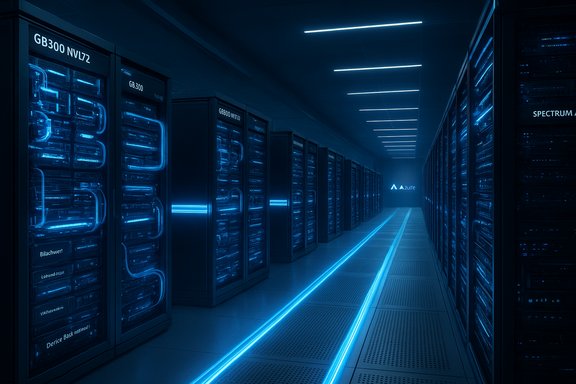
Microsoft’s public documentation and partner briefings frame Fairwater as a deliberate re‑thinking of cloud datacenter architecture — not an incremental datacenter build, but a rack‑first, two‑story campus model designed to behave like a single, continent‑scale supercomputer. Fairwater’s Atlanta site is presented as the second signature location joined to the original Wisconsin campus; together they form what Microsoft describes as an AI “superfactory” connected by a dedicated AI wide‑area optical backbone. NVIDIA’s Blackwell platform — particularly the GB200 and GB300 families and the NVL72 rack reference designs — is the hardware backbone for this strategy. A single NVL72 rack can contain up to 72 Blackwell GPUs tightly coupled with NVIDIA Grace‑class host CPUs and NVLink/NVSwitch fabrics so the rack behaves like a single, pooled accelerator with tens of terabytes of fast memory. Microsoft exposes these building blocks to customers via ND/NC‑style VM SKUs and new orchestration optimizations tuned for very large model training and high‑throughput inference.
Source: StreetInsider NVIDIA expands Microsoft partnership with Blackwell GPUs for AI infrastructure
 Background / Overview
Microsoft’s public documentation and partner briefings frame Fairwater as a deliberate re‑thinking of cloud datacenter architecture — not an incremental datacenter build, but a rack‑first, two‑story campus model designed to behave like a single, continent‑scale supercomputer. Fairwater’s Atlanta site is presented as the second signature location joined to the original Wisconsin campus; together they form what Microsoft describes as an AI “superfactory” connected by a dedicated AI wide‑area optical backbone. NVIDIA’s Blackwell platform — particularly the GB200 and GB300 families and the NVL72 rack reference designs — is the hardware backbone for this strategy. A single NVL72 rack can contain up to 72 Blackwell GPUs tightly coupled with NVIDIA Grace‑class host CPUs and NVLink/NVSwitch fabrics so the rack behaves like a single, pooled accelerator with tens of terabytes of fast memory. Microsoft exposes these building blocks to customers via ND/NC‑style VM SKUs and new orchestration optimizations tuned for very large model training and high‑throughput inference. What exactly did Microsoft and NVIDIA announce?
The headline elements
- Microsoft’s Fairwater program now includes a second Fairwater datacenter in Atlanta, linked to the Wisconsin campus to form a distributed AI superfactory optimized for frontier model training and large‑scale inference.
- Fairwater infrastructure will integrate NVIDIA Blackwell platform GPUs — both GB200 and the higher‑end GB300 “Blackwell Ultra” — inside GB300 NVL72 rack systems for training and inference. Early production clusters already show multi‑rack GB300 NVL72 deployments.
- Microsoft plans global inference capacity using NVIDIA GB300 NVL72 systems and reports deploying large numbers of Blackwell Ultra GPUs for inference (company messages describe deploying more than 100,000 Blackwell Ultra GPUs across inference systems over time, framed as a global roll‑out target). That target is presented as a scale objective rather than a single‑moment inventory snapshot.
- New Azure VM offerings and server‑grade RTX SKUs — Microsoft is introducing Azure VM families that expose NVIDIA’s workstation/enterprise server GPUs (examples include RTX PRO 6000 Blackwell Server Edition on partner systems and an NC/ND family alignment for customers) and Microsoft lists RTX/NC additions in preview across partner materials. These SKUs are intended for interactive AI workloads, developer toolchains, and enterprise app integrations.
- Network and switching: Microsoft is deploying NVIDIA Spectrum‑X Ethernet switching in key Fairwater locations to connect these racks, and using InfiniBand (Quantum‑X800 / ConnectX‑8 class) for pod/rack stitching where required for synchronous large‑model training.
- Software and services integration: NVIDIA NeMo/Nemotron families and NeMo Agent Toolkit components will be connected into Microsoft’s platform stack — including integrations with Microsoft SQL Server 2025, Microsoft 365 (Agent 365) and Microsoft Foundry where Nemotron/Cosmos models will be offered as secure microservices. Microsoft and NVIDIA also describe joint optimizations that they say have materially lowered per‑token/model operating costs for Azure customers. Some of those cost‑reduction figures are company‑reported and should be treated as vendor claims pending independent verification.
Technical anatomy — what makes Fairwater different
Rack‑as‑accelerator: NVL72 and pooled fast memory
Fairwater’s core design principle is treating the rack as the atomic accelerator. An NVL72 rack couples up to 72 Blackwell GPUs with 36 Grace‑class host CPUs, using NVLink/NVSwitch fabrics so intra‑rack communication looks like shared, very high‑bandwidth memory to schedulers. Vendor numbers for GB300 NVL72 variants suggest pooled fast memory on the order of tens of terabytes (vendor literature cites ~37 TB in certain GB300 configurations) and aggregate NVLink bandwidth figures in the hundreds of terabytes per second at the rack level. Those numbers are rack‑level envelopes — not per‑GPU numbers — and they are crucial because they alter how model shards, activation shuffles and KV caches are architected. Why that matters: large LLM training and reasoning workloads are often limited by inter‑GPU communication and memory locality. By collapsing communication inside an NVLink domain, Microsoft reduces synchronization overhead, improves tokens‑per‑second, and makes certain classes of models feasible without brittle cross‑node partitioning.Networking: NVLink inside, InfiniBand and Spectrum‑X between
Inside racks, NVLink/NVSwitch provides ultra‑low latency GPU‑to‑GPU fabric. For pod and multi‑rack scale‑out, Microsoft and partners use Quantum‑X800 / ConnectX‑8 class InfiniBand for GPU‑heavy all‑reduce operations, and Spectrum‑X Ethernet where hyperscaler economics or multi‑tenant interoperability favor Ethernet with RDMA/RoCE extensions. Microsoft’s Fairwater architecture layers a dedicated AI WAN (hundreds of miles of purpose‑built fiber) to allow synchronous, multi‑site training to behave more like a single system despite physical separation.Cooling and facility engineering
Fairwater uses closed‑loop liquid cooling to hit high rack power densities (public materials cite figures like ~140 kW per rack and ~1,360 kW per row in dense configurations). The two‑story hall design shortens cable and fiber runs and allows more compact GPU density per square foot. These are non‑trivial facility changes: floor loading, chilled loop plumbing, and power procurement all need re‑engineering to host GB300 NVL72 systems at scale.Productization: VMs, SKUs, and developer toolchains
Azure VM families and RTX PRO server editions
Microsoft is introducing and expanding VM SKUs that expose the Blackwell family and related RTX server SKUs for on‑demand use. Partner materials and vendor announcements reference ND GB300 v6 / ND GB200 v6 families for ND (training/inference) and new NC Series SKUs for RTX PRO server editions aimed at workstation‑class and developer workflows. NetApp and ecosystem partners also reference the NVIDIA RTX PRO 6000 Blackwell Server Edition as an emerging enterprise server GPU that will be supported in Azure‑adjacent offerings and partner on‑prem systems. Public preview status is reported for some integrations in partner literature, though Microsoft’s own VM availability per region should be checked in the Azure Portal for exact region and quota details.NeMo, Nemotron, Agent toolkits and Microsoft 365
A major part of the announcement is software: NVIDIA NeMo and the Nemotron family (NVIDIA’s large model products and agent toolkits) are being integrated into Microsoft stacks:- Nemotron models integrated with Microsoft SQL Server 2025 to enable in‑database LLM operations and retrieval‑augmented capabilities.
- NeMo Agent Toolkit linked to a Microsoft “Agent 365” surface to let developers build AI agents that run as Copilot experiences in Outlook, Teams, Word and SharePoint.
- Microsoft Foundry will offer Nemotron (digital AI) and Cosmos (physical AI / Omniverse) models as secure microservices that enterprises can consume as managed model instances.
Claimed business and cost impacts — what vendors say (and what’s verifiable)
Microsoft and NVIDIA highlight dramatic cost and performance improvements after stack‑level optimizations. Some vendor messaging and partner articles claim very large reductions in model costs for customers (figures like “over 90% reduction in GPT model pricing for Azure users over two years” appear in some industry reports and press summaries). That specific percentage is a company‑reported optimization claim and is difficult to independently verify in public disclosures; it should be treated as a vendor statement until detailed methodology and third‑party audits are published. What is verifiable from independent reporting:- Microsoft has deployed an initial GB300 NVL72 cluster containing multiple racks (public reporting reconstructs a first large cluster of ~4,608 GB300 GPUs across racks). Those deployments deliver order‑of‑magnitude increases in inference and rack‑level throughput versus previous generations.
- NVIDIA and partners are shipping GB300 (Blackwell Ultra) and GB200 systems to cloud and co‑lo providers; CoreWeave and other providers have publicly confirmed early GB300 rollouts.
Strategic and commercial implications
For Microsoft
- Fairwater positions Azure as a provider of frontier‑class infrastructure: Microsoft can now offer synchronized, multi‑site training capacity at scales previously reserved for national labs or custom supercomputers. That improves Azure’s attractiveness to model labs, internal AI teams (OpenAI and Microsoft AI Superintelligence teams are named customers), and enterprises needing low‑latency, high‑throughput inference for Copilot and enterprise agents.
- The stack integration (NeMo/Nemotron + Microsoft 365 + SQL Server) tightens the product moat: model ecosystems become embedded in Microsoft’s application and data stack, raising the switching cost for enterprises once pipelines and governance are built around these integrations.
For NVIDIA
- Moving beyond GPU silicon to a systems‑level play (reference racks, switching, DGX/GB300 SuperPODs, Spectrum‑X, DPUs) accelerates NVIDIA’s position as the default systems vendor for hyperscale AI factories. Co‑engineering at the rack and network level helps NVIDIA sell more than chips — entire validated blocks of infrastructure.
For enterprise customers and ISVs
- Faster time‑to‑model and agent deployment: integrated microservices (Foundry Nemotron/Cosmos) and the new VM SKUs lower friction for enterprises that want to run advanced agents inside Microsoft 365 or fast DB‑augmented models in SQL Server.
- New procurement dynamics: enterprises will face choices about whether to rely on Azure’s superfactory capacity, buy co‑located GB300 racks from partners, or pursue hybrid designs that attempt to replicate some rack‑scale characteristics on‑premises. Each path has tradeoffs in cost, control and governance.
Risks, unknowns and operational caveats
- Concentration and vendor lock‑in
The deeper software and infrastructure integration between Microsoft and NVIDIA increases lock‑in risk. Enterprises that adopt Nemotron microservices and Azure NDv6 GB300 capacity may find migration costly if performance or pricing changes. The rack‑as‑accelerator paradigm further ties software to a physical topology that is non‑trivial to replicate elsewhere. - Supply chain and geopolitical constraints
Advanced AI chips and high‑density racks require complex supply chains and may be subject to export restrictions, licensing and geopolitical review. Large cross‑border deployments should factor in regulatory and trade risk. Recent reporting shows major shipments and deals sometimes require regulatory approvals (examples exist where Microsoft and others sought licenses for particular exports). Those approvals can be material to global rollouts. - Energy, water and local impacts
Even with closed‑loop liquid cooling, dense racks consume substantial energy and trigger local grid planning requirements. Microsoft’s Fairwater materials emphasize sustainability measures and low operational water use, but hosting many NVL72 racks still changes the operational profile of a datacenter (peak power, backup strategies, and heat rejection). Local regulators and communities will scrutinize these builds. - Economics versus alternatives
Vendor claims of large percentage declines in model pricing are plausible given improved hardware efficiency, quantization and software stack optimizations — but the realized cost per token for a given workload depends on many factors: model architecture, context length, serving topology (sharded vs. rack‑local), data egress, and service SLAs. Procurement teams should demand transparent cost models and run proof‑of‑concepts to get real numbers for their workloads. - Security and supply software stack attack surface
Deeper integrations (DPUs, Spectrum‑X, BlueField DPUs, NeMo microservices) increase the stack’s complexity and therefore the potential attack surface. Customers should require robust threat modeling, encryption and supply‑chain assurances when adopting full‑stack offerings.
Practical guidance for IT leaders and architects
- Reassess model placement and lifecycle economics
- Run benchmark experiments that match your production workloads (long‑context inference, complex retrieval augmented generation, or massive fine‑tuning) on Azure’s ND/NC previews and compare TCO versus on‑prem or hybrid options. Use real token mixes and account for egress, storage and orchestration overhead.
- Insist on measurable SLAs and transparent cost modeling
- When negotiating Azure or partner deals, insist on workload‑level SLAs and access to the profiling tools used to derive vendor cost‑reduction claims. Vendor‑reported percentage cuts should be validated against your sample workloads.
- Plan for rack‑aware software design
- If you intend to exploit NVL72 advantages, design model parallelism and memory placement to keep hot working sets inside rack domains where possible; this may require re‑thinking sharding and checkpoint strategies.
- Treat security and governance as first‑class requirements
- Evaluate the supply chain, DPU/BlueField integrations, and microservice hardening for Nemotron/Foundry offerings. Demand controls around data residency, model provenance, and access auditing.
- Avoid single‑source dependency where feasible
- Consider multi‑cloud or multi‑supplier strategies for long‑term resilience, especially for mission‑critical model workloads.
The verdict — why this matters to the Windows and enterprise audience
This collaboration marks a transitional moment: it takes NVIDIA’s Blackwell silicon and elevates it into a system‑level product that Microsoft can operationalize at hyperscale across Azure. For Windows‑centric organizations and enterprise IT teams, the practical effects are immediate:- Microsoft 365 Copilot and other enterprise AI experiences can be powered by much larger, lower‑latency model backends hosted in Azure Fairwater, enabling richer agentic experiences that integrate with Outlook, Teams, Word and SharePoint.
- Enterprises get access to managed Nemotron/Cosmos model microservices via Microsoft Foundry, shortening time to market for AI agents and domain‑specific reasoning.
- The new NVL72 rack model changes procurement, facilities planning and long‑term capital budgeting for organizations that decide to host or co‑locate similar scale infrastructure.
Conclusion
Microsoft and NVIDIA’s expanded partnership — built around Blackwell GB200/GB300 NVL72 racks, Spectrum‑X switching, NeMo/Nemotron model integrations and Azure VM innovations — is more than a new hardware refresh. It’s a systems‑level play to turn clouds into AI superfactories that can train, fine‑tune and serve frontier models at planetary scale. The technical design choices (rack‑as‑accelerator, liquid cooling, dedicated AI WANs and integrated model microservices) are real and already visible in production deployments, but several of the headline commercial claims (exact GPU counts in global fleets and vendor‑stated percentage reductions in model pricing) are company‑reported and warrant careful independent validation by customers and auditors. For IT leaders and Windows ecosystem partners, the opportunity is clear: these platforms make previously impractical model sizes and agentic applications commercially available. The caution is equally clear: lock‑in, operational complexity and the need for transparent cost accounting mean that adoption should be deliberate, workload‑driven and backed by measurement. The era of AI superfactories has arrived — but turning that raw compute into sustained, secure, and cost‑effective business advantage will be the work of the next several years.Source: StreetInsider NVIDIA expands Microsoft partnership with Blackwell GPUs for AI infrastructure
