

Microsoft has quietly switched on a new class of AI datacenter — the Fairwater family — and connected it to other sites to create what the company calls its first AI superfactory, an intentionally distributed, high-density compute fabric optimized for training frontier-scale models.
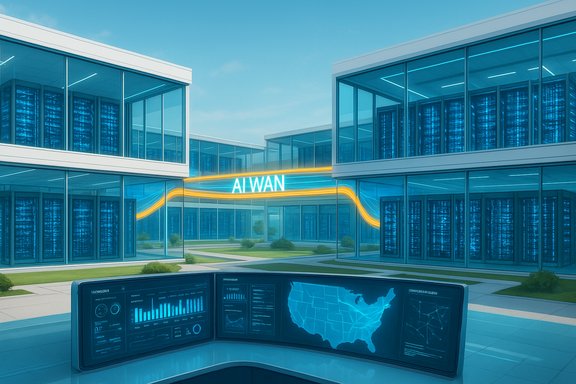
Microsoft’s announcement places the new Fairwater site near Atlanta at the center of a larger, continent-spanning effort to treat multiple datacenters as one cohesive machine rather than as isolated cloud pods. The Atlanta installation entered service in October and is described as the second Fairwater site, joining the initial Wisconsin deployment. This is not merely a marketing label. The Fairwater design bundles several technical decisions — ultra-dense GPU racks, two-story buildings to shorten cable lengths, closed-loop liquid cooling with near-zero evaporative water use, and a dedicated optical backbone Microsoft dubs the AI WAN — all engineered to reduce latency between GPUs and keep large distributed training jobs from stalling.
Source: StartupHub.ai https://www.startuphub.ai/ai-news/a...5/microsofts-ai-superfactory-goes-live/?amp=1
 Background
Microsoft’s announcement places the new Fairwater site near Atlanta at the center of a larger, continent-spanning effort to treat multiple datacenters as one cohesive machine rather than as isolated cloud pods. The Atlanta installation entered service in October and is described as the second Fairwater site, joining the initial Wisconsin deployment. This is not merely a marketing label. The Fairwater design bundles several technical decisions — ultra-dense GPU racks, two-story buildings to shorten cable lengths, closed-loop liquid cooling with near-zero evaporative water use, and a dedicated optical backbone Microsoft dubs the AI WAN — all engineered to reduce latency between GPUs and keep large distributed training jobs from stalling. Overview: What Microsoft built and why it matters
The core idea: a geographically distributed supercomputer
At its core, Fairwater reframes the unit of compute from "one datacenter" to "one distributed system spanning multiple centers." That system is intended to run singular, massive jobs — the kind of training runs that power next-generation foundation models with hundreds of billions to hundreds of trillions of parameters. Microsoft says this allows training exercises that used to take months to complete in a single location to finish in weeks when spread across linked Fairwater sites. This distributed compute paradigm is important because physics and site constraints make it increasingly infeasible to pack every resource into one monolithic campus. Land availability, local power capacity, permitting, and heat removal all create practical limits. By knitting multiple sites together with an AI-optimized WAN, Microsoft aims to scale beyond those physical constraints while keeping GPUs effectively synchronized.Purpose-built vs. general-purpose cloud
Traditional hyperscale datacenters are optimized for fungibility — running millions of small, independent workloads for many customers. Fairwater is the opposite: it’s optimized for running one or a few very large workloads across hundreds of thousands of accelerators in concert. That design choice changes nearly every engineering trade-off: networking topology, building layout, cooling, and even the procurement of fiber and power.Fairwater hardware: racks, chips, and density
NVIDIA GB200 / GB300 NVL72 racks at the center
Fairwater’s compute foundation hinges on rack-scale GPU systems: Microsoft highlights NVIDIA GB200 and GB300 NVL72 rack architectures — each rack containing up to 72 Blackwell GPUs interconnected by NVLink to form very large, low-latency domains inside a rack. Those GB200/GB300 NVL72 systems are purpose-built for high-throughput training and dense inference workloads. These NVL72 racks provide exceptionally large pooled memory and inter-GPU bandwidth inside the rack, which helps short-circuit many of the communication bottlenecks that typically slow distributed training. Packing many such racks into a two-story datacenter enables Microsoft to reduce internal cable runs and maintain higher effective GPU-to-GPU communication rates.Density and power figures to watch
Microsoft’s published design targets include rack-level power densities in the order of ~140 kW per rack and row-level densities above 1 MW for contiguous rows, enabled by liquid cooling and careful power planning. Those figures are consistent with the shift in the industry toward higher-power, liquid-cooled GPU racks. The implication: each Fairwater site packs far more compute per square foot than prior-generation general-purpose datacenters. Note: rack and row power figures are operational targets from Microsoft’s design descriptions; actual deployed densities can vary by site and by configuration.Cooling and sustainability: near-zero water, closed-loop liquid systems
Why liquid cooling
High-density GPU racks produce far more heat per rack than older CPU-optimized designs. Microsoft’s Fairwater sites use rack-level direct liquid cooling and large-scale chiller systems to move heat out of the building efficiently. The company describes a closed-loop liquid circulation that is filled during construction and then re-used with minimal makeup water — an approach that reduces evaporative water consumption to near zero.Water usage and WUE improvements
Microsoft’s broader datacenter planning already emphasized Water Usage Effectiveness (WUE) improvements. The shift to closed-loop, chip-level cooling is intended to reduce per-site evaporative water use dramatically, a meaningful consideration as AI scaling increases both energy and water demand for cooling across the industry. Microsoft’s public materials call the Fairwater approach near-zero evaporative water consumption for cooling, though routine facility water usage for offices and local services still applies. Caveat: closed-loop systems still require initial fill water and occasional chemistry-based replacements; they are not literally water-free in the absolute sense but dramatically reduce freshwater evaporation compared with traditional evaporative cooling schemes.The AI WAN: a dedicated backbone for distributed training
What Microsoft built in fiber and protocols
A signature innovation for Fairwater is the AI WAN: a dedicated wide-area optical backbone that connects Fairwater sites using a mix of newly laid and repurposed fiber. Microsoft reports expanding its optical route mileage by roughly 120,000 miles, a roughly 25% increase in fiber mileage in a single year to support the project. The goal is a congestion-free, low-latency, high-throughput fabric optimized for AI traffic patterns rather than conventional internet flows. To orchestrate communication across that backbone, Microsoft developed advanced transport techniques and application-aware routing features — described in technical summaries as improvements to packet spraying, trimming, high-frequency telemetry, and congestion control. Those network software features aim to keep distributed GPUs synchronized by minimizing the tail latency and retransmission noise that can otherwise idle large fractions of a training cluster.Multi-Path Reliable Connected (MRC) and app-aware networking
Industry reporting indicates Microsoft is using a protocol stack tailored for AI traffic, referred to internally as Multi-Path Reliable Connected (MRC) in some briefings. MRC-like approaches combine multipath forwarding, rapid retransmit strategies, and telemetry-driven path selection to optimize for the demanding, synchronized exchanges of gradient and parameter updates during training. These techniques are complementary to the physical fiber investment and are what allow geographically separated racks to function as if they were closely coupled.Why distribution: training at scale and synchronization challenges
The scale problem
Modern foundation models have ballooned in size. Microsoft and its technical leads argue that training models in the hundreds of trillions of parameters range requires infrastructure that spans multiple data centers — simply because power, land, and thermal limits make singular, larger-than-ever campuses impractical. Mark Russinovich at Microsoft framed this as a capacity and architectural inflection point: "The amount of infrastructure required now to train these models is not just one datacenter, not two, but multiples of that."The synchronization problem
When you distribute training across thousands of GPUs in multiple buildings — or different states — the core challenge is keeping all participants busy. Training parallelism relies on frequent, high-throughput parameter exchanges. Any bottleneck (network congestion, straggler nodes, noisy links) stalls progress and wastes compute. Fairwater’s whole thesis is to reduce those bottlenecks through co-design of racks, buildings, fiber, and network software so the idle time of expensive accelerators is minimized.Practical implications: who benefits and how
- Internal Microsoft teams (including the AI Superintelligence Group and Copilot development) gain elastic access to extreme-scale training clusters.
- Strategic partners and customers training very large models could access the distributed superfactory to reduce time-to-train from months to weeks.
- Research institutions and enterprise AI teams may find capabilities previously limited to national labs now available via cloud interfaces, accelerating experimentation and iteration.
Technical deep dive: design trade-offs and implementation details
Two-story buildings and cable physics
A seemingly small design choice — moving from single-story halls to two-story facilities — is driven by cable length and thus latency. Shorter intra-site cable runs reduce hop counts and propagation delays, which matters when GPUs exchange terabits per second of gradients. The two-story layout also compresses physical distances and lets Microsoft achieve higher effective density while managing mechanical loads and coolant routing.Ethernet-based backend and SONiC
Microsoft describes Fairwater’s internal cluster fabric as a two-tier, high-speed Ethernet-based backend that leverages the open-source SONiC network operating system to avoid vendor lock-in and keep costs manageable. That architecture enables GPU-to-GPU connectivity at 800 Gbps in some cluster designs, while relying on commodity switch ecosystems scaled with software innovations to overcome traditional Clos-network limits.Rack-level NVLink domains and intra-rack bandwidth
By using NVLink inside racks, the Fairwater design creates enormous intra-rack bandwidth (multiple TB/s) and pooled memory contexts that let many GPUs share states more efficiently. The NVL72 rack architecture from NVIDIA is engineered to maximize this locality and reduce the frequency and cost of cross-rack synchronization — a critical optimization for throughput-centric training jobs.Environmental, local grid, and community impacts
Power and grid considerations
Packing more compute into a region increases demand volatility. Microsoft states it chose sites like Atlanta for resilient utility power and designed software/hardware mitigations — including power-aware scheduling, GPU-enforced power thresholds, and on-site energy storage — to smooth out grid impacts while avoiding excessive on-site generation costs. These measures are part of an explicit attempt to be a more responsible large-scale energy consumer.Water reduction and sustainability messaging
The movement to closed-loop, near-zero evaporative water cooling is a direct response to growing scrutiny over datacenter water use as chip density increases. By minimizing evaporative water use, Microsoft aims to reduce stress on local watersheds and present a lower environmental footprint for large AI datacenters. The trade-off is a small increase in energy usage versus evaporative systems, but engineers argue efficiency gains elsewhere offset that cost.Risks, caveats, and open questions
1. Vendor and supply chain dependencies
The Fairwater concept depends heavily on access to the latest accelerators (GB200/GB300 families), high-performance racks, and advanced networking kit. Global supply constraints, export controls, or production issues (as seen in prior rollouts of new GPU generations) could slow scale-up. Past reporting has shown customers sometimes delay or adjust orders in response to early hardware issues. Such supply-side shocks would disproportionately affect purpose-built AI factories.2. Thermal failure modes and operational complexity
Liquid cooling at extreme densities reduces some risks but adds plumbing complexity — more pumps, valves, and chemistry management. While the closed-loop systems minimize evaporative water use, they require strict operational discipline to avoid leaks, corrosion, or chemistry drift. Those operational risks need careful site engineering and a mature maintenance program.3. Security and attack surface
A high-speed dedicated AI WAN optimizes for speed and throughput, but any large backbone is also attractive for adversarial actors. Securing fiber, edge nodes, and control-plane telemetries at this scale requires substantial investment in network security, monitoring, and isolation to prevent theft, tampering, or data leakage during multi-tenant or partner training runs.4. Geographic concentration and regulatory scrutiny
Massive distributed compute fabrics will draw scrutiny from local governments and regulators concerned about energy pricing, demand spikes, and economic impacts on communities. As Fairwater-like projects replicate, expect more public debate and possible permitting constraints that could shape future siting decisions.5. Claims to performance improvements: measured vs. projected
Microsoft and partners claim dramatic reductions in time-to-train and improved utilization, but those are dependent on workload characteristics and orchestration software. The most persuasive evidence will be independent benchmarks and customer outcomes once the infrastructure is used across a variety of real-world workloads. Until third-party performance data is widely available, some performance claims should be treated as vendor-provided projections.How the industry will respond: competition and collaboration
Competitors will accelerate
Other hyperscalers and specialized "neocloud" providers have been expanding capacity and negotiating GPU supply deals. The influence of Microsoft’s Fairwater strategy will likely push competitors to invest more in both their fiber backbones and in optimizing datacenter designs around GPU density and low-latency fabrics. Expect faster rollouts of liquid cooling, tighter partnerships with chipset vendors, and more private fiber builds.Partnerships and reseller ecosystems matter
Microsoft’s scale allows it to combine owned capacity with contracted capacity from third-party neoclouds. The economics and flexibility of such partnerships will influence how enterprises choose between public cloud training vs. renting capacity from specialist providers or building private clusters.Five practical takeaways for IT and cloud architects
- Design for network locality and latency — training at extreme scale is as much a networking problem as it is a compute or storage problem.
- Expect liquid cooling to be standard for high-density GPU deployments — water-saving closed loops will become common in future GPU-heavy sites.
- Plan for a distributed compute model — single-campus scale will not be enough for frontier models; multi-site orchestration is now an architectural requirement.
- Watch supply chain and export policy — hardware availability and geopolitical controls on advanced chips can change timelines quickly.
- Prioritize operational maturity — high-density, liquid-cooled, multi-site systems require advanced telemetry, automation, and maintenance regimes to be reliable and secure.
Verdict: strengths, strategic bets, and where caution is warranted
Microsoft’s Fairwater and the AI WAN are a clear and coherent strategic response to the physical limits of single-site scaling. The strengths of the approach are straightforward:- Co-design across layers — integrating racks, buildings, fiber, and protocols reduces the classic mismatch between compute and network.
- Sustainability-forward cooling — near-zero evaporative water use is a meaningful step for water-constrained regions.
- Operational fungibility for AI workloads — treating multi-site resources as a single pool can increase utilization and accelerate model iteration cycles.
- Hardware continuity: sustained access to next-gen GPUs at scale is critical. Supply interruptions or design problems would be painful.
- Network perfection: the economic value of a distributed superfactory collapses if inter-site latency or packet loss regularly creates stragglers. The AI WAN must deliver not just bandwidth but repeatable low tail latency.
- Public acceptance and regulation: large footprints and high energy demands invite scrutiny; handling local grid impacts and permitting will be essential for continued scale-out.
Conclusion
Fairwater and the AI WAN represent a pivotal architectural bet: that the next leap in AI capability will come not from a single megasite, but from a tightly coupled, geographically distributed compute fabric whose network is as important as its chips. Microsoft’s early deployments — the Atlanta site that came online in October and the Wisconsin origin point — validate that the company is moving from theory to operational reality. If the strategy works, it changes how enterprises, researchers, and the hyperscalers will approach training, procurement, and datacenter design. If the strategy encounters bottlenecks in hardware supply, network fidelity, or regulatory pushback, those same constraints will become a proving ground for how robust next-generation AI infrastructure must be. Either way, Fairwater marks a decisive step in the industry’s evolution toward treating cloud-scale AI as an integrated system — and it makes the network the center of gravity for future compute design.Source: StartupHub.ai https://www.startuphub.ai/ai-news/a...5/microsofts-ai-superfactory-goes-live/?amp=1
