

Microsoft has flipped the switch on a second Fairwater-class Azure AI datacenter in Atlanta, Georgia, and announced that it is now linked with the original Fairwater campus in Wisconsin to form what the company calls the world’s first “planet‑scale AI superfactory.” This is not merely another hyperscale expansion: Microsoft describes Fairwater as a purpose‑built, rack‑first supercomputing topology that packs GB‑family NVIDIA Blackwell GPUs into liquid‑cooled NVL72 racks, stitches multiple sites with a dedicated AI WAN, and rethinks building, cooling and power to make very large model training and high-throughput AI inference cheaper, faster and more fungible across Azure’s global cloud. Microsoft’s technical narrative and independent reporting make clear that Fairwater is intended to change the unit of compute from the individual server to the entire rack — and, ultimately, the multi‑site campus — with profound engineering, commercial and governance implications.
Microsoft first publicized the Fairwater concept with its large Wisconsin campus announcement: a multi‑building, high‑density AI campus designed to host new generations of NVIDIA GB200/GB300 (Blackwell) racks with NVLink‑based rack‑scale aggregation and closed‑loop liquid cooling. The Atlanta facility is the second in that family and, according to Microsoft, began operating in October before being publicly detailed in November. The company frames the two sites as joined into a single distributed compute fabric — an “AI superfactory” — via a dedicated fiber backbone built to provide high‑bandwidth, low‑latency connectivity between distant racks and entire data halls. Independent reporting and technical briefings supplied by Microsoft emphasize several recurring design goals:
Key claims that have multiple, independent confirmations:
Key items to watch in the coming months:
Source: W.Media Microsoft launches “planet-scale AI superfactory” in Atlanta – W.Media
 Background
Microsoft first publicized the Fairwater concept with its large Wisconsin campus announcement: a multi‑building, high‑density AI campus designed to host new generations of NVIDIA GB200/GB300 (Blackwell) racks with NVLink‑based rack‑scale aggregation and closed‑loop liquid cooling. The Atlanta facility is the second in that family and, according to Microsoft, began operating in October before being publicly detailed in November. The company frames the two sites as joined into a single distributed compute fabric — an “AI superfactory” — via a dedicated fiber backbone built to provide high‑bandwidth, low‑latency connectivity between distant racks and entire data halls. Independent reporting and technical briefings supplied by Microsoft emphasize several recurring design goals:- Treat the rack (an NVL72 GB‑family configuration) as the atomic accelerator, not the individual server.
- Use closed‑loop liquid cooling to enable very high rack power density and to cut operational water consumption.
- Reduce intra‑site cable lengths and latency with a two‑story hall design and vertical rack placements.
- Join multiple Fairwater sites with a dedicated AI WAN so geographically separated hardware can participate in synchronous, large‑model training.
What is Fairwater? An architecture overview
The rack-as-accelerator model
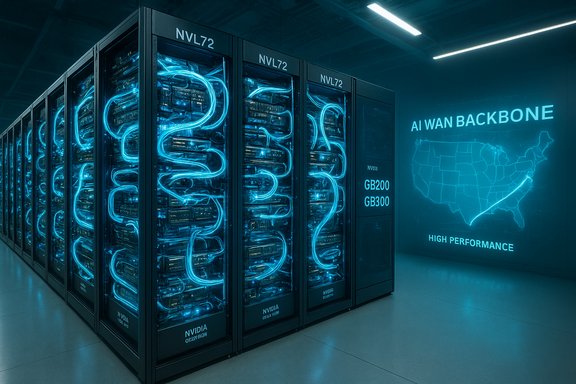
At the heart of Fairwater is the NVL72 rack concept: a rack contains dozens of Blackwell (GB200/GB300) GPUs plus matched host CPUs and high‑bandwidth NVLink/NVSwitch fabric that effectively makes the entire rack behave like a single accelerator with pooled fast memory. Microsoft and vendor materials describe this as a deliberate move: collapsing intra‑rack latency and presenting a simpler, higher‑utilization scheduling target for large models that previously required brittle cross‑host sharding. Independent coverage confirms the NVL72 footprint — up to 72 GPUs per rack — and the performance tradeoffs that make rack‑level placement attractive for long‑context and multi‑trillion parameter training. Why this matters in practice: gradient exchanges, activation shuffles and model parallel synchronization are communication‑heavy during each training step. By keeping as many of those exchanges as possible inside an NVLink‑rich rack domain, Fairwater reduces the fraction of communication that must cross slower or more congested fabrics. That improves per‑step throughput and lets Microsoft claim much higher effective utilization on synchronized training jobs than in a conventional cloud datacenter.Network fabric and the AI WAN
Fairwater’s second pillar is networking. Inside each site, Microsoft layers NVLink inside racks with high‑speed, RDMA‑capable fabrics between racks and pods (press reports describe 800 Gbps class links and two‑tier Ethernet-based backends in some configurations). The boldest and most novel element is the AI WAN: a dedicated optical backbone connecting Fairwater sites so they can participate in the same synchronous training job with minimized cross‑site congestion. Microsoft claims this enables distinct Fairwater sites to behave more like nodes in a single supercomputer rather than isolated datacenters. Independent reporting confirms the presence of a new, high‑capacity fiber backbone that Microsoft says spans tens of thousands of miles and is designed specifically to support large‑model training across states.Cooling and facility design
Fairwater departs from typical datacenter cooling in two ways: density and water management. The design leverages direct liquid cooling at the rack level (cold plates, closed loops) so server heat is removed more effectively than with airflow. Microsoft emphasizes a closed‑loop approach that reuses coolant and minimizes makeup water, claiming operational water draws are tiny once the system is filled. The two‑story hall design reduces cable run lengths and helps shrink latency between GPU domains. Datacenter engineering coverage places per‑rack densities at up to 140 kW per rack with row power numbers also much higher than standard colocation halls — figures Microsoft and industry reporting have repeated.Power, resilience and the economics of availability
One of Fairwater’s operational choices is to locate sites on resilient, high‑availability grid power so Microsoft can reduce or avoid some traditional redundancy measures (like on‑site diesel generation and full dual‑corded UPS at every distribution path) and cut per‑unit cost of service while aiming for very high availability. Microsoft explicitly mentions achieving “99.99% uptime” (or “4×9” availability in company wording) using grid improvements and power‑management software that regulate GPU power draw, paired with on‑site energy storage where needed. This is framed as a push to reduce the cost of delivering frontier TFLOPS while maintaining reliability.Verified technical claims and what’s still aspirational
Microsoft’s public posts and independent reporting converge on many design details, but distinguishing verified facts from aspirational marketing is essential.Key claims that have multiple, independent confirmations:
- Fairwater sites are NVL72‑style deployments built around NVIDIA GB‑family hardware (Blackwell GB200/GB300 racks).
- The Atlanta site is online and connected to the Wisconsin Fairwater via a dedicated high‑capacity fiber backbone (the AI WAN).
- The datacenters use closed‑loop liquid cooling with two‑story halls to reduce cable lengths, enabling very high rack‑level power densities.
- Microsoft describes a two‑tier backend network and 800 Gbps‑class interconnects in certain fabrics between racks/pods. Independent coverage has reported similar numbers.
- Exact GPU counts per site (phrases such as “hundreds of thousands of GPUs” or “more than 4,600 GB300 rack systems”) are repeated in company and vendor messaging, but independent, itemized inventories for each site are not publicly auditable. These numbers are plausible but appear to be high‑level capacity targets or marketing frames rather than currently verifiable inventories. Flagged as aspirational unless Microsoft publishes a precise asset list.
- The headline metric “10× the performance of today’s fastest supercomputers” depends entirely on the benchmark and workload chosen; Microsoft defines that comparison in terms of AI training throughput for specific model classes, which is a different measure than classical HPC rankings. Treat the 10× claim as workload‑dependent marketing rather than a universal performance multiplier.
- Absolute claims about water use reductions framed as “almost zero water” are credible in the context of closed‑loop designs, but the net environmental impact depends on site‑specific grid carbon intensity and chiller energy consumption. Those depend on local power contracts and are not fully visible in Microsoft’s public statements.
Strengths and strategic benefits
1. Radical efficiency at scale
Fairwater’s co‑designed hardware, network and facility stack is optimized for sustained, synchronized training workloads — the sort of jobs that waste compute when run on general‑purpose cloud infrastructure. By presenting the rack as the atomic compute unit and delivering tighter intra‑rack connectivity, Microsoft can increase GPU utilization rates and reduce epoch time for large models. That is a direct productivity and cost advantage for customers running frontier training.2. Lower marginal cost of frontier compute
By siting facilities on resilient grid power and architecting the facility to avoid some legacy resiliency costs, Microsoft aims to reduce per‑GPU operating costs. If Microsoft achieves a materially lower $/GPU‑hour for high‑end training, that will accelerate innovation by lowering the barrier to train large models or iterate faster on research experiments.3. Fungibility and lifecycle coverage
Fairwater is pitched as a platform that can run the entire model lifecycle — pretraining, fine‑tuning, RLHF, evaluation and inference — without customers needing to stitch disparate clouds or build specialized on‑prem hardware. That kind of managed, end‑to‑end capability is attractive to both large AI labs and enterprises that require scale but want to avoid owning physical infrastructure.4. Engineering leadership and partner alignment
Microsoft’s close hardware partnership with NVIDIA and the integration of storage and orchestration layers positions Azure as a leader for customers who need guaranteed access to the latest accelerators and optimized racks. For OpenAI and other strategic partners, this is a de‑risked route to frontier compute.Risks, tradeoffs and open questions
Vendor and supply‑chain concentration
Fairwater is heavily optimized for NVIDIA’s GB‑family and rack‑scale topologies. That tight coupling speeds deployment and achieves superior throughput, but it also concentrates risk: a disruption in GPU supply, a change in vendor roadmaps, or pricing shifts could have outsized effects on Microsoft’s ability to sustain its claims or on customer pricing. Enterprises that require long‑term portability should factor potential vendor lock‑in into procurement and contract terms.Energy and environmental tradeoffs
Closed‑loop liquid cooling reduces evaporative water use, but the energy cost of pumps, chillers and external heat rejection remains significant. The net carbon footprint of Fairwater hinges on grid mixes, renewable contracts, and the credible delivery of firming capacity. Microsoft’s pledge to match or procure carbon‑free energy is positive, but the site‑specific energy mix and the lifecycle emissions of manufacturing and shipping thousands of GPUs are material factors that need independent accounting. Public claims about “minimal water use” should be considered conditioned on local climate and cooling strategy.Concentration of frontier capability and geopolitical risk
Concentrating frontier AI compute in a small number of hyperscaler campuses raises systemic risk. If a small set of facilities or a single cloud provider controls the majority of the most advanced training capacity, that reshapes competition, governance and national security conversations. Host‑country policy, export controls and international tension over access to cutting‑edge models will likely increase as compute centralizes. These are macro risks that go beyond engineering and will require policy, legal and industry coordination.Software complexity and the physics of distance
While Microsoft’s AI WAN reduces congestion, physics still imposes real limits: speed‑of‑light latency means synchronous training across continental distances will face diminishing returns as you cross geographic boundaries. Microsoft will have to invest in algorithmic mitigations (communication compression, asynchronous techniques, model‑parallel innovations) to sustain efficiency at very large geographic scales. The AI WAN reduces, but does not eliminate, these constraints.Community and local impacts
Large datacenters change local infrastructure: electricity demand, workforce dynamics, and land use. Microsoft has negotiated grid upgrades and local investments for Wisconsin and selected Atlanta for its favorable grid attributes. Nevertheless, local stakeholders — regulators, utilities and residents — should insist on transparent impact studies and robust community benefit commitments. Microsoft’s prior negotiations show the company can arrange dedicated power and economic investments, but scrutiny remains warranted.What this means for enterprise customers and developers
- Faster iteration cycles for frontier models: customers who can procure Fairwater capacity (via Azure ML/ND SKUs or bespoke engagements) will be able to reduce wall‑clock training time and experiment at scales that were previously prohibitively expensive.
- New procurement considerations: enterprises should negotiate explicit SLAs, capacity reservation terms, and exit/portability clauses to hedge against vendor‑specific hardware lock‑in.
- Hybrid and multi‑cloud tooling: organizations should invest in model‑parallel and distributed training frameworks that support both NVL‑style rack topologies and more loosely coupled clouds to preserve flexibility.
- Data gravity and security: moving massive training datasets to Fairwater farms means enterprises must consider data egress, residency, provenance and governance controls. The convenience of a managed supercluster does not absolve customers from responsibility for data governance and compliance.
- Audit model architecture for rack‑friendly sharding and evaluate cross‑rack communication patterns.
- Estimate data ingress and egress costs for large training corpora and incorporate them in total cost of ownership (TCO).
- Confirm access windows and reservation options with Microsoft — frontier clusters are high‑demand and may require long booking lead times.
- Build observability for distributed training to detect stragglers, network jitter and cross‑site anomalies early.
Governance, safety and policy considerations
The industrialization of frontier AI compute raises legitimate governance questions:- Who controls access to the largest training fabrics, and what rules govern that access?
- How will regulators treat the concentration of compute that enables state‑scale models?
- What transparency or auditability should providers offer to confirm compliance with export controls, human rights constraints or national security directives?
Bottom line: an industrial turning point — with caveats
Fairwater embodies a deliberate pivot: hyperscalers are no longer just adding capacity; they are changing the physical and logical topology of cloud compute to treat entire racks and interconnected campuses as single units of acceleration. In doing so, Microsoft is promising meaningful reductions in training time, higher utilization, and a new class of managed frontier compute for customers that cannot or will not build their own on‑prem superclusters. This is an engineering and commercial leadership move that will accelerate certain classes of AI research and enterprise adoption. At the same time, several important caveats remain. Headline GPU counts and “10× performance” metrics are workload‑dependent and, in some cases, strategic targets rather than independently verifiable inventories. The environmental payoff depends on energy sourcing and firming; vendor concentration introduces both speed and vulnerability; and the geopolitical and governance implications of concentrated frontier compute are unresolved policy problems. Organizations that plan to use Fairwater should do so with careful contractual protections, clear governance expectations and a strategy to avoid brittle vendor lock‑in.Final assessment and recommended watchlist
Fairwater is a bold technical and commercial statement. It codifies what many in the industry predicted would happen next: purpose‑built data centers that behave as single supercomputing fabrics for AI. For Microsoft, Fairwater strengthens Azure’s strategic position with partners that need frontier compute, and it signals a durable investment in the future of cluster‑scale AI.Key items to watch in the coming months:
- Published, auditable inventories for Atlanta and Wisconsin (GPU counts, rack counts and pod sizes), which will help translate marketing claims into verifiable capacity.
- Pricing and reservation models from Azure for access to Fairwater capacity, and whether Microsoft offers firmed SLAs suitable for enterprise R&D budgets.
- Independent environmental assessments of the lifecycle carbon and water impacts, especially as more Fairwater‑class sites are announced.
- Industry and regulatory responses to compute concentration and any new frameworks for cross‑border model training governance.
Source: W.Media Microsoft launches “planet-scale AI superfactory” in Atlanta – W.Media
