

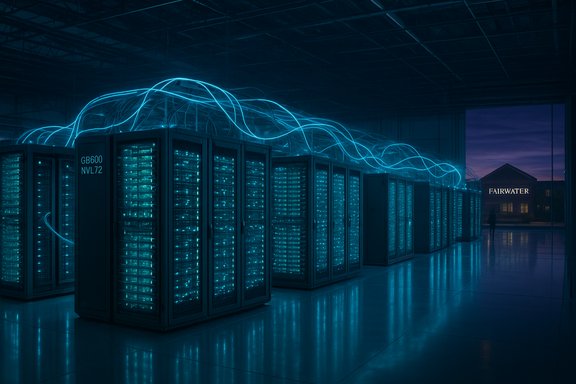
Microsoft has flipped the switch on what it calls an “AI superfactory” — a purpose‑built, rack‑scale Azure installation powered by NVIDIA’s latest Blackwell Ultra GB300 family that stitches thousands of GB300 NVL72 racks into a single production fabric and sets a public target to scale to hundreds of thousands of GPUs across Microsoft’s AI datacenters.
Microsoft’s announcement frames the new program as a fundamental shift in cloud infrastructure: move from generalized, multi‑tenant datacenters to specialized AI campuses engineered to behave like single, tightly coupled supercomputers. The flagship site — branded Fairwater and located in Mount Pleasant, Wisconsin — is described as a multi‑building, 315‑acre campus with about 1.2 million square feet under roof and construction metrics typically measured in miles of fiber, tens of millions of pounds of steel, and bespoke utility plants. At the hardware level Microsoft exposed a production cluster containing more than 4,600 NVIDIA GB300 NVL72 systems (arithmetic commonly reported as roughly 64 NVL72 racks × 72 GPUs = ~4,608 GPUs) and published a roadmap to expand this rack‑first architecture to hundreds of thousands of Blackwell‑class GPUs across Azure regions. The public exposure of the GB300 class in Azure appears as the ND GB300 v6 VM family for customers and partners. This is not a simple SKU refresh — it is a co‑engineered stack that binds NVIDIA’s GB300 NVL72 rack design, a next‑generation InfiniBand fabric (Quantum‑X800 / ConnectX‑8 class), Azure’s storage and scheduler rework, liquid cooling at scale, and new power procurement models intended to make continuous, large‑job training and inference practically affordable and reliable.
Practical implications include:
Source: Seeking Alpha Microsoft fires up 'AI superfactory' powered by hundreds of thousands of Nvidia GPUs (MSFT:NASDAQ)
 Background / Overview
Microsoft’s announcement frames the new program as a fundamental shift in cloud infrastructure: move from generalized, multi‑tenant datacenters to specialized AI campuses engineered to behave like single, tightly coupled supercomputers. The flagship site — branded Fairwater and located in Mount Pleasant, Wisconsin — is described as a multi‑building, 315‑acre campus with about 1.2 million square feet under roof and construction metrics typically measured in miles of fiber, tens of millions of pounds of steel, and bespoke utility plants. At the hardware level Microsoft exposed a production cluster containing more than 4,600 NVIDIA GB300 NVL72 systems (arithmetic commonly reported as roughly 64 NVL72 racks × 72 GPUs = ~4,608 GPUs) and published a roadmap to expand this rack‑first architecture to hundreds of thousands of Blackwell‑class GPUs across Azure regions. The public exposure of the GB300 class in Azure appears as the ND GB300 v6 VM family for customers and partners. This is not a simple SKU refresh — it is a co‑engineered stack that binds NVIDIA’s GB300 NVL72 rack design, a next‑generation InfiniBand fabric (Quantum‑X800 / ConnectX‑8 class), Azure’s storage and scheduler rework, liquid cooling at scale, and new power procurement models intended to make continuous, large‑job training and inference practically affordable and reliable. What Microsoft actually deployed: the verifiable technical picture
The building block: GB300 NVL72 rack
- 72 NVIDIA Blackwell Ultra GPUs per rack and 36 NVIDIA Grace‑family CPUs that act as the host and memory fabric for the rack.
- Pooled “fast memory” on the order of ~37–40 TB per rack (HBM combined with CPU‑attached memory exposed in the rack domain).
- Intra‑rack NVLink bandwidth of roughly 130 TB/s, delivering an all‑to‑all low‑latency domain so the rack behaves like a single, huge accelerator rather than a loose cluster of servers.
- FP4 Tensor Core performance in the 1,100–1,440 PFLOPS range per rack in vendor‑quoted metrics (precision and sparsity assumptions apply).
The cluster fabric and scale-out
Microsoft uses an 800 Gbps‑class InfiniBand fabric (NVIDIA Quantum‑X800 / ConnectX‑8 family) to stitch racks into pods and pods into larger clusters. The fabric choice is essential for synchronous large‑model training because it minimizes the communication overhead of exchanging gradients and activations across massive numbers of GPUs. Microsoft’s blog and Azure’s technical brief explicitly call out the Quantum‑X800 fabric and the goal of near‑linear scale‑out for large collective operations.Facility engineering: cooling, power, and storage
- Closed‑loop liquid cooling is used for the majority of compute to handle the extreme heat density of NVL72 racks while limiting freshwater use. Microsoft describes outside‑building heat rejection loops and other measures to minimize evaporative water consumption.
- Custom power delivery and pre‑paid utility arrangements are highlighted as ways to avoid local rate shocks while guaranteeing the firm capacity these clusters need. Microsoft has stated investment figures in the billions for the Wisconsin campus and an additional multi‑billion pledge to expand capacity in the same state.
- Storage re‑architecture to feed GPUs at high sustained throughput — Azure says Blob and object stacks were reworked to reduce I/O stalls and to operate at multi‑gigabyte‑per‑second levels for training data.
Why the architecture matters: rack-as-accelerator and the new bottlenecks
Treating the rack as the primary accelerator is the defining architectural pivot. When 72 GPUs are collapsed into an NVLink domain with tens of terabytes of pooled memory, training and inference workloads that previously required fragile sharding tricks or multi‑host synchronizations can run with much higher efficiency and lower latency.Practical implications include:
- Longer context windows and larger KV caches for reasoning models because larger working sets can remain resident in the fast memory envelope.
- Faster iteration cycles: Microsoft and NVIDIA claim training timelines for frontier models can drop from months to weeks when compute, memory, and network bottlenecks are removed. These claims, while plausible, depend heavily on model architecture, software parallelization, and dataset I/O patterns.
- New software and orchestration demands: schedulers, failure‑tolerance logic, and model‑parallel libraries must evolve to operate across rack domains and across multi‑site fabrics without introducing wear‑leveling or throughput cliffs.
Verifying the headline claims: what’s solid and what needs nuance
- Claim: “More than 4,600 GB300 NVL72 systems are in a single Azure cluster.”
- Verified: Microsoft’s ND GB300 v6 announcement and Azure blog explicitly state “more than 4,600” GB300 NVL72 deployments and the NDv6 GB300 exposure. Independent coverage reconstructs the arithmetic to ~4,608 GPUs. This assertion is verifiable against both Microsoft and NVIDIA product pages.
- Claim: “Microsoft will scale to hundreds of thousands of Blackwell Ultra GPUs across Azure.”
- Context: Microsoft publicly states a scaling intent and roadmap; this is a corporate strategic target rather than a contemporaneous inventory figure. It reflects an aggressive multi‑year capex plan and supply agreements but should be read as a strategic ambition rather than an immediately realized fleet size. Multiple Microsoft posts and press reports describe the plan; independent verification of the ultimate tally will require future capacity disclosures.
- Claim: “Fairwater delivers 10× the performance of the world’s fastest supercomputer.”
- Nuance: Microsoft frames the performance claim specifically for AI training throughput on purpose‑built hardware and not against generic HPC benchmarks like LINPACK. Because performance multipliers depend on precision formats (e.g., FP4/FP8), sparsity assumptions, and workload characteristics, the “10×” statement is metric dependent and requires careful benchmarking context. Vendor‑quoted exascale numbers use AI precisions and in‑network primitives that cannot be directly compared to older HPC FLOPS metrics without those caveats.
- Claim: “Per‑rack NVLink = ~130 TB/s; fast memory ≈ 37–40 TB; per‑rack FP4 TFLOPS ~1.1–1.44 PFLOPS.”
- Verified: These figures appear consistently in NVIDIA documentation and Microsoft’s technical briefs; they are vendor‑provided specs. Independent reporting reproduces these numbers. It is appropriate to treat them as vendor specifications, subject to measurement and precision caveats.
Strategic implications for Microsoft, NVIDIA, OpenAI and the wider cloud market
Microsoft: product and go‑to‑market
Owning the physical substrate for frontier AI gives Microsoft a meaningful, tangible advantage: tighter product integration for Copilot and Azure AI services, privileged throughput and lower effective cost per token for enterprise customers that choose Azure, and a public handhold to anchor its partnership with OpenAI. The ND GB300 v6 SKU signals Microsoft’s intent to offer not just capacity but frontier‑grade capability as an Azure product.NVIDIA: the single‑vendor vector
NVIDIA’s GB300 and the Quantum‑X800 fabric are central to the design. That creates a high‑stakes dependency: GB300 NVL72 becomes a common substrate for hyperscalers and model builders, increasing NVIDIA’s influence on pricing, supply allocation, and architectural direction. The industry benefit is rapid progress and interoperability; the risk is vendor concentration that can affect pricing and availability globally.OpenAI and model developers
For organizations training very large models or operating inference at scale, the availability of rack‑scale NVL72 clusters in the public cloud may lower barriers — enabling experiments that were previously limited to bespoke research supercomputers. That will accelerate model experimentation and also concentrate frontier model deployments with a few hyperscalers.Risks, trade‑offs and watchdog items
Energy, environmental, and local grid impacts
Massive GPU farms consume city‑scale power. Microsoft’s public materials emphasize closed‑loop cooling and matched carbon‑free energy procurement, including pre‑paid utility arrangements to avoid local rate shifts. Those commitments are significant, but practical grid reliability often depends on firming resources and storage; replacing or firming fossil capacity at scale requires time and capital. Sustainability claims should be treated as process claims that require transparent third‑party validation over time.Supply chain and geopolitical concentration
Concentrated demand for GB300/Blackwell GPUs increases exposure to supply constraints, export controls, and geopolitical risk. When the next generation of accelerator is controlled by a single or small set of vendors, hyperscalers and cloud customers face materially increased vendor negotiation leverage and potential single‑point supply shocks. Microsoft’s multi‑vendor and third‑party agreements (e.g., systems integrators, external GPU providers) are an attempt to diversify short‑term capacity risk, but structural vendor concentration remains a systemic market factor.Centralization of frontier compute and governance
When a handful of companies operate the majority of frontier capacity, control over who can train and deploy the most capable models becomes more centralized. This has benefits for safety and oversight (fewer gates to monitor and secure) but raises questions about market access, competition, and the potential for asymmetric regulatory pressure. Policymakers and companies will need clear governance, transparency, and robust security controls around model access and export.Operational complexity and reliability
Running at this scale requires novel operational tooling — not just for scheduler or network telemetry but for firmware, spare parts, liquid cooling leakage detection and multi‑site orchestration. The failure modes of exascale rack fabrics are different from prior cloud fleets; Microsoft’s operational playbook will be an important test case for whether hyperscalers can keep ultra‑dense racks fully productive without unacceptable reliability penalties.What this means for IT pros, developers and WindowsForum readers
- If you build large models or use inference at scale: Azure’s ND GB300 v6 offerings will be the first broadly visible public cloud route to GB300 rack‑scale compute. Expect to see early access programs and priority throughput arrangements for strategic partners. Evaluate whether your model training and inference stacks can exploit NVLink‑based memory pooling and whether your parallelization strategy maps to the rack‑first topology.
- For enterprise architects: The existence of repeatable AI factories makes it realistic to target near‑real‑time agentic systems and long‑context reasoning workflows in production. However, lock‑in risk increases with deeper dependence on a single cloud and GPU family. Plan hybrid strategies and multi‑region failover if continuity is critical.
- For Windows developers and hobbyists: This announcement won’t change the average desktop workflow tomorrow, but the downstream effects will matter: faster model iteration at hyperscale will accelerate the release cadence of features that eventually show up in productivity apps and services integrated with Windows. Expect Copilot and Azure‑backed features to leverage larger, more capable models sooner.
Short, practical checklist for teams evaluating ND GB300 v6 or similar offerings
- Inventory current models and identify which would materially benefit from:
- Larger pooled memory per job (tens of TB).
- Lower cross‑device latency (for reasoning/attention heavy models).
- Higher FP4/FP8 compute throughput efficiency.
- Run a cost/benefit analysis that includes:
- Raw cloud invoice + data egress.
- Developer time saved via faster iteration.
- Potential vendor lock‑in and migration costs.
- Validate software readiness:
- Does your parallelization framework (e.g., Megatron‑style sharding, tensor/pipe parallelism) support NVL72 rack domains?
- Test end‑to‑end I/O performance with representative datasets to avoid GPU idling.
- Confirm compliance and governance needs:
- Who manages model weights and training logs?
- What data residency and export controls apply to your projects?
- Prepare an energy and availability contingency plan if you require guaranteed throughput during model launches.
Deeper reading and how to watch the rollout
Microsoft’s Azure technical announcement, Microsoft’s Fairwater and On the Issues posts, and NVIDIA’s GB300 NVL72 product pages are the canonical vendor documents to follow for specification changes and availability announcements. Independent industry coverage and infrastructure press will be the best way to see validated benchmarks and real customer case studies as the ND GB300 v6 SKU gains adoption. Early independent reports and technical briefings already reproduce the key rack math and vendor numbers, but they also stress the importance of workload‑specific measurement before assuming identical gains across different model classes.Conclusion
Microsoft’s public launch of a rack‑first GB300 NVL72 production cluster and the Fairwater AI campus signals a concrete pivot in hyperscale datacenter design: the cloud is being industrialized for AI in the same way factories were industrialized for manufacturing. The technical strengths are clear — unprecedented intra‑rack bandwidth, massive pooled memory, and a purpose‑built fabric that lets very large models train and infer with drastically improved efficiency. At the same time, the move crystallizes several systemic risks: energy and environmental trade‑offs that require transparent verification, vendor concentration around a single GPU/fabric vendor, geopolitical exposure in global supply chains, and governance questions about centralization of frontier compute. These are not theoretical concerns — they are immediate, practical priorities that enterprises, regulators, and technologists must address as the industry scales. For WindowsForum readers and practitioners, the arrival of AI “superfactories” means faster model capability improvements will reach consumer and enterprise applications sooner — but it also means being deliberate about where and how you consume and depend on hyperscale AI infrastructure. The next year will be decisive: vendor claims will give way to operational experience, benchmark results, and the first wave of production models trained and served at this new scale.Source: Seeking Alpha Microsoft fires up 'AI superfactory' powered by hundreds of thousands of Nvidia GPUs (MSFT:NASDAQ)
