

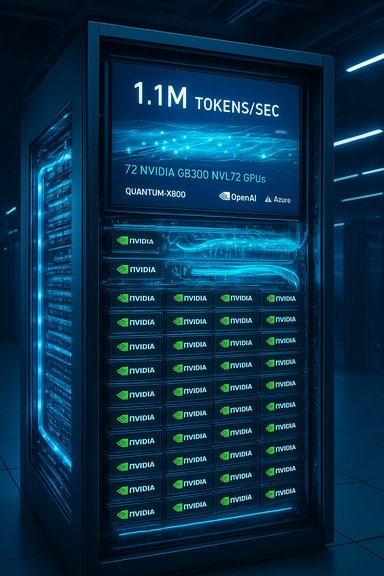
Microsoft Azure has demonstrated an industry-record inference throughput — 1.1 million tokens per second from a single GB300 NVL72 rack built on NVIDIA’s Blackwell Ultra GPUs — a milestone Microsoft says underscores deep co‑engineering with NVIDIA and the new ND GB300 v6 VM family for large-scale reasoning workloads.
Microsoft and NVIDIA have delivered a showcase of what rack‑scale engineering can do for large‑model inference. For traders and technologists alike, this is both an exciting capability inflection and a reminder that durable advantage comes from confirmed adoption, not alone from single benchmark milestones.
Source: Blockchain News Microsoft Azure sets 1.1M tokens per second record on GB300 GPUs with NVIDIA; implications for MSFT, NVDA, BTC and ETH | Flash News Detail
 Background
What was announced, in plain terms
Microsoft’s public brief describes the ND GB300 v6 virtual machines as the Azure packaging of NVIDIA’s GB300 NVL72 rack platform: a liquid‑cooled rack containing 72 Blackwell Ultra GPUs and 36 NVIDIA Grace CPUs, tied together with a high‑bandwidth NVLink switch fabric and Quantum‑X800 InfiniBand for pod‑level scale‑out. Microsoft reports that one such NVL72 rack achieved an aggregated ~1,100,948 tokens/sec running an MLPerf‑style Llama 2 70B inference workload, which calculates to roughly 15,200 tokens/sec per GPU.Why tokens/sec matters
Tokens per second (TPS) is the practical currency of inference: higher TPS directly translates to the ability to serve more concurrent users, reduce latency under heavy load, and lower cost per answered query in production. For conversational AI, retrieval‑augmented generation (RAG), and multi‑step agentic systems, sustainable TPS is a first‑order capacity metric. MLPerf’s Llama 2 70B benchmark is now widely used as a proxy for large‑model inference performance, giving context to vendor claims.Technical anatomy: how Azure hit 1.1M tokens/sec
Rack‑as‑accelerator architecture
The defining architecture here is rack‑as‑accelerator: rather than exposing many discrete servers, each NVL72 rack is presented as a single coherent accelerator domain with pooled fast memory and an NVLink/NVSwitch internal fabric. That design reduces cross‑host synchronization and preserves large KV caches inside low‑latency HBM‑class memory, which is precisely what long‑context and reasoning models require. Azure’s descriptions and independent technical coverage emphasize pooled fast memory in the high tens of terabytes (commonly cited around ~37 TB per rack) and NVLink intra‑rack bandwidth in the ~130 TB/s range.Software and numeric formats
Achieving these kinds of throughput gains is not just hardware — it relies on software stack improvements: optimized runtimes (e.g., TensorRT‑LLM), attention‑layer offloads, in‑network collective primitives, and quantized numeric formats such as FP4/NVFP4 that reduce memory footprint while keeping accuracy high. Vendors report the benchmark used TensorRT‑LLM optimizations and FP4 precision to reach the published numbers. These tradeoffs are typical in MLPerf‑style high‑throughput submissions.What the 1.1M number represents — and what it doesn’t
The recorded 1.1M tokens/sec is an aggregated inference throughput measured under a specific benchmark setup (Llama 2 70B in an MLPerf‑style configuration, using vendor optimizations). Benchmarks are useful proof points, but they are not turn‑key guarantees of identical real‑world performance. End‑to‑end systems add retrieval, storage, pre/post‑processing, and network tails that reduce user‑perceived throughput. Independent observers and vendor briefings note this result was observed in a controlled, production‑grade Azure environment and validated by an external lab (Signal65), but enterprise customers should expect lower end‑to‑end throughput when including retrieval and storage I/O.Verification and caveats: what’s confirmed, what’s vendor claim
- Confirmed technical primitives: NVIDIA’s GB300 NVL72 rack design (72 GPUs + 36 Grace CPUs), the NVLink intra‑rack fabric, and Quantum‑X800 interconnect appear in vendor product pages and independent reporting. These hardware specifications are stable and documented.
- Verified benchmark observation: Multiple independent industry outlets reported the 1.1M tokens/sec measurement and the involvement of Signal65 as a validator; Microsoft provided logs and a breakdown of runs in vendor materials. That convergence gives the claim credibility as a benchmark observation.
- Claims requiring caution: Statements about having the “world’s first at‑scale GB300 NVL72 cluster” or precise global GPU counts (e.g., “more than 4,600 GPUs” aggregated across racks) are marketing‑grade and should be treated as vendor‑stated until independently auditable inventories and third‑party audits are published. Several independent analyses urge customers to demand auditable SLAs and performance isolation guarantees before assuming identical production behavior.
Why this matters: systems engineering and product implications
For cloud customers and product teams
- Lower cost per token: If per‑rack throughput increases materially, operators can deliver equivalent user concurrency with fewer racks, lowering raw infrastructure cost and simplifying scheduling for the largest models.
- Longer practical context windows: More pooled fast memory per logical accelerator reduces the need to shard KV caches across hosts, enabling longer contexts or larger in‑memory caches per request.
- Simpler sharding and less brittle orchestration: Rack‑level coherence reduces the engineering overhead of sharding transformer layers across many hosts, which improves reliability and developer productivity for large‑model deployments.
These are concrete product advantages for enterprises building large‑scale conversational agents, RAG pipelines, or multi‑agent systems.
Operational tradeoffs
- Power and cooling: NVL72 racks are liquid‑cooled and demand significant power (per‑rack figures reported in vendor materials). Expect higher up‑front capital and site engineering costs for deployment at scale.
- Vendor lock‑in risk: Much of the architecture relies on NVIDIA‑specific interconnects (NVLink/NVSwitch), middleware, and optimized runtimes. Porting finely tuned models to different fabrics or vendors requires substantial reengineering.
- Supply concentration: Hyperscalers’ reliance on a single vendor’s rack‑scale design amplifies supply and geopolitical risk; customers should evaluate multi‑cloud or hybrid strategies where appropriate.
Market implications for Microsoft (MSFT) and NVIDIA (NVDA)
NVDA: infrastructure demand and competitive positioning
NVIDIA is the hardware anchor of this milestone — the GB300 Blackwell Ultra family is the core enabler of the 1.1M tokens/sec result. Practical market impacts:- Demand uplift: Azure’s demonstrated performance is likely to drive enterprise and hyperscaler demand for GB300/Blackwell Ultra capacity and associated networking (Quantum‑X800, ConnectX‑8). Multiple outlets report that Blackwell Ultra improves inference throughput materially over GB200/Hopper generations.
- Revenue and margin leverage: Continued hyperscaler procurement tends to show up in NVIDIA’s data‑center revenue lines in subsequent quarters. Strong performance narratives can reinforce premium pricing for rack‑scale solutions and Drive partner margins.
- Concentration and scrutiny: As demand concentrates on a single architecture, antitrust, export control, and supply chain scrutiny can intensify — a long‑term strategic risk despite near‑term demand strength.
- Focus on relative valuation and earnings‑cycle exposure rather than single headlines. Infrastructure milestones historically produce sentiment spikes; however, these are often followed by profit‑taking.
- Watch NVIDIA’s supply guidance, datacenter revenue trends, and OEM order flow for confirmatory signals.
MSFT: Azure differentiation and revenue mix
- Cloud differentiation: Demonstrating production‑grade GB300 capacity strengthens Azure’s product narrative for enterprise AI workloads, potentially improving Azure’s competitive posture versus other hyperscalers on large‑model inference SLAs.
- Revenue exposure: Gains are likely to trickle through via higher‑value managed AI offerings, premium enterprise contracts, and more attractive SLAs for high‑concurrency inference.
- Strategic alignment with OpenAI: Continued co‑investment with OpenAI and other partners can deepen Azure’s sticky revenue base, but it also deepens operational coupling and exposure to partner strategies.
- For equity investors, judge news value relative to the market’s expectations. Much of the market already prices ongoing hyperscaler investments in GPU infrastructure; the marginal impact depends on scale, monetization cadence, and margin mix.
- Volatility around AI feature announcements usually increases near earnings and product release windows; options markets can price expected moves. Institutional investors should watch sequential cloud revenue and data‑center margin disclosures.
Crypto markets: what this means for BTC, ETH and AI tokens
Direct vs. indirect channels
AI infrastructure milestones affect crypto markets primarily through sentiment and capital‑flow channels, not through direct technical links. There are three channels to consider:- Sentiment spillover: Positive AI headlines often create a broader "risk‑on" environment, which can flow into high‑beta assets including certain cryptocurrencies and AI‑focused tokens. Historically, AI sector rallies have sometimes coincided with elevated interest in AI‑themed crypto tokens.
- Sector rotation and ETF flows: Heavy inflows into AI equities can lead to portfolio rebalancing that increases or decreases allocations to digital assets; correlation strength varies over time. Market research has shown periods of elevated correlation between Nvidia and Bitcoin, though that relationship is not static and has narrowed at times.
- On‑chain activity: If AI enables new dApps (e.g., agentic trading bots, on‑chain AI marketplaces), that could increase gas usage on networks like Ethereum and lift short‑term activity metrics, but product adoption timelines are distinct from infrastructure deployment timelines. Reports show AI‑related on‑chain interest can lift volumes for tokens like Fetch.ai (FET) and Render (RNDR), though these moves are typically more volatile and speculative than stock moves.
Specific token outlooks (qualitative)
- Fetch.ai (FET) and Render (RNDR): These projects have explicit AI/compute narratives and often trade on news about GPU availability or major cloud partnerships. Positive AI infrastructure headlines can spark speculative interest; however, price reactions are typically short‑lived and accompanied by elevated on‑chain and centralized exchange volumes. Past spikes in AI token prices were often driven by narrative momentum rather than durable on‑chain adoption.
- Bitcoin (BTC) and Ethereum (ETH): These behave more like macro risk assets in the context of AI headlines. Strong risk‑on sentiment can lift BTC/ETH, but the relationship is indirect and mediated by macro liquidity, ETF flows, and crypto‑specific events. Historical correlation between NVDA equity moves and BTC has been observed, but it fluctuates and is not a reliable timing tool on its own.
- Use on‑chain metrics (active addresses, TVL, gas fees) as leading indicators for real adoption in AI‑related dApps.
- Treat AI token rallies as event‑driven and manage position sizing accordingly; volatility and liquidity risk are higher than for major coins.
- Cross‑market signals (e.g., large institutional equity inflows into AI ETFs) may precede crypto moves, but causality is noisy.
Trading strategies and risk controls for equities and crypto
For NVDA/MSFT equities
- Monitor earnings updates and NVIDIA’s supply guidance for concrete confirmation of sustained demand.
- Watch implied volatility and options skews around quarterly reporting dates — use calendar spreads or collars to limit downside while capturing upside from AI headlines.
- Avoid relying on single‑announcement extrapolations; build conviction with sequential, confirmatory signals (order books, supply chain OEM reports, datacenter capex disclosures).
For AI tokens and crypto
- Use liquidity screens and volume confirmation before entering positions — elevated social buzz without volume often precedes sharp reversals.
- Consider pairs trades (long AI token / short crypto index) to isolate idiosyncratic AI sentiment from broader crypto beta.
- Apply strict stop losses and position limits: AI token rallies are frequently high‑variance and prone to quick reversals when broader sentiment shifts.
Technical indicators to follow
- RSI and volume surges to detect overbought conditions on headline‑driven rallies.
- 50/200‑day moving average crossovers for trend confirmation on equities.
- On‑chain activity metrics (unique active wallets, gas fees, DEX volume) as leading indicators for token adoption.
Strategic takeaways for CIOs and infrastructure leads
- Treat vendor benchmarks as directional evidence: they prove what’s technically possible under engineered conditions, but customers must benchmark representative workloads in their environment.
- Insist on auditable SLAs and performance isolation clauses if deploying mission‑critical inference services on a hyperscaler.
- Evaluate topology awareness in software: container orchestration, scheduler placement, and NVLink locality matter. Applications must be designed to exploit rack‑level coherence to realize the advertised throughput gains.
Final assessment: opportunity and risk
Microsoft’s 1.1M tokens/sec claim — validated in multiple independent writeups and accompanied by vendor documentation — represents a material upward shift in what public‑cloud AI infrastructure can deliver for inference workloads. The milestone is meaningful for enterprises building at scale: it reduces the number of racks required for a given QPS, eases the engineering burden of cross‑host sharding, and enables larger working sets inside a single coherent domain. At the same time, this is a benchmarked achievement rather than a turnkey guarantee for every production workload. Operational friction — power, cooling, software porting, and vendor lock‑in — remains, and the claim about being “first” at scale or exact cluster counts should be read as vendor messaging pending independent audits. Investors and infrastructure buyers should prize verification over headlines and prioritize defensible SLAs and benchmarking on representative workloads before committing to large migrations.Microsoft and NVIDIA have delivered a showcase of what rack‑scale engineering can do for large‑model inference. For traders and technologists alike, this is both an exciting capability inflection and a reminder that durable advantage comes from confirmed adoption, not alone from single benchmark milestones.
Source: Blockchain News Microsoft Azure sets 1.1M tokens per second record on GB300 GPUs with NVIDIA; implications for MSFT, NVDA, BTC and ETH | Flash News Detail
