

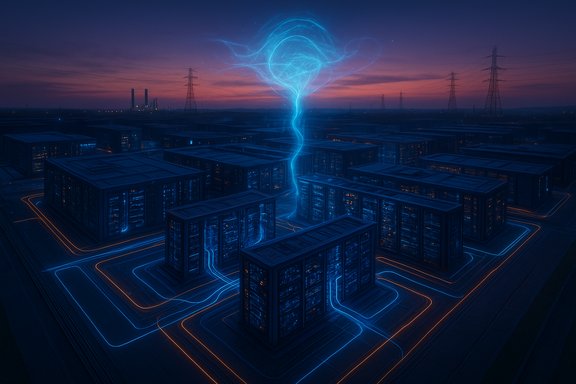
Microsoft’s move from software giant to a vertically integrated infrastructure powerhouse has crossed a threshold: Azure is now being architected as a purpose-built utility for industrial-scale AI, with implications that ripple across technology, energy, regulation, and geopolitics.
The last two years have turned generative AI from a research curiosity into a demand tsunami that is reshaping cloud economics. Hyperscalers responded by redesigning their clouds to favor the economics of inference — the steady, high-frequency execution of trained models — rather than the once-dominant emphasis on episodic model training. Microsoft, through an aggressive program of custom silicon development, massive data-center expansion, and strategic energy procurement, is executing the most visible and capital-intensive version of that strategy.
Key elements of this industry inflection include the rise of first-party AI accelerators, the reorientation of data-center design for liquid cooling and ultra-high rack density, and the emergence of multi‑gigawatt energy contracts tied directly to cloud operators. Over the last year, Microsoft has consolidated many of these trends into a single narrative: Azure as an AI "utility" that delivers inference at the scale and price point enterprises require.
That said, claims about precise performance improvements — for example, single-digit to tens-of-percent gains in performance-per-watt from second‑generation Maia chips — are plausible given general trends in custom‑silicon adoption, but specific numbers reported in market commentary (e.g., a 40% improvement) should be treated as vendor or analyst estimates until validated in independent benchmark releases or official disclosure.
Two corollaries follow:
Microsoft’s agreements to source firm, carbon‑free power for data‑center clusters — including long‑term deals tied to nuclear restarts in the U.S. northeast — are emblematic of this shift. Those deals provide a guaranteed, high‑quality power supply that supports 24/7 inference workloads and, importantly, reduce the company’s exposure to volatile spot-market power pricing.
This compute‑energy nexus will shape the geography of AI infrastructure: states and regions that can offer grid capacity, permitting efficiencies, and industrial-scale clean power packages will be the winners for future super-factory deployments.
The key features attributed to the initiative include:
Regulators are examining not only market share but also control over data flows, contractual terms for customers, and cross-ownership arrangements among infrastructure providers and model owners. The larger and more interdependent the ecosystem — for example, consortia involving model developers, silicon vendors, and cloud operators — the more likely policymakers are to probe for competitive harms.
Microsoft and other hyperscalers are already pursuing regional variants and controlled-deployment models to balance commercial reach with regulatory compliance. The result will be a hybrid topology: global hyperscale regions linked to a mosaic of sovereign hubs.
But the plan carries material risks. The economics hinge on continued enterprise adoption of agentic AI at scale, successful and timely rollout of second‑generation custom silicon, and the smooth execution of large, geographically concentrated energy projects. Several headline numbers and consortium arrangements reported in market commentary reflect ambitious targets and early-stage commitments; some are confirmed by corporate disclosures, while others remain industry reporting or analyst estimates and should therefore be regarded as provisional.
Operationally, Microsoft appears to be playing a high‑stakes, capital‑intensive game: the combination of custom chips, NVIDIA partnerships for the bleeding‑edge GPU capacity, and firm energy contracts is intended to lock in a durable competitive advantage. If the company can sustain execution without catastrophic delivery, the payoff is an enduring position as the infrastructure backbone for enterprise AI.
At the same time, the speed, scale, and concentration of that transformation raise important questions about competition, resilience, and governance. The industry is entering a period where physical infrastructure decisions will shape not only commercial outcomes but also national economic strategy and regulatory policy.
For enterprises and investors, the short‑to‑medium horizon will be decisive: CapEx-to-revenue metrics, sustained reductions in per‑inference cost, and transparent execution on energy and chip roadmaps will determine whether Microsoft’s Silicon Fortress becomes a durable utility or an expensive experiment in scale. Until the next wave of official benchmarks and audited financial disclosures arrive, some of the largest claims about scale and performance should be read with cautious optimism rather than treated as settled fact.
Source: FinancialContent https://markets.financialcontent.co...es-its-dominance-in-the-enterprise-cloud-war/
 Background
The last two years have turned generative AI from a research curiosity into a demand tsunami that is reshaping cloud economics. Hyperscalers responded by redesigning their clouds to favor the economics of inference — the steady, high-frequency execution of trained models — rather than the once-dominant emphasis on episodic model training. Microsoft, through an aggressive program of custom silicon development, massive data-center expansion, and strategic energy procurement, is executing the most visible and capital-intensive version of that strategy.Key elements of this industry inflection include the rise of first-party AI accelerators, the reorientation of data-center design for liquid cooling and ultra-high rack density, and the emergence of multi‑gigawatt energy contracts tied directly to cloud operators. Over the last year, Microsoft has consolidated many of these trends into a single narrative: Azure as an AI "utility" that delivers inference at the scale and price point enterprises require.
The Architecture of Dominance
Custom silicon and the new hardware stack
Custom silicon has moved from optional optimization to strategic necessity. Microsoft’s in‑house chips — initially revealed as the Maia accelerator and the Arm-based Cobalt CPU — were designed to reduce per‑token inference costs and to enable denser, more power-efficient server designs. Building chips in-house delivers two powerful levers:- Control over the hardware roadmap and tighter integration with Azure’s software stack.
- The ability to optimize performance-per-watt for inference workloads, which is the single largest operating cost for massive AI deployments.
That said, claims about precise performance improvements — for example, single-digit to tens-of-percent gains in performance-per-watt from second‑generation Maia chips — are plausible given general trends in custom‑silicon adoption, but specific numbers reported in market commentary (e.g., a 40% improvement) should be treated as vendor or analyst estimates until validated in independent benchmark releases or official disclosure.
Data centers built for inference
Legacy cloud regions were designed around balanced, multi‑purpose servers. The new generation of AI-optimized regions looks different: high-density racks packed with GPU/accelerator arrays, specialized power distribution systems, and facility-level design choices (substation upgrades, water treatment for cooling circuits, and redundant direct power feeds) that prioritize continuous, high‑load operation.Two corollaries follow:
- Data-center economics shift from space-and-network to power-and-cooling as dominant constraints.
- Providers with the ability to build or secure multi‑gigawatt power packages gain a structural advantage.
Energy procurement: the compute‑energy nexus
Compute without cheap, reliable power is impossible at scale. The new battleground is energy procurement. Long-term, firm power purchase agreements (PPAs), and in some high-profile cases nuclear restarts or large-scale hydrogen / fusion experiments, are being positioned as strategic assets in the AI race.Microsoft’s agreements to source firm, carbon‑free power for data‑center clusters — including long‑term deals tied to nuclear restarts in the U.S. northeast — are emblematic of this shift. Those deals provide a guaranteed, high‑quality power supply that supports 24/7 inference workloads and, importantly, reduce the company’s exposure to volatile spot-market power pricing.
This compute‑energy nexus will shape the geography of AI infrastructure: states and regions that can offer grid capacity, permitting efficiencies, and industrial-scale clean power packages will be the winners for future super-factory deployments.
Project Stargate and the Era of Mega‑Consortia
What Project Stargate represents
Project Stargate — as described in public reporting and industry briefings — is an audacious, multi-stakeholder initiative to build a series of hyperscale AI infrastructure hubs with multi‑hundred‑billion-dollar investment horizons. It draws in hardware vendors, cloud operators, and sovereign investors, and promises an unprecedented concentration of compute capacity.The key features attributed to the initiative include:
- A multi‑phase roll‑out with an initial tranche of capital targeted at immediate buildouts and a multi‑year plan to scale to tens of gigawatts.
- Consortium governance that mixes private capital sponsors and strategic technology partners.
- A stated objective to secure national leadership in AI compute while accelerating commercial capacity for foundation-model providers.
The implications of a private “AI superfactory”
If a single consortium can marshal hundreds of billions in private capital to build the physical and energy infrastructure for AI, the industry will see a step change in capacity centralization. That has three major consequences:- Rapid scaling of compute for extremely large models and sustained high-throughput inference, lowering effective per‑query costs.
- Tight coupling of core model developers to a smaller set of infrastructure providers, increasing commercial leverage for those providers.
- Regulatory and geopolitical attention, because physical concentration of AI compute invites scrutiny similar to utilities, telecommunications hubs, and other critical infrastructure.
Winners, Losers, and the New Supply Chain Topography
Immediate beneficiaries
- Nvidia: GPU demand remains the single highest-cost line item for AI operations. Nvidia’s recent GPU architectures (the Blackwell family in industry nomenclature) are the performance backbone for both training and inference clusters. Close partnerships with hyperscalers make Nvidia a primary beneficiary of expanded Azure deployments and consortium-level projects.
- Infrastructure specialists: Vendors of liquid cooling systems, modular rack designs, and high-density power distribution (companies in the thermal and critical-infrastructure sector) have seen order books and multi‑year contracts expand rapidly.
- Regional economies: Localities that secure large data-center projects — especially when paired with long-term energy deals — stand to gain jobs, tax base, and supply‑chain investment.
Under pressure
- Smaller cloud providers: The economics of custom silicon, bespoke power deals, and hyperscale facilities create a high barrier to entry for smaller clouds and colocation providers. Competing on price/performance for inference workloads without similar scale becomes increasingly difficult.
- Legacy hardware vendors: Companies that remain reliant on off‑the‑shelf CPU or GPU supply without deep partnerships to secure future chip allocations face rising costs and procurement uncertainty.
- Rivals in public cloud: Amazon Web Services and Google Cloud are technologically sophisticated and have their own strategies, but Microsoft’s deep enterprise distribution, combined with aggressive CapEx, creates immediate competitive pressure in enterprise AI contracts.
The Inference Inflection Point: How Enterprise Spending Shifts
From training to ubiquitous inference
The industry’s near-term revenue pool is migrating. Model training — episodic, expensive, and capital‑intensive — creates headline risk and marketing splash, but inference represents recurring, day‑to‑day spending by enterprises. As more knowledge workers and systems rely on AI agents and copilots, inference becomes the dominant, predictable line item in cloud bills.- Inference workloads are characterized by extremely high request counts and lower marginal compute per request compared with training.
- Scaling inference efficiently requires hardware and software co‑design to keep per‑call latency and cost acceptable at enterprise scale.
Agentic AI and enterprise adoption
“Agentic AI” — autonomous multi-step agents that can perform complex business processes — is an adoption vector that multiplies inference demand. Enterprise pilots that once called for isolated model queries now generate continuous, multi-threaded agent interactions integrated with back-office systems. The result: predictable, platform-level revenue streams and higher per-customer lifetime value for providers that can guarantee scale and reliability.Capital Intensity, Financials, and the Investor View
CapEx as strategy
Massive capital expenditure is the trade-off for building a blue-water advantage. Microsoft’s fiscal programs have shown CapEx at historical highs as the company prioritizes AI-ready infrastructure. For investors, the core metrics to watch are:- CapEx-to-revenue ratio — how much capital is being invested to generate each incremental dollar of revenue.
- Margins on AI services — whether per-query economics improve as custom silicon and scale effects kick in.
- Bookings and multi‑year commercial commitments — indicators of long-term demand visibility.
Return horizons and risk
Investors face a multi-year horizon: the full payoff of infrastructure investments may not be visible in quarterly results for several fiscal cycles. Compounding the risk are:- Delivery slippage on chip and facility rollouts.
- Energy procurement delays or political backlash to nuclear and large-scale power projects.
- Regulatory interventions that alter competitive dynamics or force structural changes.
Regulation, Sovereignty, and the Risk of Monoculture
Antitrust and “gatekeeper” scrutiny
Consolidation of the intelligence layer — where a small set of platforms host models, provide APIs, and manage inference at scale — invites antitrust and regulatory attention. The parallels to historical utility monopolies are relevant: once a platform controls essential inputs to commerce, governments often consider special regulatory status or structural remedies.Regulators are examining not only market share but also control over data flows, contractual terms for customers, and cross-ownership arrangements among infrastructure providers and model owners. The larger and more interdependent the ecosystem — for example, consortia involving model developers, silicon vendors, and cloud operators — the more likely policymakers are to probe for competitive harms.
Sovereign clouds and the data-localization trend
In response to concentration concerns and national-security considerations, governments are accelerating plans for “Sovereign AI Clouds” — localized infrastructure built with domestic partners and governed by national rules on data residency, model access, and auditing. The economic logic is straightforward: governments want critical AI infrastructure onshore, under local legal jurisdiction.Microsoft and other hyperscalers are already pursuing regional variants and controlled-deployment models to balance commercial reach with regulatory compliance. The result will be a hybrid topology: global hyperscale regions linked to a mosaic of sovereign hubs.
Constraints and Critical Risks
The Energy Wall
The single most immediate bottleneck for massive AI scale is power. Building chips and racks is necessary but meaningless if grid interconnection or firm power contracts lag. Nuclear restarts, grid upgrades, and long-term PPAs can take years and face permitting, community, and financing hurdles. If energy supply growth cannot keep pace with chip deployments, the industry will hit a hard ceiling that far outweighs other supply-chain constraints.Supply chain and silicon production
Custom silicon reduces dependence on commodity GPUs but introduces its own risks: yield issues, fabrication delays, and the need to secure advanced packaging and memory technologies. Programmatic delays in next‑generation chips are common and can compress expected efficiency gains into later quarters.Concentration risk and systemic failure modes
When compute capacity is concentrated into a small number of physical sites and consortiums, the systemic impact of outages or policy blockades increases. A major outage at one of these hubs, or the imposition of export controls, could have outsize effects on downstream enterprises that have become dependent on those services.What to Watch Next
Short-term (next 6–12 months)
- Progress on the second‑generation of custom accelerators and their real‑world performance-per-watt results.
- Trajectory of enterprise uptake of agentic AI workflows and the percent of Azure’s revenue attributable to inference vs. training.
- The status of multi‑gigawatt PPA executions and any local opposition or regulatory hurdles tied to major energy projects supporting data centers.
Medium-term (12–36 months)
- Execution and financing details from mega‑consortium projects and whether they convert announced targets into deployed capacity.
- Regulatory responses in major markets (U.S., EU) to platform concentration, including antitrust inquiries or proposed “common carrier” rules for AI infrastructure.
- The emergence and scale of Sovereign AI Clouds and how they affect enterprise vendor selection.
Long-term (3+ years)
- Whether per‑unit inference costs decline enough to democratize agentic AI beyond hyperscale customers.
- The maturation of alternative architectures (e.g., memory-centric accelerators, 3D DRAM inference engines) that could shift the vendor landscape.
- The net effect of compute and energy concentration on innovation — whether centralization accelerates model capability or creates fragility in the ecosystem.
Assessment: Strengths, Weaknesses, and Strategic Takeaways
Microsoft’s strategy combines a set of mutually reinforcing strengths: deep enterprise distribution for software and services, heavy capital commitment to AI‑ready infrastructure, tight product integration across Azure and Copilot offerings, and an energetic push into energy procurement. These elements create a high barrier to entry for competitors and position Azure as a leading platform for enterprise AI deployments.But the plan carries material risks. The economics hinge on continued enterprise adoption of agentic AI at scale, successful and timely rollout of second‑generation custom silicon, and the smooth execution of large, geographically concentrated energy projects. Several headline numbers and consortium arrangements reported in market commentary reflect ambitious targets and early-stage commitments; some are confirmed by corporate disclosures, while others remain industry reporting or analyst estimates and should therefore be regarded as provisional.
Operationally, Microsoft appears to be playing a high‑stakes, capital‑intensive game: the combination of custom chips, NVIDIA partnerships for the bleeding‑edge GPU capacity, and firm energy contracts is intended to lock in a durable competitive advantage. If the company can sustain execution without catastrophic delivery, the payoff is an enduring position as the infrastructure backbone for enterprise AI.
Conclusion
The move to treat compute as a strategic, utility‑like asset is the defining trend of the Industrial AI Era. Microsoft’s investments — in custom silicon, purpose‑built data centers, and firm energy — articulate a clear vision for Azure as the operating substrate of enterprise intelligence. That vision matters because it reframes how businesses will buy AI: not as a set of isolated projects but as a continuous, platform-level service that runs the day‑to‑day processes of organizations.At the same time, the speed, scale, and concentration of that transformation raise important questions about competition, resilience, and governance. The industry is entering a period where physical infrastructure decisions will shape not only commercial outcomes but also national economic strategy and regulatory policy.
For enterprises and investors, the short‑to‑medium horizon will be decisive: CapEx-to-revenue metrics, sustained reductions in per‑inference cost, and transparent execution on energy and chip roadmaps will determine whether Microsoft’s Silicon Fortress becomes a durable utility or an expensive experiment in scale. Until the next wave of official benchmarks and audited financial disclosures arrive, some of the largest claims about scale and performance should be read with cautious optimism rather than treated as settled fact.
Source: FinancialContent https://markets.financialcontent.co...es-its-dominance-in-the-enterprise-cloud-war/
