

Microsoft’s announcement that an Azure blueprint tailored for UK public-sector requirements can shrink the time to deploy secure cloud workloads from “weeks to hours” is more than a marketing line: it bundles policy-as-code, compliance mappings and deployment templates that codify the UK government’s cloud security expectations and make repeatable, auditable Azure environments easier to create. The move ties Azure Blueprints to the UK OFFICIAL and NHS control mappings and ships a GitHub template and messaging infrastructure guidance—while also calling out the availability of Service Bus Premium in UK regions—giving public organizations a formally documented, machine-actionable starting point for cloud migration.
Azure Policy can operate in two modes: audit (report-only) and deny (enforce). A sensible migration path is to first deploy with audit policies to surface drift and configuration gaps, then move to deny policies as teams mature their pipelines and operational processes.
For teams running hybrid networks, the provided template includes configuration for secure connectivity patterns—ExpressRoute or well-secured VPNs, Private Link / Private Endpoints, and network segmentation artifacts—so web-facing workloads can be bounded and access controlled. The template approach encourages standard naming, tagging and subscription design, which are crucial for operations, billing and security automation.
At the same time, the blueprint is not a substitute for rigorous assurance and operational discipline. Shared responsibility, contractual clarity, tested continuity plans and well-managed identity and audit processes remain the axes on which public sector trust is built. Use the blueprint to accelerate the routine parts of cloud setup, but keep assurance, legal review and staged testing at the heart of any production rollout. With that balance, public organisations can legitimately capture the speed gains Microsoft promises while maintaining the control and assurance demanded by sensitive and regulated services.
Source: BetaNews Microsoft Azure Blueprint helps public organizations move faster to the cloud
 Background
What is Azure Blueprints and why it matters for the public sector
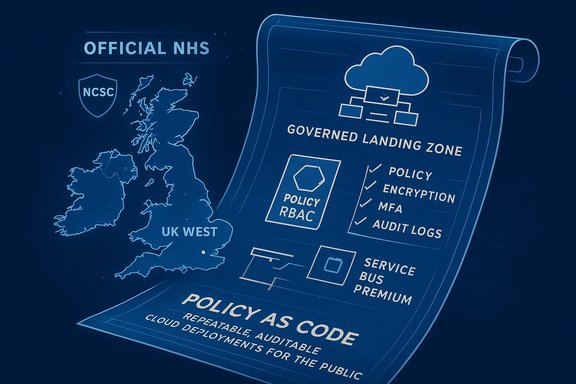
Azure Blueprints is a governance service that packages resource templates, Azure Policy assignments, role-based access control (RBAC) settings and resource groups into a single, reusable definition that can be applied to subscriptions. It’s designed to deliver repeatable, governed landing zones so that organizations can spin up production-ready environments that already implement required security controls and configuration guardrails. Microsoft has used this service to produce compliance-focused blueprints—mapping platform controls to regulatory checks and standards—so that customers in regulated sectors can accelerate compliance work. For the UK public sector this is explicitly important because the National Cyber Security Centre’s (NCSC) 14 Cloud Security Principles form the baseline expectations for cloud procurement and operation. Mapping Azure’s native controls to those principles helps procurement teams and security assessors understand where responsibility lies and how the platform addresses specific requirements such as encryption, identity, auditability and operational resilience. The Microsoft blueprint claims to map a core set of policies to the UK OFFICIAL and NHS control frameworks, making compliance-focused patterns available as code rather than checklists.The announcement and the core elements
The public write-ups around the blueprint highlight a few concrete elements:- UK OFFICIAL and UK NHS blueprint mappings that assign Azure Policy definitions to specific NCSC/G-Cloud and NHS controls (for example: audits for insecure storage connections, cryptography enforcement, MFA and privileged account monitoring).
- A UK Official template published on GitHub that scaffolds a hybrid-capable environment—extending on-prem networks into Azure and providing a preconfigured, secure landing zone.
- Service Bus Premium Messaging availability in Microsoft’s UK data centers, offering dedicated-resources, predictable messaging throughput and higher message size limits for mission-critical integrations.
- Public statements from Microsoft’s UK Azure leadership framing the release as evidence of Microsoft’s emphasis on “security, trust and flexibility” for public and hybrid cloud solutions.
Overview of the UK OFFICIAL / NCSC alignment
The 14 Cloud Security Principles in practice
The NCSC’s 14 Cloud Security Principles are not prescriptive configuration lists; they are outcome-oriented expectations: protect data in transit, ensure asset resilience, maintain separation between users, operate secure administration and provide audit information to users, among others. For public bodies, these principles are used both during procurement (to evaluate providers) and during operational assurance. Microsoft’s blueprint maps several of these principles to Azure Policy and other platform controls—so an assessor can see, for example, which policy audits for missing endpoint protection or enforces cryptographic strength. That mapping reduces the interpretive work done by both supplier and buyer and can materially shorten the assurance timeline.What the blueprint automates
The UK OFFICIAL blueprint provides a set of policy assignments, role definitions, and deployment artifacts that:- Enforce or audit encryption settings for storage and compute.
- Limit resources to UK regions when required for residency.
- Flag or deny insecure configuration patterns (eg: public storage endpoints).
- Assign baseline monitoring and log retention settings to enable audit trails.
- Configure identity and privileged access controls including conditional access and MFA checks.
Technical deep dive
Azure Policy, Blueprints and infrastructure-as-code
Azure Blueprints bundles Azure Resource Manager templates, policy assignments and RBAC settings. When a blueprint is assigned to a subscription, Azure evaluates and enforces the embedded policies. For public-sector uses that means compliance checks become part of provisioning rather than post-deployment audits.Azure Policy can operate in two modes: audit (report-only) and deny (enforce). A sensible migration path is to first deploy with audit policies to surface drift and configuration gaps, then move to deny policies as teams mature their pipelines and operational processes.
For teams running hybrid networks, the provided template includes configuration for secure connectivity patterns—ExpressRoute or well-secured VPNs, Private Link / Private Endpoints, and network segmentation artifacts—so web-facing workloads can be bounded and access controlled. The template approach encourages standard naming, tagging and subscription design, which are crucial for operations, billing and security automation.
Service Bus Premium: what it brings to public workloads
Service Bus Premium is the enterprise-tier messaging service that isolates compute and memory resources through messaging units, delivers predictable throughput, supports message sizes up to 100MB and offers improved SLAs, partitioning and geo-disaster recovery options. For public-sector workloads—where integration between systems, event-driven processing and latency-sensitive message pipelines are common—the premium tier reduces variability and provides isolation from noisy neighbors. Microsoft specifically called out Service Bus Premium availability in UK regions as part of the package.Regional residency and UK data centres
Azure’s UK regions—UK South (London) and UK West (Cardiff)—have been generally available since 2016 and are the logical locations for UK OFFICIAL workloads when onshore data residency is required. Running blueprints in UK regions simplifies regulatory and procurement conversations; it also reduces latency for local users and makes it easier to commit to “data at rest in the UK” assertions. That said, residency claims are contractual and operational: customers must validate backups, failover and replication behavior to ensure copies of data do not unintentionally leave the jurisdiction.Critical analysis: strengths, limits, and risks
Notable strengths
- Time-to-value compression: Prebuilt blueprints convert policy and architecture decisions into deployable artifacts. For organizations starting a migration programme, that can shave weeks off the setup and governance phase by reducing manual policy implementation and documentation work. Microsoft’s claim of hours vs. weeks reflects the reality that templated provisioning and compliance mappings can accelerate the initial environment creation.
- Repeatability and auditability: Infrastructure-as-code artifacts (ARM templates/Bicep/Terraform) combined with policy-as-code ensure deployments are consistent and auditable. That is especially important in environments required to demonstrate repeatable controls during procurement and audits.
- Alignment with UK standards: By mapping Azure controls to the NCSC/G-Cloud and NHS frameworks, the blueprint reduces ambiguity during assurance reviews and helps buyer organisations focus on residual risks rather than debating baseline platform capabilities.
- Regional support and performance: Service Bus Premium availability in UK regions and the presence of UK datacentres provide the infrastructure foundation for data residency and low-latency integrations.
Key risks and practical limits
- Shared responsibility remains: The platform may ship with policy assignments and recommended configurations, but the customer is still responsible for application-level security, data classification, secure coding, identity lifecycle and operational runbooks. Blueprints reduce setup work but do not absolve organizations of the ongoing operational controls required by the NCSC and NHS guidance. This is the fundamental shared-responsibility model the NCSC also emphasises.
- “Hours instead of weeks” is conditional: The marketing shorthand glosses over real-world complexity. For simple greenfield services the blueprint can indeed shrink setup times. But for brownfield migrations—large estates, legacy identity systems, third-party integrations, regulatory constraints and bespoke network topologies—the time saved will be smaller and the heavy lifting of migration, testing and assurance remains. Treat speed claims as an accelerant, not an eradicator, of complexity.
- Misconfiguration and policy gaps: The effectiveness of a blueprint depends on the quality of the policies and whether they are applied properly. Default templates may use audit-mode policies where denial is required, or leave optional settings unset. Organizations must validate each control and raise the policy enforcement level only after testing. Over-reliance on defaults without verification is a common cause of later non-compliance.
- Procurement, legal and data sovereignty nuance: Running resources in a UK region simplifies residency claims but does not replace contractual assurances about personnel access, key management, logs and cross-border backups. Procurement teams must still insist on contractual specifics—where encryption keys are stored and managed, what logging access Microsoft or its sub-processors have, and what the egress/replication policies are under disaster scenarios. These are legal and operational questions that templates cannot automate.
- Cost and operational overheads: Premium tiers, messaging units and hardened environments add predictable but non-trivial costs. Service Bus Premium’s dedicated resources yield performance guarantees but increase base charges. Public organisations must bake FinOps disciplines and cost governance into their rollout plans to avoid unexpected operating expenses.
- Supply-chain and third-party risk: The blueprint may reference third-party tools (eg: threat modelling utilities, monitoring integrations) that introduce their own supply-chain risks. The NCSC’s principles call out supply-chain security explicitly; implementers should require third-party attestations and articulate supplier responsibilities clearly.
Practical recommendations for public-sector adopters
Verify, test, and iterate—don’t ingest blindly
- Assess and baseline: Start with a formal mapping exercise: confirm which NCSC principles your selected blueprint covers, and where gaps remain. Use audit-mode policies initially to generate a baseline of non-compliant resources before you switch to deny-mode.
- Run a constrained pilot: Deploy the blueprint to a small, representative subscription and run a full assurance cycle: penetration test, policy drift analysis, SIEM integration and recovery exercises. Validate that backups and geo-replication behave as your policy and contracts require.
- Lock down identity and privileged access: Enforce least privilege, conditional access, and strong MFA for privileged roles. Use Privileged Identity Management (PIM) or just-in-time access patterns to reduce standing privileges. The blueprint can scaffold these controls, but teams must operationalize access reviews and emergency access processes.
- Use private connectivity for critical flows: Where data exchange involves sensitive records, prefer ExpressRoute / private peering, Private Link and VNet Service Endpoints over internet-exposed endpoints. Ensure network egress and inspection rules are consistent with your data transfer policies.
- Integrate to logging and SIEM: Configure audit log retention, centralised logging and threat-hunting playbooks (for example: Microsoft Sentinel or another SIEM). The NCSC expects customers to have audit information that enables detection and response. The blueprint’s audit policies are a starting point; iterate on alerts, retention and playbooks.
- Define exit and continuity plans: Ensure data exportability, key handover and breach response are contractual obligations. Don’t assume the template covers long-term continuity: vendors’ failover and geo-DR behavior must be validated and documented.
- Cost governance: Model the cost impact of premium services and messaging units in your financial planning. Tag environments and enable FinOps reporting to track consumption across pilot and production phases.
- Contractual and legal verification: Procurement must verify the Microsoft compliance documentation and assert requirements for data access, personnel screening where necessary and right-to-audit clauses. Templates speed technical deployment; contracts and data processing agreements finalize legal cover.
A suggested phased adoption plan
- Inventory and risk classification (what data and systems will move).
- Choose the appropriate Azure Blueprint sample (UK OFFICIAL / NHS) and run in audit mode.
- Deploy pilot landing zone to UK region and integrate with logging and identity.
- Execute assurance tests (pen test, backup recovery, failover).
- Harden and move policies from audit→deny where safe.
- Scale to production subscriptions with CI/CD templates, monitoring and FinOps guardrails.
- Embed continuous compliance—automated drift detection, periodic penetration testing, and regular reviews tied to policy changes or new guidance.
Verification notes and caveats
The core claims in the original BetaNews coverage mirror Microsoft’s own Azure blog and UK Stories posts: the UK OFFICIAL blueprint maps Azure resources to key NCSC/NHS controls and a GitHub template is provided to speed deployments; Service Bus Premium was highlighted as available in Microsoft’s UK data centers as part of the rollout. These claims are verifiable in Microsoft’s public materials and documentation for Azure Blueprints and Service Bus Premium. However, the practical pace of migration (hours vs. weeks) depends on the customer context: greenfield vs brownfield, existing identity complexity, legacy integrations and contractual requirements. Treat declarative speed claims as demonstrable under specific, prepared conditions and validate them in a pilot. For public-sector organisations that require additional sovereignty or personnel-screening assurances, Azure Government and other sovereign deployments offer additional contractual and physical isolation options; these differences are material to procurement and security assessments. Public organisations should therefore pair any blueprint-based technical work with procurement-level verification of contractual guarantees and personnel access policies.Conclusion
Azure Blueprints that map platform controls to the UK OFFICIAL and NHS frameworks are a meaningful step toward faster, more repeatable cloud adoption for public bodies. By codifying policy, identity and deployment patterns and offering regionally available messaging infrastructure, Microsoft gives public-sector IT teams a documented, machine-actionable starting point for migration and modernisation. The benefits—reduced manual configuration, clearer audit artefacts and predictable messaging infrastructure—are real and can shorten the path to authorisation and operation.At the same time, the blueprint is not a substitute for rigorous assurance and operational discipline. Shared responsibility, contractual clarity, tested continuity plans and well-managed identity and audit processes remain the axes on which public sector trust is built. Use the blueprint to accelerate the routine parts of cloud setup, but keep assurance, legal review and staged testing at the heart of any production rollout. With that balance, public organisations can legitimately capture the speed gains Microsoft promises while maintaining the control and assurance demanded by sensitive and regulated services.
Source: BetaNews Microsoft Azure Blueprint helps public organizations move faster to the cloud
