

Microsoft’s public tracking and multiple security vendors point to a serious elevation‑of‑privilege vulnerability in Azure’s confidential container offerings — documented in public reporting under CVE‑2026‑21522 — but the specific identifier CVE‑2026‑26124 named in the prompt does not appear in vendor or independent feeds I can verify, so defenders should prioritize confirmed advisories while treating any mismatched CVE references with caution. tps://www.crowdstrike.com/content/crowdstrike-www/locale-sites/us/en-us/blog/patch-tuesday-analysis-february-2026.html)
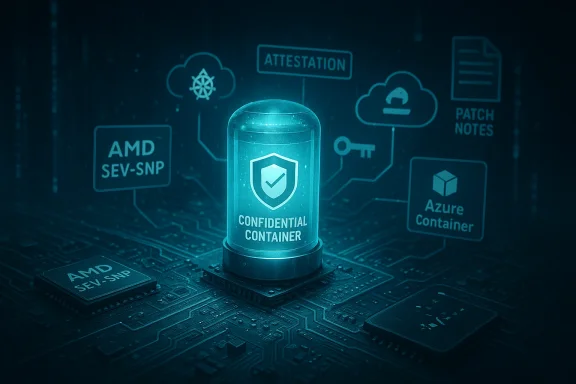
Confidential containers are an evolution in cloud security that combine container orchestration with hardware‑backed Trusted Execution Environments (TEEs) — for example AMD SEV‑SNP or Intel TDX — to provide stronger runtime confidentiality and integrity guarantees than ordinary containers. Azure supports confidential container scenarios in Azure Container Instances (ACI) and as an option for Azure Kubernetes Service (AKS) node pools, and Microsoft’s design emphasizes attested runtimes, minimal trusted computing bases, and cryptographically verifiable imes. These features are specifically intended to protect secrets, models, and sensitive processing inside an enclave against a compromised host or hypervisor.
That architectural promise — strong isolation between guest workloads and host or co‑tenants — is why vulnerabilities that allow privilege escalation from inside a confidential guest to host resources are materially urgent. When isolation fails, confidential computing guarantees can collapse: keys, secrets, and tenant‑specific data that were assumed protected may be exposed or abused.
Key technical points observed across independent reports:
Best practice for operators:
Conclusion
Confidential containers materially raise the bar for protecting sensitive cloud workloads, but they also concentrate risk when implementation errors occur. Whether the advisory you referenced is numbered CVE‑2026‑26124 or the publicly triaged CVE‑2026‑21522, the practical steps are the same: verify vendor KBs, patch quickly, rotate secrets, harden provisioning and CI systems, and deploy focused detection hunts for host‑side interactions that should never originate from an attested enclave. If you need a tailored remediation playbook for your Azure subscription mapping or help building automated detection rules for EDR and cloud audit logs, prepare the inventory (subscription IDs, AKS/ACI versions, and RBAC mappings) and the security operations runbook — that data will let you convert this generic response into a prioritized, low‑noise action plan.
Source: MSRC Security Update Guide - Microsoft Security Response Center
 Background
Confidential containers are an evolution in cloud security that combine container orchestration with hardware‑backed Trusted Execution Environments (TEEs) — for example AMD SEV‑SNP or Intel TDX — to provide stronger runtime confidentiality and integrity guarantees than ordinary containers. Azure supports confidential container scenarios in Azure Container Instances (ACI) and as an option for Azure Kubernetes Service (AKS) node pools, and Microsoft’s design emphasizes attested runtimes, minimal trusted computing bases, and cryptographically verifiable imes. These features are specifically intended to protect secrets, models, and sensitive processing inside an enclave against a compromised host or hypervisor.That architectural promise — strong isolation between guest workloads and host or co‑tenants — is why vulnerabilities that allow privilege escalation from inside a confidential guest to host resources are materially urgent. When isolation fails, confidential computing guarantees can collapse: keys, secrets, and tenant‑specific data that were assumed protected may be exposed or abused.
What the public record actually shows (and what it doesn’t)
- Multiple reputable vendors and Patch‑Tuesday summaries report an ACI Confidential Containers elevation‑of‑privilege entry cataloged as CVE‑2026‑21522, assigning a CVSS base score in the mid‑range but flagging it as critical in operational terms due to the confidential computing context. These writeups describe command‑injection or improper input neutralization in ACI’s confidential runtime path as the core impact vector.
- Community tracking and vendor summaries mirrored in Windows/Cloud security feeds likewise call out CVE‑2026‑21522 for Azure Container Instances Confidential Containers and recommend immediate remediation and restricted access until patches are applied.
- The exact identifier CVE‑2026‑26124, however, does not show up in the vendor‑of‑record mirrors I can access, and a direct fetch of Microsoft’s Security Update Guide interactive page for that CVE can fail to render without JavaScript. That absence in independent reporting and security vendor triage suggests either (a) the CVE number in your prompt is a transcription error, (b) the CVE exists only as a short‑lived internal tracking tag that Microsoft has not widely mirrored, or (c) the MSRC entry is present but not indexed by third‑party feeds yet. Until Microsoft’s interactive advisory or other authoritative feeds publish matching content, defenders must treat the 26124 label as unverified and base operational action on the confirmed CVE entries and vendor KBs. (msrc.microsoft.com)
Technical summary of the confirmed issue (CVE‑2026‑21522, reflected in public reporting)
Public technical summaries reported by security vendors (and summarized in Patch‑Tuesday reviews) describe the root cause as inadequate sanitization or improper handling of command/exec paths inside the confidential container host/runtime layer. In practice, the reported class of flaw allows an attacker with code execution inside a confidential guest to influence command processing and cause command execution in a context that can affect host‑side resources or break the enclave boundary.Key technical points observed across independent reports:
- The flaw arises in the ACI confidential runtime path — not the TEE hardware itself — making it an implementation bug rather than an intrinsic TEE vulnerability. That distinction matters for remediation and exploitability assessment.
- Exploitation requires some level of code or command execution inside the confidential guest. In other words, an attacker must already have a foothold inside the container to escalate. However, in multi‑tenant or CI/CD scenarios where workloads process untrusted artifacts, that prerequisite is feasible for determined attackers.
- Successful exploitation can allow the attacker to execute commands with greater privileges than the containerized workload’s original context, and — crucially for confidential containers — to influence or read host‑side resources that were assumed unreachable. That includes possible exposure of secret material, attestation bypass, or artifact tampering.
Why the MSRC “confidence” metric matters for operators
Microsoft’s Security Update Guide typifies vendor advisories that pair an impact classification with a confidence metric: how sure the vendor is that the vulnerability exists and how much technical detail they disclose publicly. This metric is operationally important:- Low confidence + thin public detail: treat as actionable alert but not fully explained. You should prioritize inventory and monitoring rather than assuming immediate exploitability.
- High confidence + public exploit references: treat as urgent patch and hunt — deploy patches quickly and hunt for indicators of compromise.
Risk analysis: real world impact scenarios
The business impact of a container breakout in a confidential environment can be disproportionate relative to the CVSS score:- Secrets exposure: Confidential containers commonly store or handle encryption keys, signing keys, or sensitive model weights that are decrypted only inside the enclave. A breakout can disclose those assets to an attacker.
- Tenant compromisation: In multi‑tenant cloud setups, a successful escalation from one tenant’s guest to the host or neighboring guest resources could enable cross‑tenant data theft. The Azure service model and per‑cluster isolation should minimize this, but implementation bugs are the primary attack vector.
- Supply‑chain and CI/CD abuse: Confidential containers are attractive for signing and build processes. If an attacker can alter build artifacts inside a confidential runtime or sign misbuilt packages, the integrity of downstream supply chains is at risk.
- Attestation/measurement bypass: If an attacker can manipulate attestation flows, they may be able to present a compromised image as “trusted” to the orchestrator or policy engine.
Detection: what to look for (practical indicators)
Detecting exploitation attempts or successful privilege escalation related to confidential containers requires layered telemetry:- Container host audit logs: Watch for unexpected exec/syscall patterns from confidential runtime processes, particularly any calls that originate from enclaved guest contexts but interact with host‑side device nodes or management sockets.
- Orchestrator events: Surges in failed attestation requests, unexpected attestation measurement mismatches, or forced redeploys shortly after se suspicious.
- Credential use and IMDS access: Monitor any unexpected attempts to access instance metadata or managed identities from within confidential guests. Unexpected token acquisition or early rotation events can be an indicator.
- EDR signatures and heuristic rules: Look for process spawning patterns where guest processes trigger host‑side command interpreters or manipulation of privileged volumes.
- Network telemetry: Lateral movement attempts originating from confidential container traffic, or unusual egress to command and control endpoints after presumed privilege changes.
Immediate mitigation and patching guidance (operational playbook)
- Inventory: Identify all Azure subscriptions and resource groups that run Azure Container Instances (ACI) Confidential Containers or AKS confidential node pools. Map them to build/version details.
- Vendor mapping: Confirm the exact CVE→KB mapping for your deployed SKUs and ACI runtime versions in Microsoft’s Security Update Guide before mass patching. Do not rely on third‑party CVE labels where mismatch is suspected. (msrc.microsoft.com)
- Patch: Apply any Microsoft updates or runtime patches Microsoft publishes for the confidential container components. If your environment uses managed services (AKS), follow the AKS node pool upgrade paths recommended by Microsoft.
- Limit privileges: Immediately reduce the number of users or service principals with admin access to confidential container provisioning or runtime control planes. Enforce least privilege policies for any accounts that can create or modify confidential container groups.
- Rotate secrets and keys: For any workload that used confidential containers for key handling or signing within the time window of the advisory, rotate secrets after you patch. Treat any long‑lived credentials stored in or provisioned to affected containers as potentially exposed.
- Harden CI/CD runners: Ensure build runners that use confidential instances are patched and reduce the use of untrusted inputs. Sanitize artifacts and enforce strong mutability/artifact immutability rules.
- Regenerate policies: If your deployment process includes CCE or confidential compute policies (e.g., infrastructure SVN/versioning or policy fragments), regenerate them to match vendor guidance and minimum recommended SVN levels.
- Monitor & hunt: Initiate a targeted hunt for the indicators listed above. Prioritize hosts and namespaces with high‑value secrets and signing roles.
- Communication: Notify stakeholders and customers (internal or external) that you have applied patches and rotated keys as needed. Document timelines and what was rotated so you can demonstrate due diligence.
- Post‑incident capture: If you find evidence of exploitation, preserve forensic images of the affected VMs/hosts — including enclave attestation records — and engage vendor incident response where appropriate.
Longer‑term engineering and platform lessons
This class of vulnerability highlights two recurring engineering challenges in confidential computing platforms:- Implementation surface vs. hardware assurances: TEEs reduce the trusted surface, but the host/runtime code that integrates with TEEs remains a critical attack surface. Rigorous code review, fuzzing, and memory‑safe implementation techniques are essential for runtime components that cross TEE boundaries.
- Operational visibility vs. confidentiality: Confidential containers intentionally limit some runtime interrogations (e.g., no trivial exec into the guest), making detection harder. Vendors and operators must design for secure observability — exposing attestation events, sanitized metrics, and tamper‑evident logs without breaking confidentiality guarantees.
- Patchability and policy management: Confidential compute environments must provide clear, auditable policies for attestation and runtime measurements, and also a practical upgrade path that preserves attestation continuity during rolling updates.
Where public reporting is inconsistent: verifying the CVE you received
You provided a Microsoft Security Update Guide link referencing CVE‑2026‑26124. I attempted to load the vendor page directly, but the MSRC interactive site requires JavaScript to render and may not be fully indexed by third‑party search engines; independent triage feeds I queried return no corroborating entries for CVE‑2026‑26124. At the same time, several independent vendors and Patch‑Tuesday analyses are consistent in reporting CVE‑2026‑21522 for ACI Confidential Containers. This divergence likely reflects a naming mismatch or a transient indexing gap.Best practice for operators:
- Always map the MSRC entry to the exact KB and update package(s) for the SKUs you manage before deploying automated remediation. The MSRC entry is the authoritative vendor record, but interactive pages can be opaque; use the KB mapping shown in the Security Update Guide to avoid CVE‑to‑package mismatches. (msrc.microsoft.com)
- Ct two independent security vendors (enterprise blogs, Patch‑Tuesday analyses) when a CVE label appears without technical detail. Where those vendors report a different CVE (e.g., 21522), treat their corroboration as an important signal.
- Flag unverifiable CVE identifiers in internal communications. If your ticketing and compliance systems require CVE IDs, record the vendor KB and internal tracking ID alongside the public CVE to avoid confusion.
Attack surface reduction checklist for confidential container operators
- Enforce image signing and strict image policy measurement (reject images without attested measurement).
- Avoid running multi‑tenant workloads on a single cluster without explicit tenant separation.
- Disallow privileged containers and reduce CAP_SYS_ADMIN exposures for confidential workloads.
- Centralize attestation logs and configure long‑term retention for attestation and policy audits.
- Rotate secrets regularly and bind secret lifetimes to attestation epochs where possible.
- Harden onboarding scripts and CI pipelines to minimize the chance that untrusted inputs reach confidential workloads.
Final assessment and recommended priorities
- Immediate action: Treat Azure Confidential Containers privilege escalation reports as high‑priority. Confirm the CVE→KB mapping in Microsoft’s Security Update Guide and apply the vendor patches for your affected ACI or AKS confidential components as soon as you can schedule safe updates.
- Hunt and mitigation: Rotate secrets used by workloads in sensitive or signing roles and start a structured hunt for the indicators described above. Reduce privileges for anyone who can provision or modify confidential container runtime policy.
- Clarify the CVE mismatch: If your organization or compliance processes specifically reference CVE‑2026‑26124, open a vendor support ticket with Microsoft to request definitive mapping and KB correlation; do not assume equivalence without vendor confirmation. While the operational urgency is clear, accurate CVE mapping is essential for auditability and post‑incident reporting. (msrc.microsoft.com)
- Engineering roadmap: Treat this incident as a prompt to invest in secure observability for confidential runtimes, to adopt memory‑safe languages and fuzzing for runtime glue code, and to formalize policy regeneration and attestation‑driven secret rotation as routine operational controls.
Conclusion
Confidential containers materially raise the bar for protecting sensitive cloud workloads, but they also concentrate risk when implementation errors occur. Whether the advisory you referenced is numbered CVE‑2026‑26124 or the publicly triaged CVE‑2026‑21522, the practical steps are the same: verify vendor KBs, patch quickly, rotate secrets, harden provisioning and CI systems, and deploy focused detection hunts for host‑side interactions that should never originate from an attested enclave. If you need a tailored remediation playbook for your Azure subscription mapping or help building automated detection rules for EDR and cloud audit logs, prepare the inventory (subscription IDs, AKS/ACI versions, and RBAC mappings) and the security operations runbook — that data will let you convert this generic response into a prioritized, low‑noise action plan.
Source: MSRC Security Update Guide - Microsoft Security Response Center
