

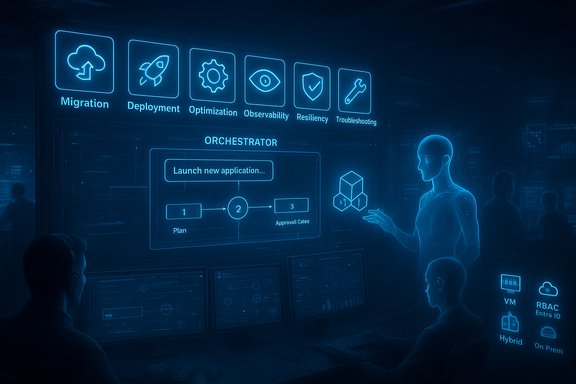
Microsoft’s latest push to make Copilot an operational partner — not just an assistant — marks a clear inflection point: Azure Copilot is being extended with a family of specialized agents and an orchestration layer that together promise to automate major parts of the cloud lifecycle for DevOps and SecOps teams. The preview bundles six purpose-built agents (Migration, Deployment, Optimization, Observability, Resiliency and Troubleshooting), an orchestrator that translates natural‑language intent into agent workflows, and a unified Operations Center that surfaces agent plans, suggestions and execution telemetry in a single pane.
Azure’s agent strategy is the next evolution of Copilot: moving beyond chat and single‑turn help into agentic automation — autonomous, policy‑aware services that can plan, act and collaborate while remaining auditable and governed. Microsoft packages this as part of an end‑to‑end stack that includes Copilot Studio for authoring, Azure AI Foundry and Azure AI Agent Service for runtime and scale, and identity/governance integrations (Entra Agent IDs, Purview, RBAC) to manage agent life cycles. This strategy folds together multiple prior investments — Copilot in Azure, Copilot Studio, GitHub Copilot modernization features and Azure Migrate’s agentic capabilities — into a single operational story: agents specialized by domain, a Model Context Protocol (MCP) and agent-to-agent protocols for interoperability, and an orchestrator that selects and coordinates agents to achieve the user’s intent.
Recommended posture for IT leaders:
Microsoft’s announcements show an ambitious, platform‑level push: agents that can plan and act, an orchestrator that reasons about intent, and an operations dashboard designed to make agent activity visible and auditable. The technical building blocks — Copilot Studio, Azure AI Foundry, Agent Service, MCP and Entra Agent IDs — are in place, but the real work for customers starts now: disciplined pilots, governance integration and rigorous testing before delegating critical infrastructure changes to autonomous agents. End of article.
Source: Emegypt Unveiling Azure Copilot’s New Agents Revolutionizing DevOps and SecOps Automation
 Background / Overview
Azure’s agent strategy is the next evolution of Copilot: moving beyond chat and single‑turn help into agentic automation — autonomous, policy‑aware services that can plan, act and collaborate while remaining auditable and governed. Microsoft packages this as part of an end‑to‑end stack that includes Copilot Studio for authoring, Azure AI Foundry and Azure AI Agent Service for runtime and scale, and identity/governance integrations (Entra Agent IDs, Purview, RBAC) to manage agent life cycles. This strategy folds together multiple prior investments — Copilot in Azure, Copilot Studio, GitHub Copilot modernization features and Azure Migrate’s agentic capabilities — into a single operational story: agents specialized by domain, a Model Context Protocol (MCP) and agent-to-agent protocols for interoperability, and an orchestrator that selects and coordinates agents to achieve the user’s intent. What Microsoft announced (the new agent family)
The six domain agents (what they are built to do)
- Migration Agent — automated discovery, dependency mapping and modernization guidance for moving IaaS workloads to PaaS or container platforms.
- Deployment Agent — natural‑language infrastructure planning and automated provisioning that encodes best practices and tradeoffs.
- Optimization Agent — cost, performance and sustainability recommendations; can propose and emit ready‑to‑run scripts to implement savings.
- Observability Agent — correlates metrics, logs and alerts, runs background investigations and surfaces prioritized root‑cause hypotheses.
- Resiliency Agent — validates redundancy, backup and recovery posture, and simulates recovery plans and readiness checks.
- Troubleshooting Agent — produces guided root‑cause analysis and remediation steps across VMs, Kubernetes clusters and data platforms.
The orchestrator: natural language → agent choreography
A central orchestrator interprets conversational intent, maps it to one or more agents and constructs a plan — a sequence of steps that are visible to the operator before execution. The orchestrator applies policy checks (RBAC/Azure Policy), enforces approval gates, logs actions under the initiating user’s identity, and manages artifact persistence (with tenant‑controlled BYOS options). This design is intended to keep humans in the loop while enabling multi‑step autonomous actions.Operations Center and Agent Mode
The Operations Center (a unified Operations dashboard) consolidates agent findings, running plans, observability signals and action history in one location. Agent Mode is a plan‑first UX that shows what an agent will do: intermediate artifacts, approval checkpoints and a rollback story. The goal is transparent execution — agents should be auditable, reversible and explainable before they change production state.How this fits into Microsoft’s platform (technical plumbing)
Azure AI Foundry & Azure AI Agent Service
Azure AI Foundry and the Azure AI Agent Service are the runtime and developer surfaces for building, testing and scaling agents. Foundry provides a model catalog, tool connectors, grounding with enterprise data (SharePoint, Fabric, Azure AI Search), and integrated observability for agent performance and cost. The Agent Service is where multi‑agent orchestration, lifecycle management and enterprise controls live.Model Context Protocol (MCP), Agent‑to‑Agent (A2A) and identity
Microsoft’s stack relies on MCP to describe tools, inputs and structured outputs, enabling reliable tool access and discoverability. Agent‑to‑agent protocols let specialized agents coordinate tasks; Entra Agent IDs give each agent a managed identity so actions are attributable and controllable through existing IAM processes. These protocols aim to reduce lock‑in and permit multi‑vendor/multicloud agent collaboration.Grounding, connectors and hybrid execution
Agents ground decisions in tenant data (Graph, Fabric, Azure Monitor) and can call platform tooling via connectors or Logic Apps. For latency or privacy needs, Microsoft offers hybrid execution: small models and vision components can run on Copilot+ hardware (on‑device), while heavyweight reasoning stays in the cloud. The architecture is explicitly hybrid to balance privacy, latency and scale.Why DevOps and SecOps teams should pay attention
Clear productivity and operational benefits
- Agents compress multi‑step workflows (discovery → plan → execute → verify) into a single conversational flow, reducing context switches and handoffs. This can shorten modernization timelines and reduce MTTR for incidents.
- Domain‑specialized agents can produce ready‑to‑use artifacts — Terraform/Bicep, CLI commands, PowerShell scripts or runbooks — accelerating change cycles while preserving reproducibility.
- Tight integration with governance (RBAC, Azure Policy) and identity (Entra Agent IDs) reduces the friction of introducing automation into regulated environments.
Operational scaling without linear headcount growth
By automating repetitive diagnostics, cost optimization and runbook steps, agents let platform engineering and SRE teams shift focus from alarm triage to higher‑value resilience engineering and architecture. For SecOps, Security Copilot integrations and agentic triage can dramatically reduce analyst toil on high‑volume alerts.Critical analysis — strengths, practical value and technical validation
Notable strengths
- Specialization and composability: Splitting responsibilities into domain agents (Migration, Observability etc. mirrors how real teams organize work and lets organizations apply fine‑grained governance per agent.
- Governance by design: Entra Agent IDs, per‑action approvals and BYOS artifact storage address the key enterprise concerns — accountability, audit trails and data residency — that often stop automation projects from scaling.
- End‑to‑end platform integration: Copilot Studio (authoring), Foundry (runtime), and Agent Service (deployment) reduce friction between building and operating agentic automation at scale.
- Practical outputs: Agents can generate deployable scripts and configurations, not just suggestions — closing the “spec → action” gap that has blocked prior automation efforts.
What’s been verified and cross‑checked
Key product claims are corroborated by Microsoft documentation and platform pages describing Copilot in Azure and Azure AI Foundry, which list troubleshooting, recommendation and automation capabilities inside Copilot and Foundry. Independent press and platform analyses confirm Microsoft’s preview of specialized agent roles and the Operations Center concept.Risks, unknowns and areas requiring caution
- Model reliability and hallucination risk
- Agents make decisions based on model reasoning plus telemetry. Incorrect root‑cause hypotheses or hallucinated fixes could cause harmful actions if executed without sufficient validation. Microsoft’s plan‑first UX and approval gates help, but the core risk of model error remains and needs staged rollouts and simulation testing.
- Agent sprawl and lifecycle management
- Low‑code authoring makes it easy for teams to create agents; without strict lifecycle, ownership and retirement processes, uncontrolled agent proliferation will multiply the attack surface and governance burden. Enterprises must enforce cataloging, telemetry, cost centers and scheduled reviews.
- Identity & privilege misconfiguration
- Agents are principals with identities — that’s powerful but dangerous if misconfigured. Machine identities must be included in identity threat models, access reviews and conditional access policies to prevent lateral movement or privilege escalation.
- Data residency and compliance challenges
- BYOS options and private networking mitigate some concerns, but legal teams must verify where prompts, artifacts and logs are stored, how long they are retained, and what the contractual model is for third‑party models or multi‑cloud orchestration. These are non‑trivial for regulated industries.
- Supply chain and model provenance
- If agents route model calls to third‑party providers, enterprises need clear SLAs and provenance guarantees; otherwise, subtle differences in model outputs or retention policies could lead to compliance gaps.
- Operational brittleness for UI‑level automation
- Some agent actions rely on vision and UI interactions (e.g., automating legacy vendor portals). These flows are fragile and require the same rigorous testing and monitoring as RPA assets.
Practical guidance: how to pilot agents safely (a recommended playbook)
- Start with a narrow, low‑risk pilot
- Pick one agent and one well‑scoped workflow (for example: the Optimization Agent doing cost‑savings suggestions in a non‑production subscription). Use read/suggest modes before allowing autonomous execution.
- Define human‑in‑the‑loop thresholds
- Require human approval for any change in production or for actions that cross defined cost or impact thresholds. Capture decision artifacts and approvals in the agent audit trail.
- Treat agents as first‑class production services
- Assign owners, cost centers and an onboarding/offboarding checklist. Include agents in access reviews and incident response playbooks.
- Harden telemetry and observability
- Integrate agent logs with SIEM, retain fine‑grained action traces, and set up alerts for anomalous agent behavior. Use Copilot analytics to monitor consumption and confidence metrics.
- Run simulated “shadow” runs and staged rollouts
- Validate agent plans in non‑production and run synthetic fault injection to ensure recommended fixes work reliably before enabling automatic remediation.
- Enforce model governance and prompt testing
- Use the preview prompt evaluation tooling to create test sets and confidence metrics; adopt deterministic patterns for high‑stakes steps and require structured outputs for downstream automation.
Integration and multicloud expectations
Microsoft signals that agentic capabilities will interoperate with third‑party models and tools, and the MCP and A2A protocols are designed to make multi‑vendor agent choreography possible. That said, integrating agents across clouds and third‑party services raises non‑technical questions — contract SLAs, telemetry sharing, and cross‑tenant identity mapping — that enterprises must resolve before production rollouts. Third‑party observability and SRE vendors (Dynatrace, Datadog, Logz.io and others) are already building integrations so agent recommendations can be enriched by vendor telemetry.Business and strategic implications
- Vendor lock‑in vs. portability: Microsoft’s emphasis on MCP and open protocols aims to reduce lock‑in, but the commercial reality of agent catalogs, proprietary connectors and consumption credits means organizations should plan for portability exercises and exit strategies.
- Cost management: agent consumption shifts part of cloud spend into a new utility‑like model (Copilot Credits, agent metering). Finance and procurement must adopt new forecasting and caps to avoid bill shock.
- Talent and operating model: automation will change role expectations — more focus on designing, monitoring and governing agents than manual execution. Upskilling plans for SRE, DevOps and SecOps teams must include agent governance and model validation skills.
Verification notes & claims to treat cautiously
- Microsoft announced agentic capabilities and the six agent roles in preview materials and platform pages; the broad architecture and governance model are documented in Microsoft Learn and Azure product pages. These are authoritative references for feature descriptions.
- Some press reports and platform roll‑ups mention future hardware specs (Copilot+ NPUs, Cobalt silicon), TOPS targets (e.g., “40+ TOPS”) and high‑level performance claims. Those hardware/performance numbers should be treated as directional until validated by Microsoft datasheets or independent benchmarks. Enterprises should request vendor documentation and run bench tests for procurement decisions.
- Early case studies and vendor claims on speedups (e.g., “months compressed to days”) are promising but often based on controlled pilot conditions. Treat ROI figures as illustrative and replicate them via internal pilots with measurable KPIs.
The security imperative for SecOps
Agentic automation changes the defender’s problem: agents become new assets to monitor and new potential attack surfaces. SecOps teams must:- Include Entra Agent IDs in identity monitoring and conditional access.
- Expand SIEM analytic rules to detect anomalous agent activity.
- Build prompt‑injection and tool‑poisoning scenarios into threat models.
- Ensure agent connectors and MCP servers have third‑party risk assessments and supply‑chain audits.
Final assessment — what this means for IT leaders
Azure Copilot’s agent family is a pragmatic next step toward reducing operational toil and enabling cloud teams to scale. The preview demonstrates strong architectural thinking: domain‑specialization, identity and policy integration, a plan‑first UX, and runtime tooling for lifecycle management. For DevOps and SecOps teams, the promise is lower MTTR, faster migrations and automated optimization — if and only if governance, observability and staged testing are prioritized.Recommended posture for IT leaders:
- Pilot early but small: favor read/suggest modes before enabling autonomous actions.
- Build governance first: agent catalogs, owners, cost centers and audit retention policies.
- Expand identity and telemetry coverage now: agents must be included in access reviews and incident playbooks.
- Validate vendor claims: bench test any performance or hardware claims that impact procurement or architecture.
- Prepare the org: update runbooks, change‑control processes and compliance reviews to treat agents as production services.
Microsoft’s announcements show an ambitious, platform‑level push: agents that can plan and act, an orchestrator that reasons about intent, and an operations dashboard designed to make agent activity visible and auditable. The technical building blocks — Copilot Studio, Azure AI Foundry, Agent Service, MCP and Entra Agent IDs — are in place, but the real work for customers starts now: disciplined pilots, governance integration and rigorous testing before delegating critical infrastructure changes to autonomous agents. End of article.
Source: Emegypt Unveiling Azure Copilot’s New Agents Revolutionizing DevOps and SecOps Automation
