

Microsoft Foundry is Microsoft’s unified Azure platform for building, deploying, observing, and governing AI applications and agents, bringing agents, models, tools, memory, evaluation, and enterprise controls into one managed environment for developers, data scientists, and IT teams. The pitch is simple: stop assembling the AI stack by hand. The catch is that Microsoft’s simplicity arrives as a very Microsoft kind of consolidation — powerful, broad, and likely to feel overwhelming until organizations decide who owns which layer.
At first glance, Foundry looks less like a new product than a reorganization of Microsoft’s AI estate. That is not a criticism so much as the point. Azure OpenAI, model catalogs, agent runtimes, evaluation tools, content safety, observability, governance, SDKs, workflow orchestration, and enterprise connectors have all been circling the same problem from different angles.
The problem is that “building an AI app” stopped meaning “call a model API.” A serious AI system now needs retrieval, permissions, tracing, tool use, cost controls, prompt management, safety filters, model evaluation, fallback behavior, and a deployment story that does not terrify the security team. Foundry is Microsoft’s answer to that messy middle.
The company is not merely selling developers another dashboard. It is trying to define the operating environment for the agent era, where the unit of software is not just an app or a service, but an autonomous or semi-autonomous worker that can use tools, remember context, and act across business systems.
That ambition explains why Foundry can feel like a grab bag. It is serving three constituencies at once: application developers who want to build agents, machine learning teams that want model control, and platform engineers who need governance. In the AI market of 2026, those groups can no longer be cleanly separated.
An agent is not just a chatbot with a nicer prompt. It is a system that interprets intent, chooses tools, retrieves knowledge, performs actions, and often coordinates with other agents or workflows. That makes it closer to an application runtime than a simple inference endpoint.
Foundry’s agent tooling reflects this shift. It supports multi-agent orchestration, workflow execution, tool catalogs, memory, and knowledge grounding. Those are the ingredients developers need once a prototype leaves the demo stage and starts touching real business processes.
The reason this matters is that most enterprise AI failures are not model failures. They are integration failures. The model can summarize, classify, reason, and generate, but it cannot safely approve an invoice, query customer records, file a ticket, or update a CRM without plumbing, authorization, auditing, and guardrails.
Foundry attempts to make those pieces first-class. Instead of asking every team to wire up tool access, retrieval, logging, and monitoring from scratch, Microsoft is making them part of the platform contract. That is the right architectural instinct, even if the resulting platform looks dense.
Foundry’s model catalog is designed for that world. It gives developers access to models from Microsoft, OpenAI, Meta, Hugging Face, DeepSeek, and other providers, while wrapping them in Azure’s deployment, evaluation, security, and billing structures. The practical promise is model optionality without platform chaos.
That matters because no single model wins every workload. A high-reasoning model may be ideal for coding analysis, a smaller model may be better for low-latency classification, and a domain-tuned model may outperform a frontier model on a narrow support workflow. Foundry gives Microsoft customers a place to compare, evaluate, fine-tune, and deploy these options without rebuilding the application around each provider.
But there is a strategic layer here too. Microsoft does not want Azure AI customers thinking of models as external destinations. It wants models to become interchangeable components inside Microsoft’s own control plane. The model provider may vary, but the governance, telemetry, identity, deployment, and procurement path remain Microsoft’s.
That is the cloud platform play in miniature. Abstraction creates convenience for customers and leverage for the platform owner.
This is where Microsoft has an advantage over many AI-native startups. Enterprise buyers do not merely want clever agents. They want agents that can be inventoried, audited, throttled, blocked, measured, and killed when they behave badly.
Foundry’s control-plane ambitions are explicit. Microsoft wants IT administrators and platform engineers to manage AI resources across teams, projects, and even non-Microsoft sources. That reflects a grim reality: organizations are already accumulating agents faster than they can govern them.
The shadow IT pattern is familiar. A business unit builds a proof of concept with a model API. Another team connects a chatbot to internal documents. A developer wires an agent into Jira or SharePoint. Soon the organization has dozens of AI systems, each with different credentials, logs, policies, and risk profiles.
Foundry is Microsoft’s attempt to prevent that sprawl from becoming the next SaaS governance hangover. The company is betting that enterprises will eventually demand a fleet-management layer for agents, just as they demanded device management, identity management, and cloud resource management.
MCP has become important because agents need a consistent way to connect to tools and data sources. Without that, every integration becomes a bespoke adapter, and the agent ecosystem fragments before it matures. By supporting MCP in Foundry, Microsoft is acknowledging that tool connectivity is too important to be trapped inside a single proprietary scheme.
Agent-to-agent communication serves a similar purpose. If enterprises end up with specialized agents for finance, HR, security, engineering, and customer operations, those agents need some way to coordinate. Otherwise, the “agentic enterprise” becomes a bunch of isolated bots with better branding.
Microsoft’s embrace of these standards should not be mistaken for surrendering control. The company’s preferred outcome is obvious: open protocols at the edge, Azure governance in the center. Developers can bring frameworks and tools, but the operational home remains Foundry.
That is not necessarily bad for customers. Standards reduce lock-in at the integration layer, while a managed control plane reduces operational burden. The risk is that the open parts become a thin veneer over a deeply sticky management environment.
The relationship between the two is becoming more important. Copilot gives Microsoft distribution. Foundry gives customers customization. Together, they create a path from “use Microsoft’s AI” to “build your own AI on Microsoft’s rails.”
That is why publishing matters. Foundry agents can move into Microsoft 365 experiences, Teams, business chat surfaces, and containerized deployments. This turns Foundry from a developer workbench into a supply chain for workplace agents.
For enterprise IT, that is attractive because it keeps custom AI close to familiar identity, collaboration, and compliance systems. For Microsoft, it increases the gravitational pull of the Microsoft 365 and Azure stack. The more useful agents live inside Teams, Outlook, SharePoint, and business workflows, the harder it becomes to treat AI as a detachable feature.
The tension is that not every organization wants its AI strategy to be so tightly braided into Microsoft’s productivity suite. Foundry can support broader deployment patterns, but Microsoft’s natural center of gravity is clear. It wants the agent to become another Microsoft-managed enterprise object.
The danger is that every abstraction hides complexity until it leaks. Agents are probabilistic systems connected to deterministic business processes. When something goes wrong, developers need to know whether the failure came from the model, the prompt, the retrieval layer, a tool call, an authorization boundary, memory, orchestration, or a policy rule.
Foundry’s tracing and observability features are supposed to help with exactly that. In practice, this will be one of the platform’s make-or-break areas. If developers can inspect agent behavior clearly, Foundry becomes a production accelerator. If they are left staring at polished dashboards that obscure the real failure path, it becomes another enterprise platform that demos better than it debugs.
There is also a skills issue. Building with Foundry is not the same as traditional Azure application development, nor is it pure machine learning. It sits in the hybrid discipline of AI engineering, where prompts, evaluations, APIs, security, data grounding, and user experience all collide.
That may be Foundry’s greatest cultural effect. It forces organizations to admit that AI applications are not owned solely by data science teams. They are software products, infrastructure workloads, compliance objects, and business process interventions all at once.
In the pre-agent era, model quality could often be evaluated in relative isolation. A team trained or selected a model, measured it against a dataset, and exposed it through an endpoint. The surrounding application mattered, but the model was the star.
In agentic systems, quality is distributed. A poor answer may come from a weak model, bad retrieval, missing context, an incorrect tool call, stale memory, ambiguous user intent, or a flawed workflow. That means evaluation must cover the full system, not just the model.
Foundry’s evaluation tooling is important because it recognizes this shift. The relevant questions are not only “Which model scores highest?” but “Which configuration completes the task safely, cheaply, and reliably under real conditions?” That is a much harder standard.
The best data science teams will use Foundry not as a replacement for rigor, but as a way to push rigor into the application lifecycle. Evaluations need to run before deployment, during CI/CD, and continuously in production. Otherwise, agents will drift quietly until they fail loudly.
That makes AI governance different from ordinary application governance. An agent may have access to a system because the user does, but that does not mean every possible action is appropriate. The agent might retrieve the right data for the wrong reason, invoke a tool at the wrong time, or combine permissions in a way no human workflow would have done.
Foundry’s enterprise controls are aimed at this problem. Authentication, policy enforcement, gateway routing, audit logging, observability, content filtering, and centralized management are all part of reducing the blast radius. Microsoft is trying to make agent behavior governable before regulators, auditors, or customers force the issue.
This is also where the platform may create friction. Developers often want fast tool access. Security teams want inspection and approval. Business teams want automation. Legal teams want assurances. Foundry places those conflicts in one environment, which is healthier than letting them play out across a dozen disconnected prototypes.
The organizations that succeed with Foundry will not be the ones that simply turn everything on. They will be the ones that define tiers of autonomy, approved tool categories, evaluation gates, monitoring requirements, and escalation paths. The platform can enforce policy, but it cannot invent governance maturity.
But the sprawl is not uniquely Microsoft’s fault. The entire AI application stack is still settling. The market has been inventing new layers faster than enterprises can standardize them: vector databases, orchestration frameworks, agent runtimes, prompt tools, evaluation suites, safety filters, synthetic data pipelines, workflow engines, and observability products.
Foundry is Microsoft’s attempt to compress that chaotic landscape into an Azure-shaped product surface. That can feel inelegant because the underlying category is inelegant. The clean lines will come later, after customers decide which capabilities are essential and which were artifacts of the first agent hype cycle.
The more interesting question is whether Microsoft can make Foundry feel coherent in daily use. A platform that theoretically serves developers, data scientists, and administrators can easily become a platform that fully satisfies none of them. The user experience must make the right path obvious without hiding the advanced controls serious teams need.
That is the central execution challenge. Foundry does not lack features. It risks lacking a simple mental model.
Cloud providers want agents to consume compute, storage, data services, APIs, and managed infrastructure. Model providers want agents to increase inference demand and lock in developer affinity. SaaS vendors want agents embedded in their applications. Open-source frameworks want to become the default developer abstraction before the hyperscalers absorb the category.
Microsoft’s advantage is distribution. It has Azure, Microsoft 365, GitHub, Visual Studio, Windows, Entra, Defender, Purview, Teams, and a vast enterprise sales channel. Foundry can plug into all of those, which gives it a practical path into organizations that already standardize on Microsoft infrastructure.
Its disadvantage is complexity. Developers who want maximum flexibility may prefer lighter frameworks. Startups may avoid the enterprise weight. Organizations with multi-cloud strategies may worry that Foundry makes Azure the de facto center of their AI architecture.
Still, enterprise AI platforms are not usually chosen by the most elegant demo. They are chosen by the least frightening production story. Microsoft is betting that governance, identity, compliance, and integration will matter more than minimalism.
Foundry’s observability and asset management features are partly about reliability, but they are also about cost visibility. Token usage, latency, model selection, tool calls, and failure rates are not just technical metrics. They are budget signals.
This will shape how enterprises deploy agents. The first wave of enthusiasm often imagines autonomous digital workers handling broad workflows. The second wave usually asks why a single support ticket consumed dozens of model calls and still required human review.
Foundry gives Microsoft a way to steer customers toward more disciplined architectures. Not every task needs the largest model. Not every workflow needs persistent memory. Not every agent should have broad tool access. Not every evaluation needs to run at the same frequency.
The organizations that treat Foundry as a cost-governed platform will fare better than those that treat it as an agent vending machine. Autonomy without budget controls is not transformation. It is a surprise invoice with a demo video attached.
Foundry’s value will not be proven by how quickly a developer can build a demo agent. That bar is now low across the industry. Its value will be proven by whether a company can run hundreds or thousands of agents with traceability, policy controls, model flexibility, known costs, and acceptable failure modes.
The key points are straightforward:
Source: InfoWorld Building AI apps and agents with Microsoft Foundry
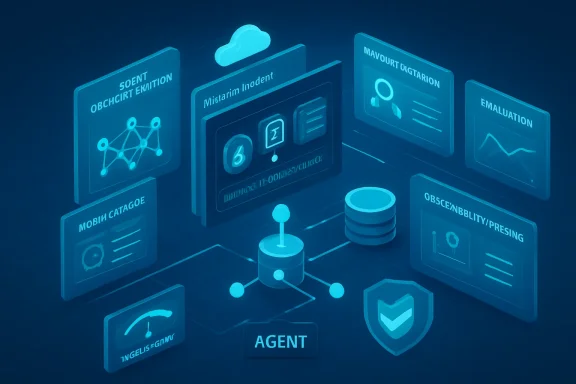 Microsoft Turns the AI Tool Sprawl Into a Platform Bet
At first glance, Foundry looks less like a new product than a reorganization of Microsoft’s AI estate. That is not a criticism so much as the point. Azure OpenAI, model catalogs, agent runtimes, evaluation tools, content safety, observability, governance, SDKs, workflow orchestration, and enterprise connectors have all been circling the same problem from different angles.The problem is that “building an AI app” stopped meaning “call a model API.” A serious AI system now needs retrieval, permissions, tracing, tool use, cost controls, prompt management, safety filters, model evaluation, fallback behavior, and a deployment story that does not terrify the security team. Foundry is Microsoft’s answer to that messy middle.
The company is not merely selling developers another dashboard. It is trying to define the operating environment for the agent era, where the unit of software is not just an app or a service, but an autonomous or semi-autonomous worker that can use tools, remember context, and act across business systems.
That ambition explains why Foundry can feel like a grab bag. It is serving three constituencies at once: application developers who want to build agents, machine learning teams that want model control, and platform engineers who need governance. In the AI market of 2026, those groups can no longer be cleanly separated.
The Agent Is the New App, and Foundry Is the Factory Floor
Microsoft’s most important Foundry bet is not the model catalog. It is the agent layer. Models are still the core intelligence, but agents are where enterprise value either materializes or evaporates.An agent is not just a chatbot with a nicer prompt. It is a system that interprets intent, chooses tools, retrieves knowledge, performs actions, and often coordinates with other agents or workflows. That makes it closer to an application runtime than a simple inference endpoint.
Foundry’s agent tooling reflects this shift. It supports multi-agent orchestration, workflow execution, tool catalogs, memory, and knowledge grounding. Those are the ingredients developers need once a prototype leaves the demo stage and starts touching real business processes.
The reason this matters is that most enterprise AI failures are not model failures. They are integration failures. The model can summarize, classify, reason, and generate, but it cannot safely approve an invoice, query customer records, file a ticket, or update a CRM without plumbing, authorization, auditing, and guardrails.
Foundry attempts to make those pieces first-class. Instead of asking every team to wire up tool access, retrieval, logging, and monitoring from scratch, Microsoft is making them part of the platform contract. That is the right architectural instinct, even if the resulting platform looks dense.
The Model Catalog Is Becoming Less About Choice and More About Control
The AI model market has moved from scarcity to abundance with unsettling speed. Enterprises now face the inverse of the 2022 problem: not “How do we get access to a powerful model?” but “Which of these models can we trust, afford, govern, and swap when the economics change?”Foundry’s model catalog is designed for that world. It gives developers access to models from Microsoft, OpenAI, Meta, Hugging Face, DeepSeek, and other providers, while wrapping them in Azure’s deployment, evaluation, security, and billing structures. The practical promise is model optionality without platform chaos.
That matters because no single model wins every workload. A high-reasoning model may be ideal for coding analysis, a smaller model may be better for low-latency classification, and a domain-tuned model may outperform a frontier model on a narrow support workflow. Foundry gives Microsoft customers a place to compare, evaluate, fine-tune, and deploy these options without rebuilding the application around each provider.
But there is a strategic layer here too. Microsoft does not want Azure AI customers thinking of models as external destinations. It wants models to become interchangeable components inside Microsoft’s own control plane. The model provider may vary, but the governance, telemetry, identity, deployment, and procurement path remain Microsoft’s.
That is the cloud platform play in miniature. Abstraction creates convenience for customers and leverage for the platform owner.
The Real Product Is the Control Plane
Foundry’s least flashy capabilities may be its most important. Observability, evaluation, RBAC, policy enforcement, AI gateway integration, tracing, monitoring, and centralized asset management are not the features that win keynote applause. They are the features that decide whether a CIO allows agents anywhere near production.This is where Microsoft has an advantage over many AI-native startups. Enterprise buyers do not merely want clever agents. They want agents that can be inventoried, audited, throttled, blocked, measured, and killed when they behave badly.
Foundry’s control-plane ambitions are explicit. Microsoft wants IT administrators and platform engineers to manage AI resources across teams, projects, and even non-Microsoft sources. That reflects a grim reality: organizations are already accumulating agents faster than they can govern them.
The shadow IT pattern is familiar. A business unit builds a proof of concept with a model API. Another team connects a chatbot to internal documents. A developer wires an agent into Jira or SharePoint. Soon the organization has dozens of AI systems, each with different credentials, logs, policies, and risk profiles.
Foundry is Microsoft’s attempt to prevent that sprawl from becoming the next SaaS governance hangover. The company is betting that enterprises will eventually demand a fleet-management layer for agents, just as they demanded device management, identity management, and cloud resource management.
Microsoft’s Open-Standards Language Is Pragmatic, Not Altruistic
Foundry leans heavily into open standards such as Model Context Protocol, Agent2Agent, and OpenAPI. That is not just developer-friendly messaging. It is a recognition that no vendor can own the entire agent ecosystem.MCP has become important because agents need a consistent way to connect to tools and data sources. Without that, every integration becomes a bespoke adapter, and the agent ecosystem fragments before it matures. By supporting MCP in Foundry, Microsoft is acknowledging that tool connectivity is too important to be trapped inside a single proprietary scheme.
Agent-to-agent communication serves a similar purpose. If enterprises end up with specialized agents for finance, HR, security, engineering, and customer operations, those agents need some way to coordinate. Otherwise, the “agentic enterprise” becomes a bunch of isolated bots with better branding.
Microsoft’s embrace of these standards should not be mistaken for surrendering control. The company’s preferred outcome is obvious: open protocols at the edge, Azure governance in the center. Developers can bring frameworks and tools, but the operational home remains Foundry.
That is not necessarily bad for customers. Standards reduce lock-in at the integration layer, while a managed control plane reduces operational burden. The risk is that the open parts become a thin veneer over a deeply sticky management environment.
Foundry Is Where Copilot Meets Custom Software
Microsoft’s AI strategy has two faces. One is Copilot: packaged AI experiences embedded in Microsoft 365, Windows, GitHub, Dynamics, and other products. The other is Foundry: the place where organizations build their own AI apps and agents.The relationship between the two is becoming more important. Copilot gives Microsoft distribution. Foundry gives customers customization. Together, they create a path from “use Microsoft’s AI” to “build your own AI on Microsoft’s rails.”
That is why publishing matters. Foundry agents can move into Microsoft 365 experiences, Teams, business chat surfaces, and containerized deployments. This turns Foundry from a developer workbench into a supply chain for workplace agents.
For enterprise IT, that is attractive because it keeps custom AI close to familiar identity, collaboration, and compliance systems. For Microsoft, it increases the gravitational pull of the Microsoft 365 and Azure stack. The more useful agents live inside Teams, Outlook, SharePoint, and business workflows, the harder it becomes to treat AI as a detachable feature.
The tension is that not every organization wants its AI strategy to be so tightly braided into Microsoft’s productivity suite. Foundry can support broader deployment patterns, but Microsoft’s natural center of gravity is clear. It wants the agent to become another Microsoft-managed enterprise object.
Developers Get Acceleration, but Also Another Abstraction Layer
For developers, Foundry’s appeal is obvious. It offers SDKs, model access, agent services, workflow orchestration, tracing, tool catalogs, and deployment primitives in one environment. That can dramatically reduce the amount of undifferentiated engineering needed to build an AI application.The danger is that every abstraction hides complexity until it leaks. Agents are probabilistic systems connected to deterministic business processes. When something goes wrong, developers need to know whether the failure came from the model, the prompt, the retrieval layer, a tool call, an authorization boundary, memory, orchestration, or a policy rule.
Foundry’s tracing and observability features are supposed to help with exactly that. In practice, this will be one of the platform’s make-or-break areas. If developers can inspect agent behavior clearly, Foundry becomes a production accelerator. If they are left staring at polished dashboards that obscure the real failure path, it becomes another enterprise platform that demos better than it debugs.
There is also a skills issue. Building with Foundry is not the same as traditional Azure application development, nor is it pure machine learning. It sits in the hybrid discipline of AI engineering, where prompts, evaluations, APIs, security, data grounding, and user experience all collide.
That may be Foundry’s greatest cultural effect. It forces organizations to admit that AI applications are not owned solely by data science teams. They are software products, infrastructure workloads, compliance objects, and business process interventions all at once.
Data Scientists Are No Longer the Sole Custodians of Model Quality
Foundry includes capabilities for fine-tuning, evaluation, benchmarking, deployment, and model management. That keeps machine learning engineers and data scientists in the loop, but it also changes their role.In the pre-agent era, model quality could often be evaluated in relative isolation. A team trained or selected a model, measured it against a dataset, and exposed it through an endpoint. The surrounding application mattered, but the model was the star.
In agentic systems, quality is distributed. A poor answer may come from a weak model, bad retrieval, missing context, an incorrect tool call, stale memory, ambiguous user intent, or a flawed workflow. That means evaluation must cover the full system, not just the model.
Foundry’s evaluation tooling is important because it recognizes this shift. The relevant questions are not only “Which model scores highest?” but “Which configuration completes the task safely, cheaply, and reliably under real conditions?” That is a much harder standard.
The best data science teams will use Foundry not as a replacement for rigor, but as a way to push rigor into the application lifecycle. Evaluations need to run before deployment, during CI/CD, and continuously in production. Otherwise, agents will drift quietly until they fail loudly.
IT’s New Job Is Governing Behavior, Not Just Access
Traditional enterprise controls are good at answering familiar questions. Who has access? Which network path is allowed? What data can this identity read? Which device is compliant? Agents complicate all of that because they act on behalf of users, across tools, with varying degrees of autonomy.That makes AI governance different from ordinary application governance. An agent may have access to a system because the user does, but that does not mean every possible action is appropriate. The agent might retrieve the right data for the wrong reason, invoke a tool at the wrong time, or combine permissions in a way no human workflow would have done.
Foundry’s enterprise controls are aimed at this problem. Authentication, policy enforcement, gateway routing, audit logging, observability, content filtering, and centralized management are all part of reducing the blast radius. Microsoft is trying to make agent behavior governable before regulators, auditors, or customers force the issue.
This is also where the platform may create friction. Developers often want fast tool access. Security teams want inspection and approval. Business teams want automation. Legal teams want assurances. Foundry places those conflicts in one environment, which is healthier than letting them play out across a dozen disconnected prototypes.
The organizations that succeed with Foundry will not be the ones that simply turn everything on. They will be the ones that define tiers of autonomy, approved tool categories, evaluation gates, monitoring requirements, and escalation paths. The platform can enforce policy, but it cannot invent governance maturity.
The Grab-Bag Feeling Is a Symptom of the Market, Not Just Microsoft
It is easy to mock Foundry as another Microsoft umbrella brand swallowing half a dozen previous services. Microsoft has earned some of that skepticism. The company’s AI naming and product boundaries have shifted quickly, and customers have had to track changes across Azure AI Studio, Azure OpenAI, Copilot Studio, Semantic Kernel, Agent Service, and now Foundry.But the sprawl is not uniquely Microsoft’s fault. The entire AI application stack is still settling. The market has been inventing new layers faster than enterprises can standardize them: vector databases, orchestration frameworks, agent runtimes, prompt tools, evaluation suites, safety filters, synthetic data pipelines, workflow engines, and observability products.
Foundry is Microsoft’s attempt to compress that chaotic landscape into an Azure-shaped product surface. That can feel inelegant because the underlying category is inelegant. The clean lines will come later, after customers decide which capabilities are essential and which were artifacts of the first agent hype cycle.
The more interesting question is whether Microsoft can make Foundry feel coherent in daily use. A platform that theoretically serves developers, data scientists, and administrators can easily become a platform that fully satisfies none of them. The user experience must make the right path obvious without hiding the advanced controls serious teams need.
That is the central execution challenge. Foundry does not lack features. It risks lacking a simple mental model.
The Competitive Fight Is Over the Agent Runtime
Foundry should be understood alongside rival efforts from AWS, Google Cloud, OpenAI, Anthropic, and the growing open-source agent ecosystem. Everyone sees the same prize: the runtime and governance layer for AI agents.Cloud providers want agents to consume compute, storage, data services, APIs, and managed infrastructure. Model providers want agents to increase inference demand and lock in developer affinity. SaaS vendors want agents embedded in their applications. Open-source frameworks want to become the default developer abstraction before the hyperscalers absorb the category.
Microsoft’s advantage is distribution. It has Azure, Microsoft 365, GitHub, Visual Studio, Windows, Entra, Defender, Purview, Teams, and a vast enterprise sales channel. Foundry can plug into all of those, which gives it a practical path into organizations that already standardize on Microsoft infrastructure.
Its disadvantage is complexity. Developers who want maximum flexibility may prefer lighter frameworks. Startups may avoid the enterprise weight. Organizations with multi-cloud strategies may worry that Foundry makes Azure the de facto center of their AI architecture.
Still, enterprise AI platforms are not usually chosen by the most elegant demo. They are chosen by the least frightening production story. Microsoft is betting that governance, identity, compliance, and integration will matter more than minimalism.
The Cost Story Will Decide How Ambitious Agents Become
There is one topic that every agent platform must eventually confront: cost. Agents can be expensive in ways that simple chatbots are not. They may call models multiple times, retrieve context repeatedly, invoke tools, run evaluations, maintain memory, and coordinate with other agents.Foundry’s observability and asset management features are partly about reliability, but they are also about cost visibility. Token usage, latency, model selection, tool calls, and failure rates are not just technical metrics. They are budget signals.
This will shape how enterprises deploy agents. The first wave of enthusiasm often imagines autonomous digital workers handling broad workflows. The second wave usually asks why a single support ticket consumed dozens of model calls and still required human review.
Foundry gives Microsoft a way to steer customers toward more disciplined architectures. Not every task needs the largest model. Not every workflow needs persistent memory. Not every agent should have broad tool access. Not every evaluation needs to run at the same frequency.
The organizations that treat Foundry as a cost-governed platform will fare better than those that treat it as an agent vending machine. Autonomy without budget controls is not transformation. It is a surprise invoice with a demo video attached.
The Foundry Bet Comes Down to Operational Trust
The most concrete reading of Foundry is that Microsoft is trying to make AI agents boring enough for enterprise production. That is a compliment. The history of enterprise computing is the history of turning exciting technologies into manageable infrastructure.Foundry’s value will not be proven by how quickly a developer can build a demo agent. That bar is now low across the industry. Its value will be proven by whether a company can run hundreds or thousands of agents with traceability, policy controls, model flexibility, known costs, and acceptable failure modes.
The key points are straightforward:
- Microsoft Foundry consolidates much of Microsoft’s AI application, agent, model, and governance tooling into a unified Azure platform.
- Its most important function is not model access alone, but the operational layer around agents, tools, memory, evaluations, and observability.
- Developers gain a faster path from prototype to production, but they also inherit a platform abstraction that must be understood deeply when agents fail.
- IT and security teams are central to Foundry’s appeal because agents require governance of behavior, not just access.
- Microsoft’s embrace of MCP, Agent2Agent, and OpenAPI is pragmatic: open interfaces can coexist with a Microsoft-centered control plane.
- Foundry’s success will depend less on feature breadth than on whether enterprises can make it coherent, cost-aware, and auditable at scale.
Source: InfoWorld Building AI apps and agents with Microsoft Foundry
