

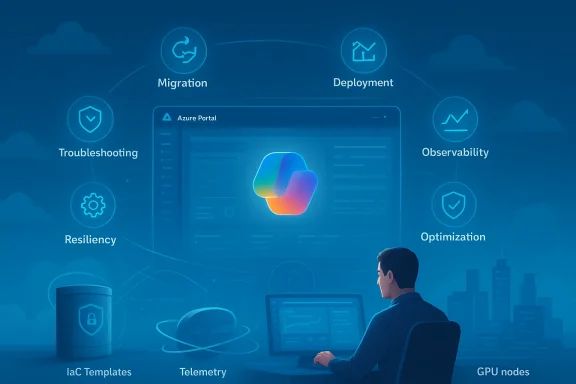
Microsoft’s vision for making AI an active, operational partner in cloud management moved from concept to concrete at Ignite: Azure Copilot and the broader idea of agentic cloud operations promise to fold specialized AI agents into the lifecycle of cloud workloads—migration, deployment, observability, optimization, resiliency, and troubleshooting—so teams can move from insight to governed action inside a unified interface.
For years cloud operations (CloudOps) evolved around scale: more VMs, more containers, more metrics, more dashboards. That model served organizations while systems grew relatively predictable. The rapid adoption of modern cloud-native applications and AI workloads has altered that calculus: change is continuous, telemetry is abundant, and programmable infrastructure lets action happen at machine speed. Microsoft’s Azure Copilot is positioned as a new operating model that treats AI agents as practical teammates, able to correlate signals, act within guardrails, and continuously improve operational posture.
Azure’s announcements bring two core ideas together. First, that specialized agents—each focused on a domain such as migration or resiliency—can turn passive observability into coordinated execution. Second, that a single agentic interface (Azure Copilot) can present those agents, policy controls, and operational history in context so humans remain in charge while automation executes routine and repeatable actions.
This article summarizes Microsoft’s claims, verifies technical guardrails and features where possible, explains what this means for IT teams, and critically assesses strengths, blind spots, and practical safeguards organizations must implement before adopting agentic cloud operations at scale.
Key interaction modes:
Mitigations:
Mitigations:
Mitigations:
Mitigations:
Mitigations:
Mitigations:
But the model is not risk-free. Agents add automation layers that can amplify misconfigurations, expand attack surfaces, and obscure decision provenance if not carefully governed. The technology’s value depends more on operational discipline—strict RBAC, policy-as-code, auditing, and human-in-the-loop safeguards—than on hype. Enterprises that pair Azure Copilot’s capabilities with mature change control, observability, and security practices will be best positioned to turn agentic promise into reliable production advantage.
Agentic operations will not eliminate the need for skilled cloud engineers; they will change the job. Engineers will spend less time wrestling dashboards and more time defining policies, vetting agent workflows, and architecting resilient systems. For organizations prepared to balance automation with oversight, Azure Copilot could be the operational multiplier modern cloud teams have been waiting for.
Source: Microsoft Azure Agentic cloud operations and Azure Copilot for AI‑driven workloads
 Background
For years cloud operations (CloudOps) evolved around scale: more VMs, more containers, more metrics, more dashboards. That model served organizations while systems grew relatively predictable. The rapid adoption of modern cloud-native applications and AI workloads has altered that calculus: change is continuous, telemetry is abundant, and programmable infrastructure lets action happen at machine speed. Microsoft’s Azure Copilot is positioned as a new operating model that treats AI agents as practical teammates, able to correlate signals, act within guardrails, and continuously improve operational posture.Azure’s announcements bring two core ideas together. First, that specialized agents—each focused on a domain such as migration or resiliency—can turn passive observability into coordinated execution. Second, that a single agentic interface (Azure Copilot) can present those agents, policy controls, and operational history in context so humans remain in charge while automation executes routine and repeatable actions.
This article summarizes Microsoft’s claims, verifies technical guardrails and features where possible, explains what this means for IT teams, and critically assesses strengths, blind spots, and practical safeguards organizations must implement before adopting agentic cloud operations at scale.
What Microsoft announced (concise summary)
- Azure Copilot: an agentic interface integrated into Azure Portal, CLI, and management surfaces that orchestrates specialized agents across the cloud lifecycle.
- Six domain agents (gated preview): migration, deployment, optimization, observability, resiliency, and troubleshooting—designed to work together, not as isolated bots.
- Governance-first design: agents respect RBAC, Azure Policy, and existing controls; actions are auditable and human-reviewable.
- Bring Your Own Storage (BYOS): organizations can store conversation history and artifacts in their own Azure storage (Cosmos DB / storage account) to meet sovereignty and compliance requirements.
- Full-lifecycle integration: agents assist from discovery and planning through production operations and continuous modernization.
- Platform investments: broader Azure infrastructure enhancements (expanded regions, AI datacenter designs, GPU scale) to support the agentic era.
How Azure Copilot is framed to work
The agentic interface
Azure Copilot is pitched as the unified, context-aware interface that sits on top of your Azure environment. Rather than another siloed dashboard, Microsoft emphasizes that Copilot is grounded in the actual tenant context—subscriptions, resources, policies, and historical telemetry—so when an operator asks an agent to take an action, the agent does so with immediate awareness of resource scope and governance boundaries.Key interaction modes:
- Natural language chat (portal chat)
- Terminal/CLI integration
- Console and actionable recommendations in the Azure Portal
- Agent workflows invoked directly from operational workflows and alerts
The agent model
Microsoft’s agents are domain-specialized and designed to coordinate:- Migration agent: scans existing environments, discovers dependencies, and suggests modernization paths and IaC templates.
- Deployment agent: guides and validates well-architected infrastructure-as-code deployments.
- Observability agent: establishes full-stack baselines and provides AI-assisted root cause analysis.
- Optimization agent: recommends and can execute cost/performance/sustainability improvements.
- Resiliency agent: verifies failover and recovery configurations and proactively strengthens posture.
- Troubleshooting agent: diagnoses incidents faster and can initiate support actions when needed.
Verified technical controls and enterprise guardrails
Microsoft’s public documentation and admin guides (Azure Copilot admin center, BYOS details, and agent access management) show that several enterprise-level controls are implemented or available at launch:- RBAC integration: Copilot honors Azure role-based access control; agent actions are constrained by the caller’s permissions.
- Azure Policy and compliance enforcement: agent-initiated changes must pass policy constraints and organizational guardrails.
- BYOS for conversation history and artifacts: tenant administrators can configure conversation storage to retain chat and artifact data in a tenant-controlled Cosmos DB instance; this is intended to support auditability and data residency requirements.
- Auditing and traceability: actions taken by agents are meant to be reviewable and auditable, aligning with enterprise change control needs.
- Administrative gating: access to Agents (preview) is tenant-level and requires admin request/approval—Microsoft signals a controlled rollout.
Where the agentic model can deliver real value
Faster migrations and modernization
- The migration agent promises automated discovery and dependency mapping—reducing manual inventory work that often consumes weeks of engineering time.
- Auto-generating infrastructure-as-code templates and modernization suggestions can compress migration projects and reduce human error in repetitive tasks.
Shorter incident resolution cycles
- Observability and troubleshooting agents that correlate multi-layer telemetry and propose root causes can shorten mean time to resolution (MTTR), especially for complex, distributed apps.
- AI-assisted diagnostics embedded in alerts and runbooks let teams move faster during early-life incidents.
Continuous optimization
- Agents that continuously analyze cost, performance, and sustainability—possibly with real-time financial and carbon impact comparisons—help teams operate leaner and meet sustainability goals.
- Hands-off execution for non-sensitive changes (e.g., rightsizing non-critical VMs) reduces toil and frees engineers for higher-value work.
Proactive resiliency posture
- Rather than testing recovery plans periodically, the resiliency agent can continuously validate and recommend improvements, helping organizations reduce risk exposure to outages and ransomware attacks.
Operational consistency and scale
- Centralizing agent workflows in a single interface reduces context switches between tools, improving operator efficiency and reducing the chance of human error when juggling multiple consoles.
Practical governance and compliance realities
Microsoft’s BYOS option and the explicit integration with RBAC and Azure Policy address some major enterprise concerns, but there are operational nuances to understand:- BYOS gives tenants control over conversation and artifact storage, but migrating to BYOS changes what historical conversations are accessible—tenants lose access to Microsoft-stored history after opting in unless they retain the previous storage. This is a concrete trade-off that must be planned.
- Enabling agents (preview) is a tenant-level administrative action—enterprises will need change control processes, subscription-level approvals, and clear role assignments before enabling agent-driven actions in production subscriptions.
- Audit trails are available, but organizations must design retention and log management to meet regulatory obligations (e.g., SOX, PCI DSS, HIPAA).
- Governance policies should be explicit about which agents can take automated actions and which require human review. Default permissive settings may be tempting but dangerous.
Risks, failure modes, and red flags
Agentic operations introduce new efficiency but also new classes of risk. Below are the most important risk vectors IT teams must assess.1) Over-automation and loss of situational awareness
Agents acting autonomously—even within policy—can hide complex changes from operators if teams rely on outputs without inspection. This risk manifests as configuration drift, unexpected cost spikes, or silent regressions in performance.Mitigations:
- Require explicit approval for impactful changes.
- Use just-in-time automation for low-risk actions and pre-approval gates for high-impact remediations.
2) Guardrail bypass via misconfigurations
If RBAC or policy definitions are misapplied, agents may be able to make changes beyond intended scope. Mistakes in policy assignment can make an agent more powerful than a human operator.Mitigations:
- Enforce least privilege for all agent identities.
- Use periodic policy audits and staged rollouts.
3) Data exposure and privacy concerns
Agents that process prompt content and resource metadata may handle sensitive information. BYOS mitigates storage concerns, but many operational interactions involve logs, credentials (even temporarily), and PR data.Mitigations:
- Target BYOS for regulated workloads.
- Implement data loss prevention (DLP) and restrict what kinds of data agents can access.
- Review agent access to secrets and key vaults carefully.
4) Attack surface and supply-chain risk
Agent frameworks and the underlying AI models expand the system attack surface. Compromised agents could be used to enumerate resources, alter configurations, or exfiltrate data.Mitigations:
- Treat agent services as first-class security domains. Apply the same threat modeling and hardening that you apply to APIs and management planes.
- Monitor agent activity with SIEM and evaluate agent behavior anomalies.
5) Cost and runaway automation
Automation that periodically optimizes or reconfigures resources can inadvertently cause churn (provisioning/teardown cycles) that increases costs and operational instability.Mitigations:
- Apply cost thresholds and cooling periods to automated optimizations.
- Monitor automated action counts and establish budget alerts.
6) Model hallucinations and inaccurate actions
Even specialized agents can misinterpret context or recommend incorrect infrastructure changes. The risk grows when models infer hidden relationships not represented in source-of-truth config.Mitigations:
- Require human verification for nontrivial actions.
- Maintain canonical infrastructure sources (IaC repositories) as single sources of truth.
Operational readiness: How to adopt agentic operations safely
Before turning on agents in production, teams should take several practical steps.- Inventory and classify workloads by risk level.
- Critical financial, healthcare, or regulated applications should be staged and tested separately.
- Establish agent policies and scopes.
- Specify allowed actions per agent, per subscription, and per resource group.
- Enable BYOS for conversations and artifacts for regulated tenants.
- Plan migration of historical searches and set retention policies aligned with compliance.
- Run agents in read-only and advisory modes initially.
- Use the preview to validate recommendations before granting write/execute permissions.
- Integrate agent logs into SIEM and incident management.
- Treat agent actions as auditable events and route them into existing SOC workflows.
- Define a rollback and “undo” strategy.
- Test how you revert automated changes; ensure runbooks and backup plans are in place.
- Train teams on agent behavior and trust boundaries.
- Document common failure modes, test incident scenarios, and update runbooks accordingly.
Vendor lock-in and portability considerations
Agentic tooling that deeply integrates with cloud metadata, policy, and proprietary control planes raises questions about portability. Auto-generated IaC and refactoring suggestions are useful, but teams should protect themselves:- Use open, standard IaC formats (ARM, Terraform, Bicep) that can be reviewed and versioned in Git.
- Keep human-readable change logs in source control and incorporate agent outputs into PR workflows.
- Avoid over-reliance on proprietary agent capabilities for core business logic. Use agents to accelerate tasks, but keep critical automation codified in versioned repositories.
Where agentic operations fit into the broader cloud strategy
Agentic cloud operations are not a wholesale replacement for DevOps or SRE disciplines. They are accelerants—tools that can reduce manual toil, speed decision-making, and make continuous modernization feasible. Expect the largest wins where:- There are repetitive, well-understood operations that can be codified and automated safely.
- Observability is already mature and exposes clean telemetry that agents can consume.
- Teams have embraced Infrastructure as Code and policy-as-code.
- Security and compliance teams are integrated into rollout planning.
Real-world questions IT leaders will ask (and how to answer them)
- Will agents reduce headcount? Not by themselves. Agents shift skill demand toward higher-level architecture and governance work while automating repetitive tasks.
- Can I let agents act without human review? For low-risk actions, yes. For anything that affects production criticality, require human approval by default.
- Does BYOS eliminate data exposure risk? BYOS increases control over storage residency, but it does not remove all risk—agents still process telemetry and prompts during runtime. DLP and access controls remain critical.
- How do I audit agent actions? Configure agent logging to integrate with your SIEM and retention policies; instrument runbooks to capture pre/post state and approval artifacts.
- Are the agents secure? They implement RBAC and policy checks, but security posture depends on your configuration. Treat agent identities like any privileged service principal.
Recommendations for early adopters
- Start with nonproduction workloads: Use migration and observability agents in staging to validate outputs.
- Require agent actions to be pull-requested and peer-reviewed in IaC pipelines.
- Use BYOS for regulated or high-sensitivity tenants and verify retention settings before switching.
- Establish quantitative KPIs up front: MTTR, migration velocity, cost savings, mean time between changes.
- Conduct tabletop exercises simulating compromised agent behavior and validate incident response.
- Engage internal compliance and legal teams during pilot planning to define acceptable data handling.
The balance of promise and prudence
Agentic cloud operations represent an important evolution in how cloud infrastructure is run. By folding AI into the operational flow—with domain-focused agents that act in context—Azure Copilot attempts to convert signals into coordinated, governed execution. For organizations facing relentless velocity in deployment and constant modernization needs, agents could be transformational: speeding migrations, reducing firefighting, and optimizing costs continuously.But the model is not risk-free. Agents add automation layers that can amplify misconfigurations, expand attack surfaces, and obscure decision provenance if not carefully governed. The technology’s value depends more on operational discipline—strict RBAC, policy-as-code, auditing, and human-in-the-loop safeguards—than on hype. Enterprises that pair Azure Copilot’s capabilities with mature change control, observability, and security practices will be best positioned to turn agentic promise into reliable production advantage.
Conclusion
Azure Copilot and the agentic cloud operations model mark a clear turning point in cloud management: the focus shifts from manual orchestration of scale to intelligent, governed action at machine speed. The combination of specialized agents, tenant-level governance controls, and BYOS options shows Microsoft is designing for enterprise realities. Early adopters should expect meaningful productivity gains around migration, troubleshooting, and optimization—provided they apply conservative rollout practices, strict governance, and rigorous auditability.Agentic operations will not eliminate the need for skilled cloud engineers; they will change the job. Engineers will spend less time wrestling dashboards and more time defining policies, vetting agent workflows, and architecting resilient systems. For organizations prepared to balance automation with oversight, Azure Copilot could be the operational multiplier modern cloud teams have been waiting for.
Source: Microsoft Azure Agentic cloud operations and Azure Copilot for AI‑driven workloads
