

Microsoft’s Azure Copilot Migration Agent arrives at exactly the moment cloud buyers are demanding more automation, tighter governance, and faster time-to-decision. The new agent is designed to sit inside Azure Migrate and help organizations move from messy inventory data to structured migration plans, landing zones, and modernization recommendations without forcing teams to stitch together half a dozen tools. But while Microsoft is marketing the capability as a step toward agentic cloud operations, the current reality is more restrained: the agent helps with planning and assessment, yet the actual migration still happens through established Azure Migrate workflows. That distinction matters, especially for enterprises comparing Azure’s approach with AWS Transform, which has already pushed further into end-to-end migration automation. (azure.microsoft.com)
Cloud migration has always been sold as a technical project, but in practice it is a business transformation problem disguised as infrastructure work. The hard part is rarely only the mechanics of lifting servers into a new environment. It is the combination of dependency discovery, application ownership, security review, landing zone design, sequencing, cost modeling, and the human coordination required to keep all of those moving parts aligned. Microsoft’s new agentic approach is best understood as an attempt to collapse that front-end complexity into a guided experience rather than a set of disconnected tasks. (azure.microsoft.com)
That is important because the pre-migration phase is where many programs lose momentum. Assessments take time, the data is imperfect, and organizations often discover late in the process that their inventory is incomplete or their target architecture is not ready. Microsoft has been steadily adding more planning tools to Azure Migrate, including wave planning and GitHub Copilot-assisted code insights, but the Azure Copilot Migration Agent is the first move that more explicitly wraps those capabilities in an AI-driven conversational layer.
The timing also reflects a market under pressure from rising cloud costs and VMware uncertainty. Flexera’s 2025 State of the Cloud Report found that 84% of organizations say managing cloud spend is their top challenge, while cloud budgets are exceeding limits by 17% on average. Those numbers help explain why migration planning is now tightly linked to cost governance rather than just speed. If a migration effort cannot produce a credible business case early, it is increasingly likely to stall before the first workload moves.
Microsoft is not alone in recognizing that shift. AWS has spent the last year turning migration into an agentic experience of its own, starting with assessment capabilities in May 2025 and expanding the service into broader VMware modernization later in the year. That rivalry is not academic; it is a direct battle for organizations re-evaluating VMware footprints in the wake of Broadcom’s licensing changes. The result is a competitive race to automate the most expensive and politically sensitive part of cloud adoption: deciding what moves, when it moves, and what the destination should look like. (aws.amazon.com)
That framing reflects a broader shift in enterprise IT. Buyers no longer accept tooling that simply inventories assets; they expect tools that tell them what to do next. Microsoft’s AI work in Azure Migrate, Azure Copilot, and GitHub Copilot modernization is clearly aimed at converting data exhaust into action. The strategic question is whether the result is a genuinely simpler operating model or just a smarter wrapper around existing processes.
A key point in Microsoft’s own documentation is that the current capability set is not universal. The service supports full end-to-end migration for VMware workloads, while Hyper-V and physical server scenarios are limited to guidance and help within Azure Migrate rather than full agentic orchestration. That scope matters because VMware remains the sharpest point of competition, especially for enterprises reconsidering platform strategy. (learn.microsoft.com)
Microsoft also makes the migration experience conditional on tenant configuration. The feature is unavailable to tenants using Bring Your Own Storage for Copilot conversation history, although those tenants can still ask Azure Copilot for migration help without the agent capabilities. In practice, that means the new experience is both powerful and gated, which is very Microsoft: feature-rich, but wrapped in controls and prerequisites that enterprises will need to plan around. (learn.microsoft.com)
That matters for procurement, risk, and rollout planning. Preview features often change quickly, have narrower support boundaries, and may be tied to specific tenant settings or region availability. For large enterprises, that means the agent is likely best evaluated in a pilot or migration factory context before it is trusted for broad program governance. (learn.microsoft.com)
Microsoft is also emphasizing an agentless VMware discovery path. According to the company’s materials, organizations can collect environment information without direct connectivity to Azure or changes to existing network topology, and the Azure Migrate Collector can support offline inventory collection when Azure connectivity is not yet established. That is a meaningful answer to one of the classic migration blockers: security teams are often reluctant to open paths just to begin an assessment.
The limitation, of course, is that discovery data is only as useful as the environment it describes. Inventory quality remains dependent on the source estate, and AI cannot conjure missing ownership data or untangle undocumented dependencies with certainty. The best-case scenario is not automation replacing architects; it is automation giving architects a faster starting point. That distinction is easy to miss and very hard to ignore. (learn.microsoft.com)
This also aligns with Azure Migrate’s broader evolution. The platform has increasingly become a planning engine, not merely a server assessment utility. Adding AI to the front end makes it easier to convert technical discovery into board-facing language, which is arguably where the real bottleneck has always been.
That is a smart move because landing zones often become the hidden bottleneck in migration programs. Teams may agree on what to move, but the destination environment is not ready, the network model is inconsistent, or policy guardrails are still under debate. By codifying the landing zone step, Microsoft is inserting AI into the part of the process that usually requires the most cross-team negotiation. (azure.microsoft.com)
There is also a strategic benefit for Microsoft in aligning with the Cloud Adoption Framework. The framework is already a familiar reference for Azure architects, so the agent is not inventing a new migration philosophy. Instead, it is operationalizing an existing one, which lowers adoption risk and makes the tool feel like an extension of standard Azure practice rather than a separate AI experiment.
That emphasis also reveals the limits of current automation. For Hyper-V and physical servers, the agent is more advisory than transformational. That makes sense technically, but it also means Microsoft is choosing to go deep where the market pressure is greatest rather than offering fully symmetric coverage across all on-premises estates. That is a rational product decision, but not a universal one. (learn.microsoft.com)
The logic here is strong. Many migration programs fail because infrastructure teams and development teams move at different speeds and with different tooling. Assessment may point to a modernization opportunity, but by the time that insight reaches the app team, momentum has already faded. Microsoft’s answer is to connect the planning layer to the modernization layer so the handoff is less brittle.
It also creates a stronger Microsoft platform story. Azure Migrate handles discovery and planning, Azure Copilot orchestrates the agentic layer, and GitHub Copilot handles code transformation. The result is not merely a toolchain but an integrated transformation story, which is exactly what large enterprises want when they are deciding whether to standardize on one vendor or build a multi-tool stack. (azure.microsoft.com)
That boundary is not a weakness so much as a design choice. Enterprises are still unlikely to hand over irreversible production cutovers to a conversational interface without controls. Microsoft seems to understand that, and the current implementation suggests an incremental strategy: automate enough to save time, but not so much that customers feel they have lost the reins. (learn.microsoft.com)
AWS’s story is more aggressive on execution. Its launch materials emphasize automated discovery, network translation, EC2 optimization, human-in-the-loop validation, and even measured improvements such as 500-VM wave plans in 15 minutes. Microsoft’s current posture is more conservative, focusing on planning and assessment inside Azure Migrate while leaving actual migration actions to the established workflow. That difference could matter to buyers deciding how much autonomy they want from the system. (aws.amazon.com)
For Microsoft, the risk is that “planning only” can sound less ambitious than the competition’s end-to-end language. For AWS, the risk is that broader automation may create more trust and operational questions. In both cases, the real differentiator is not the presence of AI, but the amount of program risk each vendor is willing to absorb on behalf of the customer. That is the hidden product comparison. (learn.microsoft.com)
That said, the market is not simply a race to automate everything. Migration programs are deeply political inside large enterprises, and a too-powerful agent can trigger governance concerns just as quickly as it wins technical admiration. Microsoft’s measured approach may actually play better with conservative buyers who want AI assistance without surrendering control. (learn.microsoft.com)
The enterprise value is not purely about speed, though. It is about standardization. When migration planning is encoded in an AI-assisted workflow, organizations can theoretically apply the same decision framework across business units, geographies, and application portfolios. That makes the tool attractive to central platform teams trying to impose order on sprawling estates. (azure.microsoft.com)
There is also an important cultural effect. Tools that reduce friction between architecture, security, and operations can make migration programs feel less like a series of gate reviews and more like a coordinated workflow. That may sound subtle, but in large enterprises the difference between an open loop and a closed loop is often measured in quarters, not days. (azure.microsoft.com)
For smaller organizations, the bigger practical issue is whether the tool saves money quickly enough to justify the move. Flexera’s data shows cost management remains the dominant cloud pain point, and SMBs are not immune. If Azure Copilot can shorten discovery and landing zone setup while improving confidence in the business case, it may have appeal beyond the enterprise segment.
At the same time, preview limitations can be more disruptive for smaller teams. If a feature is gated by tenant settings, storage choices, or supported workload type, a lean IT staff may spend too much time just getting access. In that sense, the assistant is most valuable when it feels boring and dependable, not cutting-edge. (learn.microsoft.com)
The competitive pressure will only intensify. AWS has already shown that it wants to own more of the migration lifecycle, and Microsoft will likely respond by expanding capabilities beyond planning, or by making the integration between Azure Copilot, Azure Migrate, and GitHub Copilot feel indispensable. In enterprise platform wars, good enough often wins if it is trusted, but deep enough wins when the market wants acceleration.
Source: infoq.com Microsoft Launches Azure Copilot Migration Agent to Accelerate Cloud Migration Planning
 Background
Cloud migration has always been sold as a technical project, but in practice it is a business transformation problem disguised as infrastructure work. The hard part is rarely only the mechanics of lifting servers into a new environment. It is the combination of dependency discovery, application ownership, security review, landing zone design, sequencing, cost modeling, and the human coordination required to keep all of those moving parts aligned. Microsoft’s new agentic approach is best understood as an attempt to collapse that front-end complexity into a guided experience rather than a set of disconnected tasks. (azure.microsoft.com)That is important because the pre-migration phase is where many programs lose momentum. Assessments take time, the data is imperfect, and organizations often discover late in the process that their inventory is incomplete or their target architecture is not ready. Microsoft has been steadily adding more planning tools to Azure Migrate, including wave planning and GitHub Copilot-assisted code insights, but the Azure Copilot Migration Agent is the first move that more explicitly wraps those capabilities in an AI-driven conversational layer.
The timing also reflects a market under pressure from rising cloud costs and VMware uncertainty. Flexera’s 2025 State of the Cloud Report found that 84% of organizations say managing cloud spend is their top challenge, while cloud budgets are exceeding limits by 17% on average. Those numbers help explain why migration planning is now tightly linked to cost governance rather than just speed. If a migration effort cannot produce a credible business case early, it is increasingly likely to stall before the first workload moves.
Microsoft is not alone in recognizing that shift. AWS has spent the last year turning migration into an agentic experience of its own, starting with assessment capabilities in May 2025 and expanding the service into broader VMware modernization later in the year. That rivalry is not academic; it is a direct battle for organizations re-evaluating VMware footprints in the wake of Broadcom’s licensing changes. The result is a competitive race to automate the most expensive and politically sensitive part of cloud adoption: deciding what moves, when it moves, and what the destination should look like. (aws.amazon.com)
Why the planning phase is now the battleground
The planning phase used to be treated as an administrative prelude. Today it is the product. Enterprises want dependency maps, business cases, wave plans, and target architectures that can be reviewed quickly by infrastructure, app, and security teams. They also want defensible recommendations that can survive finance scrutiny and architecture review boards. Microsoft’s pitch is that the agent can generate those artifacts faster and with less manual assembly, while still keeping humans in control. (learn.microsoft.com)That framing reflects a broader shift in enterprise IT. Buyers no longer accept tooling that simply inventories assets; they expect tools that tell them what to do next. Microsoft’s AI work in Azure Migrate, Azure Copilot, and GitHub Copilot modernization is clearly aimed at converting data exhaust into action. The strategic question is whether the result is a genuinely simpler operating model or just a smarter wrapper around existing processes.
Overview
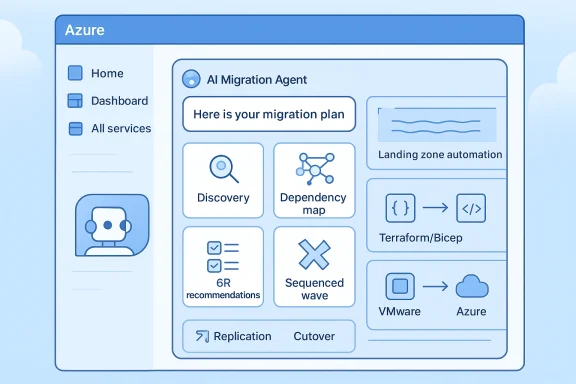
The Azure Copilot Migration Agent is an AI assistant built into the Azure portal, surfaced through Azure Migrate’s “Accelerate migration” experience when the Agents preview is enabled at the tenant level. Microsoft says the agent can help with discovery, assessment, strategizing, landing zone creation, and workload planning using existing Azure Migrate context. It is positioned as part of a larger agentic cloud ops vision where specialized agents handle different operational phases across the lifecycle. (azure.microsoft.com)A key point in Microsoft’s own documentation is that the current capability set is not universal. The service supports full end-to-end migration for VMware workloads, while Hyper-V and physical server scenarios are limited to guidance and help within Azure Migrate rather than full agentic orchestration. That scope matters because VMware remains the sharpest point of competition, especially for enterprises reconsidering platform strategy. (learn.microsoft.com)
Microsoft also makes the migration experience conditional on tenant configuration. The feature is unavailable to tenants using Bring Your Own Storage for Copilot conversation history, although those tenants can still ask Azure Copilot for migration help without the agent capabilities. In practice, that means the new experience is both powerful and gated, which is very Microsoft: feature-rich, but wrapped in controls and prerequisites that enterprises will need to plan around. (learn.microsoft.com)
Public availability versus preview language
One of the more confusing aspects of the launch is Microsoft’s wording. The announcement language suggests public availability, but Microsoft Learn describes the feature as part of Agents (preview) in Azure Copilot. That is not a trivial semantic difference. Publicly available software can still be preview software, and in this case the practical takeaway is that organizations should treat the agent as a previewed control plane, not a fully finalized migration platform. (learn.microsoft.com)That matters for procurement, risk, and rollout planning. Preview features often change quickly, have narrower support boundaries, and may be tied to specific tenant settings or region availability. For large enterprises, that means the agent is likely best evaluated in a pilot or migration factory context before it is trusted for broad program governance. (learn.microsoft.com)
Discovery and Assessment
The strongest immediate use case for the Migration Agent is turning discovery into a structured migration narrative. Microsoft says the agent can generate inventory, dependency information, and 6R recommendations using the data already collected in Azure Migrate. That is valuable because many organizations already have the raw data but lack the time or staff to turn it into a coherent plan. (learn.microsoft.com)Microsoft is also emphasizing an agentless VMware discovery path. According to the company’s materials, organizations can collect environment information without direct connectivity to Azure or changes to existing network topology, and the Azure Migrate Collector can support offline inventory collection when Azure connectivity is not yet established. That is a meaningful answer to one of the classic migration blockers: security teams are often reluctant to open paths just to begin an assessment.
Why agentless discovery matters
Agentless discovery is not just a convenience feature. It reduces friction at the exact moment when stakeholders are deciding whether to trust the migration program at all. If a discovery process requires network changes, credentials, and complex installation steps before any value is visible, the probability of delay rises sharply. Microsoft’s approach lowers that first barrier and gives assessment teams something they can work with quickly.The limitation, of course, is that discovery data is only as useful as the environment it describes. Inventory quality remains dependent on the source estate, and AI cannot conjure missing ownership data or untangle undocumented dependencies with certainty. The best-case scenario is not automation replacing architects; it is automation giving architects a faster starting point. That distinction is easy to miss and very hard to ignore. (learn.microsoft.com)
- Agentless discovery reduces early program friction.
- Offline collection helps where Azure connectivity is constrained.
- Inventory quality still depends on source data fidelity.
- Dependency maps are most useful when validated by app owners.
- AI shortens discovery work, but does not eliminate judgment.
Assessments as business case inputs
Microsoft’s documentation says Azure Copilot can create business cases and assessments using existing context. That is important because the assessment is no longer just a technical artifact; it is the input to capital planning, scheduling, and executive approval. In a budget-sensitive climate, the tool’s ability to surface ROI-style information can be more important than raw migration readiness. (learn.microsoft.com)This also aligns with Azure Migrate’s broader evolution. The platform has increasingly become a planning engine, not merely a server assessment utility. Adding AI to the front end makes it easier to convert technical discovery into board-facing language, which is arguably where the real bottleneck has always been.
Landing Zones and Wave Planning
A second major capability is automated landing zone creation. Microsoft says the agent can generate Terraform or Bicep templates, configure networking and identity policies, and produce structured wave plans aligned to the Cloud Adoption Framework. In effect, the agent is trying to bridge the gap between assessment output and implementation-ready infrastructure design.That is a smart move because landing zones often become the hidden bottleneck in migration programs. Teams may agree on what to move, but the destination environment is not ready, the network model is inconsistent, or policy guardrails are still under debate. By codifying the landing zone step, Microsoft is inserting AI into the part of the process that usually requires the most cross-team negotiation. (azure.microsoft.com)
Templates, policy, and governance
The choice of Terraform and Bicep is telling. Those are not just implementation formats; they are governance mechanisms. If the agent emits infrastructure-as-code artifacts, then review, versioning, and repeatability become part of the workflow rather than side conversations. That makes the output more enterprise-friendly, assuming teams trust the generated code enough to adopt it.There is also a strategic benefit for Microsoft in aligning with the Cloud Adoption Framework. The framework is already a familiar reference for Azure architects, so the agent is not inventing a new migration philosophy. Instead, it is operationalizing an existing one, which lowers adoption risk and makes the tool feel like an extension of standard Azure practice rather than a separate AI experiment.
- Landing zone generation compresses architecture prep time.
- Terraform and Bicep outputs support repeatable deployment.
- Policy alignment makes the tool more enterprise-ready.
- Wave planning helps sequence large migrations realistically.
- The real challenge is validating generated artifacts before use.
Where the VMware focus shows through
Microsoft’s current end-to-end support is strongest for VMware, and that is where the landing zone story becomes most actionable. The agent can appear to simplify the whole path from discovery to destination, but the deeper reality is that Microsoft is prioritizing the migration estate most likely to trigger competitive churn. VMware customers are the prize, and infrastructure automation is one of the few differentiators that can influence a platform decision. (learn.microsoft.com)That emphasis also reveals the limits of current automation. For Hyper-V and physical servers, the agent is more advisory than transformational. That makes sense technically, but it also means Microsoft is choosing to go deep where the market pressure is greatest rather than offering fully symmetric coverage across all on-premises estates. That is a rational product decision, but not a universal one. (learn.microsoft.com)
Modernization Handoff to GitHub Copilot
Microsoft is not treating migration planning as an isolated activity. The company is explicitly linking Azure Copilot with GitHub Copilot so modernization tasks can be handed off to application teams, including .NET and Java upgrades. That integration suggests Microsoft wants the migration journey to behave like a pipeline: assess, plan, modernize, and then execute.The logic here is strong. Many migration programs fail because infrastructure teams and development teams move at different speeds and with different tooling. Assessment may point to a modernization opportunity, but by the time that insight reaches the app team, momentum has already faded. Microsoft’s answer is to connect the planning layer to the modernization layer so the handoff is less brittle.
The value of a shared modernization pipeline
If this works as intended, it could reduce one of the most expensive forms of organizational waste: duplicated analysis. A migration assessment can tell you what to move, while app modernization tooling can tell you how to change it. Bringing those together in one ecosystem means fewer context switches, fewer handoff documents, and fewer opportunities for work to stall in a queue.It also creates a stronger Microsoft platform story. Azure Migrate handles discovery and planning, Azure Copilot orchestrates the agentic layer, and GitHub Copilot handles code transformation. The result is not merely a toolchain but an integrated transformation story, which is exactly what large enterprises want when they are deciding whether to standardize on one vendor or build a multi-tool stack. (azure.microsoft.com)
- Discovery leads into assessment.
- Assessment leads into landing zone planning.
- Planning leads into modernization tasks.
- Modernization tasks can be handed to GitHub Copilot.
- The promise is one continuous migration factory.
What still needs human oversight
Despite the orchestration story, Microsoft is clear that the agent cannot perform actual migration actions on a server by itself. Replication, test migrations, and cutover remain in Azure Migrate, not inside the agent layer. That means the tool is an accelerator, not an autonomous operator. (learn.microsoft.com)That boundary is not a weakness so much as a design choice. Enterprises are still unlikely to hand over irreversible production cutovers to a conversational interface without controls. Microsoft seems to understand that, and the current implementation suggests an incremental strategy: automate enough to save time, but not so much that customers feel they have lost the reins. (learn.microsoft.com)
Competitive Implications
The competitive context is impossible to ignore. AWS Transform, launched in 2025, already offers migration assessment, dependency mapping, wave planning, and broader modernization automation, with AWS publicly describing the service as automating the full modernization lifecycle in its VMware offering. In other words, Microsoft’s move is part of a direct arms race over who owns the pre-migration and migration-control plane. (aws.amazon.com)AWS’s story is more aggressive on execution. Its launch materials emphasize automated discovery, network translation, EC2 optimization, human-in-the-loop validation, and even measured improvements such as 500-VM wave plans in 15 minutes. Microsoft’s current posture is more conservative, focusing on planning and assessment inside Azure Migrate while leaving actual migration actions to the established workflow. That difference could matter to buyers deciding how much autonomy they want from the system. (aws.amazon.com)
Planning-only versus execution-plus
The simplest way to view the market is this: Microsoft is selling a smarter planning layer, while AWS is selling a broader agentic transformation engine. Neither position is automatically superior. Some enterprises will prefer a tightly governed assistant that improves planning without altering the migration control plane. Others will value a single service that pushes deeper into execution and modernization. (learn.microsoft.com)For Microsoft, the risk is that “planning only” can sound less ambitious than the competition’s end-to-end language. For AWS, the risk is that broader automation may create more trust and operational questions. In both cases, the real differentiator is not the presence of AI, but the amount of program risk each vendor is willing to absorb on behalf of the customer. That is the hidden product comparison. (learn.microsoft.com)
- Microsoft is emphasizing governed planning.
- AWS is emphasizing broader automation and execution.
- VMware migration remains the hottest battleground.
- Customer trust, not just feature count, will decide adoption.
- The winning platform will be the one that reduces friction without increasing fear.
The VMware market pressure
The VMware angle is especially important because licensing uncertainty has made many enterprises revisit their virtual infrastructure strategy. AWS openly references rising costs and vendor uncertainty as migration drivers, and Microsoft is clearly trying to capture the same sentiment. In this environment, even small differences in assessment speed, landing zone automation, or modernization handoff can tip platform preference. (aws.amazon.com)That said, the market is not simply a race to automate everything. Migration programs are deeply political inside large enterprises, and a too-powerful agent can trigger governance concerns just as quickly as it wins technical admiration. Microsoft’s measured approach may actually play better with conservative buyers who want AI assistance without surrendering control. (learn.microsoft.com)
Enterprise Impact
For enterprises, the immediate value proposition is reduced planning latency. If Azure Copilot can turn existing inventory into assessments, landing zone templates, and wave plans faster, then migration programs can spend less time in analysis paralysis and more time validating execution readiness. That is especially attractive for organizations with large estates and thin platform teams. (learn.microsoft.com)The enterprise value is not purely about speed, though. It is about standardization. When migration planning is encoded in an AI-assisted workflow, organizations can theoretically apply the same decision framework across business units, geographies, and application portfolios. That makes the tool attractive to central platform teams trying to impose order on sprawling estates. (azure.microsoft.com)
Security, compliance, and controls
Microsoft is leaning heavily on RBAC, Azure Policy, and data residency controls as part of the Azure Copilot story. That is not marketing fluff; it is what enterprises need to hear before they let an assistant touch migration data and infrastructure blueprints. The stronger the governance layer, the easier it is for security teams to justify experimentation. (azure.microsoft.com)There is also an important cultural effect. Tools that reduce friction between architecture, security, and operations can make migration programs feel less like a series of gate reviews and more like a coordinated workflow. That may sound subtle, but in large enterprises the difference between an open loop and a closed loop is often measured in quarters, not days. (azure.microsoft.com)
- Faster planning helps under-resourced platform teams.
- Standardized outputs improve governance reviews.
- AI-assisted handoffs may reduce inter-team friction.
- Security teams will care about tenant controls and data handling.
- Preview status means pilot-first adoption is still the sane approach.
Consumer and SMB Impact
Consumers are not the main audience here, but small and mid-sized businesses can still benefit indirectly from Azure’s push toward simpler migration workflows. SMBs often lack dedicated migration architects, so a tool that explains options, surfaces risks, and generates next-step artifacts could lower the barrier to cloud adoption. The challenge is that SMBs also tend to have less tolerance for preview complexity and less patience for feature gating.For smaller organizations, the bigger practical issue is whether the tool saves money quickly enough to justify the move. Flexera’s data shows cost management remains the dominant cloud pain point, and SMBs are not immune. If Azure Copilot can shorten discovery and landing zone setup while improving confidence in the business case, it may have appeal beyond the enterprise segment.
Why smaller teams may care differently
SMBs usually do not run migration factories. They need clarity, not orchestration theater. That means the most useful part of the agent may be its ability to give plain-language guidance and produce structured recommendations that do not require a full-time cloud program office to interpret. (learn.microsoft.com)At the same time, preview limitations can be more disruptive for smaller teams. If a feature is gated by tenant settings, storage choices, or supported workload type, a lean IT staff may spend too much time just getting access. In that sense, the assistant is most valuable when it feels boring and dependable, not cutting-edge. (learn.microsoft.com)
Strengths and Opportunities
The strongest case for Azure Copilot Migration Agent is that it attacks the exact stages where migration programs lose time and confidence. It gives Microsoft a chance to unify discovery, planning, governance, and modernization into a more coherent journey than many customers currently have. If the experience is smooth, it could become a powerful default path for Azure-first organizations.- Agentless discovery lowers the entry barrier.
- Offline collection helps secure or disconnected environments.
- Landing zone automation can compress architecture planning.
- Terraform and Bicep output make the results operationally useful.
- GitHub Copilot integration extends the value into app modernization.
- Governance alignment should appeal to enterprise security teams.
- Tenant-level controls make the tool easier to position in regulated environments.
Risks and Concerns
The biggest risk is expectation mismatch. Microsoft’s marketing around “public availability” can make the capability sound more complete than it is, while the documentation still describes the experience as preview-based and limited in execution. If customers assume the agent can run the entire migration, they may overestimate what the tool can safely replace.- Execution remains manual for replication and cutover.
- Preview status means feature behavior may change.
- Supported scope is strongest for VMware, not everything.
- BYOS limitations can complicate adoption.
- Generated artifacts still need expert validation.
- AI confidence may outpace actual environment accuracy.
- Overreliance on automation could create governance blind spots.
Looking Ahead
The next phase will be about proving whether Microsoft can turn this into a durable operating model rather than a flashy assistant. The key question is not whether the agent can chat about migration; it is whether it can consistently reduce the time from discovery to validated migration plan while keeping humans confident in the result. Microsoft will need strong examples, clear boundaries, and reliable integration with the rest of Azure’s modernization stack.The competitive pressure will only intensify. AWS has already shown that it wants to own more of the migration lifecycle, and Microsoft will likely respond by expanding capabilities beyond planning, or by making the integration between Azure Copilot, Azure Migrate, and GitHub Copilot feel indispensable. In enterprise platform wars, good enough often wins if it is trusted, but deep enough wins when the market wants acceleration.
- Expansion beyond VMware will be closely watched.
- Better clarity around preview and pricing would help adoption.
- More proof of landing zone quality will matter to architects.
- Broader execution capabilities could narrow the AWS gap.
- Integration with modernization tools will be a major differentiator.
Source: infoq.com Microsoft Launches Azure Copilot Migration Agent to Accelerate Cloud Migration Planning
Last edited:
