• Thread Author
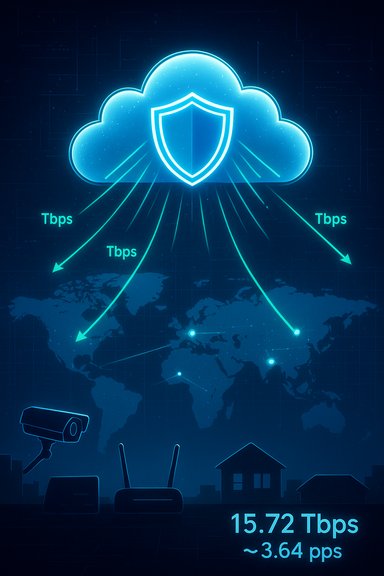
On October 24, Microsoft Azure’s automated DDoS protection neutralized an unprecedented, multi‑vector flood that reached a peak of 15.72 terabits per second (Tbps) and nearly 3.64 billion packets per second (pps) against a single public IP in Australia — an event Azure says it mitigated without any customer downtime.

A neon shield with a cloud icon guarding data in a futuristic network.Background​

The attack was attributed to the Aisuru family of Mirai‑variant IoT botnets, a rapidly evolving threat that has been responsible for multiple record‑setting volumetric and packet‑rate incidents in 2025. Aisuru’s operations primarily rely on compromised consumer devices — home routers, CCTV/DVRs and similar CPE — often hosted inside residential ISP address spaces. Industry telemetry shows this botnet and related “TurboMirai” variants have produced attacks in the 20–30 Tbps class and pushed packet rates into the billions per second. This Azure incident joins a string of hyper‑volumetric events observed across the industry in 2025, including a later publicized attack that Cloudflare reported at 22.2 Tbps and 10.6 billion pps, underscoring a fast‑moving escalation in both bandwidth and per‑packet aggression.

Why this matters: a short primer on Tbps vs pps​

Volumetric magnitude (Tbps) and packet rate (pps) stress different parts of the internet stack. High Tbps floods saturate bandwidth and force bandwidth‑level filtering and rerouting; extremely high pps attacks hammer routing and server CPUs, line cards, and stateful network appliances because every single packet requires processing, even if that processing is minimal.
  • Bandwidth (Tbps) attacks can be mitigated by capacity and volumetric scrubbing, but they can still overwhelm last‑mile or carrier interconnects if attackers coordinate large, widely distributed sources.
  • Packet per second (pps) attacks are often the harder problem: they can break routers and firewalls long before raw bit capacity is exhausted because the per‑packet work (interrupts, lookups, counters) is expensive. Azure’s October 24 target saw both extremes — massive bandwidth and immense pps — making it a textbook “hyper‑volumetric” test.

The attack: anatomy and observed characteristics​

What happened on October 24​

Azure’s published account describes a multi‑hour, automated campaign aimed at a single public IP in Australia that peaked at 15.72 Tbps and ~3.64 billion pps. The traffic was predominantly UDP floods using randomized source ports and limited source IP spoofing, which suggests the botnet relied on large numbers of legitimately routable infected hosts rather than spoofed/reflective amplification. Azure says its automated DDoS defenses detected the anomaly and applied adaptive filtering and scrubbing in real time, allowing customer workloads to continue serving legitimate users.

Who was behind it​

Microsoft and multiple industry analysts point to the Aisuru botnet — a TurboMirai‑style Mirai derivative — as the origin. Aisuru’s distinguishing characteristics are scale (hundreds of thousands of infected CPEs), use of residential ISP address space, and a preference for high‑rate UDP/TCP/GRE floods that are tuned for both bandwidth and pps impact. Netscout, KrebsOnSecurity and other investigative sources have documented Aisuru’s recent history of record attacks, including brief, experimental floods that reached even higher instantaneous peaks.

Attack techniques to note​

  • High‑speed UDP floods targeting random ports — maximizes wasted work on the target stack.
  • Minimal spoofing — most attack traffic came from unique, routable source IPs, enabling high pps while complicating simple traceback but also allowing ISPs to correlate and remediate infected subscribers.
  • Use of residential ISP hosts en masse — amplifies impact across provider network backbones and produces “outbound” congestion that harms innocent third parties.

How Azure defended (and what it proves)​

Microsoft credits its globally distributed scrubbing fabric, continuous telemetry and automated mitigation rules with absorbing and filtering the flood without service loss. Technical elements called out in Azure’s account include:
  • Global scrubbing centers that ingest, analyze, and drop malicious flows close to origination.
  • Automated detection based on baselining and anomaly detection to kick mitigation into gear without human intervention.
  • Adaptive filtering that discriminates between legitimate and malicious flows in real time, preserving good traffic while rejecting the rest.
These are the same core design patterns that large cloud providers and DDoS mitigators have pursued for years: push intelligence to the edge, scale scrubbing horizontally, and automate reaction so human operators don’t become the bottleneck.
Industry research highlights broader architectural dependencies and capabilities required to counter such events: large threat intelligence feeds, per‑flow telemetry at scale, and cooperation with ISPs to remediate infected CPE devices. Netscout’s post‑incident analysis emphasizes that botnets like Aisuru can generate multi‑Tbps floods and multi‑gpps packet rates that will overwhelm poorly instrumented networks and break chassis line cards in carrier gear if left unchecked.

Wider context: the new normal in DDoS​

2025 has shown a shocking pace of escalation. Several public incidents pushed the upper bound of what was previously assumed practical:
  • Cloudflare reported an attack peaking at 22.2 Tbps and 10.6 billion pps, which it mitigated automatically, establishing a new public benchmark for scale.
  • Investigations of Aisuru and TurboMirai families show repeated, sometimes experimental bursts above 20 Tbps and isolated spikes approaching 30 Tbps, often short in duration but devastating if unmitigated.
These events show two trends converging: (1) exploitation of enormous pools of consumer devices whose upstream links provide more bandwidth than many defenders can absorb, and (2) increasing emphasis on packet‑rate stress, which targets control‑plane and forwarding hardware rather than simply raw capacity.

Strengths of the defensive model demonstrated​

  • Automation at scale — Azure’s mitigation without downtime underscores the need for programmatic, telemetry‑driven defenses. Manual intervention is too slow at multi‑Tbps velocities.
  • Distributed scrubbing — filtering traffic close to the source reduces collateral damage to intermediary networks and prevents saturated transit links. Azure’s global fabric was central to the outcome.
  • Intelligence sharing and research — public vendor analyses (Netscout, Cloudflare and independent reporters) help map attacker toolchains and device populations used in botnets, enabling ISPs and vendors to prioritize firmware patches and device hardening.
The incident confirms the defensive playbook for hyperscale providers works when built with adequate breadth and automation. It also validates investments in high‑capacity backbones, scrubbing farms, and ML‑backed detection.

Weaknesses and risks the incident exposes​

While the mitigation was successful, the event also highlighted systemic and residual risks:
  • Reliance on provider scrubbing — many organizations lack independent mitigations and must rely on cloud or anti‑DDoS vendors. This concentration of defensive capability is effective, but it creates single points of dependency and potential vendor lock‑in.
  • Upstream and ISP impact — when botnets use residential devices en masse, the upstream ISP aggregate links can experience outbound churn and degradation. In some earlier Aisuru incidents carriers reported line‑card stress and service disruptions for innocent residential customers. That kind of collateral harm is visible in the telemetry Netscout and ISPs published.
  • Device insecurity and patch gaps — Aisuru propagates through poorly secured consumer CPEs and IoT devices, many of which lack update mechanisms or are managed by unaware consumers. Long‑term remediation requires ISPs, manufacturers and regulators to invest in firmware hygiene and secure default configurations.
  • Attribution and legal enforcement limits — even when mitigators can trace attack sources to subscriber IPs, the path from technical attribution to enforcement or remediation is long and complicated by transnational jurisdictional issues. Public statements by vendors often omit firm attribution beyond the botnet family.
Where mitigation succeeds at preserving availability, the industry still faces an unresolved upstream problem: how to shrink the ‘attack surface’ presented by insecure devices before they are harnessed at scale.

Practical guidance for Windows admins, site owners and cloud customers​

This incident is a wake‑up call for the upcoming holiday shopping season and for any organization exposed to public internet traffic. The following actions are prioritized, practical and achievable.

Immediate (0–7 days)​

  • Confirm your public endpoints are protected by a DDoS provider or have a plan for traffic scrubbing — if you rely on a cloud provider, validate mitigations and failover playbooks.
  • Verify monitoring and alerting thresholds — define normal baselines and ensure automated alarms for sudden Tbps/pps anomalies.
  • Enable layered protection: ensure you have both network‑layer DDoS protection and an application WAF for Layer‑7 threats.

Short term (1–3 months)​

  • Deploy or test automated failover and DNS/TLS routing plans to redirect traffic to scrubbing networks.
  • Run tabletop exercises and DDoS playbooks with incident response (IR) teams to exercise the process of coordinating with providers and ISPs.
  • Harden public‑facing authentication paths and APIs; remove exposed non‑essential services from public networks.

Mid to long term (3–12 months)​

  • Work with your ISP to identify outbound suppression and subscriber remediation processes — demand hardening of CPE and opt‑in firmware update programs.
  • Implement per‑flow and per‑tenant rate limiting and graduated throttling to throttle malicious pps without cutting legitimate traffic.
  • Consider multi‑region or multi‑provider architectures for critical services that must remain online under any provider stress.
Across all time horizons, the most valuable investments are in automation, telemetry and tested runbooks that coordinate between the cloud provider, customers and transit ISPs.

Technical deep dive: what defenders must measure and build​

Scrubbing capacity and distribution​

Effectively mitigating multi‑Tbps attacks requires scrubbing capacity that is:
  • Sufficiently large in aggregate and distributed to avoid concentrating traffic at a few PoPs.
  • Able to perform fast, per‑packet classification at extremely high pps.
  • Programmatically integrated with global routing (BGP) to steer traffic into scrubbing planes without manual intervention. Microsoft’s own description emphasizes these elements.

Per‑packet processing optimizations​

To survive billions of pps, mitigation systems must minimize work per packet:
  • Use hardware‑accelerated filtering and kernel bypass techniques to avoid CPU interrupts per packet.
  • Prioritize stateless filters for initial cuts and escalate to stateful inspection only for suspected traffic that needs deeper analysis.
  • Implement early‑drop heuristics to prevent resources from being spent on obviously malicious flows.

Outbound mitigation (ISP responsibilities)​

When botnets originate inside ISP address space, mitigation must include outbound suppression:
  • ISPs need telemetry to detect sudden, large outbound flows per subscriber aggregation and the ability to apply per‑subscriber rate limits or quarantines.
  • Coordination with subscriber owners (customers) to remediate infected devices is essential, but it must be accompanied by fast technical containment options to avoid network collateral damage. Netscout’s guidance makes the case for treating outbound suppression as equally important as inbound scrubbing.

Policy and vendor responsibilities​

The recurrence and scale of these botnets demand a policy and supply‑chain response:
  • Manufacturers must ship devices with secure defaults, remove hardcoded credentials, and provide reliable firmware update paths.
  • ISPs should implement stronger egress filtering, subscriber notification and quarantine flows.
  • Regulators might consider minimum security standards for consumer networking gear and mandatory disclosure requirements for large‑scale botnet infections.
  • Cloud and DDoS vendors must continue to invest in automated detection, open telemetry and inter‑vendor sharing to avoid duplication and speed mitigation.
These are not short‑term fixes; they require coordinated investments across the ecosystem.

What we still don’t know — and where caution is needed​

Public reporting provides firm numbers for this event because Microsoft published a mitigation summary; however, several items remain uncertain or are intentionally withheld by vendors for operational security:
  • Precise duration and full timeline of the attack from first packet to last scrubbed second are partially summarized by vendors but full packet captures and raw telemetry are not publicly released.
  • The exact infection vectors and exploits used to grow Aisuru’s army are still being pieced together by researchers; attribution of the operators behind Aisuru remains tentative in public reporting and should be treated with caution until law‑enforcement or multi‑party attribution is published.
Flagging these uncertainties is essential: defenders and policymakers should not over‑interpret early press claims that lack corroborating forensic evidence.

The business impact: cost, trust and the holiday calendar​

For any customer who sells directly online or depends on low‑latency services, these events pose real business risk:
  • Reputational risk — outages during peak shopping days are damaging even if short; customers notice dropped checkouts and failed sessions.
  • Operational cost — emergency mitigation, traffic reroutes and legal consultations carry direct costs, while longer‑term mitigation investments (scrubbing subscriptions, multi‑region replication) are an added budget line.
  • Insurance and contractual exposure — service level agreements and cyber insurance policies may be impacted by frequency and magnitude of these attacks; legal teams should re‑examine force majeure clauses and readiness for DDoS losses.
The Azure incident shows that when the provider has the pieces in place, availability can be preserved — but the preparedness gap between the largest clouds and the rest of the internet is widening. Businesses without appropriate coverage or partnerships remain exposed.

Final analysis and takeaway​

The October 24 mitigation demonstrates that with enough scale, automation, and distributed scrubbing capacity, hyperscalers can absorb hyper‑volumetric attacks without customer impact. Azure’s account and corroborating industry analyses make clear that the threat landscape has shifted: attackers now routinely target both bandwidth and packet processing limits using botnets made from insecure consumer gear. That achievement does not mean the problem is solved. The attack underlines several urgent needs:
  • Continued investment in automated, edge‑distributed mitigation.
  • A stronger focus on ISPs and device vendors to reduce the pool of exploitable hosts.
  • Regulatory and industry cooperation to improve baseline device security and incident response.
  • Operational preparedness by enterprises: layered protection, tested runbooks, and contractual clarity with providers.
The strategic lesson is simple: resilience depends on both defensive horsepower in the cloud and upstream remediation of insecure devices. Organizations that treat DDoS as an infrastructure problem — not just a perimeter problem — will be best positioned to survive the next wave of hyper‑volumetric assaults.

Checklist: immediate actions for IT teams​

  • Confirm DDoS and WAF coverage for every public IP and CDN endpoint.
  • Test provider mitigation procedures in a non‑production drill.
  • Instrument per‑flow telemetry and set pps and Tbps alerts.
  • Coordinate with ISPs about outbound suppression and subscriber remediation.
  • Harden and update CPE and IoT device inventories; require secure defaults on procurement.
These steps will not make attacks impossible, but they materially reduce the likelihood of service impact and speed recovery when incidents occur.

Microsoft’s October 24 mitigation stands as both a technical victory and an urgent reminder: cloud defenders can blunt even the largest current assaults when scrubbing capacity, automation and telemetry are correctly combined, but the broader ecosystem — device makers, ISPs, enterprises and regulators — must move faster to reduce the raw attack surface that enables this new era of hyper‑volumetric DDoS.
Source: Red Hot Cyber Microsoft Azure blocks a 15.72 terabit per second DDoS attack
 

On October 24, 2025, Microsoft Azure’s DDoS Protection automatically detected and neutralized a multi‑vector Distributed Denial‑of‑Service (DDoS) attack that peaked at 15.72 terabits per second (Tbps) and approximately 3.64 billion packets per second (pps), an event Microsoft describes as the largest DDoS attack ever observed in the cloud — a flood traced to the Aisuru IoT botnet and mitigated without reported customer downtime.

Neon blue cloud streams data to devices with a DDoS shield.Background​

Azure’s mitigation of this October 24 incident did not happen in isolation: 2025 has shown a rapid escalation in hyper‑volumetric DDoS activity, with multiple providers publicly reporting ever‑higher peaks in both bandwidth and packet rate. Cloudflare’s Q2 2025 report documents a 44% year‑over‑year increase in attacks during that quarter and highlights a surge in hyper‑volumetric incidents (attacks exceeding 1 Tbps or 1 Bpps), underscoring that the internet’s attack baseline is rising fast. Industry researchers and vendors point to a new generation of Mirai‑derived botnets — exemplified by Aisuru — that conscript vast numbers of consumer devices and CPE (customer‑premises equipment) to mount direct‑path, non‑spoofed floods that stress both bandwidth and packet‑processing capacity. Netscout’s ASERT team and investigative reporting show Aisuru has been associated with multiple record‑setting events across 2024–2025, and that its operations now intersect with a broader DDoS‑for‑hire economy.

What Microsoft reported: the October 24 event​

The headline numbers and target​

Microsoft’s Azure Infrastructure Blog states the attack peaked at 15.72 Tbps and ~3.64 billion pps, and that it targeted a single public IP hosted in Australia on October 24, 2025. Azure says the attack originated from more than 500,000 unique source IP addresses across multiple regions and consisted primarily of extremely fast UDP floods using randomized source ports and minimal source‑spoofing. Those characteristics, Microsoft argues, made the flood both brutally forceful and — importantly for defenders — traceable to infected devices rather than to forged sources.

Anatomy of the traffic​

The attack’s primary signatures were:
  • High‑throughput UDP floods tuned for both bandwidth (Tbps) and packet‑rate (pps) impact.
  • Pseudo‑randomized source and destination ports intended to waste target stack cycles.
  • Minimal IP spoofing — traffic came from routable addresses, which simplifies network‑level traceback and ISP remediation.
  • Extremely short, sharp peak bursts that maximize disruption potential while complicating long‑duration detection heuristics.
Microsoft reports its automated DDoS defenses detected and kicked in immediately, applying adaptive filtering and scrubbing at the edge of Azure’s network so that the customer’s services continued to serve legitimate traffic. The company’s published account credits global scrubbing centers, continuous telemetry, and automated mitigation logic as the keys to the resilience Microsoft demonstrated.

Who (likely) did it: Aisuru and the TurboMirai class​

Aisuru is described by multiple industry sources as a next‑generation Mirai derivative — part of what some analysts term TurboMirai — that recruits insecure home routers, CCTV/DVRs, and other IoT/CPE devices. Public incident analyses link Aisuru to earlier record events in 2025, including a 6.3 Tbps flood against KrebsOnSecurity in mid‑2025 and a string of subsequent, even larger bursts observed by network telemetry vendors. Netscout’s ASERT analysis and independent reporting by KrebsOnSecurity corroborate Aisuru’s emergence as a repeat offender capable of multi‑Tbps and multi‑gpps attacks. Aisuru’s operators appear to run a semi‑commercial service model that has, at times, excluded government and law‑enforcement targets — an operational restriction that does not absolve the actors of criminality and offers little protection to broader internet infrastructure. The botnet’s reliance on real, non‑spoofed devices means that ISPs can trace attack sources to subscriber networks, but it also means very large outbound volumes can saturate ISP upstream links and damage network hardware before remediation is complete.

Why these numbers matter: Tbps vs. pps and where damage happens​

DDoS metrics are not interchangeable. Bandwidth (Tbps) and packet rate (pps) stress different elements of the network and application stack, and the October 24 event was notable because it pushed both dimensions simultaneously.
  • High Tbps floods aim to saturate transit links and peering interconnects; if volume exceeds an ISP’s or data center’s capacity, traffic black‑holing or upstream disruption becomes inevitable.
  • High pps floods — billions of small or medium‑sized packets per second — hammer packet processing, exhausting CPU, interrupts, flow tables, and forwarding ASICs on routers and firewalls, sometimes causing line‑card failures long before bandwidth is saturated.
This dual‑dimension stress makes mitigation more complex. Volumetric scrubbing can absorb bit‑level load if capacity exists at the scrubbing layer, but extremely high packet rates require specialized mitigation appliances and per‑flow classification at massive scale. The attack Azure handled was therefore a real stress test of both anycasted scrubbing capacity and fine‑grained, automated traffic classification.

How Azure’s defenses worked — and what that shows​

Microsoft’s public summary attributes the successful defense to these capabilities:
  • A globally distributed scrubbing fabric that can absorb and analyze high volumes of traffic close to the ingress points.
  • Automated detection based on continuous baselining and anomaly detection that triggers mitigations without human intervention.
  • Adaptive filtering that preserves legitimate flows while removing malicious packets in real time.
  • Coordination with upstream peers and ISPs when traceback and remediation of infected CPE is required.
That mix — scale plus automation — is the architecture that leading cloud providers and DDoS mitigation vendors have pursued for years. The Azure case demonstrates the practical payoff: when mitigation is programmatic, sufficiently provisioned, and distributed, a hyperscaler can blunt hyper‑volumetric assaults without visible customer impact. However, the same architecture also concentrates resilience in a few providers; organizations that rely on smaller ISPs or run their own ingress points without a major mitigator remain substantially more exposed.

Cross‑checks and corroboration​

Microsoft’s blog post is the primary public account of the October 24 mitigation. Independent and authoritative corroboration appears in Netscout’s ASERT executive summary and investigative reporting from KrebsOnSecurity, which provide context about Aisuru’s growth, technique set, and prior incidents. That multi‑party corroboration (cloud provider + network security vendor + independent reporter) satisfies the need for cross‑referencing on the central claims about the attack’s origin and profile — while leaving some operational details (exact duration, raw telemetry, device counts at per‑ISP granularity) private for security reasons. A caution is warranted when comparing public peak numbers across incidents: measurement vantage points, aggregation methods, and the difference between instantaneous short spikes and sustained throughput can produce divergent headline figures. Netscout documents Aisuru‑related bursts already exceeding 20 Tbps in October, and Cloudflare and others have reported separate record peaks in 2025; these figures are real indicators of escalating capacity, but precise comparisons require common measurement framing. Treat cross‑incident magnitudes as directional evidence of escalation rather than perfectly harmonized metrics unless raw telemetry and methodology are disclosed.

The systemic implications: what this means for networks, ISPs and enterprises​

The October 24 mitigation should be read as both a defensive win and as a systemic alarm bell.
  • For cloud providers, the event validates aggressive investment in global scrubbing capacity, per‑flow telemetry, and automated response playbooks. These capabilities will remain essential and costly.
  • For ISPs and broadband operators, the problem is upstream: compromised home devices generate outbound floods that can congest upstream peering and damage carrier gear. Greater egress filtering, automated quarantine of infected subscribers, and CPE remediation programs are now operational necessities. Netscout emphasizes the need for outbound suppression equal in priority to inbound mitigation.
  • For enterprises and SMBs, reliance on provider protections must be paired with architectural hardening: CDN/fronting, DDoS protection subscriptions, layered defenses (L3/4 scrubbing plus Layer‑7 WAFs), and exercised incident plans are now baseline risk management practices.
The October event also sharpens the policy and procurement picture: secure‑by‑default IoT hardware, firmware update obligations, liability frameworks for device vendors, and better transparency from ISPs about CPE security are logical policy responses if the attack surface is to be reduced sustainably.

Practical checklist for IT teams and WindowsForum readers​

  • Enable provider DDoS protections (Azure DDoS Protection Standard or equivalent) for every public IP and internet‑facing endpoint.
  • Front origins with CDN or WAF services to avoid exposing raw origin IPs.
  • Configure and test DNS failover and traffic‑routing playbooks; exercise them in planned drills.
  • Monitor both bandwidth (Tbps) and packet‑rate (pps) metrics; set alarms for unusual pps spikes.
  • Work with ISPs on egress filtering and subscriber remediation workflows; require automated quarantine for CPE that shows attack behavior.
  • Inventory and segment IoT/CPE: remove consumer devices from production networks, change default credentials, and apply firmware updates promptly.

Strengths demonstrated by the mitigation — and why they matter​

The October 24 event showcased several notable strengths in contemporary cloud defense:
  • Automation at scale: Azure’s systems detected and mitigated the flood without requiring human‑in‑the‑loop decisions, which is essential when attacks reach millions or billions of packets per second.
  • Distributed scrubbing: Anycasted scrubbing centers limited the need to push traffic all the way to a single sink, containing link saturation and protecting downstream workloads.
  • Traceability due to non‑spoofed traffic: Because the botnet used real, routable IPs, network operators had a better chance at correlating traffic to infected subscribers and initiating remediation. This is an operational advantage when defending at scale.
These strengths reduce the probability of visible customer outages for large clouds, but they are not a universal fix. Smaller providers and self‑hosted services often lack equivalent capacity and automation, meaning their exposure remains much higher.

Risks, unknowns and caveats​

  • Measurement variance: Peak numbers reported across vendors and press accounts can reflect different measurement points and durations. Short, high‑intensity bursts may produce very large instantaneous peaks without representing sustained throughput, so direct comparisons between incidents should be made cautiously.
  • Attribution limits: Publicly naming a botnet family such as Aisuru is useful operationally, but detailed forensic attribution of the human operators often remains unresolved without multi‑party law‑enforcement coordination. Public vendor reports rightly withhold some raw telemetry for operational security reasons.
  • Collateral infrastructure damage: Even when cloud mitigations prevent service outages for targeted tenants, outbound floods from infected CPE can damage ISP networks, degrade service for other subscribers, and even cause router hardware failures at carriers if not suppressed quickly. Netscout has warned about chassis line‑card stress and operational impacts to ISPs in multiple incidents.
  • Attack evolution and monetization: The Aisuru family has reportedly expanded beyond simple DDoS to offer residential proxy capabilities and other services that monetize compromised devices — a development that makes the botnet more resilient and financially sustainable. This turns IoT compromise into a long‑term systemic risk rather than a short‑lived nuisance.
Where specific, extraordinary claims appear in public reporting (for example, intermittent references to 20–30 Tbps “experimental bursts”), they should be labeled as indicative and subject to verification; the industry is seeing transient spikes and experimental testing by botnet operators, but unified telemetry and standardized measurement methodologies would be required to treat every headline figure as directly comparable.

Strategic takeaways: an industry at an inflection point​

  • Attack capacity is growing because the underlying internet is faster: higher‑speed consumer links, ubiquitous broadband, and more capable CPE equip botnets with more aggregate throughput than in previous years. The consequence is a steady increase in the size and destructive potential of volumetric and packet‑rate attacks.
  • Providers must keep automating: Manual mitigation cannot keep pace when an attack generates billions of packets per second. Automated detection, mitigation orchestration, and failover playbooks are now operational prerequisites rather than optional capabilities.
  • Upstream remediation is critical: Cloud scrubbing wins time and prevents customer impact, but the long‑term solution requires ISPs and device vendors to reduce the pool of exploitable endpoints through secure defaults, firmware delivery, and egress filtering. Policy and market incentives (e.g., procurement standards and liability frameworks) will accelerate progress if adopted.
  • Smaller operators are exposed: The protection gap between hyperscalers and smaller networks is widening. Organizations that cannot afford large‑scale scrubbing should use multi‑provider strategies, fronting via major CDNs, or contract commercial scrubbing services to reduce risk.

Conclusion​

Azure’s automatic mitigation of the October 24, 2025 attack was a clear technical victory: a hyperscale cloud demonstrated the capacity to absorb a 15.72 Tbps, ~3.64 billion pps onslaught with no reported downtime for customer workloads. That success, corroborated by Microsoft’s own account and by independent vendor analyses, proves that with sufficient scale, automation, and distributed scrubbing, defenders can blunt even the largest current assaults. Yet the episode is as much a warning as it is a proof point. Botnets like Aisuru are evolving in capability and business model, consumer‑grade devices remain insecure at scale, and measurement ambiguity makes public comparison of “record” attacks noisy. The long‑term path to resilience runs through coordination: cloud providers, ISPs, device manufacturers, security vendors, and regulators must all act together to shrink the attack surface and invest in the upstream controls that stop massive botnets from forming in the first place. Until that happens, the record books will likely be rewritten again — and defenders must plan for that inevitability.
Source: Techzine Global Microsoft Azure thwarts largest cloud DDoS attack ever
 

Microsoft Azure’s edge network absorbed and neutralized a staggering distributed denial-of-service campaign on October 24, 2025 that peaked at 15.72 terabits per second (Tbps) and pushed roughly 3.64 billion packets per second (pps) at a single public IP in Australia — an event Azure says it mitigated automatically without customer downtime.

Blue neon shield labeled DDoS MITIGATION, with network gear and a scrubbing center in a cyber defense scene.Background​

The October 24 event is one of a string of hyper‑volumetric DDoS incidents recorded throughout 2025 that have re‑shaped defensive priorities for cloud operators, ISPs, device manufacturers, and enterprise security teams. The attack has been attributed to the Aisuru family of Mirai‑derived, Turbo‑Mirai–class IoT botnets, which industry telemetry shows can marshal hundreds of thousands of compromised consumer devices to generate both enormous bandwidth and extreme packet rates.
This incident is notable for three converging trends: (1) an escalation in aggregate bandwidth available to attackers as residential and small‑business links move to fiber and higher upstream capacities; (2) a shift in attacker focus toward packet‑rate stress (pps) that targets forwarding and control‑plane resources, not just raw link capacity; and (3) the persistence of insecure customer premises equipment (CPE) and IoT devices as a renewable pool of botnet assets.

What happened: the attack in plain terms​

On a single day in late October, malicious actors launched a multi‑hour, multi‑vector campaign that combined high throughput and massive packet rates against a single public IP address hosted in Australia. The attack profile included:
  • Peak throughput: 15.72 Tbps.
  • Peak packet rate: ~3.64 billion pps.
  • Source population: more than 500,000 unique source IP addresses drawn largely from residential ISP address space.
  • Primary vectors: sustained UDP floods with randomized source ports and minimal source IP spoofing — indicating the traffic came from legitimately routable, compromised endpoints rather than classic reflector/amplifier attacks.
That combination — very high Tbps plus very high pps produced by real, routable hosts — stresses both bandwidth and packet‑processing capacity across networks and end devices, making mitigation materially harder than a pure volumetric or pure application‑layer assault.

Anatomy of the defensive response: how Azure stopped it​

Azure’s account stresses automation, global scale, and rapid scrubbing as the pillars of the defense that prevented customer impact. The mitigation playbook implemented in real time included:
  • Automated detection based on per‑flow telemetry and baseline anomaly detection to trigger mitigation without human delay.
  • Global scrubbing fabric using anycasted front doors and distributed scrubbing centers to ingest, analyze, and drop malicious flows close to the ingress.
  • Adaptive filtering that discriminates legitimate from malicious traffic in real time to preserve good sessions while dropping attack traffic.
  • Coordination with transit providers where upstream suppression and routing adjustments limit collateral congestion on carrier links.
Azure reports the mitigation completed automatically and preserved availability for protected workloads — a validation of cloud‑native, telemetry‑driven DDoS architectures built at hyperscale.

Technical analysis: why Tbps and pps matter — and why both together are dangerous​

Tbps and pps stress fundamentally different parts of the network:
  • Throughput (Tbps) stresses link capacity and demands large aggregate bandwidth to be absorbed or rerouted. Defenses rely on headroom, anycast distribution, and volumetric scrubbing.
  • Packet rate (pps) stresses per‑packet processing: interrupts, routing/forwarding lookups, firewall/state management and NIC/line‑card resources. High pps can cause forwarding plane or control plane failure long before a link is saturated.
When attackers combine both vectors — sending large numbers of medium‑sized packets to maximize both bps and pps — the defender must both absorb raw capacity and avoid overwhelming forwarding hardware, a materially harder engineering problem. Azure faced such a hybrid stressor in this attack.

The botnet: Aisuru’s capabilities and tactics​

Aisuru is described by industry telemetry as a Turbo‑Mirai–class IoT botnet that leverages poorly secured consumer devices to produce enormous aggregate capacity. Key operational characteristics attributed to Aisuru include:
  • Scale: hundreds of thousands of compromised CPEs (home routers, IP cameras, DVRs) forming a widely distributed source pool.
  • Preference for direct floods: high‑rate UDP, TCP, and GRE floods targeted at both bandwidth and pps saturation.
  • Minimal spoofing: most traffic originates from real subscriber IPs, which helps generate extreme pps while also leaving traceable trails for ISPs.
  • Monetization and re‑use: beyond DDoS, botnets like Aisuru are sometimes repurposed as residential proxy platforms or for other criminal services, which sustains their persistence.
The practical consequence is stark: an attacker needs fewer technical tricks when sheer per‑node throughput and population size are large. That reduces sophistication requirements at the operator level while increasing the destructive capacity of the botnet.

Strengths demonstrated by the mitigation — what worked​

Azure’s successful defense exposes a set of defensive strengths that are now essential for any organization that faces internet‑scale threats:
  • Automation at scale — detection and mitigation without manual intervention prevented operator bottlenecks at multi‑Tbps speeds.
  • Edge distribution and scrubbing capacity — global anycast and scrubbing centers limited the attack’s capacity to saturate a single egress/ingress point.
  • Telemetry and per‑flow visibility — rich data allowed adaptive filtering to preserve legitimate flows while discarding malicious ones.
Organizations and defenders should treat these attributes — automation, breadth of scrubbing, and deep visibility — as minimum requirements rather than optional extras.

Risks exposed and unresolved problems​

The incident also highlights systemic weaknesses that mitigation alone cannot solve:
  • The expanding attack surface — more fiber to the home and more powerful consumer CPE increase per‑node capacity for botnets, raising baseline attack ceilings.
  • Collateral impact to ISPs and third parties — when hundreds of thousands of subscriber devices are used, upstream links and carrier hardware can experience line‑card stress or congestion that harms innocent customers.
  • Dependence on a few large defenders — many businesses lack in‑house capacity and must rely on hyperscalers or anti‑DDoS vendors, creating concentration risk and potential vendor lock‑in.
  • Attribution and enforcement friction — technical tracebacks can identify contributing IPs, but cross‑border legal action, takedown, and remediation remain slow and uneven.
These systemic issues mean mitigation is necessary but not sufficient: the broader ecosystem — ISPs, device vendors, regulators, and cloud providers — must coordinate to reduce the pool of vulnerable devices and implement upstream controls such as egress filtering and rapid subscriber remediation.

Practical guidance for IT teams, Windows admins, and site owners​

The Azure incident should inform immediate and medium‑term operational priorities. The following checklist organizes actions by timeframe.

Immediate (0–7 days)​

  • Confirm DDoS protection is enabled for every public IP and CDN endpoint; verify the protection tier matches business needs.
  • Validate monitoring and alerting thresholds for Tbps and pps anomalies; set automated alarms.
  • Ensure layered defenses: network‑layer DDoS scrubbing plus an application‑level WAF.

Short term (1–3 months)​

  • Exercise traffic rerouting and DNS/TLS failover plans with your provider.
  • Run tabletop DDoS drills to validate operational runbooks and escalation contacts with cloud and transit providers.
  • Harden exposed management APIs and remove unnecessary public services.

Mid to long term (3–12 months)​

  • Implement per‑flow and graduated rate limiting to throttle malicious pps while preserving legitimate traffic.
  • Work with ISPs to establish upstream suppression and subscriber quarantine/remediation workflows.
  • Consider multi‑region or multi‑provider architectures for critical services requiring maximum resilience.
Across all horizons, invest in automation, telemetry, and tested runbooks that integrate cloud providers, ISPs, and internal incident response teams.

Policy, vendor, and industry actions that matter​

Mitigation alone will not blunt the trend toward larger botnets. Structural remedies include:
  • Secure defaults for consumer devices: ship with no default credentials, disable remote management by default, and include robust, signed firmware update mechanisms.
  • ISP egress filtering: deploy and enforce source address validation and rate limiting at the access edge (BCP38/BPI frameworks where applicable).
  • Industry telemetry sharing: anonymized indicator feeds between hyperscalers, ISPs and CERTs accelerate remediation and enable upstream suppression.
  • Regulatory levers: minimum security standards, warranty and update obligations, and liability incentives for insecure devices could shift vendor incentives.
Without these systemic changes, the internet will continue to scale in capacity while leaving the weakest links — consumer devices and access networks — unresolved.

The CVE list included in early reporting — exercise caution​

Initial publicized summaries circulating after the attack included a tabulated set of CVE‑style identifiers (for example CVE‑2025‑1234, CVE‑2025‑5678, CVE‑2025‑9101 and others) paired with vulnerability descriptions. Those entries are not corroborated by the operational telemetry publicly disclosed by Microsoft and industry analysts, and they should be treated as unverified until vendors or CVE authorities publish formal advisories. If you see such CVE lists in press accounts or vendor blogs, validate each entry directly against official CVE and vendor advisories before acting.

What defenders should expect next: trends and projections​

Several credible trajectories make similar incidents more likely:
  • Faster upstream links on consumer connections will raise per‑node throughput, enabling larger botnet peaks even without expanding device counts.
  • Botnet operators will continue to optimize for packet‑rate impact — pps — because hitting packet handling limits in routers and appliances can produce disproportionate disruption.
  • Attackers will diversify monetization models (DDoS‑for‑hire, residential proxying) to finance sustained botnet operation and growth.
The defensive implication is clear: mitigation scale must continue to grow, and upstream remediation (device hardening, egress controls, and regulated device lifecycles) must become central to internet stability.

Industry takeaways: the limits of a provider‑only strategy​

The Azure mitigation shows hyperscale clouds can, and do, absorb record attacks when they have the right automation and capacity in place. That, however, is not a universal panacea:
  • Small and mid‑sized businesses without provider scrubbing contracts risk being overwhelmed.
  • Concentrating defensive capacity in a few hyperscalers addresses availability for those customers but concentrates systemic dependency and may shift collateral risk to ISPs and transit networks.
Meaningful resilience therefore requires a blended approach: provider scrubbing plus upstream ISP controls, plus vendor responsibilities and regulatory incentives to shrink the population of compromised devices.

Conclusion​

The October 24 mitigation event is a technical triumph for Azure’s automated DDoS protection and a sobering reminder that attacker capacity has climbed rapidly — driven by insecure IoT and faster consumer broadband. The incident validated the modern defensive playbook: push telemetry and mitigation to the edge, automate responses at hyperscale, and coordinate with transit providers and ISPs.
At the same time, the attack exposes deep systemic fragility. Without coordinated action across vendors, ISPs, cloud providers, and policymakers to secure the vast installed base of consumer devices and enforce upstream controls, defenders will be locked into a perpetual race to add more scrubbing capacity. For enterprises and Windows admins, the imperative is immediate: enable and test DDoS protection now, exercise incident playbooks, and prioritize layered defenses and telemetry.
This episode will likely be remembered not just for the headline numbers, but for the hard lesson it reinforces: availability at internet scale is achievable — but only when mitigation engineering is paired with upstream remediation and a commitment to secure‑by‑default device economics.

Source: Cyber Press https://cyberpress.org/azure-network-hit-15-tbps-ddos-attack/
 

Neon cloud security shield with flowing data streams and automated mitigation metrics.
Microsoft's Azure network automatically detected and mitigated a multi‑vector distributed denial‑of‑service (DDoS) attack that peaked at 15.72 terabits per second (Tbps) and nearly 3.64 billion packets per second (pps) on October 24, 2025 — a single event Microsoft describes as the largest cloud DDoS attack observed to date. The assault originated from an evolving Mirai‑style IoT botnet known as Aisuru (also spelled Aisuro in some reporting), which leveraged more than 500,000 compromised IP addresses — mostly consumer routers, cameras and other internet‑connected edge devices — to push extreme UDP flood bursts at a single public IP in Australia. Azure’s distributed DDoS Protection network intercepted, filtered and rerouted the malicious traffic, keeping the targeted customer workloads online without visible impact.

Background and context​

The escalation in raw DDoS scale over 2024–2025 has been dramatic: what used to be measured in single‑digit Tbps is now regularly breaking into double digits, and packet rates in the billions per second are becoming a central metric for impact. Cloudflare’s public reporting earlier in 2025 documented attacks at 7.3 Tbps (mid‑June) and later incidents rising above 11 Tbps, with other industry reporting confirming further spikes into the low‑20 Tbps range in September and October. These events illustrate two connected trends: attackers are weaponizing vast fleets of insecure Internet of Things (IoT) devices, and the combination of higher consumer fiber speeds and more powerful CPE (customer premises equipment) is lifting the maximum possible throughput attackers can generate.

Why this attack matters​

This October 24 event is significant for three technical reasons:
  • Throughput peak (15.72 Tbps): raw bandwidth at this scale threatens transit and peering capacity as well as targeted links.
  • Packet‑rate pressure (3.64 Bpps): packet processing — interrupts, kernel paths, firewall state tables, and forwarding engines — becomes the limiting factor for many devices and appliances, often long before raw bandwidth saturates.
  • Source distribution (>500k IPs): vast, geographically dispersed source pools make simple upstream filtering or single‑ASN blocking ineffective and increase collateral damage risk for ISPs and customers.
These traits — hyper‑volumetric throughput, hyper‑high packet rates and massive source counts — are the defining characteristics of hyper‑volumetric DDoS attacks that defenders now face.

What Microsoft reported: the technical summary​

Microsoft’s Azure Infrastructure blog provides a concise, technical account of the incident and the protective measures that worked in this case. Key technical takeaways from the Azure post and corroborating reporting are:
  • The attack occurred on October 24, 2025, and targeted a single public IP address hosted on Azure in Australia.
  • Peak throughput reached 15.72 Tbps and the packet rate peaked near 3.64 billion pps. The attack used high‑rate UDP floods aimed at saturating both the link and the endpoint’s packet processing capacity.
  • Malicious packets came from more than 500,000 unique source IPs, with minimal source IP spoofing and randomized source ports — a pattern that both raised volume and, paradoxically, made some traceback simpler for providers.
  • Microsoft attributes the attack to the Aisuru botnet, a "Turbo Mirai–class" IoT botnet that researchers and multiple reporters say has been responsible for several record‑scale DDoS events in 2025, and which expanded rapidly after an April compromise of a consumer router firmware update infrastructure.
  • Azure DDoS Protection’s global, anycasted scrubbing and automatic mitigation functionality detected and mitigated the attack without any visible downtime for the customer. Microsoft emphasizes automated detection, traffic filtering and redirection to preserve service availability.
These are the most load‑bearing technical claims about the event; they are consistent across Microsoft’s own disclosure and independent reporting from specialist security outlets.

The Aisuru botnet: anatomy and evolution​

Aisuru (sometimes referenced as Aisuro in press) is now front and center in public DDoS threat analysis. Independent research teams, including XLab (Qi’anxin’s research arm), tracked the botnet’s expansion and have linked it to multiple high‑throughput attacks through 2025.

What makes Aisuru dangerous​

  • It is built from the classic Mirai family lineage but augmented with “turbo” capabilities for higher concurrency and throughput.
  • Aisuru’s operators actively exploit both N‑day and zero‑day vulnerabilities across common home networking gear, IP cameras, DVRs/NVRs and widely used Realtek‑based device firmware. Those compromised devices often reside on residential ISP networks, where subscribers have high upstream capacity and less operator scrutiny.
  • The botnet is modular: besides raw UDP/TCP flood engines it offers features for proxying, residential‑proxy services and reverse shells — suggesting monetization beyond simple DDoS‑for‑hire.
A critical expansion vector for Aisuru was a reported compromise of a Totolink router firmware update server in April 2025. That supply‑chain style incident allowed the botnet to seed a very large number of devices quickly and is frequently cited by researchers as a turning point in the botnet’s scale. While vendor patching and takedowns mitigated that specific vector, the episode shows how fragile the firmware‑update and distribution trust chain can be for consumer CPE.

Attribution caveats​

Attributing botnets to a specific operator is inherently probabilistic. XLab’s detailed telemetry and captured C2 artifacts present a strong linkage between Aisuru and the recorded attack waves, but caution is warranted: botnet panels can be forked or sold, and multiple actors sometimes reuse the same exploit chains. As such, when public reports attribute attacks to Aisuru, they do so from a combination of code‑level signatures, observed C2 infrastructure and infection telemetry — not definitive law‑enforcement‑grade attribution in all cases. Where reporting lacks direct access to fullforensic data, those conclusions should be treated as credible but not absolute.

How Azure and modern cloud scrubbing networks mitigated the attack​

Microsoft’s post highlights three pillars of modern cloud DDoS defense that allowed Azure to absorb and filter the attack without customer‑facing disruption:
  • Global anycast scrubbing fabric: traffic destined to an IP is automatically routed to a distributed scrubbing network that spreads load across many scrubbing points and leverages massive aggregate capacity. This reduces the chance a single upstream link or scrubbing center becomes the choke point.
  • Automated detection and policy activation: Azure’s DDoS Protection detected anomalous high‑rate UDP bursts and activated mitigation rules automatically, rather than waiting for manual intervention. This is essential for sub‑minute bursts where human reaction time is too slow.
  • Layered filtering and rerouting: by applying coarse upstream filters (to protect backbone links) and fine‑grained packet inspection at scrubbing nodes, the service retained legitimate sessions while dropping malicious state‑exhausting packets. Microsoft emphasizes the combination of rate‑based filters, protocol validation and behavioral signatures.
These defensive elements — anycast absorption, automation, and layered filtering — are widely recommended by network security practitioners and were demonstrably effective here. However, the event also exposes where even these best practices must keep evolving.

Critical analysis: why defenders can’t be complacent​

Azure’s success in this instance demonstrates the efficacy of cloud‑scale automatic mitigation, but it is not a reason for complacency. The landscape is changing in ways that raise new and systemic risks.

1) Scaling is asymmetric​

Attackers scale by aggregating insecure endpoints (IoT devices and consumer routers) and exploiting the continued rollout of faster home broadband. Defenders must scale both bandwidth and packet‑processing capacity across distributed nodes. The latter is costly and operationally complex: upgrading forwarding plane capacity, maintaining large scrubbing fabrics and ensuring low‑latency distribution are nontrivial tasks for cloud and network providers. Microsoft’s mitigation was effective because Azure already had that scale; smaller providers and enterprises often do not.

2) PPS is the new hard limit​

High packet rates (billions per second) stress CPU and interrupt handling on routers, firewalls and load‑balancers. Even if bandwidth is absorbed by an anycast fabric, the edge devices that carry local customer traffic can collapse under the packet load. Mitigation strategies that address only bandwidth (Gbps/Tbps) without considering packet processing (pps/Bpps) will fail under hyper‑volumetric bursts. Network architecture must now be survivable on a packets‑per‑second basis as well as throughput.

3) Residential ISPs are collateral battlegrounds​

Aisuru and similar botnets rely heavily on compromised devices sitting in home networks, often upstream of residential ISPs. These ISPs are ill‑equipped to inspect or remediate large infected fleets, and they also risk service disruption when upstream filters are applied. The result: attack traffic can cause congestion and outages for entirely uninvolved customers and small businesses. That exposes a structural vulnerability in last‑mile networks that industry, regulators and consumer device vendors must address.

4) Supply‑chain infection vectors are catastrophic​

The reported Totolink firmware update server compromise shows that single points of trust — firmware servers, code signing processes, and vendor update channels — can be leveraged for mass infection. Defender strategies must include more robust verification of firmware integrity, code signing enforcement, and monitoring of distribution infrastructure to detect anomalous post‑update behavior.

5) Monetization & proxying complicate takedowns​

Aisuru’s modular features — residential proxying and proxy resale — suggest criminal economies beyond pure DDoS rentals, which complicates law enforcement and industry responses. Botnets that act as infrastructure for multiple illicit services mix protection‑against‑DDoS with revenue streams that make takedown a higher‑value target and a moving one.

Practical recommendations for IT teams and service providers​

Given the increased frequency and magnitude of hyper‑volumetric attacks, organizations should update their DDoS readiness across people, process and technology.
  • Harden internet‑facing workloads by default. Ensure all public endpoints are protected by a cloud DDoS scrubbing service or an ISP‑level filtering agreement.
  • Treat packet rate (pps) ceilings as first‑class requirements. Benchmark edge routers, firewalls and load‑balancers by Mpps performance and plan capacity accordingly.
  • Use anycast and multi‑region anycast routing to distribute inbound traffic. Anycast absorption reduces the probability of single‑link saturation.
  • Pre‑arrange BGP Flowspec / upstream filtering agreements with carrier partners. During a hyper‑volumetric surge, upstream blocks can prevent last‑mile congestion.
  • Apply network segmentation for IoT and CPE. Isolate consumer‑grade devices from enterprise traffic and avoid exposing them to the internet where possible.
  • Enforce firmware and device management hygiene. Require automatic updates where acceptable, validate code signing, and disable legacy services like UPnP on routers where feasible.
  • Automate detection and response. Mitigation playbooks should activate within seconds; manual ticketing paths are too slow for 30–60 second bursts.
  • Run DDoS tabletop and live exercise drills with scrubbing providers and ISP partners. Test failover behavior and SLO impacts under simulated high‑pps loads.
These are operational priorities that turn technical lessons into actionable defenses. They are not a checklist for total immunity — rather, they narrow the attack surface and reduce downtime risk.

Broader industry implications​

  • Market pressure for scrubbing capacity: Providers that offer DDoS mitigation will be pressured to expand both aggregate bandwidth and packet‑processing capability. Expect increased investment in anycast scrubbing networks, specialized packet processors, and hardware offload for per‑packet operations.
  • Regulatory and vendor responsibility spotlight: Device vendors and upstream firmware distributors will attract scrutiny when supply‑chain compromises are shown to catalyze mass infections. Stricter baseline security requirements for consumer networking equipment are likely to become a demand from regulators and enterprise procurement.
  • Insurance, SLAs and contractual risk: As DDoS events escalate in peak magnitude and collateral impact, cyber insurers, cloud providers and MSPs will need clearer SLA language around mitigation timelines, capacity guarantees and compensation where mitigation cannot prevent downstream outages.
  • Law enforcement & cross‑border coordination: Botnets that exploit devices in many countries require rapid, international coordination to neutralize C2 infrastructure and disrupt monetization channels. Public‑private partnerships will be essential to combine telemetry and effect takedowns.

What remains uncertain or unverified​

Several public claims about the botnet and its behavior deserve cautious treatment:
  • The precise number of compromised devices and exact operator identities are difficult to verify publicly; research teams provide estimates based on telemetry and captured command‑and‑control artefacts, but these numbers can fluctuate and should be treated as informed estimates rather than absolute counts.
  • While multiple sources have linked earlier ultra‑large DDoS events to Aisuru, some later public reports differ in attribution or lack full forensic disclosures; this is common in botnet reporting and underscores the need for corroborating telemetry before firm attribution.
  • Not all vendor or upstream mitigation details are publicly disclosed — for example, exact scrubbing node locations, filter rules or BGP actions are operational details that providers rarely publish at scale. That can make independent verification of mitigation timelines and collateral effects incomplete from outside observers.
Where public reporting lacks corroborating forensic evidence, cautionary language is applied: statements are labeled as credible reporting from industry researchers, not incontrovertible facts.

Conclusion: a new baseline for internet resilience​

The October 24 attack on Azure — at 15.72 Tbps and 3.64 Bpps — is a clear inflection point in publicly disclosed DDoS history. It confirms that modern attackers can marshal enormous, short‑duration bursts that threaten both bandwidth and packet‑processing capacity, and that botnet operators will continue to exploit insecure consumer endpoints and supply‑chain weaknesses.
Microsoft’s successful mitigation illustrates that cloud‑scale automated defenses can and do work when properly architected and provisioned. Yet the event also signals a tougher operational environment for smaller providers, residential ISPs and enterprises that cannot replicate Azure’s scale overnight. Resilience now requires a mix of technical investment (anycast scrubbing, Mpps headroom), operational readiness (automated playbooks and upstream filtering), and ecosystem measures (vendor firmware security, coordinated takedown capabilities).
The immediate takeaway for IT leaders is straightforward: assume the next DDoS will be larger, faster and measured in both Tbps and billions of pps. Plan for packet‑processing resilience, force automation for detection and mitigation, and hold vendors accountable for device‑level security — these steps are no longer optional if sustained availability is a business requirement.
Source: heise online New DDoS peak: Microsoft fends off 15.7 TBit/s attack
 

A digital visualization related to the article topic.
Microsoft’s Azure DDoS Protection absorbed and neutralized an unprecedented cloud‑scale assault on October 24, 2025 that peaked at 15.72 terabits per second (Tbps) and roughly 3.64 billion packets per second (pps), an event Microsoft and independent industry reporting describe as the largest cloud DDoS incident recorded to date.

Background​

The October 24 incident targeted a single public IP hosted in Australia and was traced to a Mirai‑derived IoT botnet known in press and telemetry as Aisuru (also referenced occasionally as Aisuro). Reports indicate more than 500,000 unique source IP addresses participated, primarily sending high‑rate UDP floods with randomized source ports and minimal spoofing — a pattern consistent with large fleets of legitimately routable consumer devices.
This event is not an isolated outlier but part of a clear 2025 trend: publicly disclosed DDoS peaks have climbed into the double‑digit Tbps range while packet‑rate attacks (pps) have reached the billions, forcing a rethink of defensive priorities across cloud operators, ISPs and enterprise IT teams.

What happened: a concise technical summary​

Microsoft’s published account and subsequent industry analyses converge on several core facts about the attack:
  • Peak throughput: 15.72 Tbps.
  • Peak packet rate: ~3.64 billion pps.
  • Target: a single public IP address in Australia on October 24, 2025.
  • Source population: >500,000 unique IPs, primarily consumer CPE (home routers, IP cameras, DVRs).
  • Primary vector: sustained UDP floods with randomized source ports and minimal source IP spoofing.
These characteristics — extremely high bandwidth plus astronomical packet rates coming from real endpoints — make the incident a textbook example of a hyper‑volumetric DDoS attack that stresses both network capacity and per‑packet forwarding/processing resources.

Anatomy of the attack​

Multi‑vector, multi‑metric pressure​

Attackers no longer need a single magic trick. The October 24 wave combined tactics that stress different parts of the internet stack simultaneously.
  • Bandwidth (Tbps) pressure: floods intended to saturate transit and peering links. This demands scrubbing capacity and anycast distribution to avoid chokepoints.
  • Packet‑rate (pps) pressure: enormous numbers of packets per second that strain router line‑cards, NICs, kernel network stacks and firewall appliances. High pps can break forwarding planes even when raw bit capacity remains available.
Because the attack used real, routable IPs (limited spoofing) and randomized ports, it achieved both high throughput and high packet rates while leaving a more straightforward trail for ISP traceback — a paradox where attackers gain efficiency at the cost of traceability.

The role of residential CPE and IoT​

Aisuru’s strength comes from scale: millions of consumer devices with increasing upstream bandwidth. As last‑mile connections move to fiber and CPE gets more powerful, each compromised device contributes more throughput than it used to. The botnet operators exploit legacy firmware, default credentials and occasionally supply‑chain or firmware distribution compromises to seed infections rapidly.

Who — and how confident are we?​

Industry telemetry and Microsoft’s account point to Aisuru, described as a Turbo‑Mirai–class IoT botnet, as the principal source. Multiple security researchers and vendors have linked Aisuru to a series of record‑scale incidents through 2024–2025.
Attribution caveats remain important. Public reporting typically relies on telemetry, C2 artifacts and code‑level signatures; definitive law‑enforcement‑grade attribution requires deeper forensic access. Industry sources themselves caution that botnet panels are forkable and actors reuse exploits, so attribution should be treated as credible but not absolute.

How Azure stopped it​

Microsoft credits a combination of three core defensive pillars for the successful mitigation: global anycast scrubbing, automated detection and mitigation, and adaptive traffic filtering.
  • Anycasted front doors and a distributed scrubbing fabric absorbed and diffused traffic close to ingress points, preventing a single carrier link or scrubbing center from becoming a choke point.
  • Automated detection deployed per‑flow telemetry and baseline anomaly rules that triggered mitigations without requiring manual intervention, a necessity for sub‑minute peak bursts.
  • Adaptive filtering discriminated legitimate sessions from attack flows, preserving application availability while dropping malicious packets. Coordination with upstream ISPs trimmed infected sources at carrier edges when possible.
Microsoft reports the mitigation executed automatically and preserved availability for protected workloads, which demonstrates the practical payoff of telemetry‑driven, edge‑distributed DDoS architectures.

Why automation matters​

Human reaction time is too slow for modern bursts. Attacks that spike to terabits and billions of pps can have critical moments measured in seconds. Automated playbooks and machine‑driven mitigation are no longer optional; they are a baseline operational requirement. Azure’s operation shows that a well‑provisioned, fully automated stack can prevent customer downtime even under extreme conditions.

Technical implications: Tbps vs pps — different enemies, same battlefield​

Throughput (Tbps) and packet rate (pps) attack fundamentally differ in where they cause failure:
  • Tbps attacks aim to saturate links; defenses scale with aggregate scrubbing bandwidth and anycast distribution.
  • pps attacks aim to overwhelm per‑packet processing — NICs, CPUs, interrupt rates and stateful firewall engines — often causing devices to fail before links are full.
Attackers who optimize packet size and inter‑packet timing can create hybrid assaults that are far harder to mitigate because defenders must both provision huge bandwidth and ensure packet processing capacity scales accordingly. The October 24 assault exemplified this hybrid pressure, combining medium‑sized UDP packets (chosen to balance bps/pps impact) with randomized ports to waste target stack cycles.

Systemic risks exposed by this incident​

The event is a defensive success for a hyperscaler, but it highlights broader fragilities in the internet ecosystem.
  • Concentration of defensive capability: Hyperscalers with massive scrubbing networks can protect their customers, but smaller providers and direct‑connect origin servers remain exposed. This gap increases systemic dependency on a handful of large mitigators.
  • ISP collateral risk: Massive outbound floods from subscriber devices can degrade transit and peering infrastructure, damaging networks for unrelated customers and raising operational costs for carriers.
  • Device and supply‑chain fragility: Firmware update mechanisms, default credentials and unpatched CPE create renewable pools of bots. Supply‑chain or updater compromises can rapidly inflate botnet size.
  • Attackers’ evolving business model: Botnets that provide residential‑proxy services or DDoS‑for‑hire monetize persistence, creating incentives to maintain and grow infected fleets.
These systemic vulnerabilities mean that the defensive burden cannot simply rest on cloud providers; device makers, ISPs, regulators and enterprises must act in concert.

What is (and is not) confirmed — caution on headline metrics​

Very large DDoS numbers are technically complex to measure. Different vantage points, aggregation methodologies, and the distinction between instantaneous spikes and sustained throughput can produce divergent public figures. Industry analyses note that peak figures for other reported incidents sometimes differ due to measurement framing. Until raw telemetry and methodology are disclosed, treat cross‑incident comparisons as directional indicators of escalation rather than absolute rankings.
That said, multiple independent accounts — Microsoft’s post plus corroborating vendor and reporting telemetry — converge on the broad facts: enormous Tbps and multi‑billion pps scale; a massive, IoT‑driven source population; and successful automated mitigation by Azure. Those core claims are well supported even if fine‑grained numbers can be sensitive to measurement choices.

Practical checklist for WindowsForum readers and IT teams​

Organizations must assume the baseline threat is rising. The following are immediate, high‑value actions to reduce exposure and improve response. Each item is practical and can be implemented by IT teams of different sizes.
  • Ensure every internet‑facing IP and workload has DDoS protection enabled. This includes provider‑level services (for example, Azure DDoS Protection Standard or equivalent).
  • Front origins with CDN or WAF services to avoid exposing raw origin IPs to direct floods.
  • Instrument per‑flow telemetry and set alerts for both bps and pps thresholds; monitor both metrics.
  • Partition / segment IoT/CPE from production networks; do not host enterprise services behind consumer‑grade routers.
  • Harden CPE and IoT devices: change default credentials, disable UPnP where unnecessary, apply firmware updates, and use vendor‑supported hardware where possible.
  • Pre‑arrange BGP Flowspec or upstream filtering agreements with carrier partners so suppression can be triggered quickly when needed.
  • Test incident response runbooks and scrubbing provider coordination in non‑production drills; exercise failover and SLO impacts under simulated high‑pps loads.
  1. Confirm protection coverage for each public IP, then validate detection/mitigation activation in a controlled test.
  2. Maintain clear escalation paths with cloud provider support and your ISP; know how to request upstream blocks or scrubbing.
  3. Regularly audit IoT inventories and procurement policies to demand secure‑by‑default behavior from vendors.
Implementing these steps will not guarantee immunity, but they materially lower the probability of service impact and shorten recovery time when incidents occur.

Policy, vendor and ISP responsibilities​

Technical countermeasures at the edge are essential but insufficient. The October 24 event underscores the need for coordinated upstream action:
  • Device manufacturers should adopt secure‑by‑default configurations, enforce signed firmware updates, and provide transparent vulnerability disclosure and patching timelines.
  • ISPs must implement egress filtering and automated quarantine for infected subscribers, and invest in detection programs that identify and remediate mass compromises on their networks.
  • Regulators and procurement bodies should consider minimum security standards for consumer networking gear, incentives for firmware maintenance, and liability models that encourage better vendor behavior.
Public‑private partnerships — combining provider telemetry, ISP routing data, and vendor remediation channels — are the fastest route to shrinking the pool of exploitable endpoints and limiting botnet re‑growth.

The business and operational fallout to watch​

The escalation in peak DDoS magnitude has knock‑on impacts for contracts, insurance and operations:
  • Service Level Agreements: As attacks grow, customers should expect clearer contractual language around mitigation timelines, capacity guarantees, and compensation for outages that cannot be prevented.
  • Cyber insurance and underwriting: Underwriters will adjust risk models to account for the rising frequency and peak scale of hyper‑volumetric attacks, potentially impacting premiums and coverage scopes.
  • Operational cost: The need for larger scrubbing capacity and more sophisticated automation increases cost pressures on mitigation providers, which could be passed through to customers or concentrated among major players.
Organizations should review SLAs, insurance policies and incident communication plans now, rather than during an active crisis.

Longer‑term outlook and final analysis​

The October 24th mitigation is a clear technical victory: a hyperscale cloud demonstrated the ability to absorb and scrub a 15.72 Tbps, ~3.64 billion pps onslaught while keeping protected workloads online. That accomplishment validates the engineering approach of distributed anycast scrubbing and automated, telemetry‑driven defenses.
Yet the event should be read less as a signal that the DDoS problem is solved and more as an urgent warning. The underlying drivers that enable such botnets — insecure consumer devices, faster upstream consumer links, and monetization strategies for botnet operators — remain in place. Without upstream remediation and stronger vendor accountability, defenders will be locked into a perpetual race to expand scrubbing capacity.
Two concurrent paths are necessary to make meaningful progress:
  • Defensive scaling: continued investment in global scrubbing networks, packet‑processing hardware offload, and automated mitigation playbooks.
  • Upstream remediation: regulations, vendor standards and ISP controls that reduce the base population of exploitable devices so botnets cannot reconstitute at scale.
For IT teams, especially those operating public services and Windows‑based infrastructures, the practical imperative is immediate: enable and test cloud DDoS protections, front origins with CDNs/WAFs, harden IoT and CPE, and rehearse incident playbooks with your providers and carriers. These are the concrete actions that convert a hyperscaler’s victory into durable organizational resilience.

The Azure mitigation on October 24 stands as a technical milestone — a hyperscaler absorbing a hyper‑volumetric storm without customer downtime — but it also marks a watershed: defenders and policymakers now face a higher baseline of DDoS capability. The lessons are stark and actionable: automate detection, provision scrubbing at edge scale, harden and manage IoT/CPE aggressively, and push for upstream controls that reduce the renewable supply of bots. Only by combining defensive horsepower with upstream remediation can the industry hope to turn the tide against record‑breaking botnets like Aisuru.

Source: ProPakistani Microsoft Azure Stopped the Largest Cloud DDoS Attack Ever
 

Microsoft’s Azure platform automatically detected and mitigated a multi‑vector distributed denial‑of‑service (DDoS) attack that peaked at 15.72 terabits per second (Tbps) and roughly 3.64 billion packets per second (pps) — an event Microsoft describes as the largest cloud‑observed DDoS on record — and named the offender as the Aisuru botnet, an aggressive Mirai‑class IoT botnet that leveraged more than 500,000 unique source IPs to overwhelm a single public endpoint in Australia.

A digital visualization related to the article topic.Background / Overview​

Cloud providers, edge networks and security vendors have been tracking a rapid escalation in volumetric attacks throughout 2025. The Azure event is the latest in a string of record‑scale strikes, including a short but extremely high‑intensity campaign that Cloudflare reported earlier in the year which peaked at 22.2 Tbps and ~10.6 billion pps, and several other multi‑terabit incidents attributed to large IoT botnets. At the same time, a separate but related trend is quietly accelerating: malicious AI‑driven bots and large‑scale web scraping are generating massive request volumes that resemble low‑level DDoS or operational denial scenarios for small sites and open‑source projects. Akamai’s 2025 Digital Fraud and Abuse report documents a roughly 300% year‑on‑year increase in AI bot traffic and shows that AI‑driven scrapers now account for a measurable portion of automated web traffic — creating both business cost and availability problems for publishers and niche sites. This article explains what happened in the Azure incident, places Aisuru and similar botnets into technical context, contrasts volumetric DDoS with AI crawler abuse, and offers a practical, prioritized playbook for site operators and cloud architects who must harden their environments against both categories of threats.

The Azure incident: what Microsoft disclosed​

Timeline and scale​

Microsoft reports the attack occurred on October 24, 2025 and was automatically detected and mitigated by Azure DDoS Protection. The peak metrics the company disclosed are significant for two reasons: the attack combined extreme packet rate (3.64 billion pps) with extreme bandwidth (15.72 Tbps), and it targeted a single public IP in Australia — a “single endpoint” scenario that forces mitigation to be surgical and immediate. The attack was a multi‑vector UDP flood, using very high packet rates from a global set of compromised IoT devices. Microsoft noted the traffic exhibited minimal source spoofing and used randomized source ports, traits that both complicate naive signature‑based defenses and simultaneously aided traceability for providers because the sources were real devices. The operator attribution Microsoft released points to the Aisuru botnet — a Turbo‑Mirai style IoT botnet that has been linked to prior record attacks.

Why these numbers matter: pps vs bps​

Both metrics matter, but they stress different parts of a network stack:
  • Packets per second (pps) targets CPU and packet‑handling limits on routers, firewalls, load balancers and virtual network functions. When pps skyrockets into the billions, devices choke on interrupts and per‑packet processing overhead.
  • Bits per second (bps / Tbps) targets link capacity and aggregate throughput. If the network path lacks headroom, packet loss rises and legitimate traffic suffers.
An attack that delivers both very high pps and high Tbps is particularly hazardous because it simultaneously stresses control‑plane processing and data‑plane capacity; mitigation has to operate at the global edge to drop malicious flows before expensive chokepoints. Microsoft’s mitigation kept downstream services available by filtering and redirecting the malicious traffic at Azure’s global edge.

Aisuru and the resurgence of Mirai families​

What Aisuru is and how it grew​

Aisuru is a Turbo‑Mirai‑class IoT botnet that infects consumer routers, IP cameras, DVR/NVRs and embedded devices using known vulnerabilities and compromised firmware update channels. Researchers have tracked Aisuru’s rapid growth through mid‑2025 after operators reportedly abused a firmware update server to propagate malware to large device fleets. The botnet’s nodes are typically real devices on residential ISPs, which makes attribution and takedown difficult and gives attackers readily available non‑spoofed source addresses. Aisuru has been tied to earlier record attempts and large volumetric campaigns. Cloudflare and other vendors observed massive, short‑duration “hit‑and‑run” strikes that reached terabits of traffic and billions of packets per second, a pattern now repeated by Aisuru and similar botnets. Those events demonstrate that cheaply assembled IoT armies can still generate extraordinary destructive power.

Why IoT devices remain a primary fuel source​

  • Devices are widely deployed, often unmanaged, and rarely patched.
  • Many ship with insecure defaults and broad network connectivity.
  • Residential fiber and faster home internet increase each node’s capacity to participate in volumetric attacks.
  • Compromised devices on residential networks supply real IPs — enabling attacks with low spoofing rates that are still very hard to compressible through traditional filters.
Microsoft and other vendors repeatedly warn that as device compute and home connectivity improve, the baseline magnitude of DDoS attacks will continue to rise.

The broader record‑setting context: Cloudflare and industry telemetry​

Several infrastructure providers have now publicly disclosed terabit‑scale attacks in 2025. Cloudflare’s public reports of a 22.2 Tbps / ~10.6 billion pps attack and other high‑water marks illustrate the trajectory: attackers are experimenting with volume, packet rate, and short burst duration to test edge defenses and bypass manual mitigation workflows. These campaigns are often traced to similar IoT botnet families. Industry telemetry also shows a massive increase in the number of attacks and in automated mitigation activity, meaning that network architectures and defensive tooling must scale in both capacity and automation to keep pace. Microsoft’s automatic mitigation in this Azure case is a concrete example of why automation is no longer optional.

Rise of malicious AI bots and the scraping problem​

What Akamai found​

Akamai’s Digital Fraud and Abuse Report 2025 records an approximate 300% increase in AI bot traffic year‑over‑year, and during a July–August measurement window recorded hundreds of billions of AI bot triggers globally. The report highlights that AI‑powered scraping and training bots increasingly target publishers, e‑commerce and healthcare sites, and that training or scraping bots account for the majority of activity in many sectors. Akamai also notes that AI tools lower the technical bar for novice attackers launching basic scraping or fraud bots, though highly adaptive, large‑scale botnets still require expertise to operate.

Why AI crawlers are a different (but related) threat​

AI crawlers aim to harvest large, structured corpora of web text and assets. They typically:
  • Perform very high‑rate GET requests across site pages.
  • Ignore robots.txt and other polite controls.
  • Use distributed residential proxies, randomized User‑Agents and request patterns that blend with legitimate traffic.
  • Avoid high‑spoofing behaviors that would make them easily traceable.
For small sites, open‑source services and community projects, the result is effectively operational denial: server resources and bandwidth are consumed, dashboards and analytics are distorted, and time‑poor maintainers must constantly triage mitigations. The open‑source site SourceHut, for example, documented dozens of brief outages per week and reported that maintainers spent substantial time fighting hyper‑aggressive LLM crawler traffic.

Technical analysis: attack vectors and defensive implications​

Multi‑vector UDP floods and carpet bombing​

The Azure incident used high‑rate UDP floods, likely combining:
  • Carpet bombing (flooding many destination ports to force broad packet processing).
  • Short, intense bursts to avoid human operator response windows.
  • High packet rate with small packet sizes to maximize pps while conserving bot upload bandwidth.
This combination is designed to overwhelm packet processing before operators can spin up reactive scrubbing or traffic re‑routing. Because sources were not heavily spoofed, traceback was more feasible; but the sheer number of distinct residential IPs complicates enforcement at ISP and national levels.

AI bots: stealth, signal‑to‑noise and economic impact​

AI crawling creates many low‑and‑slow but coordinated streams that:
  • Inflate compute and bandwidth costs.
  • Corrupt analytics and ad revenue signals.
  • Drive up false positives in fraud detection.
Because many AI bots use legitimate browser emulation and distributed residential proxies, simple IP blacklists or CAPTCHAs often fail or create user friction. The problem is both technical and economic: small publishers lack the resources to deploy advanced bot management services.

Practical mitigation playbook (for sysadmins and site owners)​

The following prioritized checklist blends architectural hardening, runtime detection and operational plans. Implement items top‑down for highest ROI.
  • Operational readiness
  • Declare DDoS runbooks and incident contacts with your CDN / cloud provider.
  • Validate that your provider’s automated DDoS protection is enabled and configured for your critical IPs or services.
  • Edge and traffic design
  • Front public endpoints with a scalable CDN or anycast network capable of absorbing Tbps+ volumes.
  • Push filtering to the edge (drop at provider backbone rather than at your origin).
  • Network hygiene
  • Encourage or require ingress filtering (BCP 38) among upstream ISPs where possible to reduce spoofed traffic.
  • Implement rate limiting and SYN/UDP rate controls at the per‑IP and per‑subnet level.
  • Bot management and application controls
  • Deploy bot management that includes behavioral fingerprinting, challenge/response, and proven device‑trust signals.
  • Use progressive challenges (JavaScript checks, ephemeral cookies, proof‑of‑work) rather than immediate CAPTCHA to avoid user friction.
  • Telemetry and detection
  • Monitor pps and bps, CPU interrupts, and socket backlog metrics — unusual pps spikes are an early DDoS fingerprint.
  • Alert on unusual downstream latency and upstream ICMP errors.
  • Cost containment
  • Use egress filters and cache headers to reduce origin load during surges.
  • Consider staged failover to rate‑limited static pages when under attack.
  • IoT supply‑chain and prevention
  • Advocate for secure‑by‑default IoT: require vendors to ship devices with unique passwords, auto‑patching and limited attack surface.
  • Encourage network operators to quarantine known vulnerable CPE using network‑level controls and subscriber notifications.
  • Legal, policy and partnership measures
  • Maintain relationships with ISPs and national CSIRTs to coordinate scrubbing and takedown when botnets are traced to specific ASNs.
  • Participate in industry sharing groups that exchange indicators of compromise and attack telemetry.

Step‑by‑step mitigation for small websites facing AI crawler overload​

  • Step 1: Enable caching aggressively (HTML, API responses). Cache hit ratio is the cheapest defense.
  • Step 2: Rate‑limit anonymous traffic per IP and API token. Apply exponential backoff for repeat offenders.
  • Step 3: Serve static or low‑resolution content under load, and introduce per‑session tokens to make scraping more expensive.
  • Step 4: Use bot‑management APIs that detect headless browsers and mark probable scrapers for progressive challenge.
  • Step 5: If under continuous strain, temporarily require authenticated access to expensive endpoints or throttle unknown User‑Agents.
These steps favor availability and cost control while minimizing customer friction.

Business and policy implications​

  • Vendors and enterprises: Cloud and CDN providers need to maintain and publicize automated, scalable mitigation; manual scrubbing centers are no longer sufficient for sub‑minute bursts at terabit scale.
  • IoT manufacturers: The Aisuru case is a red flag for regulators and manufacturers — unsafe devices remain a systemic risk to global infrastructure.
  • Website operators: The AI crawling problem is a monetization and availability issue. Publishers should consider commercial bot management and legal recourse if scraping violates terms and imposes measurable costs.
  • National security and law enforcement: The prevalence of residential proxies and jurisdictional dispersion of bot armies complicates takedowns and requires coordinated cross‑border action.

Strengths and weaknesses of current defenses — a critical assessment​

Strengths​

  • Edge automation: Microsoft’s and Cloudflare’s automatic mitigations show cloud providers can now absorb terabit events without visible customer impact in many cases. Automated detection reduces reaction time and human error.
  • Industry telemetry: Visibility across backbones and CDNs allows detection of emerging botnets and improves intelligence sharing.

Weaknesses and risks​

  • IoT ecosystem fragility: The persistent presence of unpatched IoT devices creates a long tail of attack surface that is difficult to remove quickly. A single firmware update compromise can add hundreds of thousands of new nodes to a botnet.
  • Arms race in automation: As defenders automate, attackers also automate. Short, high‑intensity bursts are designed to outrun human incident response and exploit any manual gaps.
  • Small target vulnerability: Community sites and small publishers cannot afford the advanced tooling that cloud providers and enterprise firms have; they remain the “canaries” that experience frequent outages from AI crawlers.
  • Attribution and enforcement: Non‑spoofed residential IPs make technical tracing possible but operationally complex; taking action requires ISP cooperation and legal processes that vary by country.

Unverifiable or caveated claims to watch​

A few claims in media and research summaries deserve cautious reading:
  • Exact botnet membership counts (e.g., “500,000 infected devices”) are often estimates derived from telemetry sampling. They should be treated as order‑of‑magnitude figures rather than immutable counts.
  • Attribution of specific attacks to named botnets may be based on overlapping techniques and telemetry; definitive attribution requires access to command‑and‑control infrastructure or operator communications, which is not always publicly available.
  • Reported packet and bit rates are supplied by vendors with different measurement windows and aggregation methods; comparing numbers across vendors can be misleading if measurement methods differ.
Where possible, rely on vendor‑published telemetry and multiple independent observers to triangulate facts. Microsoft’s Azure community post provides first‑party disclosure for the Azure incident, and industry outlets corroborate its core metrics.

Final recommendations (short, operational)​

  • Prioritize edge‑first defenses: use CDN/anycast and enable provider DDoS protection for all public endpoints.
  • Instrument pps and interrupt metrics, not just bandwidth graphs; packet rate anomalies are an early warning.
  • Harden IoT supply chains: require unique credentials, signed firmware updates and auto‑patching.
  • For content owners, adopt layered bot management: caching + progressive challenges + focused blocking of abusive proxies.
  • Maintain cross‑provider incident playbooks and legal relationships for fast takedown and scrubbing coordination.

The Microsoft‑reported Azure event is another escalation in a trend that combines old vulnerabilities (insecure IoT devices) with new operational tactics (super‑fast, hit‑and‑run volumetric floods) and an accelerating parallel threat — AI‑assisted scraping — that can cripple thinly resourced sites. Mitigation is now a three‑front effort: scale at the edge, smarter behavioral defenses at the application layer, and systemic reform of the IoT device ecosystem. Failure to act on all three leaves both major cloud providers and small publishers exposed to increasingly large and economically painful disruptions.
Source: CXOToday.com Microsoft thwarts billion-packet DDoS attack, while rogue AI bots threaten websites
 

A tidal wave of malicious traffic slammed into Microsoft Azure on October 24, 2025 — a multi‑vector distributed denial‑of‑service assault that peaked at 15.72 terabits per second (Tbps) and approximately 3.64 billion packets per second (pps) — and was automatically detected and mitigated by Azure’s DDoS protection with no customer downtime reported.

Neon blue cloud security shield guarding global data amid swirling high-speed data streams.Background​

On October 24, Azure’s security team confirmed that an automated mitigation pipeline identified and absorbed an extraordinary flood of traffic aimed at a single public endpoint in Australia. Sean Whalen, Azure Security senior product marketing manager, summarized the incident as: “On October 24, 2025, Azure DDOS Protection automatically detected and mitigated a multi‑vector DDoS attack measuring 15.72 Tbps and nearly 3.64 billion packets per second (pps). This was the largest DDoS attack ever observed in the cloud and it targeted a single endpoint in Australia.”
Investigation traced the blast to Aisuru, a Mirai‑derived Internet‑of‑Things (IoT) botnet often described as part of the emerging “TurboMirai” family. The attack used blunt high‑volume UDP bursts with randomized ports and low levels of source spoofing, originating from hundreds of thousands of compromised devices across many networks and geographies.
This event sits inside a broader 2025 trend: multiple record‑breaking, very short duration “hyper‑volumetric” attacks that stress both bandwidth (Tbps) and stateful processing (pps). In the months surrounding the Azure incident, security operators documented even larger short bursts — most notably an autonomous mitigation of a 22.2 Tbps event — showing that botnet operators are rapidly scaling both packet‑rate and aggregate throughput.

Overview: what made this attack notable​

  • Scale: 15.72 Tbps is far beyond typical volumetric incidents targeted at single web properties. This incident combined very high bit rate with an extremely high packet rate (3.64 billion pps), producing pressure on both throughput and per‑packet processing systems.
  • Source profile: traffic came from a massive IoT population — residential routers, cameras, DVRs and other consumer CPE — numbering in the hundreds of thousands of unique IPs.
  • Technique: repeated, short bursts of UDP packets with pseudo‑randomized ports and minimal spoofing — a pattern that maximizes the load on packet processing without relying on amplification primitives.
  • Target: a single public IP in Australia, demonstrating that attackers still prefer precision hits even when using global botnet capacity.
  • Outcome: Azure’s global scrubbing capacity and automated DDoS playbooks filtered the malicious flows in real time and kept customer workloads online.

Technical anatomy of the assault​

Attack vectors and packet characteristics​

The attack was a multi‑vector, UDP‑centric flood with characteristics designed to tax both network links and L3/L4 stateful devices:
  • Large and medium UDP packets used to push raw bandwidth.
  • High packet‑per‑second (pps) microbursts to overwhelm hardware forwarding engines and firewall connection tables.
  • Randomized source and destination ports to complicate static rule‑based filtering.
  • Minimal source‑address spoofing, which made traceback possible but still left defenders with the immediate task of scrubbing enormous traffic volumes.
This blend — medium/large packets for throughput and high pps for state exhaustion — is a hallmark of the latest TurboMirai‑class botnets. The technique leverages the growing upstream capacity of residential broadband as more households have fiber and multi‑gigabit links.

Botnet profile: Aisuru and TurboMirai class​

Aisuru is best understood as a next‑generation Mirai derivative with additional capabilities:
  • Rapid expansion by exploiting unpatched router and CPE firmware vulnerabilities.
  • Residential proxy and reflection capacities that can be used for HTTPS/HTTP application floods.
  • Focus on direct‑path floods (i.e., traffic originating directly from infected devices rather than leveraging reflection/amplification).
  • Limited or no IP spoofing capabilities on many compromised hosts — making sources traceable to subscriber prefixes if operators apply source tracing.
The Aisuru threat profile reveals an evolution of Mirai: instead of simply enlisting devices for blunt SYN/UDP storms, operators are tuning packet sizes, inter‑packet timing, and targeting to maximize impact on modern infrastructure.

Why cloud providers are still winning — and where they’re exposed​

Strengths demonstrated in this case​

  • Massive distributed scrubbing capacity: Azure’s edge and scrubbing centers absorbed the flood before it reached customer backends, illustrating the value of vast, geographically distributed mitigation clouds.
  • Automated detection and mitigation: Automated playbooks and telemetry avoided the need for lengthy human triage, cutting mean time to mitigation to seconds or minutes.
  • Global routing and traffic engineering: Dynamic rerouting and on‑the‑fly policy application prevented saturation of regional transit links.
  • Visibility and forensic tracebacks: Low spoofing meant defenders could analyze source IP ranges, identify compromised ISPs and provide actionable remediation guidance.

Remaining weaknesses and operational risks​

  • Collateral ISP congestion: While Azure absorbed the attack for its customer, the upstream ISPs that hosted the infected devices experienced severe outbound congestion and potential service degradation for legitimate customers.
  • Hardware failure risk: High pps floods pose a real threat to carrier routers and line cards; overloaded forwarding engines can fail, causing collateral outages beyond the intended target.
  • Attack surface at the edge: The proliferation of vulnerable CPE devices remains the root cause. Cloud scrubbing is effective, but it treats symptoms rather than removing the infected population.
  • Short burst strategy: Hit‑and‑run bursts can be timed to evade some mitigation thresholds and to exploit human response latencies. The shorter the burst, the more it favors attackers who rely on speed rather than persistence.

The state of DDoS today: a new baseline​

DDoS metrics that looked extreme even a few years ago have become routine in headlines. Two concurrent trends are reshaping the threat model:
  • Bandwidth increases at the edge — fiber to the home and multi‑gigabit cable connections mean a single infected household can now supply many times the throughput previously possible from that customer class.
  • Device scale and fragility — the number of always‑on, underpatched IoT/CPE devices continues to balloon. Many run outdated firmware, lack automatic patching, or interoperate poorly with modern security best practices.
The combination raises the baseline for what an attacker can achieve. Whereas a decade ago an attack measuring a few hundred Gbps might qualify as “gigantic,” in 2025 multi‑Tbps attacks are entering the playbook for criminal DDoS operators.

Cross‑industry context: how this event fits with other record incidents​

Aisuru and related TurboMirai botnets were linked to multiple high‑volume incidents in 2025. Larger short‑duration events have been observed and mitigated by other major scrubbing providers, including autonomous mitigations that exceeded 20 Tbps in late summer and early fall. Those episodes demonstrate both the growth of botnet firepower and the effectiveness of automated mitigation at large scale.
Two consistent patterns across incidents:
  • Operators are increasingly favoring short, extremely high‑intensity bursts rather than long, sustained saturations.
  • Attacks often target critical infrastructure players and gaming platforms where packet‑rate and throughput both matter, producing outsized operational and reputational impact.

Practical advice: what organizations should do now​

Microsoft’s public note urged organizations not to wait for an attack before testing defenses. The following is a concise, prioritized playbook for infrastructure teams, network operations centers (NOCs), and security ops.
  • Validate and enable cloud DDoS protection
  • Ensure DDoS protection is enabled on all public endpoints and scaled to match peak ingress patterns.
  • Verify automated mitigation playbooks are active and tuned for your traffic profiles.
  • Run realistic tabletop exercises and live simulations
  • Schedule periodic stress tests and scenario rehearsals to ensure operational readiness and communications.
  • Include ISPs and transit providers in exercises where feasible.
  • Instrument outbound/crossbound telemetry at ISP and edge
  • Monitor egress flows from CPE and aggregation points to spot outbound floods early.
  • Implement flow‑level anomaly detection and per‑subscriber thresholds.
  • Work with ISPs to trace and remediate compromised CPE
  • When large source clusters are discovered, engage ISPs for customer notification, quarantining, and firmware remediation.
  • Push for device replacement programs where remediation is impractical.
  • Harden network edge devices
  • Apply ingress/egress filtering (BCP 38/84 where applicable) and infrastructure ACLs to reduce abuse potential.
  • Rate‑limit unusual volumetric flows at aggregation points, with careful whitelisting of critical prefixes.
  • Prepare DNS, CDN and application‑layer fallbacks
  • Separate critical internal traffic and admin access into protected circuits not publicly routable.
  • Use layered defenses: perimeter filtering, cloud scrubbing, CDN fronting, and application WAFs.
  • Plan for supplier and business continuity
  • Verify contractual SLAs and incident response obligations with cloud and CDN providers.
  • Prepare communications templates for stakeholders and customers to use during incidents.

For ISPs and device vendors: containment strategies​

  • Aggressively patch vulnerable firmware and enable secure update mechanisms. Many botnets exploit update servers or default credentials; hardening supply chains is essential.
  • Enforce source‑address validation and anti‑spoofing at the access layer to make large spoofed floods more difficult.
  • Implement per‑customer egress policing on CPE aggregation nodes so a single subscriber cannot saturate aggregation uplinks.
  • Expand customer notification and remediation programs, with clear paths for device replacement and remote patching.

The geopolitics and ethics of botnet discovery and takedown​

Large botnets like Aisuru raise difficult operational and legal questions:
  • Attribution and takedown: operators often reside across multiple jurisdictions; private sector mitigation and cleanup are limited without cross‑border law enforcement cooperation.
  • Disclosure tradeoffs: revealing full technical detail about a botnet may aid defenders but also risks arming other adversaries with tactics. Coordinated disclosure through trusted CERTs and industry coalitions remains the best practice.
  • ISP responsibilities: commercial ISPs must balance customer privacy with urgent remediation; public expectations push for faster, more decisive action when networks are weaponized.

What defenders should watch for next​

  • Residential proxy monetization: botnets that pivot into offering residential proxy services can persist longer, because monetization incentivizes operators to maintain and grow infrastructure.
  • Hardware and ASIC failure modes: line cards and ASICs are being pushed to their limits by extreme pps events. Watch for vendor advisories and patch recommendations.
  • Supply‑chain firmware compromise: attackers that exploit vendor update processes to mass‑infect devices represent a particularly dangerous escalation.
  • Hybrid multi‑vector assaults: combining high‑bps UDP floods with high‑pps small‑packet floods and targeted application layer attacks complicates automated mitigation.

Strengths, limitations and the path forward — critical analysis​

Notable strengths​

  • Cloud mitigation works: large cloud providers have proven the value of scale and automation; automatic scrubbing kept services online in the Azure incident.
  • Traceability improving: limited spoofing in many TurboMirai‑class attacks allows better traceback and ISP remediation.
  • Shared intelligence: cross‑industry reports and ASERT‑style advisories accelerated operator responses and informed targeted mitigations.

Persistent risks and gaps​

  • Root cause remains unfixed: as long as millions of consumer devices remain unpatched or unmanaged, adversaries will have the raw materials to build larger botnets.
  • Operational fragility of the access layer: outbound floods originate inside ISPs’ own networks, creating a conflict of interest — providers must police customers aggressively or shoulder the downstream cost.
  • Attack economics favor short bursts: “hit‑and‑run” strategies make it harder to maintain blocking rules without impacting legitimate traffic.

Strategic recommendations​

  • Move from reactive scrubbing to preventive ecosystem hardening: large‑scale mitigation must be paired with mass remediation programs for vulnerable CPE.
  • Embed DDoS‑resilience into procurement and architecture: require upstream and cloud partners to demonstrate scrubbing capacity and automated playbook testing.
  • Incentivize vendors and ISPs through regulation and market pressure to implement secure update mechanisms, zero‑trust defaults, and automatic patching.

How to communicate during an incident — brief guidance​

  • Use clear, concise status updates with three lines of information: current impact, mitigation status, and expected next steps.
  • Avoid technical overload for external stakeholders but provide a technical appendix for partners and regulators.
  • Coordinate messaging with upstream providers and scrubbing partners to prevent mixed signals that can confuse customers and the media.

Conclusion​

The October 24 incident that struck Azure — a 15.72 Tbps, 3.64 billion pps multi‑vector burst traced to the Aisuru botnet — is both a demonstration of cloud scalability and a warning about the expanding baseline for internet attack capability. Cloud scrubbing and automated DDoS mitigation are effective shields, but they are not a substitute for broader ecosystem hygiene: patching, secure device provisioning, ISP egress controls, and cross‑industry cooperation remain essential.
The attackers are scaling with the internet itself; the response must scale faster and be smarter. Organizations must validate mitigation posture today, exercise incident playbooks, and collaborate with network operators and device vendors to reduce the population of abusable endpoints. Without that, record‑breaking events will continue to arrive — and some future burst may find a target that is not yet well protected.

Source: TechRepublic Microsoft Azure Fends Off Record-Breaking Attack
 

On October 24, 2025, Microsoft’s Azure DDoS Protection automatically detected and mitigated a multi‑vector distributed denial‑of‑service campaign that peaked at 15.72 terabits per second (Tbps) and nearly 3.64 billion packets per second (pps) — an event the company and multiple independent outlets describe as the largest cloud‑observed DDoS attack to date and one traced to the Aisuru IoT botnet.

A glowing cloud with a shield icon radiates Tbps data lines to global locations, illustrating secure cloud networking.Background​

This October incident did not occur in isolation. Throughout 2024–2025, industry telemetry documented a rapid escalation in volumetric DDoS magnitude and packet rates, driven largely by Mirai‑derived IoT families and supply‑chain compromises that seeded hundreds of thousands of consumer routers, cameras and other CPE (customer‑premises equipment). The Aisuru botnet — a Turbo Mirai‑class IoT threat first flagged in mid‑2024 — has repeatedly appeared in public incident data as a source of multi‑Tbps floods and multi‑billion‑pps attacks. Microsoft’s operational account, industry reporting, and community analysis converge on a compact set of core claims about the October 24 event:
  • Peak throughput: 15.72 Tbps.
  • Peak packet rate: ~3.64 billion pps.
  • Source population: >500,000 unique source IP addresses, primarily consumer IoT/CPE.
  • Primary vector: high‑rate UDP floods with randomized source ports and minimal source spoofing.
These metrics are material because they stress different parts of the internet stack: raw Tbps pressure threatens transit and peering links, while extreme pps exhausts packet‑handling capacity in routers, firewalls and virtual network functions. The October 24 assault combined both dimensions, producing a hyper‑volumetric event that required mitigation at scale.

Anatomy of the attack​

What the numbers actually mean​

Bandwidth (bits per second) and packet rate (packets per second) are orthogonal stressors. A very high Tbps flood can saturate links and peering capacity, but devices configured with hardware offload and large buffers may continue to forward packets until links congest. By contrast, extremely high pps attacks — even with moderate packet sizes — trigger interrupts, kernel overhead and flow state exhaustion, often causing routing or firewall line cards to fail before raw throughput peaks. The October 24 attack combined both extremes: enormous aggregate bandwidth and astronomical packet rates, multiplying defensive complexity.

Attack vectors and signatures​

Microsoft and downstream analyses describe the event as a multi‑vector UDP flood campaign that:
  • Targeted a single public IP hosted in Australia.
  • Used randomized source ports and destination ports to defeat simple port‑based filtering.
  • Exhibited minimal source spoofing, indicating the traffic came from legitimately routable infected devices rather than classic reflector/amplifier techniques.
Minimal spoofing is notable: it helps defenders trace traffic back to infected networks but makes immediate mitigation harder because you cannot simply null‑route whole address ranges without causing massive collateral damage to ordinary subscribers.

Source scale and orchestration​

Reported telemetry estimates that more than 500,000 distinct IP addresses participated in the attack. These were primarily consumer routers, IP cameras and embedded devices hosted in residential ISP address spaces. Attack orchestration leveraged the sheer breadth of compromised hosts to deliver synchronized, short‑duration bursts that maximize instantaneous impact and complicate detection heuristics tuned for longer‑running anomalies.

Who — the Aisuru botnet​

Profile and evolution​

Aisuru is a Mirai‑lineage botnet that researchers and vendors characterize as a member of what some call the Turbo Mirai family: improved concurrency, higher throughput tuning, and diversified infection vectors. Since mid‑2024 it has expanded rapidly through default‑credential abuses, exposed management interfaces, and in at least one publicized case, a firmware update compromise that accelerated infection counts. The botnet is modular and industrialized: beyond basic DDoS engines it is reported to support proxying, residential‑proxy functionality and rented access for third parties.

Targeting policy and monetization​

Operational indicators suggest Aisuru operators often avoid direct government or military targets, preferring commercial services such as online gaming infrastructure and hosting providers. That selective targeting pattern is consistent with a DDoS‑for‑hire business model that wants to remain commercially useful while minimizing political heat. Nevertheless, the criminal nature of the operation and its collateral harms to ISPs and other customers remain unequivocal.

Why Aisuru is dangerous now​

Several converging trends amplified Aisuru’s destructive power:
  • Rising upstream speeds for consumer broadband (fiber‑to‑the‑home), increasing per‑device available throughput.
  • More powerful CPE hardware (multi‑core SoCs, hardware offload) capable of pushing far higher outbound rates than older devices.
  • Supply‑chain and firmware distribution compromises that can seed thousands of devices quickly.
This combination turned millions of previously low‑value exploit targets into a renewable, high‑capability weapon.

How Azure defended — the engineering behind the mitigation​

Microsoft reports that Azure’s DDoS Protection automatically detected and mitigated the October 24 wave using a globally distributed, anycasted scrubbing fabric and automated traffic‑classification logic. The public narrative highlights three defensive pillars that made mitigation possible: global distribution (anycast scrubbing), automated detection and adaptive filtering.

Global anycast scrubbing​

Anycast front doors route malicious flows into multiple scrubbing centers distributed across the provider backbone. This approach spreads load, reduces the chance of saturating a single transit link, and places filtering close to traffic ingress. At multi‑Tbps scales, horizontally scaling scrubbing capacity and ensuring scrubbing centers have sufficient per‑second packet processing headroom (Mpps) is essential. Microsoft credits this architecture with preventing a single choke point and keeping the targeted customer’s service online.

Automated detection and playbooks​

Human reaction times cannot keep up with sub‑minute bursts at multi‑Tbps or billion‑pps velocities. Azure’s mitigation reportedly relied on continuous baseline telemetry, anomaly detection models, and automated playbooks that triggered mitigations without human‑in‑the‑loop delays. This automation allowed real‑time application of adaptive filters and redirection to scrubbing centers.

Adaptive filtering and preserving legitimate traffic​

The attack used randomized ports and high pps, so blunt blackholing would have caused excessive collateral. Azure’s system reportedly applied adaptive, per‑flow filters designed to discriminate normal sessions from malicious flows, preserving legitimate connections while dropping attack packets. That capability requires rich telemetry, rapid classifier updates, and confidence that the mitigation will not unduly harm legitimate traffic.

What this victory proves — and what it hides​

Strengths demonstrated​

  • Cloud scale works. With enough scrubbing capacity, automation and global distribution, a hyperscaler can blunt even the largest current assaults with no visible customer downtime. Microsoft’s account shows modern defense architecture can be effective under extreme stress.
  • Automation is mandatory. The event underscores that automated detection and mitigation are operational prerequisites when attacks happen at terabit and billion‑pps velocities.
  • Telemetry matters. Per‑flow telemetry and broad situational awareness allowed targeted filtering that protected legitimate sessions.

Risks and hidden fragilities​

  • Measurement ambiguity. Very large DDoS numbers can vary by vantage point, telemetry methodology, and whether the measurement captures egress at source networks or ingress at the target. Short, high‑intensity test bursts can inflate headline peaks. Independent corroboration across vantage points is needed for forensic certainty.
  • Protection gap. Not every organization or ISP can replicate Azure’s scale. Smaller clouds, regional providers and enterprises remain exposed and can be collateral victims when transit or peering links saturate.
  • Upstream fragility. Carrier and ISP chassis, last‑mile interconnects and peering links can still fail under downstream pressure. Scrubbing at the cloud edge buys time, but upstream remediation — ISPs isolating infected subscribers — is needed for a structural fix.

Practical checklist: what Windows admins, IT managers and SMEs should do now​

The attack is a wake‑up call. The following prioritized checklist is designed for immediate operational hardening and for teams with limited DDoS insurance:
  • Confirm coverage:
  • Ensure Azure DDoS Protection (or equivalent provider mitigation) is enabled for all internet‑facing public IPs and load‑balanced endpoints.
  • Test playbooks:
  • Run tabletop exercises and simulate mitigations with your provider to validate automation and runbooks.
  • Instrument telemetry:
  • Configure alerts for both high‑bps thresholds and high‑pps anomalies — both metrics matter.
  • Front services with CDNs:
  • Use reputable CDNs and multi‑provider fronting to diversify scrubbing and avoid single‑point failures.
  • Coordinate with ISPs:
  • Establish escalation and subscriber remediation contacts with your upstream ISPs to speed infected host suppression.
  • Harden CPE and IoT inventories:
  • Maintain an accurate inventory of CPE/IoT devices; require secure defaults and enforce firmware update policies.
  • Legal & contractual:
  • Review SLAs and cyber insurance clauses for DDoS coverage, mitigation timeframes and capacity guarantees.
  • Short‑term wins include enabling provider DDoS services, hardening public endpoints with WAF rules, and adding CDN fronting.
  • Medium‑term actions involve architecting for anycast, testing automated mitigations and building telemetry pipelines that expose both pps and bps trends.

Wider consequences: ISPs, regulation and product liability​

The October attack surfaces policy and market issues that will shape resilience over the coming years.
  • ISPs face operational risk when large numbers of their own subscribers’ devices generate outbound terabit‑scale traffic. Outbound protection and per‑subscriber egress throttling now matter as much as ingress filtering.
  • Device vendors and supply‑chain management are critical. Firmware update integrity failures can rapidly scale botnet populations; procurement standards demanding secure defaults and signed updates will reduce long‑term risk.
  • Regulators and industry bodies will need to weigh incentives and liability frameworks. Absent market or regulatory pressure, insecure, low‑cost devices will keep fueling botnet economies.
The structural solution will require a mix of market pressure, procurement rules, and international law‑enforcement coordination to remove the profitability of DDoS‑for‑hire markets.

Attribution, provenance and caveats​

Attribution to Aisuru is credible but not absolute. Public reporting and vendor telemetry link the October 24 wave to Aisuru through behavioral signatures, C2 artifacts and infection telemetry; however, botnet panels can be forked, sold or repurposed by third parties. Therefore:
  • Treat operator identity and device counts as informed estimates rather than unassailable facts.
  • Recognize that reported peaks (Tbps and pps) are sensitive to measurement point; different observers may report different peak figures depending on network vantage points.
These caveats are not a reason for complacency. They are a reason to demand robust cross‑vantage forensic telemetry and to push for coordinated takedowns and vendor remediation.

Technical recommendations for network architects​

For cloud architects​

  • Design scrubbing fabrics with both Mpps (packets per second) and Gpbs/Tbps headroom.
  • Automate anomaly detection and deploy runbooks that can be triggered without manual approval.
  • Ensure anycast front doors and global traffic engineering are part of the default DDoS mitigation design.

For on‑prem and enterprise networks​

  • Use upstream scrubbing services and CDNs as front layers for critical public endpoints.
  • Harden stateful devices: increase flow table sizes where feasible, tune TCP/UDP timeout parameters, and enable hardware offload for packet classification where supported.
  • Implement egress filtering and per‑host rate limiting to reduce the chance that compromised internal hosts can be conscripted into outbound campaigns.

For ISPs and carrier networks​

  • Monitor per‑subscriber outbound behavior for sudden spikes in upstream usage and establish automated quarantine or throttling modes for suspected infected CPE.
  • Work with device vendors to patch boot‑time vulnerabilities and remove unsafe default management options.

Strategic takeaways for readers​

  • The Microsoft mitigation is a demonstration that cloud providers with sufficient scale, automation and telemetry can protect customers from hyper‑volumetric attacks. That defensive model should be the minimum bar for any serious internet‑facing service.
  • The broader internet remains fragile. Without upstream remediation — better device security, signed firmware updates, and stronger ISP controls — defenders will remain stuck in an arms race buying incremental scrubbing capacity.
  • For most organizations the practical priority is resilience through diversity: enable provider mitigation, front with CDNs, test playbooks, and ensure SLAs and insurance are explicit about DDoS capacity and response.

Conclusion​

The October 24, 2025 event — a 15.72 Tbps, ~3.64 billion pps assault traced to the Aisuru botnet and mitigated by Azure DDoS Protection — is a clear inflection point in publicly disclosed DDoS history. It proves that defense at hyperscale, when paired with automation and global scrubbing, can blunt even the most powerful current attacks. At the same time, the episode is a stark reminder that the root cause — an enormous, insecure installed base of consumer devices and fragile firmware supply chains — has not been solved.
Security teams, Windows administrators, ISPs, device manufacturers and policymakers must treat availability and DDoS resilience as systemic problems that require coordination across layers: telemetry and automation in the cloud, upstream control and remediation in ISPs, and secure‑by‑default procurement and firmware integrity across device vendors. The Microsoft incident is a technical victory — but it should be used not as a reason to relax, but as the catalyst for an urgent, multi‑stakeholder push to harden the internet’s weakest links.
Source: Mezha Microsoft repels the largest DDoS attack in history with a capacity of 15.7 Tb/s
 

Back
Top