Azure Rebuffs Record 15.72 Tbps DDoS Attack with Global Cloud Mitigation

  • Thread Author
Microsoft’s Azure platform successfully detected and neutralized a record-breaking distributed denial-of-service (DDoS) attack in late October, a multi-vector assault that peaked at 15.72 terabits per second (Tbps) and nearly 3.64 billion packets per second (pps) — the largest single cloud-based DDoS event Microsoft has observed to date. The company traced the attack to the Aisuru family of TurboMirai-class IoT botnets, and said the assault was launched from more than 500,000 source IP addresses and targeted a single public endpoint in Australia; Azure’s globally distributed DDoS Protection network filtered and redirected the malicious traffic so customer workloads remained available without interruption.

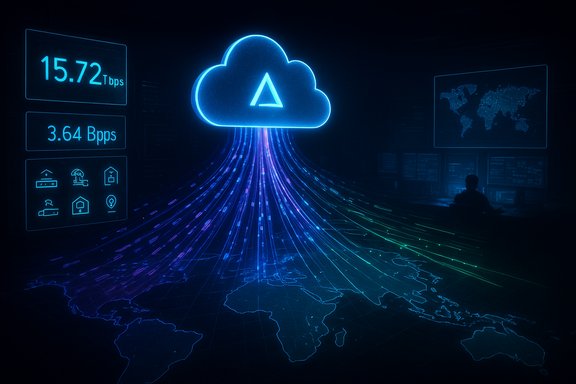
Neon cloud icon with streaming data across a world map.Background​

The accelerating arms race in volumetric DDoS attacks​

DDoS attacks have steadily grown in size and sophistication over the past decade, but 2024–2025 saw a marked acceleration: Mirai-derived botnets and their modern derivatives (commonly grouped under labels such as TurboMirai) have demonstrated the ability to aggregate massive bandwidth by commandeering residential routers, cameras, and other IoT devices. These botnets increasingly produce both extreme throughput (Tbps) and extreme packet rates (gpps), creating attacks that stress link capacity and packet processing simultaneously. Netscout’s ASERT group documented a wave of “demonstration attacks” in October that exceeded 20 Tbps and multiple billion-packet-per-second events, underlining a new scale of threat to network operators and cloud providers.

Why this incident matters​

This Azure incident is noteworthy for three interrelated reasons: the absolute scale (15.72 Tbps / 3.64 Bpps), the source distribution (hundreds of thousands of compromised consumer devices), and the target (a single cloud endpoint). Together those factors demonstrate how compromised edge devices plus ever-increasing residential broadband speeds turn what were formerly “small” botnets into potential infrastructure-level threats. Microsoft’s public mitigation of the event is an important proof point that modern cloud-scale DDoS defenses can still protect tenant workloads when engineered and deployed at global scale.

Anatomy of the attack​

Multi-vector, high-rate floods​

Microsoft described the October 24 attack as a multi-vector assault that included extremely high-rate UDP floods aimed at a single public IP. The peak metrics reported — 15.72 Tbps and ~3.64 billion pps — place this event among the largest volumetric and packet-rate attacks publicly disclosed. Those numbers represent a combination of sheer byte-volume pressure (the terabit metric) and packet-churning intensity (the pps metric), which together can overwhelm both peering links and the packet-processing capacity of routers, firewalls, and load balancers.

Source profile: consumer devices and Aisuru/TurboMirai family​

The attack was attributed to the Aisuru botnet, described by Microsoft and others as a TurboMirai-class IoT botnet that commonly compromises consumer routers, IP cameras, and other internet-connected home devices. Netscout’s ASERT analysis positions Aisuru within a broader family of Mirai derivatives that have evolved to generate multi-Tbps volumes and multi-gpps packet rates. Attack traffic was observed originating from over 500,000 source IPs spanning multiple regions, with substantial representation from residential ISPs in the United States. Because many CPE (customer-premises equipment) devices have fast upstream links today, compromised home endpoints can each contribute sizeable throughput to a coordinated attack.

Attack characteristics that complicate mitigation​

Several characteristics made this event particularly hazardous:
  • High packet rate (billions of pps) that stresses router line cards and middlebox CPU cycles.
  • Medium-sized randomized packets and pseudo-randomized ports/flags, complicating simple signature-based filtering.
  • Direct-path traffic from many real, non-spoofed source IPs — effective for generating volume while reducing attacker traceability challenges.
  • Distribution across hundreds of thousands of residential networks, making takedown or remediation of sources operationally and legally complex.

How Azure’s DDoS Protection stopped the attack​

Layered, global mitigation fabric​

Microsoft credits its success to Azure’s globally distributed DDoS Protection infrastructure and continuous detection capabilities. That infrastructure operates as a layered mitigation fabric: detection systems rapidly identify volumetric anomalies, automated scrubbing and filtering nodes scale to absorb and separate malicious traffic, and traffic that must be preserved for legitimate clients is routed away from overloaded paths. In this incident, Azure’s automated systems “filtered and redirected” malicious flows so customer-facing workloads experienced no visible downtime.

Automation and telemetry: the operational advantage​

A key practical advantage for hyperscale cloud providers is automation. Manual mitigation cannot match the speed and scale required for Tbps-scale events. Azure’s DDoS platform uses telemetry and behavioral analysis to automatically adjust mitigations in real time. That eliminates human-in-the-loop delays and enables scrubbing capacity to be applied to affected regions or tenants as needed. Microsoft reports that these automated measures initiated on detection and were sufficient to neutralize the attack.

Why cloud-scale mitigation succeeds where standalone appliances fail​

Traditional perimeter appliances — firewalls, NGFWs, and on-premise scrubbing devices — have finite packet-processing limits. Packet-rate-driven attacks can exhaust CPU and ASIC resources even when link capacity remains available. Cloud DDoS mitigation leverages distributed scrubbing at scale, absorbing traffic across many geographically dispersed locations and leveraging backbone capacity to dissipate the attack volume. That model is not infallible, but in this case it prevented service impact to Azure customers.

Broader operational implications​

Residential broadband and IoT are changing the baseline​

Microsoft’s messaging highlights a simple, consequential fact: attackers are scaling with the internet itself. As fiber-to-the-home rolls out and consumer upstreams increase, the per-device attack contribution grows. Combined with increasingly capable IoT devices, the baseline for possible attack volume rises in lockstep. This means that network operators, cloud providers, and governments must assume the potential for larger volumetric and gpps events moving forward.

The ISP and CPE angle: inbound vs. outbound responsibilities​

Netscout’s analysis emphasizes that these botnets cannot spoof source IPs — a mixed blessing. It means ISPs can trace and correlate compromised CPE to subscribers, enabling remediation and quarantine. But it also means upstream controllers must prioritize outbound suppression (egress filtering, rate-limiting) and work with access-network operators to mitigate outbound floods that destabilize upstream infrastructure. Access networks have a new onus: stop traffic leaving residential networks that could be used to attack the broader internet.

Hardware stress and collateral impacts​

High pps attacks do more than consume transit capacity: they can cause chassis or line-card failures in routers and break stateful devices that aren’t engineered for extreme packet churn. Netscout reported real-world impairments where line cards and routing gear suffered operational impact under the stress of outbound device-driven floods. This elevates the risk that a single large DDoS event could produce cascading outages in service provider networks if not properly contained.

What this means for enterprises and service operators​

Practical steps for enterprises (ordered actions)​

  • Ensure DDoS protection is enabled for public-facing assets — prefer cloud-native or multi-provider scrubbing solutions that can scale beyond local appliance limits.
  • Implement rate limits and behavioral detection on ingress where possible; use Anycast-distributed services to spread volumetric load.
  • Maintain up-to-date BGP routing and failover plans; advertise null routes (blackholing) only as a last resort and for very small windows.
  • Harden exposed services (e.g., gaming endpoints, APIs) with application-layer protections and require strong authentication where appropriate.
  • Conduct DDoS tabletop exercises and ensure runbooks are in place for high-volume incidents.
These steps reduce risk and improve recovery time during attacks, but they do not eliminate the underlying infrastructure challenges posed by Tbps/gpps events.

What ISPs and access providers should prioritize​

  • Deploy egress filtering and enforce BCP38/BCP84-style anti-spoofing and rate-limiting at the network edge.
  • Instrument CPE telemetry to detect abnormal outbound flows originating from subscriber devices.
  • Cooperate with cloud providers and national CERTs to identify and remediate compromised devices at speed.
  • Offer subscribers managed device hygiene: automated updates, default password enforcement, and notifications when devices are compromised.
ISPs that treat outbound DDoS traffic suppression as a core operational requirement will reduce the frequency and severity of network-impacting events. Netscout’s reporting explicitly recommends bringing outbound suppression to the same priority level as inbound mitigation.

Policy, OEM responsibility, and the internet hygiene problem​

Device manufacturers must be part of the solution​

The root cause for TurboMirai-class botnets remains largely the insecure default posture of many IoT devices: unchanged factory credentials, embedded vulnerabilities, and weak or absent update mechanisms. OEMs should adopt secure-by-default designs, implement mandatory update pathways, and work with regulators and ISPs to enable remote remediation when devices are compromised. These are engineering and commercial choices that will materially reduce botnet potential if widely adopted.

Regulatory and marketplace levers​

Governments and standards bodies can impose minimum security baselines for consumer devices (unique default credentials, automatic secure updates, vulnerability disclosure requirements). Marketplace pressure — such as liability or certification programs for “secure” IoT — can shift manufacturer behavior faster than voluntary approaches alone. Both public policy and consumer education are required to change the infeasible scale of commoditized insecure devices.

The Cloudflare incident and what it reveals about Internet centralization​

An initial DDoS suspicion, then an internal misconfiguration​

In the days following Microsoft’s disclosure, Cloudflare experienced a major global outage that briefly disrupted numerous high-profile services. Cloudflare initially considered the possibility of a hyper-scale DDoS attack but later concluded the outage was caused by an internal change to a database query and an associated Bot Management configuration file; the oversized propagated file triggered failures in core proxy systems. While not caused by malicious traffic, the outage highlighted the risk that a single provider’s internal failure can have wide-reaching, internet-scale effects.

Lessons from the outage​

  • Centralization of routing and security functionality into a few large providers increases systemic risk.
  • Failure modes are not only malicious attacks — benign operational changes can cascade across dependent services.
  • Providers must invest in robust configuration governance, failover, and global kill-switch mechanisms to avoid broad disruption resulting from routine internal changes.

Risks and caveats — what to watch next​

Larger attacks are both more expensive to fight and more impactful​

The Azure mitigation demonstrates capability, but the industry should not conflate a single successful mitigation with long-term safety. Attackers and botnet operators evolve rapidly; demonstrated “proof-of-capacity” events (multiple >20 Tbps demonstrations in October) are signals that attackers can and will keep pushing limits. Defenders must plan for sustained escalation in both Tbps and gpps metrics.

Hardware and supply-chain risk​

As packet rates grow, the frontier of defense shifts toward hardware resiliency: line-card throughput, TCAM capacity, and specialized DDoS mitigation ASICs. Upgrading infrastructure is capital-intensive and takes time — a gap attackers can exploit. Providers should prioritize investments in packet-processing resilience and redundant routing capacity.

Legal and incident-response complexity​

With source IPs mapping to end-user subscribers across jurisdictions, coordinated remediation requires cross-organizational workflows and legal clarity. Tracing and notifying hundreds of thousands of infected endpoints poses privacy and operational challenges; ISPs, cloud providers, and national CERTs must work collaboratively to streamline notifications and quarantines while respecting subscriber rights.

Practical recommendations (for boards, CISOs, and network teams)​

  • Treat DDoS as a strategic risk: include it in risk registers and incident tabletop exercises.
  • Contract for scalable DDoS mitigation with multiple providers or a cloud provider that has demonstrated Tbps/hyper-scale capacity.
  • Harden public endpoints: apply rate-limiting, CDN fronting, and application-layer defenses for critical APIs and services.
  • Partner proactively with your upstream ISPs for coordinated response playbooks and escalation contacts.
  • Monitor device fleets and customer devices (for ISPs or managed providers) for unusual outbound behavior; enforce patching and secure defaults on CPE where possible.
These measures are not foolproof but materially reduce the surface area and improve response times when hyper-scale attacks occur.

Final analysis: what this event tells us about cloud security maturity​

Microsoft’s mitigation of a 15.72 Tbps / ~3.64 Bpps attack demonstrates that cloud-scale DDoS protection, when architected and automated, can be effective even against unprecedented volumetric events. That is an encouraging sign: the architecture of distributed mitigation, telemetry-driven automation, and global scrubbing capacity works in practice.
However, the raw facts that enabled the attack — massive numbers of insecure consumer devices, higher consumer upstream speeds, and economically cheap bandwidth — have not changed. The Internet’s “baseline attack surface” has shifted upward. That means defenders must continue evolving: better telemetry, faster cross-stakeholder remediation, secure-by-default IoT design, and investment in packet-processing resiliency.
A connected internet offers enormous value, but it also provides greater amplification for attackers. The only durable path forward is coordinated improvement across the technology stack: OEMs hardening devices, ISPs enforcing outbound suppression, cloud providers scaling and automating mitigation, and policymakers setting minimum device security standards. The Azure incident is both a wake-up call and — because it was mitigated — a validation of the investments required to keep cloud services reliable in an era of exponentially growing DDoS capability.
Microsoft’s public disclosure and Netscout’s analysis together provide a clear picture: the threat has grown, the tools to fight it are scaling, and systemic changes are required to prevent constant escalation. The technical community, industry leaders, and regulators all have roles to play in ensuring the internet remains robust against future record-breaking attacks.
Source: Cybersecurity Dive Record-breaking DDoS attack against Microsoft Azure mitigated
 

Microsoft’s Azure network absorbed and neutralized a staggering distributed denial‑of‑service (DDoS) assault on October 24, 2025 that peaked at 15.72 terabits per second (Tbps) and roughly 3.64 billion packets per second (pps) — an event Microsoft says was launched from more than 500,000 unique source IP addresses and traced to the Aisuru family of Turbo‑Mirai‑class IoT botnets, targeting a single public endpoint in Australia while Azure DDoS Protection filtered and redirected the malicious traffic without reported customer downtime.

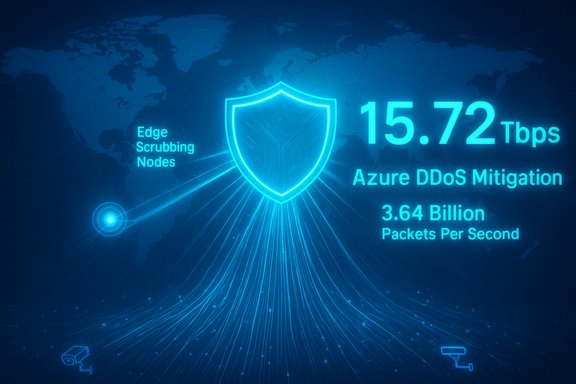
Blue neon shield center with Azure DDoS Mitigation at 15.72 Tbps and 3.64B packets/sec.Background / Overview​

The October 24 incident is not merely a headline about unprecedented numbers; it crystallizes a shift in the DDoS threat model. What used to be extraordinary — multi‑Tbps floods — has become a new baseline for highly resourced botnets. The attack combined enormous raw bandwidth with astronomical packet rates, forcing defenses to address both link saturation and per‑packet processing exhaustion simultaneously. Microsoft characterized the event as a multi‑vector UDP flood directed at a single public IP, with very low levels of source IP spoofing and randomized source ports — a pattern consistent with large fleets of legitimately routable infected consumer devices.
Industry telemetry shows 2024–2025 as a period of rapid escalation in volumetric DDoS capability. Independent reports and vendor telemetry documented multiple record‑setting events throughout the year, including other peaks that exceeded 20 Tbps and multi‑billion‑pps bursts — a trend that places the Azure incident squarely inside an accelerating arms race between botnet operators and cloud/ISP mitigators.

Anatomy of the October 24 Attack​

Key metrics (what Microsoft reports)​

  • Peak throughput: 15.72 Tbps.
  • Peak packet rate: ~3.64 billion pps.
  • Source population: >500,000 unique source IPs, primarily consumer CPE devices (home routers, IP cameras, DVRs/NVRs).
  • Target: a single public IP hosted on Azure in Australia.
  • Botnet family: Aisuru — described as a Turbo‑Mirai (Mirai‑derived) IoT botnet.
These are the most load‑bearing facts in Microsoft’s public account and the independent coverage that followed. Each metric embodies different technical pressures and operational responses.

Why Tbps and pps both matter​

  • Terabits per second (Tbps) measure raw bandwidth. Attacks that dominate this dimension aim to saturate transit and peering links, choke interconnection points, and force volumetric scrubbing or rerouting.
  • Packets per second (pps) measure per‑packet processing load. Extremely high pps attacks target router line cards, NIC interrupts, firewall CPUs and kernel networking stacks. A high‑pps flood can break network appliances long before raw bandwidth becomes the limiting factor.
The October 24 wave combined both dimensions. That combination multiplies defensive complexity because solutions that solve only for bandwidth (e.g., oversized links, straightforward scrubbing) may still lose when devices cannot process millions or billions of tiny packets per second.

Attack techniques and signatures​

  • Multi‑vector UDP floods using medium‑to‑large packet sizes tuned to maximize both bps and pps.
  • Randomized source and destination ports to complicate static signature rules.
  • Minimal source IP spoofing — traffic originated from real, routable addresses of compromised consumer devices — which simultaneously raises volume and gives ISPs a clearer trail for remediation.

Who — Aisuru and the TurboMirai lineage​

Aisuru is described by Microsoft and multiple industry research teams as a Turbo‑Mirai‑class botnet: a Mirai descendant that leverages insecure IoT and CPE (customer‑premises equipment) to generate hyper‑volumetric attacks. The botnet’s operational characteristics include rapid expansion through unpatched firmware vulnerabilities, modular attack engines (UDP/TCP floods, proxying), and a footprint concentrated in residential ISP address spaces where upstream capacity is growing with fiber rollouts. These attributes make Aisuru especially effective at producing both high Tbps and high pps events.
Researchers have observed supply‑chain style leverage points for Aisuru — including a reported compromise of a router firmware distribution mechanism earlier in 2025 — which allowed very rapid infection growth. Attribution of botnet operations is inherently probabilistic, but telemetry, C2 artifacts and code similarities have repeatedly linked Aisuru to multiple multi‑Tbps events in 2025. Where attribution is not absolute, public reporting flags that linkage as credible but not conclusive.

How Azure mitigated the event — what worked​

Microsoft credits the successful mitigation to Azure’s globally distributed DDoS Protection fabric: automated detection at edge nodes, anycasted scrubbing centers that filter malicious flows close to origination, and real‑time adaptive filtering that preserves legitimate traffic while discarding attack traffic. The key elements were:
  • Edge‑distributed scrubbing capacity that absorbs and disperses volumetric load across many points of presence.
  • Automated telemetry and anomaly detection to initiate mitigation without human delays. Automation is essential at Tbps/pps velocities.
  • Per‑flow behavioral analysis and adaptive filtering to reduce false positives and keep customer workloads online.
The mitigation outcome — no reported customer downtime — validates the cloud‑scale defensive playbook: push detection and response to the edge; scale scrubbing horizontally; automate decisions so human operators are not the throughput bottleneck. That model worked in this case because the provider had the global capacity and orchestration to execute it.

Strengths and notable lessons​

Strengths demonstrated by Microsoft​

  • Resilience at hyperscale. Azure’s ability to automatically detect and mitigate a 15.72 Tbps/3.64 Bpps assault without visible impact to the protected workload demonstrates that cloud providers can reliably defend tenants when properly provisioned.
  • Operational automation is non‑negotiable. Human response is too slow for hyper‑volumetric incidents; automated playbooks and telemetry are decisive.
  • Traceability benefits when attackers use non‑spoofed sources. Attacks originating from real IPs make ISP remediation and takedowns feasible, even if operationally complex.

Broader lessons for the ecosystem​

  • The baseline attack capability is rising. As residential upstreams get faster (fiber, DOCSIS upgrades) and CPE becomes more powerful, the theoretical per‑device contribution to botnets grows — enlarging the potential scale of attacks.
  • IoT/CPE insecurity is now an infrastructure problem. Device vendors, ISPs, software distributors and regulators must address defaults, firmware update integrity and secure provisioning as part of resilience planning.

Risks, caveats and unresolved questions​

Systemic fragility for smaller operators​

Microsoft and other hyperscale mitigators can absorb extreme events because of massive backbone capacity and globally distributed scrubbing. Smaller cloud providers, on‑premise scrubbing appliances, and regional ISPs may not have that headroom. A future attacker could find a target outside the reach of a hyper‑scale mitigator, producing real outages. This asymmetry increases systemic risk for mid‑market and localized services.

Collateral damage and ISP strain​

When hundreds of thousands of compromised devices generate multi‑Tbps outbound volume, upstream ISPs face transit saturation and potential hardware stress. Even if a cloud scrubs traffic near the cloud’s edge, ISP backbones and peering points can experience transient overloads and hardware failures if mitigation is not coordinated with carriers. Microsoft’s account highlights that such coordination is necessary but operationally challenging.

Attribution and operator intent​

Public reports attribute the attack to Aisuru, but botnet panels are often forked, sold, or reused by different actors. Attribution rests on telemetry patterns, captured command‑and‑control artifacts, and forensic indicators — not on incontrovertible proof of a single named operator. Analysts advise caution and note that while Aisuru is a plausible and likely actor, absolute attribution remains probabilistic.

Supply‑chain and firmware risks​

Aisuru’s rapid expansion has been linked in reporting to a compromise of router firmware distribution in 2025. If device update mechanisms are attacked, entire device families can be seeded quickly. Mitigation requires not only patching but verifying firmware provenance, vendor accountability and improvements to update infrastructure. These are non‑trivial fixes that span commercial, engineering and regulatory domains.

Practical recommendations for Windows admins, IT teams and site owners​

The Azure incident is both a reassurance (cloud mitigation can work) and a wake‑up call. Enterprises should assume that future attacks will be larger and faster. The following prioritized playbook is aimed at practical readiness:
  • Confirm coverage:
  • Verify every public IP, load balancer and application endpoint has a DDoS protection posture (cloud provider mitigation or contracted scrubber).
  • Test and exercise:
  • Run tabletop exercises and simulated failovers with your provider. Validate failover time and communication channels.
  • Monitor both Tbps and pps:
  • Instrument network telemetry to alert on both throughput and packet‑rate anomalies. High pps can be a more dangerous signal than raw bandwidth.
  • Use layered defenses:
  • Combine edge scrubbing (CDN/WAF), provider DDoS protection, and on‑prem perimeter hardening for defense‑in‑depth.
  • Harden IoT and CPE inventories:
  • Identify all connected devices in scope, enforce vendor patching, change defaults, and isolate IoT onto segmented networks.
  • Coordinate with ISPs:
  • Establish escalation paths with upstream carriers for source suppression and subscriber remediation if your traffic is being abused.
  • Contract clarity:
  • Ensure SLAs cover DDoS mitigation responsibilities and that pricing models account for mitigation usage during incidents.
  • Plan for cost and capacity:
  • Understand potential bill impacts from mitigation and prepare budget/insurance contingencies for extreme events.
  • Apply egress and rate controls:
  • On your own devices and networks, use outbound shaping and uRPF where applicable to reduce inadvertent contribution to amplification.
  • Secure firmware update chains:
  • Wherever feasible, insist vendors provide signed firmware and transparent update logs; prefer devices that support secure boot and verified updates.
These actions are tiered: some are immediate (confirm coverage, test runbooks), others are strategic (supply‑chain accountability, ISP coordination).

Technical deep dive: mitigation strategies and trade‑offs​

Anycasted scrubbing vs. centralized scrubbing​

  • Anycasted scrubbing distributes attack handling across numerous locations to avoid chokepoints — ideal when attacks are massive and distributed. Azure’s approach uses globally distributed scrubbing to ingest and discard attack traffic near the edge.
  • Centralized scrubbing funnels traffic to a finite number of scrubbing centers and can be overwhelmed at extreme peaks. Smaller providers often rely on this model and are therefore vulnerable to hyper‑volumetric waves.

Behavioral filtering and stateful vs stateless defenses​

  • Behavioral models that detect anomalies in flow behavior, packet sizes, or rate patterns allow safer mitigation with fewer false positives.
  • Stateful defenses (e.g., connection tracking) are vulnerable to pps attacks because each packet can trigger expensive state operations; stateless, hardware‑accelerated filtering is often necessary to survive high pps loads.

ISP cooperation and source suppression​

  • When attack sources are real, routable consumer devices, ISPs can use subscriber tracing and outbound filters to reduce the attack population. This requires operational coordination, subscriber outreach, and often regulatory or contractual authority to act quickly.

Wider strategic implications​

The economics of resiliency​

Defending at cloud hyperscale is expensive. As the baseline for attacks grows, organizations face a choice: invest in provider defense, accept residual availability risk, or offload to CDN/edge providers. This creates market pressure for cheaper, more automated DDoS services and pushes complexity to contracts, SLAs and risk transfer mechanisms.

Policy and vendor accountability​

Improving device security at scale requires regulation, vendor incentives and better procurement standards. Governments and industry bodies will increasingly be drawn into debates over minimum device security standards, firmware update integrity, and liability for insecure CPE that participates in criminal botnets.

The long view: arms race continues​

Attackers are innovating both technically (packet‑rate optimization, supply‑chain seeding) and economically (DDoS‑for‑hire, resale of proxy services). Defenders must scale both technically and cooperatively — no single vendor can fix the problem alone. Microsoft’s mitigation demonstrates that the right architecture can succeed, but it also shows why upstream remediation and device security are essential to truly reduce the attack surface.

Conclusion​

The October 24 DDoS event against Azure — 15.72 Tbps and ~3.64 billion pps from more than 500,000 compromised IPs — represents a pivotal moment in modern internet security. It proves that cloud‑scale defenses, when designed with distributed scrubbing, automated telemetry, and adaptive filtering, can blunt even the largest currently observed assaults. At the same time, the attack exposes systemic fragility: an insecure base of consumer‑grade devices, faster residential upstreams, and uneven mitigation capacity across providers create a rising baseline for destructive capability.
For Windows administrators, IT teams and enterprises, the message is unambiguous: assume future DDoS events will be larger and faster, validate mitigation posture now, exercise incident plans, and push for ecosystem fixes that harden devices and improve ISP‑level controls. The technical victory won at Azure is meaningful, but it cannot substitute for cross‑industry action to secure the vast population of devices that remain the raw material for the next record‑breaking attack.

Source: hi-Tech.ua Microsoft repels record-breaking DDoS attack from 500,000 IP addresses
 

Neon blue cloud computing hub linking secure processing to many devices.
On October 24, 2025, Microsoft Azure’s DDoS Protection automatically detected and mitigated a multi‑vector distributed denial‑of‑service campaign that peaked at 15.72 terabits per second (Tbps) and nearly 3.64 billion packets per second (pps) — an event Microsoft calls the largest DDoS attack ever observed in the cloud and one traced to the Turbo Mirai–class IoT botnet known as Aisuru.

Background​

Azure’s short technical post provides the core metrics: peak throughput of 15.72 Tbps, peak packet rate near 3.64 billion pps, attack origin traced to Aisuru, and more than 500,000 unique source IP addresses, with the campaign targeting a single public IP hosted in Australia. Those figures match the summary published by Microsoft and were reproduced by multiple industry outlets and internal analysis threads supplied with this brief. This incident sits inside a rapid escalation of “hyper‑volumetric” DDoS activity throughout 2024–2025, a period that saw repeated record‑setting floods driven largely by Mirai‑derived IoT botnets. Public reporting and vendor telemetry documented multiple multi‑Tbps events and multi‑billion‑pps bursts over the year, underscoring that attackers are weaponizing the proliferation of insecure IoT/CPE devices and rising consumer upstream speeds.

Overview: what happened and why it matters​

Azure’s account is concise: their automated detection and mitigation pipeline filtered the malicious traffic at scale and redirected the attack without any reported customer downtime. That outcome is technically impressive — it shows cloud‑scale scrubbing can still preserve availability even when assault volumes climb into the double‑digit Tbps range — but the episode is also a warning. The weapons being used against the internet are growing faster than many smaller providers and on‑premises defenses can scale to counter. Why the numbers matter:
  • Terabits per second (Tbps) measure raw bandwidth and the ability to saturate transit and peering links.
  • Packets per second (pps) measure the per‑packet processing load and attack pressure on routers, NICs, firewalls, and virtual network functions.
    This attack combined both extremes: high Tbps and extremely high pps, which multiplies mitigation complexity and places stress on both link capacity and device forwarding planes.

Anatomy of the attack​

Key metrics and observed characteristics​

Microsoft’s technical summary lists the primary characteristics of the October 24 campaign:
  • Peak throughput: 15.72 Tbps.
  • Peak packet rate: ~3.64 billion pps.
  • Source population: >500,000 unique IP addresses, predominantly consumer CPE and IoT devices.
  • Primary vectors: high‑rate UDP floods with randomized source ports and minimal IP spoofing — traffic came from legitimately routable addresses.
The combination of randomized ports, medium‑to‑large packet sizing, and very high pps means the assault was engineered to waste per‑packet CPU cycles on forwarding and counting operations, not just to fill link capacity. That blend targets both transport capacity and the packet processing resources that are often the weakest link in network stacks.

Source profile: Aisuru and Turbo‑Mirai lineage​

Aisuru is described by Microsoft and independent researchers as a Turbo Mirai–class IoT botnet that conscripts insecure home routers, IP cameras, DVRs/NVRs and similar customer premises equipment (CPE). The botnet’s footprint has grown rapidly since mid‑2024, in part by exploiting device firmware vulnerabilities and in part by leveraging supply‑chain compromises that seed large numbers of devices quickly. The botnet has also been observed being rented or operated within a DDoS‑for‑hire economy. Aisuru’s operational profile includes:
  • Use of unspoofed, routable endpoints (residential IPs) as the main source pool.
  • Modular attack engines tuned for both throughput and packet‑rate impact.
  • Monetization through semi‑commercial DDoS services and rented access via public messaging channels.

How Azure defended: automated, global, and close to the edge​

Microsoft credits three broad pillars for the successful mitigation:
  • Global, anycasted scrubbing fabric that absorbs and analyzes traffic near the edge.
  • Automated detection using continuous baseline telemetry to trigger mitigation without human delay.
  • Adaptive filtering to discriminate legitimate sessions from attack traffic in real time and preserve good traffic.
That operational model — push scrubbing to the edge, automate detection and response, and scale horizontally — is the standard playbook for hyperscale cloud providers. Azure’s report underscores the advantage of immense global capacity and distributed mitigation centers; those features allowed Microsoft to drop or redirect malicious flows before they caused customer‑facing outages.
Yet the success also signals a growing protection gap: smaller clouds, regional ISPs and individual enterprises often cannot match this scale, and therefore remain at far higher risk when attackers concentrate capacity or exploit chokepoints in the service path.

Independent corroboration and the wider data points​

Industry and independent reporting confirm that 2025 saw a series of record‑scale incidents. Cloudflare and other mitigators reported multi‑Tbps assaults earlier in the year, and security researchers documented Aisuru‑linked events ranging from the mid‑Tbps to much larger, short‑duration bursts. KrebsOnSecurity’s reporting on earlier Aisuru attacks (including a ~6.3 Tbps event against KrebsOnSecurity in May 2025) and vendor telemetry establish a consistent pattern of escalating botnet capability. Multiple independent outlets reproduced Microsoft’s October 24 metrics and added context about the target (single Australian IP) and the botnet’s source profile, which strengthens confidence in the core numbers even as some peripheral claims remain subject to measurement methodology differences.

Technical analysis: why Tbps × pps matters​

High‑bandwidth floods and high‑packet‑rate floods stress different parts of the stack, and an attack that combines both is especially dangerous.
  • High Tbps floods saturate physical and peering links. If peak traffic exceeds available transit or peering capacity, even well‑engineered scrubbing can be forced to drop large swathes of incoming traffic or push the problem upstream.
  • Extremely high pps floods target the per‑packet work: interrupts, kernel network stacks, flow lookups, firewall state tables, and router line‑cards. Hardware may have high raw throughput capacity but still fail if a device cannot keep up with packet processing at scale.
Mitigating both dimensions requires a layered approach:
  • Anycasted scrubbing and wide distribution to avoid single chokepoints.
  • Specialized Mpps (million packets per second) headroom in scrubbing appliances and line cards.
  • Behavioral and statistical filtering to identify and drop illegitimate flows without harming legitimate sessions.
    Azure’s mitigation reportedly used these tactics at scale, which is why the company reports no customer downtime.

Enterprise and WindowsForum implications: what organizations should do now​

This episode is not just a hyperscaler concern. Any organization that exposes public endpoints must treat DDoS as an infrastructure risk with a defined mitigation posture. The following practical steps are prioritized for WindowsForum readers responsible for enterprise Windows estates, Azure workloads, or border network infrastructure.
  • Confirm coverage:
    1. Ensure all public IPs and endpoints (including Azure‑hosted services) have active DDoS protection and WAF coverage.
    2. Validate SLAs and mitigation thresholds with cloud and CDN providers.
  • Test your playbook:
    1. Run tabletop exercises simulating high‑volume, high‑pps attacks.
    2. Conduct non‑disruptive failover and mitigation drills with your provider.
  • Instrument for pps and bps:
    1. Set telemetry and alert thresholds for both Mbps/Tbps and packets per second.
    2. Monitor link utilization, peer saturation, and device CPU/interrupt metrics.
  • Reduce the attack surface:
    • Replace or patch insecure CPE and IoT devices on your estate.
    • Enforce secure defaults for any staff‑provisioned home equipment and remote access devices.
  • Multi‑provider strategy:
    • Consider fronting critical services with multiple CDNs or mitigation providers to reduce single‑provider dependence.
  • ISP coordination:
    • Pre‑establish contact and escalation channels with transit providers and ISPs for rapid upstream filtering and source remediation.
These steps won't make organizations immune, but they materially reduce the risk of lasting outages when an attacker launches hyper‑volumetric campaigns.

Ecosystem and policy considerations​

Aisuru’s reliance on residential ISP address spaces and insecure consumer devices reveals structural weaknesses that require industry coordination:
  • Device vendors must adopt secure default configurations, authenticated firmware update mechanisms, and timely patch distribution to close recruitment vectors. Evidence suggests some botnet expansion was accelerated by firmware‑update compromises, making supply‑chain trust a crucial mitigation axis.
  • ISPs need stronger egress controls and subscriber remediation playbooks. When attack traffic comes from routable residential IPs, ISPs can trace and curtail outgoing malicious flows — but only if they have incentives, automation, and legal clarity to act rapidly.
  • Regulators and procurement can shift incentives by requiring minimum device‑security standards and secure‑by‑default procurement terms for IoT/CPE sold into consumer markets. Market forces alone have not produced adequate baseline security for billions of internet‑connected devices.
Cloud scrubbing is necessary but not sufficient; long‑term resilience requires upstream remediation that reduces the raw attack surface that botnet operators monetize.

Business model: DDoS‑for‑hire and attribution caveats​

Aisuru’s operators have been connected to DDoS‑for‑hire markets, where botnet capacity is rented out through messaging channels for short campaigns. That model increases attack velocity because multiple clients can pay for rapid, targeted floods. Public reporting and research indicate the botnet’s operator(s) have advertised tiers of service and even made selective promises about which sectors they will not target — practices that do not mitigate criminality. Attribution caution: tying an incident to a named botnet (Aisuru) relies on a combination of observed C2 infrastructure, code fingerprints and infection telemetry. While those links are credible and used by multiple independent research teams, attribution is inherently probabilistic: botnet panels can be forked, sold, or repurposed, and multiple actors can reuse the same exploit chains. Public attribution is useful operationally, but it should be treated as credible rather than absolute unless law enforcement releases forensic confirmation.

Risks, unknowns, and unverifiable claims​

  • Measurement ambiguity: public “record” claims can be noisy. Differences in sampling points, measurement tools, and whether an attacker targeted specially instrumented measurement hosts can produce divergent peak numbers. Some third‑party telemetry reported even larger short bursts in the same time window, and not all providers measure pps and bps the same way. Treat peaks as directional and stress tests rather than absolute, immutable facts.
  • Attribution uncertainties: as noted, Aisuru linkage is strong but not forensic‑grade in public datasets; multiple independent indicators support Microsoft’s conclusion but caveats remain.
  • Collateral risk: the use of residential IP source pools increases the likelihood of collateral service degradation for innocent customers, and it can damage ISP peering relationships when large outbound volumes cause congestion upstream. Network operators should prepare for this secondary damage during mitigation.
Flagged for caution: any public number that does not originate from a provider’s official post or that is reported without methodological detail should be treated with skepticism until corroboration from independent meter points is available.

Practical checklist: immediate and medium‑term actions for WindowsForum readers​

Short term (0–30 days)
  • Verify that all Azure public endpoints have DDoS Protection Standard or equivalent enabled.
  • Confirm contractually how your cloud provider handles automated scrubbing and whether any mitigation costs could be passed to customers.
  • Set alerts for both bps and pps on firewalls, routers, and cloud telemetry.
  • Run a mitigation drill with your primary cloud provider and document escalation contacts.
Medium term (1–6 months)
  • Harden CPE and remote worker device inventories: require vendor‑backed firmware updates and disable legacy management interfaces.
  • Adopt multi‑provider fronting (CDN + cloud scrubbing) for mission‑critical services.
  • Work with ISPs to establish pre‑authorized upstream filtering or source suppression playbooks.
Strategic (6–18 months)
  • Include DDoS MTTD/MTTR objectives in vendor SLAs.
  • Push procurement teams to require secure defaults in purchased IoT/CPE.
  • Participate in cross‑industry information sharing for rapid takedown and remediation.

What this means for the future of cloud security​

Azure’s October 24 mitigation demonstrates that cloud providers with global scrubbing scale and automation can blunt even the largest current assaults, but it also exposes a persistent reality: the baseline attack capability is rising because the internet itself is getting faster and more connected. As residential upstreams grow and insecure devices proliferate, attackers can aggregate unprecedented aggregate throughput without centralized infrastructure. That trend pushes responsibility beyond cloud operators to device vendors, ISPs, enterprise buyers and regulators. Hyperscalers will continue to invest in automated, anycasted scrubbing architectures and per‑flow behavioral analytics. Meanwhile, the global community must focus on reducing the raw pool of abusable devices through secure hardware practices, authenticated firmware channels, and stronger ISP egress controls. Absent that, defenders will always be playing catch‑up against cheap, commodified botnet capacity.

Conclusion​

The October 24, 2025 attack that Azure absorbed is notable for both its absolute scale — 15.72 Tbps and ~3.64 billion pps — and for what it signals: a new operational baseline for what well‑resourced botnets can produce using compromised consumer devices. Microsoft’s ability to filter and redirect the traffic without customer impact validates the cloud‑scale defensive model, but it does not eliminate systemic exposure. The long‑term answer requires layered defenses across the internet ecosystem: hyperscale scrubbing, rigorous device security, proactive ISP remediation, and regulatory incentives for safer device design. Until that coordination matures, record‑breaking events will likely be rewritten — and preparedness, automation and cross‑sector cooperation will determine who stands up and who goes dark.
Source: CPO Magazine Microsoft Azure Hit by the Largest DDoS Attack Ever in the Cloud - CPO Magazine
 

Back
Top