

Microsoft’s long march to make cloud disaster recovery and data protection practical for everyone took another visible turn with renewed Azure feature announcements that bundle tighter security controls with easier, cheaper recovery options — a strategy first signaled years ago and now reinforced by modern partners and platform-level upgrades. The brief BetaNews report that flagged the rebadging of Hyper‑V Recovery Manager into Microsoft Azure Site Recovery, the addition of anti‑malware protections, and the launch of private connectivity services like Azure ExpressRoute captures a foundational pivot in how Azure has framed security and resilience for enterprises.
The modern Azure playbook is therefore not a single feature announcement but an operational program: adopt platform capabilities, integrate specialized protection for data‑heavy object stores, and institutionalize the tests and governance that turn marketing promises into repeatable reality.
Source: BetaNews https://betanews.com/article/microsoft-azure-to-get-extra-security-and-disaster-recovery-features/]
 Background
How the story began — DR for every workload
Azure’s push to democratize disaster recovery (DR) was visible even in early TechEd announcements: Microsoft framed DR not as an expensive, niche capability reserved for the handful of mission‑critical apps, but as an operational discipline that could — and should — be broadly available across enterprise portfolios. The original Hyper‑V Recovery Manager provided orchestration for replication and recovery between private clouds and was explicitly positioned to simplify runbooks, failovers, and recovery sequencing. Over time Microsoft evolved that capability into the modern Azure Site Recovery (ASR) service that supports failover to alternate datacenters or to Azure infrastructure directly.The BetaNews snapshot and what it emphasized
The article you provided summarized a set of early enhancements: better anti‑malware protections for Azure virtual machines, performance protections for VMs, a rebrand and preview for disaster recovery orchestration (Hyper‑V Recovery Manager → Azure Site Recovery), and xpressRoute as a private connectivity option to reduce latency and increase bandwidth reliability for hybrid setups. Those changes were pitched as making DR cheaper, simpler, and thus more widely adoptable.Overview: Where Azure’s security and DR strategy stands today
From orchestration to platform‑level resilience
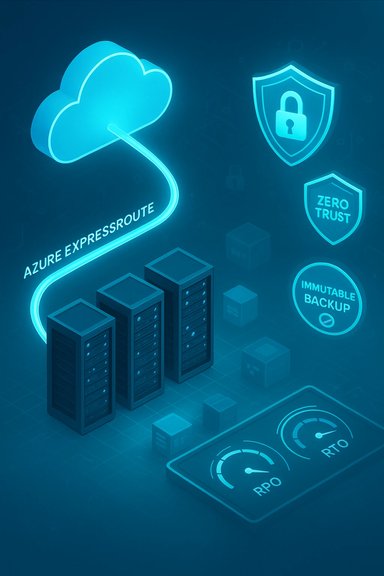
What began as orchestration and replication tooling has become a multi‑layered set of capabilities across Azure:- Azure Site Recovery (ASR) now supports orchestrated replication and failover across Hyper‑V, VMware, and Azure VMs, and integrates with backup and automation tooling to define RPO/RTO targets and runbooks at scale.
- Private connectivity through ExpressRoute offers predictable performance and lower latency for hybrid traffic — an important architectural choice for busy replication and recovery workloads that can’t tolerate public internet variability. ExpressRoute’s footprint and feature set have grown since initial launches.
- Data protection and cyber‑resilience partners such as Rubrik have added purpose‑built layers for object storage (Azure Blob) protection: continuous discovery, classification, immutable backups, and rapid granular recovery are now part of many Azure data‑protection architectures. These third‑party solutions emphasize cyber resilience — the ability to recover clean copies and maintain operations after ransomware or malicious activity.
The modern security posture: Zero Trust, encryption in motion, and detection
Azure’s security posture today layers Zero Trust principles (least privilege, continuous verification), network encryption, and integrated detection:- Platform features now include virtual network encryption to protect VMs and traffic inside VNets, DNSSEC for DNS integrity, and enhanced security posture tooling that plugs into security operations workflows. These capabilities reduce attack surface and enable equipping the security operations center (SOC) with richer telemetry for incident response.
- Third‑party integrations extend native capabilities. For example, Rubrik’s Azure Blob protection offers automated discovery/classification, continuous monitoring for risky activity, and fast recovery patterns that align with ASR and Azure Backup practices. This hybrid model — platform features plus focused partners — is now the common pattern for enterprise-grade resilience.
What the BetaNews items meant — technical details and verification
Rebranding Hyper‑V Recovery Manager → Azure Site Recovery
BetaNews reported the rebrand and preview of what became Azure Site Recovery. Microsoft documentation and blog posts confirm that Hyper‑V Recovery Manager was introduced and later expanded into disaster recovery to Azure scenarios; the evolution into Azure Site Recovery consolidated DR orchestration across on‑prem and cloud targets. This transition wasn’t a simple rename — it reflected functional expansion: failover to Azure IaaS VMs, broader orchestrated recovery plans, and deeper automation hooks for enterprise runbooks.Anti‑malware and VM performance protections
The addition of malware protection and VM performance protection in early Azure announcements foreshadowed today’s integrated approach: platform‑managed endpoint protections, VM performance tooling, and agentless/agent‑based security options for cloud workloads are now standard. Those features evolved into what Microsoft markets today as a blend of Azure-native protections (e.g., Microsoft Defender for Cloud) and partner solutions for workload‑specific controls. The core claim — that Azure enhanced malware protection for hosted VMs — is consistent with how Microsoft built its defense‑in‑depth strategy across years.ExpressRoute’s launch and ongoing expansion
BetaNews noted the launch of ExpressRoute as a private connection to Azure. That initial launch established the architectural practice of using private WAN links for production hybrid workloads. Microsoft has continued to expand ExpressRoute, adding Metro SKUs, Global Reach, and more peering locations to increase resiliency and reduce single points of failure — features that directly matter for disaster recovery architectures that rely on synchronous or high‑bandwidth replication. The ExpressRoute story is verified by Microsoft’s networking documentation and blog posts.Where platform updates and partner solutions intersect: the modern Azure DR and security stack
A typical modern architecture for secure DR on Azure
- Replicate primary workloads to Azure using ASR (or native replication for PaaS-managed services).
- Use ExpressRoute or private connectivity for replication traffic and for application traffic routing in failover scenarios.
- Protect storage (including large AI/data lakes in Azure Blob Storage) with a cyber‑resilience solution that provides:
- continuous discovery/classification,
- immutable/air‑gapped backups,
- rapid object‑level and container‑level recovery options.
- Use Defender for Cloud, Sentinel, and partner SIEMs to monitor detection signals and automate containment and recovery playbooks.
Verified platform limits and scale changes you should care about
Microsoft’s networking updates have included higher‑scale options for virtual networks. Historically, VNets were constrained to ~65,536 private addresses; more recent preview features introduce options to support up to 1 million routable IP addresses per virtual network through NIC prefix features — an important change for cloud‑native customers running large containerized fleets or massive scale‑out VNets. These limits and options are documented in Azure’s networking announcements and limits pages. If your DR or recovery plan assumes large‑scale IP space, this change is material and verifiable.Critical analysis — strengths, gaps, and risks
Strengths: democratized DR, platform scale, and focused cyber‑resilience
- Democratized DR: Making DR orchestration accessible changed the calculus for many enterprises; ASR and related tooling mean DR is now an operational exercise, not a rare, expensive project. The democratization reduces the risk of under‑protected workloads.
- Platform scale and predictable connectivity: ExpressRoute and Azure’s private backbone enable replication and failovers under predictable network conditions — a practical requirement for low RTO/RPO architectures. The expansion of ExpressRoute locations and Metro/global reach enhances resilience.
- Purpose‑built cyber‑resilience: Partners like Rubrik add crucial capabilities for cloud‑native object stores that historically lacked mature backup paradigms. Immutable backups, rapid recovery, and sensitive data discovery are pragmatic defenses in a ransomware‑first threat landscape.
Gaps and risks: shared responsibility, misconfiguration, and hidden costs
- Shared responsibility confusion: Platform protections are powerful, but the security model is shared. Misunderstanding what Microsoft protects versus what the customer must secure leads to gaps — especially in identity, access configuration, and data lifecycle management.
- Operational complexity and configuration drift: Tools such as ASR, ExpressRoute, NF‑segmentation, and third‑party backups require disciplined change control. Without automated testing and a governance cadence, configuration drift or untested runbooks can erode recovery guarantees. Real world DR failure modes are usually operational, not purely technical.
- Cost and egress considerations: Using dedicated links, expanded IP spaces, and storage tiers for backups introduces ongoing costs. Unexpected egress or large‑scale restore operations can spike bills if not modeled and guarded by FinOps controls. Azure Cost Management and partner pricing transparency must be part of procurement.
- Third‑party dependency risks: Vendor‑provided cyber‑resilience features are valuable, but they add dependency and integration complexity. Ensure contracts include portability and export rights (ARM/Bicep/Terraform artifacts, data egress timelines), and validate third parties’ access models — especially for features that claim “no data movement” for classification or monitoring. Ask for architecture details and security attestations.
Unverifiable or cautionary claims
Some marketing statements — particularly those promising “complete protection” or guaranteeing specific RTO/RPOs without disclosed test methodology — should be treated cautiously. Any claim about “air‑gapped” or “immutable” backups is meaningful only when backed by documented controls (e.g., retention lock, quorum authorization, separation of duties) and independent audits. Demand concrete test results, pen test summaries, and contractual SLAs before accepting absolute guarantees. Where specific numbers are claimed without a published validation method, flag them as requiring customer‑side verification in test windows.Practical guidance — a checklist and recommended steps for IT teams
Quick checklist before adopting new Azure DR/security features
- Confirm the shared responsibility boundaries for each workload: what Azure secures vs. what you must secure.
- Inventory all critical data and workloads; map dependencies (DNS, identity, networking).
- Define RTO and RPO per workload and turn those SLAs into testable runbooks.
- Select connectivity: public internet, VPN, or ExpressRoute — base choice on recovery performance needs and cost.
- Include a cyber‑resilience partner only after validating their access model, immutability mechanisms, and restore test evidence.
- Model costs (ingress, egress, storage tiers, interconnects) with FinOps scenarios for monthly and worst‑case recoveries.
- Run regular DR drills that include full restores from cold tiers and validating recovery of AI/ML datasets where applicable.
Step‑by‑step recommended rollout (numbered for operational use)
- Inventory and classification: Use native tools plus partner discovery to map data sensitivity and retention needs.
- Define recovery SLAs: Document RTO/RPO and required recovery sequencing for each application tier.
- Architect networking: Choose ExpressRoute or equivalent for high‑bandwidth, low‑latency replication if RPO/RTO demands require it.
- Implement ASR for VM orchestration and configure Azure Backup for daily snapshots; align retention policies with compliance needs.
- Add cyber‑resilience layer for Blob and object stores: ensure immutable backup policies, access controls, and recovery playbooks are in place.
- Automate testing: schedule automatic failover/failback tests in non‑production windows; validate recovery of databases and DNS, and measure actual RTO/RPO.
- Governance and FinOps: embed monthly reviews that include security posture remediation, cost anomalies, and runbook updates.
Observations and the long view
Microsoft’s early statements captured in the BetaNews piece were accurate about intent: to make DR easier and more accessible. What the intervening years have shown is that intention needs three practical complements to deliver value at scale:- Scaleable platform features (e.g., expanded VNet IP options and ExpressRoute enhancements) that remove previous architectural limits;
- Operational rigor (repeatable runbooks, regular tests, governance cadence) to maintain recovery guarantees; and
- Ecosystem partners (backup and cyber‑resilience vendors) to fill specialized gaps — particularly for object storage and AI dataset protection.
Conclusion
The BetaNews snapshot was a clear early signal that Azure intended to pair security with practical disaster recovery — an orientation that has proven durable and consequential. Today, Azure’s ASR, private connectivity options like ExpressRoute, platform encryption and networking improvements, and partner cyber‑resilience offerings collectively offer organizations a powerful toolkit for reducing downtime and protecting cloud assets. However, converting that toolkit into reliable outcomes requires disciplined architecture, clearly defined RTO/RPO SLAs, continuous testing, and explicit contractual and operational controls with third‑party providers.The modern Azure playbook is therefore not a single feature announcement but an operational program: adopt platform capabilities, integrate specialized protection for data‑heavy object stores, and institutionalize the tests and governance that turn marketing promises into repeatable reality.
Source: BetaNews https://betanews.com/article/microsoft-azure-to-get-extra-security-and-disaster-recovery-features/]
