

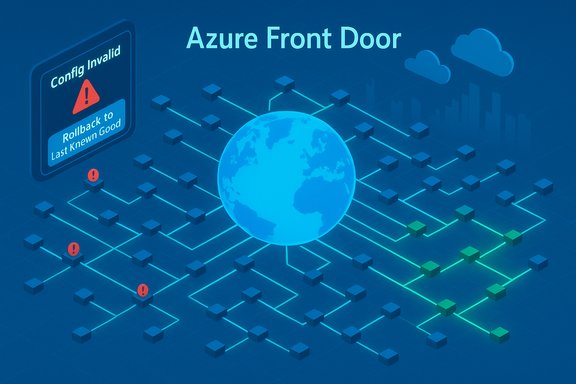
Microsoft's Azure cloud platform suffered a widespread outage on October 29, 2025, that traced back to a configuration error inside Azure Front Door (AFD) — Microsoft's global content delivery and routing service — and exposed how a single invalid configuration combined with a software validation flaw can cascade into global service disruption, long recovery windows, and painful downstream impacts for enterprises and consumers alike.
Background / Overview
Azure Front Door is the global edge and traffic-routing fabric that sits in front of many Microsoft services and thousands of customer applications. It performs traffic management, CDN caching, web application firewalling, and global load balancing from hundreds to thousands of edge nodes. Because so many first‑party Microsoft services (and countless customer workloads) rely on AFD for reachability and performance, any serious control-plane or configuration fault in AFD has outsized systemic risk.On October 29, 2025, Microsoft acknowledged that an inadvertent configuration change was the proximate trigger for the incident. The configuration was identified as invalid but — critically — a software flaw in the AFD control plane allowed that invalid configuration to bypass built‑in safety checks and be deployed. The result: a large number of AFD nodes went offline, global routing became unbalanced, and timeouts and latency spikes rippled across regions. Microsoft temporarily blocked all further AFD configuration changes and initiated a rollback to a previously stable configuration while teams recovered nodes and rebalanced traffic.
The outage affected first‑party experiences (including Microsoft 365, Xbox ecosystems, certain portal endpoints, Copilot-related services, and multiple customer workloads) and highlighted both the fragility introduced by centralized cloud fabrics and the difficulty of safe, large‑scale config rollouts.
How Azure Front Door works — why a config error matters
A distributed control plane with global consequences
Azure Front Door operates with a distributed data plane (edge nodes that handle user traffic) and a centralized control plane that validates and distributes configuration changes. When a valid configuration is pushed, the control plane incrementally propagates rules, routes, and policies to thousands of edge nodes worldwide.- Edge nodes serve cached content, enforce routing and security policies, and perform health checks of origin backends.
- The control plane validates configuration updates against a set of rules, schemas, and safety checks before rolling them out.
- Changes are typically staged and rolled out progressively to prevent large blast radii.
The mechanics of the October 29 incident (technical summary)
- An invalid configuration was unintentionally deployed into AFD’s control plane.
- ADF’s safety/governance checks failed to catch the invalid state because of a software defect, allowing the invalid payload to be propagated.
- Thousands of AFD nodes reported failures or were taken offline; as these nodes dropped out, healthy capacity fell and traffic steering became suboptimal.
- Unbalanced traffic routing caused increased latency, timeouts (503/504 errors), and application instability across multiple first‑party and customer services.
- Microsoft blocked further configuration changes to AFD, rolled back to its last known good configuration, reloaded node configurations on thousands of servers, and gradually rebalanced traffic to healthy nodes to avoid overloads.
Timeline and chronology (absolute dates)
- October 29, 2025 — Microsoft traces the disruption to a configuration change in Azure Front Door and reports the trigger as an inadvertent configuration deployment.
- Immediately after detection — Microsoft blocks further AFD configuration changes and begins deploying the "last known good" configuration.
- Same afternoon/evening — Microsoft reports initial signs of recovery as stable config is pushed and nodes begin recovery; recovery and rebalancing continue for hours, with some residual latency reported as systems stabilize.
What actually failed — deeper root‑cause analysis
Two interacting failure modes
- Invalid configuration deployment
- A configuration change containing invalid or inconsistent settings was pushed into AFD’s control plane.
- This config was able to reach the distribution stage rather than being rejected early.
- Software validation flaw
- A bug in the control plane’s validation or gating logic permitted the invalid payload to bypass safeguards.
- That allowed the invalid configuration to be applied across multiple nodes and regions.
Why nodes went offline and traffic destabilized
When edge nodes receive configuration that references bad route maps, invalid origins, or malformed rules, typical node behavior options include rejecting the configuration (staying with prior known good config), entering a degraded state, or failing health checks and being marked unhealthy. In this incident, the combination of invalid config and the control-plane defect led many nodes to report unhealthy status or to be removed from routing tables, shrinking available capacity. The traffic that would normally be distributed across a large, healthy edge fleet was instead concentrated on fewer nodes, causing elevated latency, queueing, and timeouts.The role of rollback and staged recovery
A safe rollback requires (a) a reliable last‑known‑good configuration, (b) the ability to push that configuration to the control plane, and (c) coordinated reloading and rebalancing on the data plane. Microsoft’s mitigation was to block further configuration changes (preventing more bad deployments), push the last‑known‑good config, and then recover nodes gradually. Because re‑bringing many nodes online at once risks a “thundering herd” of requests toward origins and internal services, teams typically throttle reintroductions and rebalance traffic incrementally — which extends recovery time but reduces secondary failures.Who and what was affected
- Microsoft first‑party services that rely on AFD experienced partial to total outages or intermittent problems (examples included productivity and consumer services).
- Large numbers of customer applications using AFD for routing, CDN, and WAF functions experienced degraded performance, increased latency, or temporary unavailability.
- Developers and operators reported portal access problems early in the incident; Microsoft mitigated this by failing management-plane traffic away from AFD to alternate ingress paths.
- Because AFD is a control point for routing, the outage was felt broadly across geographic regions — even those where some nodes remained functional — due to global traffic-steering dependencies.
The recovery: what Microsoft did and why it mattered
- Blocked all further configuration changes to AFD to prevent compounding the blast radius.
- Deployed the last known good configuration and monitored initial signs of recovery.
- Began recovering nodes one by one and routing traffic through healthy nodes.
- Gradually rebalanced global traffic to avoid overloading recovering infrastructure.
- Failed the Azure management portal away from AFD to preserve a management-path for customers.
Risk assessment — what this outage reveals
Strengths surfaced by the response
- Microsoft’s ability to identify and push a last‑known‑good configuration indicates disciplined configuration management and backups.
- The blocking of further config changes and the use of staged rollbacks are sound mitigation practices under crisis conditions.
- The ability to fail specific services (management portal) away from AFD shows the team had alternative routing/ingress options and contingency procedures.
Weaknesses and systemic risks
- A software validation bug in a control plane that governs thousands of global nodes is an existential risk. Failing to catch invalid inputs at the gate turned a single bad config into a global incident.
- Over-centralization: when a broad swathe of Microsoft and customer services depend on a single fabric, failures become correlated and systemic.
- Change management and release procedures for global control-plane components appear to need tougher safety nets (for example, stronger schema validation, multi‑stage canaries that isolate regional impact, or automated rollback triggers).
- The incident demonstrates the operational complexity of rolling back distributed systems safely without introducing additional failures.
Business and regulatory implications
- For enterprises, availability and resilience SLAs are put to the test when provider control-plane faults propagate. Service credits rarely compensate for business disruption or reputational damage.
- For hyperscalers, repeated high-profile outages (whether at Microsoft, AWS, or others) increase regulatory scrutiny around critical cloud infrastructure and may accelerate policies demanding greater transparency, multi‑region segregation, or migration options.
Comparison to prior large incidents (context)
Large cloud outages are not new, but their frequency and scale are a growing concern. Two contextual comparators:- A massive CrowdStrike update in July 2024 caused kernel‑level crashes (Blue Screen of Death) on millions of Windows hosts worldwide after a faulty content update. That event showed how endpoint security software with deep OS access can create cascading failures across industries when update validation fails.
- An AWS US‑EAST‑1 outage on October 20, 2025, likewise demonstrated how a single region/service failure at a hyperscaler can affect thousands of dependent services.
Practical guidance and a checklist for enterprises
Enterprises must assume that hyperscaler control‑plane faults can happen and design for tolerances.- Validate multi‑layer redundancy
- Ensure critical services are multi‑region and, where possible, multi‑cloud.
- Avoid tight coupling to a single provider-managed fabric for ingress/egress without a proven failover path.
- Harden edge and CDN strategy
- Use multiple CDNs or allow traffic to fail over to a secondary CDN when the primary control plane is affected.
- Cache critical static assets in origin‑adjacent caches and within application stacks to reduce dependency on provider edge during failures.
- Practice emergency runbooks
- Maintain and rehearse incident runbooks for provider outages (e.g., DNS failover, traffic fail‑back sequences).
- Test management-plane access alternatives (e.g., direct portal failover, API fallbacks).
- Improve change control and testing
- Adopt a zero‑trust validation philosophy for configuration: strong schema validation, semantic checks, and staged canary rollouts with automatic rollbacks.
- Add automated, pre‑deployment preflight checks that simulate node‑level application of new configs in isolated test fleets.
- Monitor provider health proactively
- Subscribe to provider service‑health alerts and augment with independent third‑party monitoring to detect outages earlier.
- Track end‑to‑end synthetic checks that reflect real‑user paths rather than internal metrics only.
- Contract and risk transfer
- Revisit contracts for SLA definitions and incident handling timelines.
- Consider insurance and disaster recovery funding for business interruptions tied to cloud provider outages.
What cloud providers must do now
- Fix the validator: root‑cause remediation must include a fix to the software flaw that allowed an invalid configuration to bypass safety checks, plus additional unit/integration tests to prevent regressions.
- Harden control-plane gating: introduce additional layers of semantic validation, model checking, and pre‑deployment simulation that mirrors the production data‑plane state.
- Improve rollout tooling: enforce stricter canarying, progressive rollout rate limits, and automated health‑based rollout halts that prevent global propagation of bad configs.
- Increase transparency and post‑incident reporting: provide detailed, machine‑readable post‑mortems so customers can improve their own resilience planning.
- Offer alternative management paths: ensure management-plane access is survivable even when primary edge fabrics are compromised.
Technical mitigations and engineering lessons
- Schema and semantic validation are distinct but complementary. Schema validation checks format; semantic validation checks whether the config makes sense in the real environment (e.g., references to non‑existent origins, conflicting route rules, or resource quota violations).
- Canary deployments must model user traffic patterns and region‑specific load to expose issues that only show under production‑like distributions.
- Automated rollback triggers should be based on real, observable production health signals (increased error rates, latency spikes, or node health metrics), not just administrative timeouts.
- Throttled re‑enablement of nodes is necessary during recovery to avoid overloading origins, but it must be balanced against the economic cost of prolonged degraded performance.
Caveats and unverifiable elements
- Some technical specifics about the exact invalid configuration content and the precise software bug class (e.g., race condition versus parsing bug) have not been fully disclosed publicly by Microsoft at the time of this writing. Where detailed internal root‑cause descriptions have not been published, this article uses conservative, engineering‑based inference to explain likely failure mechanisms.
- Timing details reported in early communications can vary between different public accounts; the high‑level sequence (inadvertent config → safety-check bypass → nodes offline → rollback → staged recovery) is consistent across provider status updates and independent reporting, but some timestamps differ by source.
Longer‑term implications for cloud architecture
The October 29 Azure Front Door incident is a reminder that cloud resilience is not only about redundancy but also about diversity and governance. Organizations must balance the operational benefits of managed global fabrics against the risk of provider‑level systemic failures.- Multi‑cloud and multi‑CDN strategies are expensive and operationally complex, but the cost of a single systemic failure can far outweigh the complexity cost.
- There is likely to be renewed interest in regulatory rules for critical cloud providers, including minimum operational transparency, incident reporting timelines, and resilience standards.
- The market for secondary, independent edge and CDN providers may get renewed attention as enterprises plan for supply‑chain resiliency in the network and delivery layers.
Checklist for immediate actions (for IT leaders)
- Verify critical services: confirm whether any in‑house services were routed through the impacted AFD bundles and validate recovery states.
- Confirm backups and failover: test that backups and alternative ingress paths are functional and can be promoted if needed.
- Audit AFD configurations: review recently published AFD config change logs and tighten change‑approval processes.
- Communicate with customers: provide clear status and expected timelines; transparency reduces churn and escalates trust during recovery.
- Post‑incident: schedule a post‑mortem to update runbooks and change validation processes, and coordinate with the cloud provider for detailed root‑cause disclosures and remediation timelines.
Conclusion
The October 29, 2025 Azure outage — driven by an inadvertently deployed invalid configuration in Azure Front Door and enabled by a validation bug — highlights a core truth of cloud computing: scale brings not just capability, but systemic risk. Microsoft’s recovery actions (blocking changes, rolling back to a stable configuration, and staged node recovery) followed best‑practice incident patterns, but the event still caused ripple effects for customers worldwide.The episode should be a wake‑up call for both provider engineering teams and enterprise architects. For providers, the imperative is to harden control‑plane validators, expand canarying and semantic checks, and provide transparent, timely post‑incident detail. For customers, the path to resilience lies in diversity (multi‑region, multi‑CDN, or multi‑cloud strategies), rigorous change governance, rehearsed runbooks, and realistic expectations about what modern outages look like.
This outage is not unique in kind, but it is instructive in scale. As infrastructure converges on large, shared clouds and edge fabrics, every organization must assess whether their resilience posture is ready for the next provider‑level fault — and if not, take concrete steps now to reduce blast radius and speed recovery when the next incident inevitably occurs.
Source: Analytics Insight Global Microsoft Azure Outage: What Really Caused the Massive Outage?
