

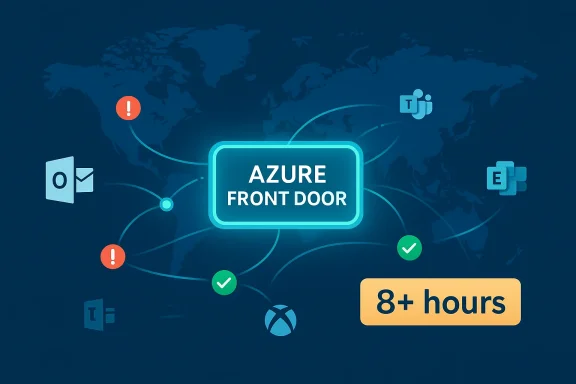
Microsoft’s cloud backbone hiccup on October 29, 2025 left millions of users and dozens of enterprise customers scrambling as Outlook, Teams and other Microsoft 365 services reported intermittent failures and timeouts, with Microsoft ultimately tracing the outage to a configuration deployment problem in Azure Front Door (AFD) and confirming the incident lasted for more than eight hours.
Microsoft 365 and Azure are tightly coupled across countless business processes: email, collaboration, authentication, media delivery and even consumer services such as Xbox rely on Azure’s global networking and edge delivery infrastructure. That architectural consolidation creates operational efficiency, but it also concentrates risk: when a core delivery fabric like Azure Front Door experiences a systemic issue, the effects can cascade from infrastructure to platform to end-user applications. The impact from the October 29 incident makes that trade-off painfully clear. Microsoft acknowledged the outage via its Azure service communications and said that while error rates and latency were back to pre-incident levels, a small number of customers might still see residual problems as Microsoft “worked to mitigate this long tail.” Microsoft also reported that customer configuration changes to AFD were temporarily blocked while recovery progressed.
Source: Times Now Microsoft Down: Thousands Report Issues With Outlook, Teams and Microsoft 365 Amid Outage
 Background
Microsoft 365 and Azure are tightly coupled across countless business processes: email, collaboration, authentication, media delivery and even consumer services such as Xbox rely on Azure’s global networking and edge delivery infrastructure. That architectural consolidation creates operational efficiency, but it also concentrates risk: when a core delivery fabric like Azure Front Door experiences a systemic issue, the effects can cascade from infrastructure to platform to end-user applications. The impact from the October 29 incident makes that trade-off painfully clear. Microsoft acknowledged the outage via its Azure service communications and said that while error rates and latency were back to pre-incident levels, a small number of customers might still see residual problems as Microsoft “worked to mitigate this long tail.” Microsoft also reported that customer configuration changes to AFD were temporarily blocked while recovery progressed. What happened: concise timeline and scope
Onset and detection
- The incident began with elevated timeouts and connection errors affecting services that depended on Azure Front Door, Microsoft’s global content delivery and application gateway platform. Dependent services reported spiky latency and failures in reachability.
- Customers and third-party outage trackers saw rapid surges of reports for Outlook, Teams, Exchange Online and other downstream services. Some high-profile corporate customers — including airlines and telecoms — reported disruptions to public-facing systems tied to Azure.
Root cause as described by Microsoft (initial findings)
- Microsoft’s internal investigation identified an inadvertent tenant configuration change within Azure Front Door. That configuration introduced an invalid or inconsistent state that prevented many AFD nodes from loading their expected configuration, causing them to be marked unhealthy and drop out of the global pool. As healthy nodes became overloaded, latency and timeout behavior spread. Microsoft’s published remediation actions included blocking further configuration changes and rolling a “last known good” configuration across the fleet, then rebalancing traffic gradually to avoid overloading recovering nodes.
Duration and recovery
- Microsoft and multiple news agencies reported the full incident ran for over eight hours from detection to broad restoration, with recovery efforts continuing afterward to clear a residual long tail of impact and to re-enable customer management operations. During the incident Microsoft left AFD configuration and propagation operations blocked to prevent re-propagation of an erroneous state.
Services and customers affected
Microsoft services
- Microsoft reported downstream impacts to Microsoft 365 services including Outlook (Exchange Online), Microsoft Teams, and supporting services such as Azure Communication Services and Media Services. Authentication-dependent systems like the Xbox ecosystem also experienced intermittent issues in some regions. These effects were visible both in consumer reports and in enterprise monitoring.
Notable customer and public impacts
- Large enterprises and public services reported knock-on effects: Alaska Airlines and Heathrow Airport cited service disruptions tied to the Azure incident during the outage window, and several telecom operators reported degraded services where they used Azure fronting and media delivery. These disruptions underline that cloud outages can quickly become operational incidents for customers across industries.
Geographic distribution and scale
- Report spikes on public trackers were global but concentrated in major urban and traffic-heavy regions. The outage produced tens of thousands of user reports on outage trackers at its height and broad anecdotal complaints across social platforms. The incident affected both consumer and enterprise tenants and highlighted dependencies present in critical digital infrastructure worldwide.
Technical analysis: why a configuration change cascaded
Role of Azure Front Door (AFD)
Azure Front Door is a global edge network that provides routing, load balancing, Web Application Firewall (WAF), CDN features and TLS termination. Because AFD sits at the network edge, configuration errors propagate fast: if many edge nodes adopt a faulty configuration, client traffic can be misrouted, experience TLS/connection failures, or be dropped entirely. The October 29 incident shows how an AFD configuration state can be a single point of failure for downstream services.The failure mode
- According to Microsoft’s initial technical account, an inadvertent tenant configuration deployment introduced an invalid or inconsistent state that caused a significant number of AFD nodes to fail to load their configuration properly. Validation safeguards that should have prevented the deployment were bypassed due to a software defect in the deployment pipeline. As unhealthy nodes dropped out, traffic rebalanced to fewer healthy nodes, amplifying load and causing additional timeouts. Microsoft then blocked further config changes, rolled a known-good configuration and rebalanced traffic in a controlled way to avoid overloading nodes returning to service.
Why staged recovery was necessary
A blunt restoration (mass restarts or immediate re-enable of all nodes) risked further instability and potential overload of recovery systems. Microsoft elected a phased approach — reload configurations, prevent new changes, and let nodes rejoin gradually — to stabilize the fleet and prevent oscillation. That approach increases time to full restoration but reduces the risk of repeated failures. The trade-off is a longer “tail” during which some customers may still suffer degraded service.Critical appraisal: strengths, weaknesses, and unknowns
Strengths shown during the incident
- Rapid public acknowledgment and visibility: Microsoft updated Azure Service Health and community channels and described actions taken to block configuration changes and restore consistency. Transparent, measurable communication is essential in large incidents.
- Deliberate staged recovery: The phased reconfiguration and traffic rebalancing limited the risk of repeated collapse from overloaded nodes, avoiding further expansion of the outage footprint.
Weaknesses and systemic risks exposed
- Change control failure: The proximate trigger was a configuration deployment that should have been validated and blocked by safeguards; Microsoft attributed bypass of protections to a software defect. That points to weaknesses in internal change validation and enforcement.
- Single-fabric dependency: The incident highlights how centralizing critical delivery services on a single global fabric increases systemic risk for tenants that rely on that fabric for authentication, email delivery and media. Enterprises increasingly place many workloads behind the same front door; a failure in that layer touches them all.
- Long-tail customer impact and operational friction: Blocking customer configuration operations to stabilize the network helps recovery but prevents tenant-level remediation during the event — a trade-off that can frustrate customers who need to enact emergency fixes. Microsoft explicitly warned that customer operations (create/update/delete/purge) remained blocked for safety while the long tail was handled.
Unverifiable or provisional claims to watch
- Microsoft’s high-level root-cause description and the claim that a software defect allowed a bad deployment to bypass safeguards are consistent across initial communications and press reporting, but the final Post Incident Review (PIR) and a detailed timeline remain the authoritative record. Microsoft indicated a PIR would follow — any technical inferences beyond the initial public disclosure should be treated as provisional until the PIR is published.
Impact assessment: costs, SLAs, and business continuity
Operational and financial impact
- Downtime of email, calendar and collaboration tools can translate directly into lost productivity, missed meetings and delayed business processes. For customer-facing systems (e.g., airline websites, airport information systems), the incident produced tangible friction for operations and traveler services. The financial impact for affected enterprises varies by industry and scale but includes the immediate costs of switching to fallback systems and potential revenue loss for customer-facing outages.
Contractual and regulatory implications
- Large enterprise customers will review their Microsoft contractual terms, SLAs and remedies. Repeated or prolonged service incidents raise questions about SLA credit sufficiency, multi-cloud contingency clauses and — where regulated services are impacted — potential notification and compliance requirements. Organizations in regulated sectors should pre-check their obligations for service interruptions and consider whether the current resilience posture meets regulatory expectations.
Practical guidance for IT teams: hardening, mitigations and playbooks
Here are prioritized, pragmatic steps IT and platform teams should adopt to reduce exposure and speed recovery when infrastructure-edge outages occur.- Verify and diversify critical paths.
- Ensure critical services (email inbound/outbound, authentication, public web sites) have diverse ingress paths and fallback routes where possible (MX fallback, secondary CDNs, alternate authentication flows).
- Validate failover and runbooks.
- Maintain tested runbooks for core failure patterns: DNS failover, SMTP relay fallback, SAML/OAuth token caching and temporary reissues, and Teams/VoIP alternate conferencing.
- Configure monitoring and synthetic transactions.
- Synthetic end-to-end checks for mail delivery, calendar sync, auth flows and application health give faster and more actionable alerts than raw infrastructure telemetry alone.
- Pre-authorize emergency vendor contacts and run escalations.
- Ensure 24/7 vendor escalation contacts and cloud-provider technical support processes are pre-authorized and understood in incident response plans.
- Use caching and queueing for resilience.
- Where possible, employ client-side or edge caches and local message queues so momentary upstream failures do not lose data.
- Consider multi-cloud or hybrid critical-path designs.
- For workloads where availability is paramount, architecting active-passive or active-active cross-cloud paths for ingress and critical APIs reduces single-fabric exposure.
- Review change control and canary strategies.
- Require multi-layered validation for global config changes, tight canary rollouts and automated rollback triggers when edge nodes report mismatch metrics.
- Short-term mitigations for admins during an outage:
- Use mobile and desktop clients where possible (some platforms had differential impact by access path).
- Engage your vendor success or account team early to coordinate targeted remediation or account-level SLAs.
- Communicate clearly to end users with expected timelines, alternate channels and prioritization guidance.
What Microsoft should (and said it will) do next
Microsoft has indicated it will complete a detailed internal retrospective and publish a Post Incident Review (PIR) within a defined window after the outage. Early public actions reported include adding validation and rollback controls to the deployment pipeline that allowed the fauafeguards. Those are appropriate immediate steps — the long-term credibility test will be in the follow-through: demonstrable hardening, measurable changes to canary policies, and improved customer-facing incident instrumentation. Key improvements that would materially reduce the likelihood and impact of similar incidents:- Stronger automated deployment gates and independent verification services for tenant-scoped changes.
- Faster, more granular customer telemetry that shows per-tenant impact in near real-time.
- Mechanisms for safe, tenant-level rollback even while global operations are in a restricted state.
- Expanded guidance and tooling for customers to test and simulate edge failures for their own workloads.
Broader lessons for cloud reliance and vendor risk management
Single-fabric convenience vs. concentrated risk
The October 29 incident is a textbook example of how convenience and integration can concentrate risk: a single control plane change at the edge caused disruptions up and down the stack. Organizations should not treat cloud provider SLAs as a substitute for architectural resilience, especially for mission-critical user-facing paths.Testing and table-top exercises matter
Table-top incident simulations that involve cloud-provider failure scenarios (edge misconfiguration, regional control plane errors, API throttling) reveal operational gaps that standard backup plans may not cover. Practicing these scenarios reduces the friction and confusion teams face during real incidents.Contract and governance hygiene
CIOs and IT procurement teams should ensure that vendor contracts include:- Clear incident notification expectations,
- Defined SLA credit mechanisms and clear definitions of ‘downtime’ for composite services,
- Technical escalation pathways and periodic operational reviews.
Conclusion: a resilience wake-up call with actionable next steps
The October 29, 2025 Azure Front Door incident demonstrates a simple but stark reality: modern cloud platforms are powerful and efficient, but they also require discipline in change control, rigorous validation, and careful customer-facing recovery procedures. Microsoft’s staged recovery and public acknowledgments showed strengths in operational discipline and customer communication, yet the root-cause narrative — a deployment that bypassed safeguards — highlights persistent vulnerabilities in how large-scale platform changes are validated and shipped. For IT leaders and Windows-focused administrators, the immediate action items are clear:- Revise incident playbooks to include edge-fabric failure modes,
- Test secondary pathways for email, authentication and critical public endpoints,
- Engage with cloud providers about post-incident improvements and timelines,
- And, critically, run the table-top exercises that reveal the human and procedural gaps that automation alone cannot fix.
Source: Times Now Microsoft Down: Thousands Report Issues With Outlook, Teams and Microsoft 365 Amid Outage
