

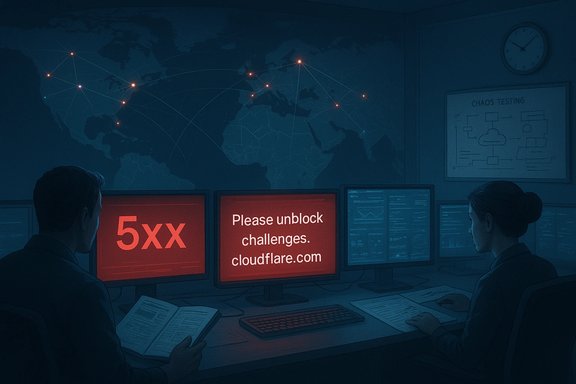
On a bright November morning, thousands of businesses and millions of internet users found themselves staring at the same message: a Cloudflare‑branded error or the blunt browser prompt, “Please unblock challenges.cloudflare.com to proceed,” as essential services — from ChatGPT and X to countless smaller sites — briefly became unreachable when Cloudflare’s edge network suffered a catastrophic internal degradation on November 18, 2025.
Background / Overview
The November 18 incident was not an isolated blip but the latest, highly visible flashpoint in a year that exposed the fragility of modern internet architecture: an economy increasingly dependent on a small set of cloud and edge providers. By 2025 the three largest hyperscalers — Amazon Web Services (AWS), Microsoft Azure and Google Cloud — together captured roughly two‑thirds of global cloud infrastructure spending, a concentration that both fuels scale and concentrates systemic risk. At the same time, surveys and industry reports show cloud adoption has become effectively universal across large organizations: roughly 94% of enterprises use cloud services in some form, and multicloud architectures are now the dominant model for resilience and feature fit. That near‑ubiquity explains why a control‑plane or edge failure at a single vendor can have cascading, cross‑sector consequences. The Rest of World reporting and firsthand accounts compiled in the wake of November 18 make the consequences personal: sales automation tools stopped working for clients in Rwanda, doctors in Mexico found patient portals unreachable, and payment experiences faltered for users who expected instant access to funds. These human stories are the practical proof of a broader architectural problem.What happened on November 18, 2025
Cloudflare’s own post‑mortem and contemporaneous reporting establish a clear sequence: around 11:20 UTC an internal Bot Management feature file began to propagate with duplicated entries after a permission change in a ClickHouse query. The oversized configuration file exceeded assumptions in the edge proxy’s bot‑management handler, causing the proxy to panic and return HTTP 5xx errors across parts of Cloudflare’s fleet. The company mis‑interpreted early symptoms as a potential DDoS, but engineers eventually halted propagation, replaced the bad feature file, and restarted affected components — services returned to normal after several hours of staged remediation. The visible symptoms for end users included:- Mass spikes of 500‑series HTTP errors on sites fronted by Cloudflare.
- Interstitial challenge pages that blocked legitimate sessions.
- Partial dashboard and API failures for Cloudflare customers.
- Intermittent recovery followed by relapse while bad configurations propagated to additional nodes.
First‑person impact: entrepreneurs and engineers on the ground
The Rest of World compilation of firsthand accounts brings the outage into sharp relief for operators in diverse markets. A few representative experiences illustrate the operational and emotional costs:- A Rwanda‑based entrepreneur who builds sales automation tools discovered his clients’ workflows frozen and support teams overwhelmed when Cloudflare‑fronted endpoints started returning errors; he describes a morning of frantic calls, customer panic and an inability to act while access to tools like Slack, HubSpot and other SaaS platforms vanished.
- A Mexico‑based go‑to‑market engineer reported feeling helpless as his company’s website and customer portals went dark during an AWS incident earlier in the year; obligations under service‑level agreements made the downtime a contractual and reputational liability.
- Founders in Kenya and Nigeria described practical mitigations they’ve adopted after multiple outages: maintaining a distributed stack across multiple public clouds, purchasing local on‑premise servers as emergency fallbacks, and delegating outage response roles so teams can execute playbooks even when executives are not immediately reachable. These steps helped preserve minimal functionality during outages but come with trade‑offs in cost and complexity.
The technical anatomy: why edge providers create a single‑point blast radius
Modern web architectures typically place an edge provider between the public internet and origin services to gain performance, caching, TLS termination, DDoS mitigation, bot management and consistent security policies. That model is efficient and often sensible, but it concentrates control into a public ingress layer: when the edge’s control plane or a critical handler fails, it can intercept, block, or misroute legitimate traffic before it ever reaches healthy back ends.Key technical features of the November 18 failure:
- The proximate failure was in a configuration/metadata feature file used by a bot‑management ML model. When that file doubled in size due to duplicate rows, the routing proxy’s code path hit an unhandled error and panicked in parts of the fleet. This is a classical control‑plane failure: not that origin servers were down, but the machinery that admits and validates sessions failed.
- Propagation mechanics made the problem worse: the same configuration is rapidly distributed across Points of Presence (PoPs) to respond to changing threats. Automation that historically increases safety can also multiply a bad state quickly.
- The default safety posture of many edge systems is fail‑closed: better to block suspicious traffic than to permit abuse. When the edge fails, fail‑closed behavior turns defensive logic into an availability hazard. This trade‑off is foundational to why control‑plane anomalies can look like origin outages.
Scope and scale: more outages, not just one event
2025 emerged as a high‑visibility year for cloud and edge disruptions. AWS experienced a severe regional control‑plane incident in October 2025 that produced extended outages in US‑EAST‑1, with reports of multi‑hour disruptions and ripple effects across services that depend on DynamoDB and related control primitives. Microsoft Azure also suffered a high‑impact Front Door configuration incident in late October, and Cloudflare’s November event was followed by another incident in early December. Aggregators and industry trackers documented dozens of significant disruptions across hyperscalers in the 12‑month window. Exact tallies vary by methodology — outage trackers, vendor status updates and newsroom compendia each count events differently — but the consistent insight is that hyperscale control‑plane incidents are no longer rare exceptions. They are systemic hazards to be managed as part of normal operational risk. Where claims about absolute counts remain noisy, the observed trend — more and larger incidents in the same calendar cycle — is verifiable across multiple independent monitors and reporters. Treat precise “more than X” claims with caution if they are not grounded in auditable cross‑provider logs.Business fallout: what failed when the cloud failed
When the edge layer hiccupped, everyday moments unraveled in predictable and unpredictable ways:- Payment flows, ticketing systems and checkout pages blocked by front‑end errors left shoppers and merchants stranded for minutes to hours at a time. Retail and travel spikes in user frustration and lost transactions are immediate revenue hits with downstream returns or chargebacks.
- Healthcare portals and EHR access can degrade or fail, creating patient care and compliance problems where clinicians rely on instantaneous record lookups.
- Smart devices and IoT telemetry that route through cloud APIs showed temporary loss of features — doorbells, CCTV, telemetry and even smart‑mattress analytics lost cloud‑dependent capabilities. These failures may not put lives at risk in most cases, but they erode trust and increase support costs.
- Operational teams spent hours triaging downstream effects instead of executing planned roadmaps. Customer support queues spiked, legal teams prepared SLA and compensation assessments, and sales cycles paused where demos or integrations depended on affected services.
How companies are responding: resilience patterns and trade‑offs
Operators worldwide described a pragmatic set of responses — none of them free.- Multi‑cloud and multi‑CDN architectures. Distributing ingress across more than one edge/cloud provider reduces single‑vendor exposure but raises integration and testing costs. Many teams run critical public endpoints through multiple CDNs and use traffic manager policies to fail over DNS records when one vendor is impaired.
- Local on‑premise fallbacks. Some startups and regional firms maintain a modest on‑premise server or local datacenter to handle emergency transactions and keep customer support platforms alive. These systems are intentionally lower performance but provide a last‑line of sovereignty. The cost is capital expense and the operational effort of synchronizing data and security.
- Standard operating procedures (SOPs) and delegated incident roles. Teams now formalize “who does what” during provider outages: customer comms, routing changes, legal notification and escalation ladders. Delegated project managers handle the immediate customer triage so founders can continue to run other parts of the business.
- Multi‑path client routing. Some user‑facing mitigations include instructing customers to switch to mobile data, use VPNs, or attempt different client routes that hit alternate PoPs. These fixes sometimes work, but they are not universally applicable and can confuse users.
- Benefits:
- Reduces single‑provider dependency and increases service availability.
- Provides tactical fallbacks for critical customer journeys.
- Encourages operational discipline (playbooks, chaos testing).
- Drawbacks:
- Higher monthly bills and increased engineering complexity.
- More complex security posture and compliance overhead.
- Greater testing surface: more failure modes to validate.
Practical resilience checklist for IT teams
- Map your dependencies.
- Catalog which external providers you depend on for DNS, CDN, bot mitigation, auth, payment gateways and monitoring.
- Prioritize critical customer journeys for special protection.
- Design multi‑path ingress for critical endpoints.
- Implement multi‑CDN for public assets and use smart DNS failover with low TTLs for emergency switchovers.
- Maintain alternate API endpoints that can bypass edge verification in an emergency.
- Validate your fail mode.
- Know whether your edge configuration is fail‑closed or fail‑open for critical flows and choose defaults aligned with business risk.
- Practice incident swaps and tabletop drills.
- Run chaos tests and simulated outages requiring full cutover to fallbacks. Time to failover is as important as the existence of a fallback.
- Adopt delegated, documented SOPs.
- Ensure at least two trained individuals can execute your provider‑facing rollback and customer‑communications playbooks outside of core engineering teams.
Economic and regulatory implications
Hyperscaler concentration — top three providers controlling roughly 60–63% of the cloud market — is a double‑edged sword: it brought economies of scale and rapid innovation but also raises competition, sovereignty and resilience questions. Industry monitoring firms and journalists repeatedly pointed to this market dominance in 2025, prompting renewed regulatory attention in multiple jurisdictions. Policymakers and procurement teams are now asking hard questions:- Should critical public services be required to run multi‑provider or on‑premise fallbacks?
- What transparency and auditability should hyperscalers provide for control‑plane operations?
- Are there proportionate market regulations that can preserve innovation while reducing systemic contagion risk?
Strengths revealed and lessons learned
These outages exposed not only fragility but also important strengths in the cloud ecosystem:- Rapid detection and staged remediation playbooks succeeded in limiting incident durations in many cases; rollback and staged node recovery are standard and effective tools.
- Public status pages and continuous updates from vendors — while sometimes delayed — enabled customers to triage and coordinate responses. Transparency, even when painful, helps downstream teams prioritize.
- Multi‑cloud and multi‑edge strategies demonstrably reduced impact for organizations that had invested in redundancy. The outage was not binary: having partial paths available often allowed critical business transactions to continue.
Risks and hard trade‑offs
Building resilience is expensive and operationally complex. The most important trade‑offs are:- Cost vs. availability: Multi‑cloud and on‑prem fallbacks raise recurring and capital costs.
- Complexity vs. reliability: More providers mean more integration points, more security considerations and more CI/CD testing.
- Fail‑open vs. fail‑closed: Choosing to allow potentially risky traffic in an outage improves availability but raises security exposure.
A note on claims and verification
Public and industry reporting across 2024–2025 consistently documents a larger number of cloud and edge incidents than in prior years. Multiple independent outlets compiled lists of notable outages and their impacts; however, precise counts and attribution can be noisy depending on the aggregator and its inclusion rules. Readers should therefore treat aggregated tallies (for example, “more than 100 outages across three providers in a single year”) as indicative of a troubling trend rather than an exact, audited census. Where possible, consult vendor post‑incident reports and independent outage trackers for the most reliable detail.Conclusion
The November 18 Cloudflare outage — and a series of hyperscaler incidents through 2025 — were not merely inconvenient interruptions. They were systemic stress tests that revealed how much modern life and commerce now depend on a handful of edge and cloud operators. The outages were a practical lesson in architectural humility: the convenience of hyperscale infrastructure brings enormous benefits, but also correlated risks that demand explicit operational, financial and governance responses.Enterprises and public institutions must now treat cloud resilience as a core design consideration rather than an optional cost center. That means mapping dependencies, investing selectively in multi‑path redundancy, exercising fallbacks with discipline, and demanding greater transparency from providers. For the millions who experienced a frozen workflow, a failed payment, or a silent dashboard that morning in November, the takeaway is simple: design for failure, test for recovery, and budget for resilience — because the cloud will go out again, and the difference between calm restoration and chaotic panic will be the preparation done today.
Bold action and modest investments in redundancy can convert hyperscale convenience into durable availability — the new baseline for doing business on the internet.
Source: Rest of World The day the cloud went out
