Azure Front Door Outage 2025: Rollback to Last Known Good

  • Thread Author
Microsoft’s cloud fabric suffered a catastrophic, broadly scoped disruption on 29 October 2025 that knocked Azure Front Door (AFD) and related network/control-plane infrastructure offline, producing cascading outages across Microsoft 365, the Azure Portal, Xbox/Minecraft sign‑in flows and many downstream customer sites — and Microsoft began rolling out a “last known good” configuration as the first major step toward recovery.

Global IT outage visualization with a red downward trend and recovery path to the Last Known Good.Background / Overview​

Microsoft Azure Front Door (AFD) is the company’s global, Layer‑7 edge fabric: a distributed service that performs TLS termination, global load balancing, web application firewalling and request routing for both Microsoft’s own services and many customer workloads. When AFD or the identity fronting layer (Microsoft Entra ID) is impaired, the outward symptom set — failed sign‑ins, blank admin portal blades, 502/504 gateway responses and intermittent DNS/TLS anomalies — looks like a total service failure even when backend compute is healthy. Microsoft’s incident messaging for this event specifically points to AFD as the initiating domain and describes a configuration rollback and traffic‑steering mitigation plan. This is not Microsoft’s first AFD‑related incident in October; earlier outages this month produced similar patterns of edge capacity loss and portal/authentication impacts. The pattern underlines how the combination of centralized identity and a shared global edge fabric magnifies the blast radius when a routing or configuration error occurs.

What happened (concise timeline and Microsoft’s public actions)​

  • Around 16:00 UTC on 29 October 2025 Microsoft began seeing availability failures tied to Azure Front Door. Public status updates blamed an “inadvertent configuration change” as the suspected trigger.
  • Microsoft took immediate containment actions: it blocked further changes to AFD configurations to prevent repeated regressions, began failing the Azure Portal away from AFD to restore management-plane access, and initiated a rollback to the “last known good configuration.” The company said it had started deploying that configuration and expected initial recovery signs within roughly 30 minutes from the update they posted. Customers were warned that tenant configuration changes would remain blocked temporarily while mitigations continued.
  • Microsoft recommended programmatic access (PowerShell, CLI) as an interim workaround for portal‑inaccessible scenarios and suggested Azure Traffic Manager failovers for customers who needed to bypass Front Door to reach origin servers. The provider did not provide an immediate ETA for full mitigation beyond progressive status updates.
These public steps — halting changes, rolling back configuration, failing critical portals off AFD and steering traffic to healthy nodes — are textbook incident containment and recovery actions for a global edge‑fabric fault. That said, the outage’s scale and the number of dependent services affected made it sharply visible and disruptive in minutes.

Scope and immediate impact​

The disruption quickly rippled well beyond Microsoft’s first‑party services because many consumer and enterprise applications rely on AFD or Entra ID. Real‑time outage trackers and news outlets reported wide service disruptions:
  • Microsoft 365 and the Microsoft 365 admin center were flagged under incident MO1181369, with admins reporting sign‑in failures, blank blades and intermittent portal access.
  • Xbox Live, Minecraft authentication and other gaming identity flows experienced login failures and party/online gameplay interruptions in affected regions. Microsoft’s consumer status surfaces and community posts reflected those user complaints.
  • Many high‑profile customer sites and mobile apps that route through Azure showed 502/504 gateway errors or complete degradation; outlets reported disruptions at airlines, retailers and banking apps that use Azure infrastructure. Downdetector‑style aggregates recorded large spikes in reports for Azure and Microsoft 365, though those user‑report counts are noisy and should be treated as approximate indicators rather than precise telemetry.
Because AFD is a global ingress fabric with Points of Presence (PoPs) distributed worldwide, the outage produced regionally uneven symptomology — some ISPs and users were affected more heavily than others depending on routing and which PoP their traffic reached. That explains why some users could still reach services via a different ISP or mobile network while others saw complete failures.

Technical anatomy — why an AFD configuration fault cascades​

To understand why this outage felt like a full‑company failure, consider three technical realities:
  • Azure Front Door is a shared, global Layer‑7 surface that terminates TLS, enforces web‑application firewall rules, and issues routing decisions for many Microsoft‑owned control planes (Azure Portal, Microsoft 365 admin center, Entra sign‑in endpoints) as well as customer applications. When AFD misroutes or loses capacity, token issuance and TLS handshakes can fail even when back‑end servers are healthy.
  • Microsoft Entra ID (formerly Azure AD) centralizes identity for a huge swath of Microsoft services, and authentication token issuance is sensitive to routing and latency. If the identity front door is unreachable or times out, authentication‑dependent services (Outlook, Teams, Xbox) can’t proceed. A front‑door disruption therefore multiplies the visible impact far beyond the initial domain.
  • Configuration changes to a distributed control plane are inherently risky: a single misapplied route, ACL or DNS rewrite can propagate globally in minutes. Microsoft’s own post‑incident histories note that configuration validation gaps and the absence of automatic rollback triggers have been recurrent hardening targets. The “last known good” rollback Microsoft began deploying is an intended safety mechanism when automated validation does not detect harmful changes quickly enough.
The public narrative for the event points to an “inadvertent configuration change” as the trigger and to DNS/addressing anomalies tied to AFD and related network infrastructure as key symptoms. Recovery actions focused on stopping further changes, rolling back the suspected bad configuration and rehoming traffic to healthy nodes — exactly the actions an operator would take to restore an edge fabric.

Microsoft’s mitigation: what they did and what customers should expect​

Microsoft’s publicly disclosed mitigation and guidance for customers included:
  • Deploying the “last known good configuration” across affected AFD profiles to restore normal routing and prevent recurrence of the problematic state. Microsoft said the deployment was initiated and expected to show initial signs of recovery within about 30 minutes of their update. Customers were warned that configuration changes would remain blocked until mitigations were complete.
  • Failing the Azure Portal away from AFD to allow tenant owners programmatic access where possible, and advising that customers use CLI/PowerShell as alternatives for management tasks while portal extensions and some Marketplace endpoints might still show intermittent issues.
  • Suggesting customers consider Azure Traffic Manager or other failover setups to redirect traffic away from AFD to origin servers if they needed immediate availability for customer workloads. Microsoft documented these interim measures in official guidance and status messages.
These actions reflect a standard operator escalation playbook: stop the change, roll back, steer traffic to healthy endpoints, and provide programmatic management routes until control planes stabilize. The critical operational caveat — and one Microsoft acknowledged publicly — is that customer configuration changes would remain blocked during mitigation to prevent reintroducing the faulty configuration. That’s a painful but necessary constraint for global rollback safety.

Corroboration and independent verification​

Key operational claims in Microsoft’s status messaging are corroborated by multiple independent outlets and telemetry:
  • Microsoft’s AFD‑centric incident message and the 16:00 UTC start time are reflected on the official Azure status page and mirrored by widespread reporting.
  • Consumer and enterprise impacts — Microsoft 365 admin center, Xbox/Minecraft authentication failures, Azure Portal inaccessibility — are reported across outlets and user complaint aggregators in parallel with Microsoft’s incident entries. These independent feeds show tens of thousands of user reports at peak on Downdetector‑style sites; those counts are useful for scale but can be noisy and should be viewed as indicative, not precise.
Where available, each of the major factual pulls here has at least two independent confirmations (Microsoft status + reputable news / outage trackers). Any assertion not visible on Microsoft’s status entries or on credible news outlets is explicitly labeled as reported by third parties or flagged as unverifiable.
Caution: When community posts speculate on root cause details beyond Microsoft’s public statements (for example, precise code or orchestration failures inside AFD), those technical reconstructions are plausible but not provably released by Microsoft at the time of reporting; treat such details as informed analysis rather than confirmed fact.

Real‑world consequences and human stories​

The outage produced visible, immediate pain:
  • Administrators were locked out of the very management consoles they need to triage tenant state, increasing incident response friction for enterprise teams.
  • Airlines and retailers using Azure reported degraded booking, check‑in or online ordering experiences; Alaska Airlines explicitly confirmed disruption for web‑based services hosted on Azure. These operational hits translate into check‑in queues and frustrated customers at airports and stores.
  • Gamers trying to sign on to Xbox Live or Minecraft encountered login failures and multiplayer disruption, a consumer‑visible symptom that often becomes a touchstone for public sentiment during cloud outages.
These anecdotes underscore a central point: major cloud provider incidents are no longer “technical-only” events. They cascade into travel, retail, finance and everyday entertainment, creating measurable economic and human friction within minutes.

Practical guidance: what admins and organizations should do now​

For IT teams and architects facing this outage (or planning for the next one), the following prioritized actions help reduce exposure and speed recovery:
  • Confirm impact scope in your tenant from your own telemetry, not just public portals.
  • If the portal is unavailable, switch to programmatic controls (Azure CLI, PowerShell, REST APIs) and ensure credentials / service principals are available offline. Microsoft explicitly advised this workaround.
  • If your public endpoints are fronted by AFD, prepare and test an origin failover route (Azure Traffic Manager, alternate DNS records, or an alternate CDN/failover path) so you can quickly redirect traffic away from AFD if necessary. Microsoft recommended this as an interim measure.
  • Validate and practice runbooks for admin access blackout drills: how to revoke sessions, rotate keys, or perform emergency changes when the admin portal itself is flaky. Treat the portal as a convenience, not a single point of control.
  • Review application retry/backoff logic and exponential backoff patterns; avoid aggressive retry behavior that can amplify request storms during degraded network conditions. Microsoft’s post‑incident guidance reiterates sensible retry patterns.
  • Assess critical workloads for multi‑region or multi‑cloud survivability where feasible — not all services are worth duplicating, but core customer‑facing flows may merit diversification or robust DNS failover strategies.
  • Tighten telemetry and SLO‑driven alerting that can detect not only application failures but also edge‑path anomalies such as increased TLS handshakes, certificate mismatches, or sudden PoP‑specific latency spikes.
These steps are practical, actionable and aligned with Microsoft’s own mitigation guidance and with mainstream resilience recommendations articulated in cloud best‑practice frameworks.

Systemic risks and post‑incident priorities​

This outage reaffirms several systemic risks that both cloud platforms and their customers must face:
  • Centralized identity as a single multiplier: a failure in the identity fronting layer (Entra ID) or the edge that fronts it magnifies downstream outages. Treat identity as a mission‑critical dependency and design alternate paths or cached token strategies where safety allows.
  • Change‑management fragility at scale: even with “safe deployment practices,” an inadvertent configuration change in a global control plane can propagate rapidly. Providers must continue investing in automated validation, canarying and safe rollback mechanisms; customers must demand clear post‑incident reports that explain the human and technical process failures as well as corrective actions.
  • The operational paradox of shared fabrics: shared global edge fabrics drive scale and efficiency, but they concentrate failure modes. Both vendors and customers must balance convenience with the risk of concentrated dependencies.
Microsoft’s stated post‑incident roadmap (improving validation, safer deployment and automating fallback to last known good states) aligns with these lessons — but recurring events in the same month raise reasonable questions about cadence and the pace of remediation.

What to watch next (and what remains uncertain)​

  • Recovery progress: Microsoft’s updates indicated deployment of a “last known good” configuration and stepwise node recovery, but at the time of the initial messaging the company did not offer a firm ETA for complete mitigation. Expect progressive restoration of services followed by a period of intermittent errors while routing converges.
  • Post‑incident report: the most useful artifact for enterprises will be Microsoft’s post‑incident report (PIR). That document should explain the chain of events, why automated validation did not prevent the deployment, and which corrective controls will be prioritized. Microsoft has published detailed PIRs for previous AFD incidents; the same level of transparency is necessary here for customers to assess contractual and operational implications.
  • Residual and third‑party effects: third‑party sites and smaller SaaS vendors that extensively rely on AFD may continue to experience longer tails of recovery if they lack independent failover paths. Administrators should monitor their service health notices and third‑party vendor updates closely.
Unverifiable claims: community speculation about precise internal software bugs, Kubernetes orchestration failures, or exact code paths that produced the request storm may be technically informed but should be treated as provisional until Microsoft’s PIR confirms those specifics. Where reporting relies on internal telemetry not publicly released, it remains analysis rather than confirmed fact.

Final analysis — strengths, weaknesses and what this means for cloud consumers​

Strengths demonstrated in Microsoft’s handling:
  • Rapid, transparent customer messaging and visible status updates across services helped large numbers of customers quickly map impact and take emergency measures.
  • The operator playbook (stop change, roll back, fail portal away from AFD, steer traffic, provide programmatic workarounds) is a mature approach and aligns with industry practice for complex distributed systems.
Weaknesses and risks exposed:
  • Recurrent AFD/edge incidents in a short time window expose an operational fragility in change validation, rollout safety and automated rollback mechanisms. Microsoft’s own historical PIRs show this has been an area for remediation, but repeated incidents indicate more work remains.
  • Centralization of identity and edge routing concentrates failure surface: many downstream services effectively share the same choke points, raising systemic risk for customers that lack divergent architectures or robust failover.
What this means for cloud customers:
  • Accept that cloud convenience involves concentrated risk; introduce compensating controls where business impact warrants (multi‑region, multi‑cloud, DNS failover, offline admin runbooks).
  • Insist on operational transparency and actionable SLAs from cloud vendors; require post‑incident analysis and remediation timelines as part of contractual discussions.
  • Practice incident drills that assume management consoles will be unavailable and keep programmatic credentials, emergency playbooks and alternate comms channels ready.

Microsoft’s outage on 29 October 2025 is a stark reminder that the internet’s plumbing — global edge routing, DNS/addressing and centralized authentication — is both powerful and brittle. The provider’s immediate steps to block configuration changes, deploy a last known good state, and reroute portals away from the troubled fabric are appropriate and already supported by independent reporting; recovery will be incremental and some customer workflows will remain constrained until routing and control‑plane health fully converge. Enterprises should treat this as a practical call to action: harden failover plans, practice blackout drills, and press platform providers for faster validation and more robust rollback safety on global control‑plane changes.

Source: Tom's Hardware Huge Microsoft outage ongoing across 365, Xbox, and beyond — deployment of fix for Azure breakdown starts rolling out
 

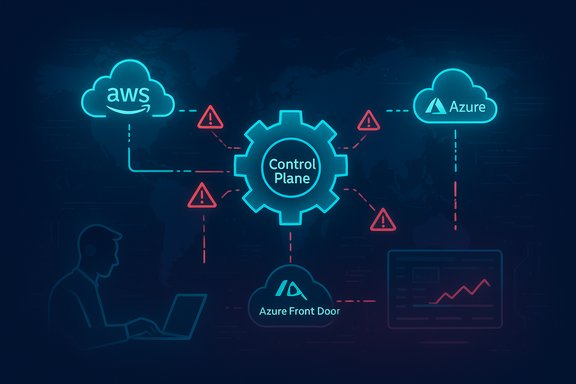
Neon control-plane gear links AWS, Azure, and Azure Front Door in a cloud network diagram.
The internet flickered — and for millions of people and hundreds of thousands of organizations the lights went out in ways that felt uncomfortably familiar: a major AWS control‑plane/DNS failure on October 20, 2025, followed less than ten days later by a wide‑reaching Microsoft Azure outage tied to an Azure Front Door configuration change, together laid bare the systemic fragility of today’s cloud‑centric internet and the business, technical, and policy risks that flow from concentrating critical infrastructure in the hands of a few hyperscalers.

Background​

In mid‑October 2025, Amazon Web Services experienced a severe outage centered in its US‑EAST‑1 (Northern Virginia) region. Engineers traced the principal failure to DNS and endpoint resolution problems affecting the DynamoDB API, which cascaded into elevated error rates and broad service degradation across multiple AWS-managed components. High‑profile consumer apps, gaming platforms, financial services, and even public agencies reported interruptions as the control‑plane issues rippled outwards. The event generated widespread commentary about the economics and risk of cloud concentration. Shortly thereafter, on October 29, 2025, Microsoft reported an incident that began around 16:00 UTC and was linked to an inadvertent configuration change within Azure Front Door (AFD) — Microsoft’s global Layer‑7 edge and routing fabric. The misapplied change produced DNS and routing anomalies that affected Microsoft management portals, Microsoft 365 sign‑ins, Xbox/Xbox Live/Tokens (including Minecraft authentication), and numerous third‑party sites fronted by AFD. Microsoft mitigated the outage by freezing configuration changes, rolling back to the last known good configuration, and rerouting traffic where possible. Both incidents shared striking themes: failures in control‑plane or DNS components, rapid global propagation because of centralized routing or endpoint dependencies, and visible downstream impacts that made entire applications appear to “break” even when back‑end compute was healthy. These events are not isolated curiosities — they’re structural signals about how internet architecture and commercial incentives have shaped systemic risk.

The technical anatomy: DNS, control planes, and the “glue” that holds services together​

What failed — the short explanation​

  • DNS and endpoint resolution are foundational: when domain names or API endpoints can’t be resolved reliably, client libraries and browsers cannot reach services irrespective of whether the compute or databases are intact. The AWS October incident pointed to a DNS resolution problem for a key DynamoDB endpoint; the result was that dependent APIs and SDK calls failed at scale.
  • Control‑plane and edge routing fabric failures can be catastrophic: Azure Front Door (AFD) combines TLS termination, hostname routing, WAF, and global request routing. A misapplied configuration or metadata propagation bug in that control plane can manifest as widespread authentication failures and unreachable services even if the origin servers are fine. Microsoft’s mitigation pattern — halt changes, deploy a rollback, and fail traffic away from the affected fabric — reflects standard containment for control‑plane incidents.

Why DNS/control‑plane failures cascade more than compute or storage faults​

  • Many modern applications separate control and data planes; the data (files, objects, databases) may remain healthy while the control signals (routing, token issuance, API endpoints) become unreachable. When the control plane is impaired, clients cannot authenticate, obtain routing, or resolve host names — so the frontend looks dead. Both October incidents followed this pattern.
  • Edge fabrics and global control planes are optimized for speed and feature parity; they are also highly distributed yet logically centralized in design. That combination can mask latent single points of failure: a global config rollout that contains bad metadata or a race condition in DNS automation can propagate quickly and broadly.

Real‑world fallout: examples and economic scale​

The visible consequences of these outages were broad and deep:
  • Consumer disruptions: Gaming platforms (including Xbox and Minecraft authentication), social media apps, messaging services, and streaming or storefront experiences experienced login failures or broken entitlement checks. For many users the experience felt like an outright service outage.
  • Enterprise and public sector impact: Microsoft 365 admin portals, bank/webshop checkouts, airline booking pages, and public agency services reported intermittent outages or degraded performance while operators scrambled workarounds. Outages that affect payments, tax services, or airline check‑in systems have direct economic and operational consequences far beyond simple user annoyance.
  • Aggregate cost estimates are headline‑driven but significant: some contemporary estimates placed the economic impact of the AWS outage in the order of billions of dollars across affected platforms and commerce windows; those estimates vary widely by methodology and should be regarded as indicative rather than precise. Reported figures should be treated as estimates unless corroborated by audited, firm financial disclosures. Be cautious with single‑figure loss claims; they are often extrapolations based on hourly revenue assumptions.

Why concentration matters: economics, incentives, and single points of failure​

The market reality​

Hyperscalers deliver unmatched economies of scale: global infrastructure, managed services, rapid feature release cadence, and attractive price/performance make AWS, Azure, and Google Cloud the default choices for many organizations. That convenience explains the market concentration where a small number of providers account for the majority of cloud spend and control‑plane usage. At scale, however, this concentration converts into systemic exposure when the providers have shared dependencies or when customers adopt the providers’ default regional endpoints without independent fallbacks.

The technical single‑point problem​

  • Default regions and global endpoints: Many teams use default or recommended regions (for example, US‑EAST‑1 with AWS) because they offer the latest features, lower latency to major user bases, and strong service coverage. This creates a “hot spot” of control‑plane activity where a regional failure can have outsized global effects.
  • Shared control‑plane primitives: Identity issuance (e.g., Microsoft Entra ID), CDN and edge routing (AFD), and managed database endpoints (DynamoDB) are often shared primitives that thousands of services depend on—so a failure in one of those primitives is effectively a correlated failure across many otherwise independent systems.

Critical analysis: strengths, shortcomings, and the lessons operators must internalize​

Notable strengths of hyperscalers​

  • Rapid mitigation and scale: Hyperscalers bring enormous operational resources to bear during incidents — global engineering teams, automated rollback tooling, and monitoring that detects anomalies early. These capabilities shorten incident windows compared with bespoke private infrastructure for many organizations. The rapid containment actions observed in both incidents (configuration freeze, rollback, traffic rebalancing) reflect mature incident playbooks.
  • Feature breadth and innovation: Managed identity, global edge fabrics, serverless databases, and integrated AI/ML platforms are hard to replicate at scale for most organizations without prohibitive capital or operational investment. These innovations drive business value and speed time to market.

Key risks and shortcomings​

  • Systemic fragility from logical centralization: Even with globally distributed hardware, the logical control plane can be centralized. A configuration bug, automation race condition, or DNS misconfiguration that touches that logic can create outsized, simultaneous impacts. The Azure and AWS incidents exemplify different technical failure modes producing similar large‑scale symptoms.
  • Opaque accountability and limited compensation: Provider SLAs limit liability and typically provide service credits rather than compensation for real economic loss. This mismatch leaves downstream organizations carrying the lion’s share of economic and reputational impact from provider outages. Claims for third‑party losses are difficult to arbitrate and often unrecoverable under standard contracts.
  • Operational complacency and test coverage gaps: Many organizations trust provider defaults and rarely test identity failover, DNS TTL behavior, cross‑region reconvergence, or offline restore procedures under realistic load. This gap turns theoretical DR plans into fragile artifacts when real incidents occur.

Practical checklist: what Windows admins, SREs, and CIOs should do now​

The roadmap below is intentionally pragmatic — it prioritizes actions that reduce blast radius and accelerate recovery without prescribing prohibitively costly redesigns.
  • Map critical dependencies (immediately)
    • Inventory which control‑plane endpoints you rely on (identity, DNS, logging, orchestration).
    • Identify which external services (CDNs, auth providers, API gateways) are single points of failure for your apps.
  • Harden identity and admin escape paths
    • Ensure alternate admin access methods exist (e.g., service principals, local break‑glass accounts, federation fallbacks).
    • Require and test programmatic admin access (PowerShell/CLI) as a fallback when portals are inaccessible. Microsoft and independent analysts flagged programmatic access as a viable interim workaround during Azure portal outages.
  • Design DNS and routing fallbacks
    1. Use low TTLs strategically for critical records where rapid switch-over is required.
    2. Prepare DNS failover scripts and validate their behavior across multiple resolvers.
    3. Consider multi‑provider DNS with health checks to avoid depending on a single chain of DNS automation.
  • Adopt a realistic multi‑region/multi‑cloud strategy where justified
    • Not every application needs active‑active across providers; prioritize critical services (payments, authentication, regulatory filings) for stronger redundancy.
    • Use warm or hot standbys in a second region or provider for services that demand short RTO (recovery time objective).
  • Exercise disaster recovery and incident playbooks
    • Run scheduled, realistic failover drills that include identity, DNS, and third‑party dependencies.
    • Test runbooks under stress to validate human and automation handoffs.
  • Monitor provider control planes actively
    • Instrument on‑path and off‑path checks: a portal may be degraded while programmatic APIs are still responsive, or vice versa.
    • Use synthetic monitoring across multiple networks and geographies to detect regional edge fabric anomalies sooner.

Developer and SRE tactics: building services that survive upstream failures​

  • Implement graceful degradation: design APIs and UIs to show cached content or reduced‑functionality modes when dependent services are unavailable.
  • Circuit breakers and client side resilience: use client libraries that implement retry/backoff, fallback endpoints, and local caching to avoid catastrophic cascading retries at scale.
  • Decouple control and data: where possible, allow read‑only or degraded modes that do not require token issuance or remote authentication during transient identity outages.
  • Use message buffering and idempotent operations: queue critical operations locally when API calls fail, and ensure safe replay semantics when the endpoint returns.
  • Embrace contract‑first integration with third parties: require test harness endpoints and independent health probes from vendors so your staging and chaos testing reflect production behavior.
These tactics reduce user pain during provider failures and buy precious time for operators to execute recovery scripts without creating further pressure on already strained systems.

Procurement, insurance, and governance: translating technical resilience into commercial terms​

  • Update contracts and SLAs: demand clearer operational transparency, faster post‑incident reporting, and contractual commitments around configuration rollout practices and change validation for services that are critical to public function.
  • Reassess insurance and indemnity: explore cyber/business interruption policies that cover provider outages and consider clauses that account for service dependency risk.
  • Board‑level risk framing: cloud availability is now a business‑continuity concern, not an IT problem. Present dependency maps, measured RTOs, and residual exposure to executives and boards so risk is priced correctly.

Policy implications and the case for systemic oversight​

The optics of consecutive hyperscaler incidents in a short period are already driving regulatory interest and public policy debates about digital continuity, sovereignty, and minimum resilience obligations for services that underpin public life (payments, tax filing, emergency communications). Expect near‑term activity in three policy areas:
  • Vendor risk reviews and procurement rules for public sector contracts.
  • Minimum resilience expectations or reporting obligations for critical cloud services.
  • Incentives or standards for provider transparency and post‑incident disclosure timelines.
These are complex interventions that must balance innovation incentives with public safety and economic continuity, but the current incident cadence makes the conversation urgent.

What the vendors say—and what they’re changing​

Both AWS and Microsoft published operational updates and follow‑up technical analysis describing root causes and mitigations. Microsoft’s Azure status messages for the October 29 event pointed to an inadvertent configuration change in Azure Front Door and outlined a remediation plan that included hardening change‑control processes and additional validation pipelines. Microsoft also committed to improving alerting and automated failover behaviors for affected management surfaces. AWS similarly described DNS and endpoint resolution problems during its October incident and emphasized mitigations and future hardening. These public statements are helpful but incomplete; independent post‑incident reviews and community telemetry remain essential to fully understand propagation mechanics and to derive robust engineering lessons.
Caveat: Where vendors provide root‑cause statements, independent verification and time for forensic analysis are necessary. Early public messaging can omit secondary contributing factors that only surface after deeper investigation; readers should treat initial vendor narratives as an essential data point but not the final account.

Conclusion: resilience is a design choice, not a default​

Convenience, innovation, and cost‑efficiency drove the internet’s migration to hyperscalers. Those same forces now concentrate systemic risk into a few logical control planes and global edge fabrics. The October 2025 incidents at AWS and Microsoft are stark reminders that resilient architecture requires intentional effort: mapping dependencies, hardening control‑plane escape routes, testing realistic failovers, and balancing centralization benefits against correlated failure modes.
For Windows administrators, SREs, and enterprise leaders, the immediate call to action is practical and urgent: inventory your dependencies, test your fallbacks (especially identity and DNS), require contractual transparency from vendors, and prioritize redundancy for services where downtime would cause material harm. For policymakers and industry groups, the incidents underline a need to update governance models for critical digital infrastructure without stifling the innovation that hyperscalers enable.
The internet will continue to run on hyperscale platforms; the important change is cultural and operational: treat resilience as a first‑class outcome, not a checkbox. The most robust systems will be those that accept the efficiency of cloud scale while deliberately engineering for the inevitable outages that come with logical centralization.

If any claim in this article requires deeper technical verification (for example, precise financial loss calculations or raw vendor telemetry), those figures are flagged as estimates and should be verified against provider post‑incident reports and audited financial disclosures once published.

Source: NewsBreak: Local News & Alerts The alarming reality of the internet blackout: As Mi - NewsBreak
 

Back
Top