

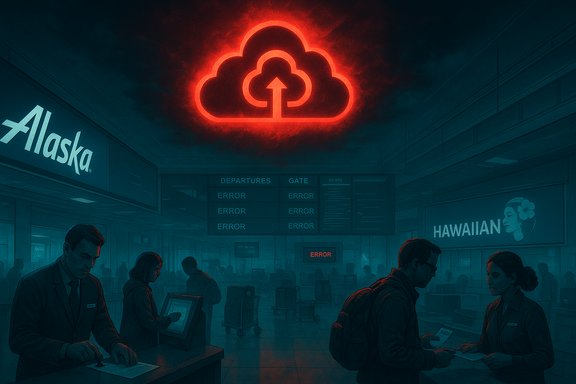
Alaska Airlines and Hawaiian Airlines saw critical customer-facing systems disrupted on Oct. 29 after a widespread Microsoft Azure outage traced to an Azure Front Door configuration error, forcing airlines to fall back to manual processes and prompting renewed scrutiny of cloud dependency and airline IT resilience.
The outage began when Microsoft engineers detected elevated latencies and gateway errors for services fronted by Azure Front Door (AFD), the company’s global edge and application delivery service. Microsoft identified an inadvertent tenant configuration change that propagated a faulty state across its edge nodes. As a result, customers and Microsoft services using AFD experienced timeouts, latency, and errors starting in the afternoon UTC on Oct. 29; Microsoft and multiple news outlets report mitigation actions continued into the early hours of Oct. 30. Alaska Air Group — which operates Alaska Airlines and Hawaiian Airlines and hosts several services on Microsoft Azure — confirmed the outage affected websites and other critical systems, directing guests unable to check in online to ticket counters and airline agents. The disruption compounded an already fragile situation for the carrier, which has experienced multiple IT incidents this year and is now pledging a review of its IT resilience.
For enterprises, the imperative is clear: adopt architecture and operational practices that treat cloud platforms as powerful but fallible building blocks. Redundancy, traffic diversity, tested manual processes and strong contractual guardrails are not optional; they are essential elements of modern operational risk management.
Microsoft’s forthcoming post‑incident review will be a key document to study. The quality of its root cause analysis and the specificity of proposed mitigations will influence corporate and regulatory responses for months to come. Early reporting indicates the company plans to share a PIR within 14 days — the community will judge whether that report provides the level of technical detail and operational transparency necessary to restore confidence.
The immediate recovery and rollback actions Microsoft took were appropriate containment measures, but the core issues — tooling safeguards, deployment validation, and control‑plane robustness — must be solved at scale. For airlines and other mission‑critical operators, this incident strengthens the case for diversified ingress strategies, rigorous failover testing, and operational playbooks that ensure continuity when a cloud provider falters.
The post‑incident review Microsoft has promised will be critical reading. Its technical and procedural findings should inform not only Microsoft’s engineering changes but also how customers, partners, and regulators approach cloud risk and resilience going forward. For Alaska Airlines and its passengers, the focus must be on restoring service confidence and executing a thorough, independent diagnosis of IT architecture so that the next outage does not become the next crisis.
Source: TechInformed Alaska Airlines systems disrupted due to Microsoft Azure outage - TechInformed
 Background
The outage began when Microsoft engineers detected elevated latencies and gateway errors for services fronted by Azure Front Door (AFD), the company’s global edge and application delivery service. Microsoft identified an inadvertent tenant configuration change that propagated a faulty state across its edge nodes. As a result, customers and Microsoft services using AFD experienced timeouts, latency, and errors starting in the afternoon UTC on Oct. 29; Microsoft and multiple news outlets report mitigation actions continued into the early hours of Oct. 30. Alaska Air Group — which operates Alaska Airlines and Hawaiian Airlines and hosts several services on Microsoft Azure — confirmed the outage affected websites and other critical systems, directing guests unable to check in online to ticket counters and airline agents. The disruption compounded an already fragile situation for the carrier, which has experienced multiple IT incidents this year and is now pledging a review of its IT resilience. What happened: a concise technical timeline
The trigger and immediate symptoms
- Approximately 15:45–16:00 UTC on Oct. 29: telemetry and external monitors registered elevated latencies, packet loss and HTTP gateway errors for AFD‑fronted services. Microsoft’s status messages and third‑party trackers showed a near‑instant spike in user reports.
- Microsoft identified an inadvertent tenant configuration change in Azure Front Door as the proximate trigger; the change caused many AFD nodes to load an invalid or inconsistent configuration state, amplifying errors across the global edge fabric.
Mitigation steps taken by Microsoft
- Engineers blocked new customer configuration changes to AFD to stop further propagation of the faulty configuration and reduced the risk of reintroducing the bad state. They then rolled back to a “last known good” configuration and progressively pushed remediation globally, restarting orchestration units and rebalancing traffic. Microsoft reported significant recovery within hours and warned that some tenants could see residual effects while caches and DNS propagated. Microsoft also committed to sharing a post-incident review with impacted customers within 14 days.
Real‑world impacts
- By mid‑evening UTC many consumer and enterprise services relying on Azure or AFD saw degraded availability. The outage affected Microsoft-owned services (Microsoft 365, Xbox Live, gaming services) and customer systems at retailers, financial services, and airlines — including Alaska and Hawaiian — whose websites and apps were temporarily unavailable or intermittently failing. Alaska’s reliance on Microsoft Azure for several customer-facing services made the carrier visibly vulnerable to the outage’s effects.
How Alaska Airlines was affected
User experience and airport operations
Passengers reported inability to check in via the Alaska Airlines website and mobile app, longer lines at Sea‑Tac and other hubs, and the need for airline staff to issue boarding passes manually. Baggage tagging and boarding workflows slowed as staff reverted to paper processes and manual entries into legacy systems. For travelers, the most-visible consequences were longer wait times, delayed check‑ins, and confusion at desks and kiosks.Business impact and reputational cost
Alaska Air Group has already faced multiple IT incidents this year. This Azure outage added to operational disruption and investor unease, with reports noting immediate share price pressure and broader concerns about recurring technological fragility in the airline sector. The carrier announced it would bring in outside experts to diagnose its IT infrastructure and review resilience across its hybrid environment.Why Azure Front Door matters (and why a misconfiguration is so harmful)
Azure Front Door is a global edge service that handles TLS termination, global load balancing, WAF, and routing for web applications at scale. Many enterprises use AFD as the public entry point for authentication, content delivery, and API ingress. When AFD’s control plane or configuration is compromised, the effects ripple into services that depend on it for authentication tokens, content routing and secure connections.- Critical path dependency: AFD often sits on the critical path for sign‑on flows and TLS handshakes. A bad configuration can prevent requests from ever reaching the application.
- Global propagation: Edge fabrics are distributed; a control‑plane change propagates quickly and can affect many regions simultaneously. The speed and breadth that make CDNs and edge platforms powerful are the same characteristics that amplify misconfiguration blast radius.
- Cache and DNS persistence: Even after a configuration rollback, DNS caches, CDN caches and client TTLs can cause residual impact for some users until caches expire and propagations complete. Microsoft warned that while error rates returned to baseline, a small number of customers might still see intermittent issues.
Cross‑industry fallout: who else felt it
The outage was notable not only because Microsoft-owned properties were affected, but because many large brands fronted by Azure experienced service degradation. Retailers, financial institutions, and consumer services reported timeouts and slowdowns; gaming platforms and productivity tools (Microsoft 365, Xbox services) were impacted, creating high‑visibility consumer pain and corporate backlash. This cascade illustrates how a single control‑plane failure at a hyperscaler can touch diverse verticals simultaneously.Strengths shown during the incident
Fast detection and containment
Microsoft’s telemetry and external observability caught the issue quickly, and the company moved to block new configuration changes to limit the blast radius — a textbook control‑plane containment action. Engineers executed a rollback to a previously healthy configuration and staged the remediation to avoid reintroducing the bad state. These are standard and appropriate incident response steps for a distributed system.Clear acknowledgement and commitment to post‑incident analysis
Microsoft publicly acknowledged the root cause as a configuration deployment mistake and committed to delivering a Post Incident Review (PIR) to impacted customers within a defined timeframe. That commitment, if fulfilled with transparency, can help customers understand impact, remediation timelines and plans to prevent recurrence. Several independent outlets reported Microsoft’s pledge to share a PIR within 14 days.Where risk remains: failures, dependencies, and operational blind spots
Single‑vector dependency on a global CDN/control plane
Many organizations treat AFD (or equivalent edge fabrics) as indispensable. But that concentrated dependency creates a single point of failure for public ingress. Enterprises that expose authentication endpoints, API gateways, or critical customer workflows exclusively through one edge service accept systemic risk if that service falters or is misconfigured.Hybrid clouds are only as resilient as their weakest link
Alaska Air Group operates a hybrid model: on‑premise data centers plus third‑party clouds. Hybrid architecture can improve resilience — or, if not designed for failover in critical paths, merely provide increased complexity with brittle dependencies. Airlines with poor failover between on‑prem and cloud front ends can still be brought to a standstill by a cloud outage.Operational and contractual exposure
Cloud outages raise immediate operational problems and longer‑term contractual and regulatory questions. Customers facing lost revenue, travel disruption and reputational harm will scrutinize SLAs, incident credits, and legal remedies. For regulated industries like aviation, repeated outages can invite regulatory interest in operational risk and contingency readiness.Human and process risk
Microsoft attributed the outage to an inadvertent tenant configuration change that bypassed safety validations due to a software defect. This highlights two failure modes:- procedural/human error that introduces bad configuration, and
- tooling or software safeguards that fail to catch the bad deployment.
Practical resilience lessons for airlines and other critical operators
The incident is a timely case study for airlines, travel platforms, and other organizations hosting customer‑facing services in the cloud.1. Design true multichannel ingress
- Avoid exposing all critical sign‑on and booking flows exclusively via a single edge provider. Implement diverse ingress paths that can fail over to an alternate provider, direct origin access, or a verified fallback route.
2. Harden authentication and token flows
- Authentication services (SSO, token issuance) should be resilient and testable independently of the CDN/control plane used for content. Where possible, provide an alternate trust path for identity verification.
3. Maintain operational runbooks and manual fallbacks
- Robust manual procedures (printed manifests, offline boarding pass issuance, manual baggage tagging, cash handling) are a must. Staff must be trained in degraded‑mode operations and have the tools to act quickly.
4. Test failover and inject faults
- Regularly run chaos engineering exercises that simulate edge or DNS failures. Validate that alternate DNS entries, TTLs, and fallback origins operate as expected under real load.
5. Measure and limit blast radius with traffic segmentation
- Use per‑tenant isolation and conservative rollout processes for control‑plane changes. Limit the scope of configuration rollouts and use canary deployments where possible.
6. Contractual clarity and SLA preparedness
- Negotiate clear SLAs and incident response expectations with cloud providers. Understand the timeline and format for PIRs and the remedies available if outages breach agreed service levels.
Technical safeguards Microsoft and other hyperscalers should consider
The Azure outage underscores specific engineering controls that can reduce recurrence probability.- Stronger pre‑deployment validation: enforce stricter schema validation, syntactic and semantic checks for tenant configuration changes and atomic rollbacks when validation fails.
- Safer control‑plane rollout tactics: smaller blast‑radius rollouts, improved automatic canarying, and independent verification of node states before global propagation.
- Faster, safer rollback automation: ensure that rollback paths are themselves robust and cannot be bypassed by the same defect that created the bad state.
- Cross‑product decoupling: reduce tight coupling where an edge control change can simultaneously affect identity, database connectivity, and portal access.
- Transparent post‑incident reporting: timely PIRs with actionable remediation and measurable timelines reduce customer uncertainty and help restore trust. Microsoft has committed to deliver a PIR to affected customers; the details and thoroughness of that report will be critical.
Regulatory, commercial and reputational fallout to watch
Airlines and other essential service providers operate under strict safety and continuity expectations. While Microsoft and others have robust incident response programs, high‑impact outages invite scrutiny across three vectors:- Regulatory oversight: Civil aviation authorities and consumer protection bodies may demand operational risk assessments and contingency audits, particularly if repeated outages disrupt flights and passenger processing.
- Insurance and contractual claims: Organizations affected by outages will evaluate claims under business interruption insurance and contractual SLAs; outcomes may influence future cloud procurement and indemnity language.
- Customer trust: For airlines, reliability is core to brand trust. Repeated IT incidents erode passenger confidence and can influence booking behavior and loyalty program sentiment. Alaska’s public statements committing to infrastructure diagnosis are a necessary first step to rebuilding that trust.
Short‑term operational checklist for airlines still recovering
- Confirm all passenger manifests, re‑bookings and crew assignments were captured accurately during the outage.
- Prioritize customer communications: transparent, frequent updates reduce anxiety and support frontline staff in managing expectations.
- Run data integrity checks on bookings, loyalty points and refunds processed during the incident window.
- Reconcile baggage logs and claims where manual handling replaced automated tagging.
- Convene cross‑functional review: IT, ops, legal, and customer care to triage immediate prioritization and resource allocation.
Looking ahead: the wider cloud resilience conversation
This outage follows a pattern of high‑impact cloud incidents across hyperscalers in recent months. The industry is grappling with the paradox that cloud services deliver unparalleled scale and flexibility — but also introduce concentrated systemic risks when their control planes experience failure.For enterprises, the imperative is clear: adopt architecture and operational practices that treat cloud platforms as powerful but fallible building blocks. Redundancy, traffic diversity, tested manual processes and strong contractual guardrails are not optional; they are essential elements of modern operational risk management.
Microsoft’s forthcoming post‑incident review will be a key document to study. The quality of its root cause analysis and the specificity of proposed mitigations will influence corporate and regulatory responses for months to come. Early reporting indicates the company plans to share a PIR within 14 days — the community will judge whether that report provides the level of technical detail and operational transparency necessary to restore confidence.
Conclusion
The Oct. 29 Azure Front Door outage was a high‑visibility reminder of how critical cloud control planes have become — and how a single, inadvertent configuration change can cascade into widespread disruption affecting airlines, retailers, financial services and millions of end users. Alaska Airlines’ operational headaches — manual check‑ins, long lines, and service slowdowns — were symptoms of a deeper industry challenge: building digital services that are resilient not just to application bugs, but to faults in the infrastructure those applications depend on.The immediate recovery and rollback actions Microsoft took were appropriate containment measures, but the core issues — tooling safeguards, deployment validation, and control‑plane robustness — must be solved at scale. For airlines and other mission‑critical operators, this incident strengthens the case for diversified ingress strategies, rigorous failover testing, and operational playbooks that ensure continuity when a cloud provider falters.
The post‑incident review Microsoft has promised will be critical reading. Its technical and procedural findings should inform not only Microsoft’s engineering changes but also how customers, partners, and regulators approach cloud risk and resilience going forward. For Alaska Airlines and its passengers, the focus must be on restoring service confidence and executing a thorough, independent diagnosis of IT architecture so that the next outage does not become the next crisis.
Source: TechInformed Alaska Airlines systems disrupted due to Microsoft Azure outage - TechInformed
