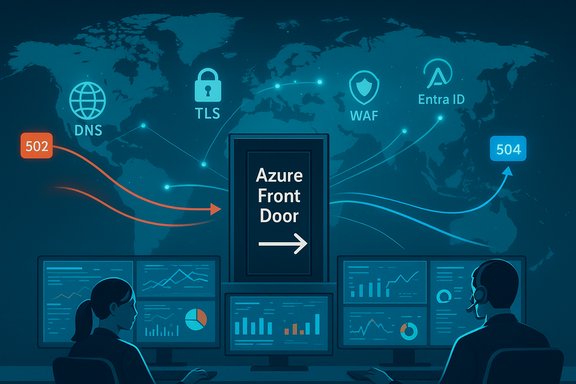
Microsoft’s cloud backbone faltered on October 29, 2025, when a configuration error in Azure Front Door — Microsoft’s global edge and routing fabric — precipitated a broad Microsoft Azure outage that knocked Xbox Live, Minecraft authentication, Microsoft 365 admin portals and a raft of customer websites offline for hours as engineers rolled back the offending config and rerouted traffic to healthy nodes.
Azure Front Door (AFD) is a global, Layer‑7 edge service that performs TLS termination, global HTTP(S) load balancing, Web Application Firewall (WAF) enforcement, DNS-level routing and origin failover for both Microsoft’s first‑party services and thousands of customer workloads. When AFD’s control plane or routing rules fail, the observable symptoms are immediate and wide‑ranging: failed sign‑ins, blank admin blades, 502/504 gateway errors and stalled game authentication flows.
On the afternoon of October 29, 2025 (beginning at roughly 16:00 UTC), monitoring systems detected packet loss and routing anomalies that traced back to a configuration change inside Azure’s edge fabric. Microsoft identified the change as "inadvertent," froze further AFD updates, and began deploying a rollback to a last‑known‑good configuration while failing the Azure Portal away from Front Door to restore management access. The outage’s visible consumer impact was unmistakable: Xbox sign‑ins failed, Game Pass and storefront operations stalled, and Minecraft multiplayer and realm access suffered authentication timeouts. At the same time, Microsoft 365 admin consoles and the Azure Portal experienced blank or partially rendered blades, complicating remediation for IT admins. Downdetector style trackers recorded tens of thousands of user reports at peak.
This incident underscores a foundational truth: convenience at scale brings concentrated risk. When authentication and edge routing are shared, authentication timing, DNS resolution and edge capacity become systemic dependencies rather than isolated features.
For system architects and IT leaders, the practical takeaway is immediate: audit your cloud dependency map, validate programmatic management paths, and rehearse failover scenarios that assume the edge and identity layers can fail independently of backend compute. For cloud providers, the imperative is equally clear: safer, more constrained deployment pipelines, better canary isolation and visible guarantees for control‑plane robustness must remain a top priority.
Microsoft’s status messages indicate a largely successful mitigation was deployed and that services were progressively recovering, but pockets of instability and residual effects persisted for some customers during the recovery window — underscoring that even a repaired configuration can take time to converge across cached DNS, ISP routing and session state.
This episode is a reminder that in a world increasingly powered by cloud fabric, operational discipline, diversified fallbacks and transparent post‑incident accountability are not optional extras — they are core controls for modern digital resilience.
Source: Happy Mag Microsoft Azure outage Knocks Xbox and Minecraft offline, here's the latest update
 Background / Overview
Azure Front Door (AFD) is a global, Layer‑7 edge service that performs TLS termination, global HTTP(S) load balancing, Web Application Firewall (WAF) enforcement, DNS-level routing and origin failover for both Microsoft’s first‑party services and thousands of customer workloads. When AFD’s control plane or routing rules fail, the observable symptoms are immediate and wide‑ranging: failed sign‑ins, blank admin blades, 502/504 gateway errors and stalled game authentication flows.On the afternoon of October 29, 2025 (beginning at roughly 16:00 UTC), monitoring systems detected packet loss and routing anomalies that traced back to a configuration change inside Azure’s edge fabric. Microsoft identified the change as "inadvertent," froze further AFD updates, and began deploying a rollback to a last‑known‑good configuration while failing the Azure Portal away from Front Door to restore management access. The outage’s visible consumer impact was unmistakable: Xbox sign‑ins failed, Game Pass and storefront operations stalled, and Minecraft multiplayer and realm access suffered authentication timeouts. At the same time, Microsoft 365 admin consoles and the Azure Portal experienced blank or partially rendered blades, complicating remediation for IT admins. Downdetector style trackers recorded tens of thousands of user reports at peak.
What exactly failed: Azure Front Door, DNS and control‑plane risk
Azure Front Door’s role explained
AFD sits at the intersection of routing, security and identity for many public endpoints. It:- Terminates TLS at edge Points of Presence (PoPs).
- Makes global routing decisions and performs origin failover.
- Enforces WAF and ACL rules at the edge.
- Fronts identity token exchanges for Entra ID (Azure AD) in many scenarios.
The proximate trigger and the mechanics of propagation
Microsoft’s operational messages and independent network telemetry converged on the same narrative: an inadvertent configuration change propagated through AFD’s global control plane, producing DNS and routing abnormalities and causing a measurable loss of capacity at a subset of frontends. That, in turn, produced authentication timeouts (Entra token issuance failures), blank admin blades and 502/504 responses for apps fronted by AFD. Microsoft halted further Front Door changes, deployed a rollback, and rerouted traffic to healthy PoPs while recovering nodes. This failure mode — a control‑plane configuration mistake that cascades through global DNS/routing — is painful precisely because it affects both Microsoft’s consumer products (Xbox, Minecraft) and enterprise control planes (Azure Portal, Microsoft 365 admin center) simultaneously.Timeline of the incident (concise)
- Detection (~16:00 UTC, October 29, 2025) — Internal telemetry and external monitors detected packet loss and routing errors at AFD frontends; user reports spiked.
- Public acknowledgement — Microsoft posted incident advisories attributing the issue to AFD and noting an inadvertent configuration change; they froze AFD configuration changes.
- Mitigation — Engineers initiated a rollback to the “last known good” configuration, failed the Azure Portal away from AFD to restore management access, restarted orchestration units where needed, and rebalanced traffic to healthy nodes.
- Initial recovery signs — Microsoft announced the last‑known‑good deployment completed and reported progressive restoration while continuing node recovery and routing convergence. Some customers still experienced intermittent issues after initial recovery.
Immediate impact: gaming, enterprise portals and downstream services
Xbox, Game Pass and Minecraft
Because Xbox Live and Minecraft authentication flows rely on Microsoft’s central identity surfaces and AFD routing, players saw:- Failed sign‑ins and repeated authentication prompts.
- Stalled downloads and blocked storefront access.
- Multiplayer and realm connectivity interruptions for Minecraft realms and hosted sessions.
Microsoft 365 and Azure Portal
Administrators reported blank or partially rendered blades in the Azure Portal and Microsoft 365 admin center, limiting their ability to act via the GUI. Microsoft suggested programmatic fallbacks (PowerShell, CLI) for urgent admin tasks while the portal failover and recovery proceeded. Failing the portal away from AFD allowed many customers to regain portal sign‑in even while broader AFD customer traffic remained inconsistent.Downstream corporate/customer impacts
Because many third‑party sites front their public endpoints through AFD, the outage surfaced as 502/504 errors or complete unreachability for external customers. Reports included impacts at airlines, retailers and some banking or payment endpoints; early media coverage named several affected brands, though corporate confirmations varied and some claims remain unverified pending statements from the affected companies.Why this outage is meaningful: systemic architecture and business risk
Concentration of critical functions
Modern hyperscaler architectures centralize essential functions — global routing, TLS termination and identity — into a small set of shared services for efficiency and manageability. That centralization reduces operational overhead but creates single‑point multipliers where one control‑plane fault affects many downstream, otherwise independent, services.This incident underscores a foundational truth: convenience at scale brings concentrated risk. When authentication and edge routing are shared, authentication timing, DNS resolution and edge capacity become systemic dependencies rather than isolated features.
Change control and validation gaps
Amoeba‑like or rapid changes to distributed control planes require rigorous pre‑deployment validation, canarying, and automated rollback triggers. The fact that Microsoft attributed the outage to an inadvertent configuration change suggests either a gap in pre‑validation, an unexpected interaction in the control plane, or a failure in the rollout safeguards that prevent a bad configuration from global propagation. These are precisely the operational areas cloud providers continuously iterate on after high‑impact incidents.Commercial and reputational consequences
For enterprises, hours of portal inaccessibility or failed authentication can translate into lost revenue, missed SLAs, and support overhead. For Microsoft, high‑visibility outages touching consumer gaming products and enterprise portals simultaneously increase scrutiny on operational practices and heighten customer pressure for improved transparency and tougher safety nets.What Microsoft did well — containment and recovery strengths
- Rapid containment playbook: Microsoft immediately blocked further AFD changes, a textbook "stop the bleeding" action that prevents further propagation of a bad config.
- Last‑known‑good rollback: Deploying a rollback and recovering to a previously validated configuration is an effective mitigation for control‑plane misconfigurations. Microsoft reported this deployment completed and observed initial recovery signs.
- Failover for management plane: Steering the Azure Portal off Front Door restored management access for many admins, reducing remediation friction for enterprise responders.
- Transparent, iterative updates: Microsoft posted rolling status updates and advised programmatic workarounds to reduce the impact on admins attempting urgent actions.
Remaining weaknesses and operational lessons
Residual fragility in centralized controls
Even with a successful rollback, the incident highlights the fragility that remains when core functions are shared. Residual, tenant‑specific edge state, DNS caches and ISP routing differences meant some customers continued to see intermittent errors after the global rollback. These sticking points are precisely the friction that makes recovery messy and drawn‑out.Change‑validation and automated safety nets
The outage suggests more investment is required in deployment safety: stronger canary isolation, programmable circuit breakers, and real‑time validation logic that can detect protocol‑level anomalies before a change reaches global PoPs. Microsoft and other hyperscalers have addressed similar needs before; this event should accelerate further hardening.Communication and third‑party impact accountability
When a cloud provider’s control plane disrupts third‑party customers, the downstream damage includes lost transactions and degraded customer trust. Greater visibility into which services and customers are fronted by shared fabrics — and clearer operational SLAs covering control‑plane events — would help enterprise buyers evaluate and mitigate vendor concentration risk.Practical guidance: what admins, developers and gamers should do now
For IT administrators and SREs
- Map your dependencies — explicitly document which public endpoints, admin portals and identity flows transit AFD or other managed edge services.
- Implement programmatic fallbacks — prepare and test PowerShell/CLI, API and service principal flows for management plane tasks when portals are unavailable.
- Adopt DNS and routing resilience — configure reliable TTLs, multiple failover paths (Azure Traffic Manager or other traffic‑manager services), and health probes that detect edge anomalies early.
- Run incident drills — rehearse an AFD/edge outage scenario, including rollbacks and cross‑team playbooks, to reduce recovery time in a real event.
For developers and SaaS vendors on Azure
- Use multi‑fronting strategies where feasible: front your app with multiple ingress options (AFD + Traffic Manager + direct origin failover) so a single fronting fabric is not a critical choke point.
- Cache resiliently: design for cache‑first experience for non‑interactive flows where possible, reducing reliance on origin traffic during edge faults.
For gamers and consumers
- Expect intermittent authentication issues during control‑plane outages; offline modes and single‑player play are often unaffected.
- Follow official service status channels; Microsoft’s status updates provide real‑time mitigation guidance and ETAs for recovery.
Broader industry context: concentration risk and vendor diversification
October 2025 saw multiple high‑profile hyperscaler incidents in close succession. Those back‑to‑back outages renewed debate about the systemic risk created by heavy dependence on a handful of cloud providers. Enterprises must reconcile the obvious operational and economic advantages of hyperscalers with the non‑trivial risk that a single control‑plane failure can cascade across business lines and consumer experiences. Diversification strategies — multi‑cloud, hybrid architectures, and well‑tested fallbacks — are costly, but they reduce blast radius and offer operational options when a single provider’s control plane is impaired.What we still don’t know — and what to watch for in Microsoft’s post‑incident report
- The exact configuration change that triggered propagation remains a technical detail Microsoft typically expands on in a formal post‑incident review. Until that report is published, specific assertions about patch semantics or root code defects should be treated cautiously.
- Concrete metrics on capacity loss (e.g., percentage of AFD frontends affected) vary between observability vendors and Microsoft’s internal telemetry; expect a later, reconciled figure in the public post‑mortem.
- Whether Microsoft will implement structural changes beyond process hardening — such as architectural segmentation to reduce AFD’s blast radius — is a strategic decision that may take months and significant product investment.
The bottom line
The October 29, 2025 Azure outage is a textbook example of how shared control planes in modern cloud platforms can amplify a single change into a global disruption. Microsoft’s containment steps — freezing changes, rolling back to a last‑known‑good configuration, rerouting the portal, and recovering nodes — were appropriate and effective in restoring most traffic. Yet the incident makes plain that convenience and scale come with architectural tradeoffs that enterprises must manage proactively.For system architects and IT leaders, the practical takeaway is immediate: audit your cloud dependency map, validate programmatic management paths, and rehearse failover scenarios that assume the edge and identity layers can fail independently of backend compute. For cloud providers, the imperative is equally clear: safer, more constrained deployment pipelines, better canary isolation and visible guarantees for control‑plane robustness must remain a top priority.
Microsoft’s status messages indicate a largely successful mitigation was deployed and that services were progressively recovering, but pockets of instability and residual effects persisted for some customers during the recovery window — underscoring that even a repaired configuration can take time to converge across cached DNS, ISP routing and session state.
Quick summary for readers who want the headline facts
- What happened: An inadvertent configuration change in Azure Front Door caused DNS/routing anomalies and a capacity loss at a subset of edge PoPs on October 29, 2025.
- Services impacted: Xbox Live, Minecraft authentication and multiplayer flows, Microsoft 365 admin centers, the Azure Portal, and many third‑party sites fronted by AFD experienced outages or degraded availability.
- Microsoft’s response: Blocked further AFD changes, deployed a last‑known‑good rollback, failed the Azure Portal away from AFD to restore management access, and recovered nodes while rebalancing traffic.
- Recovery status: Initial fix deployment showed signs of recovery; services were progressively restored though some users experienced intermittent issues as routing and caches converged.
This episode is a reminder that in a world increasingly powered by cloud fabric, operational discipline, diversified fallbacks and transparent post‑incident accountability are not optional extras — they are core controls for modern digital resilience.
Source: Happy Mag Microsoft Azure outage Knocks Xbox and Minecraft offline, here's the latest update