

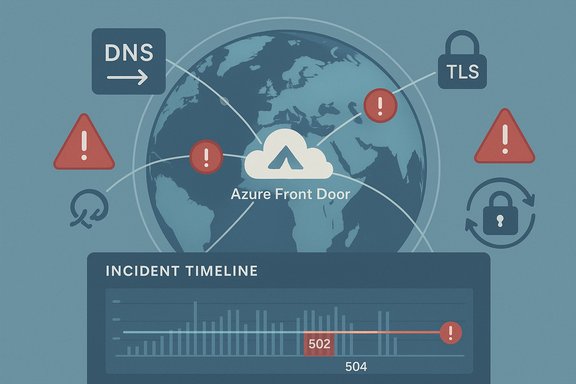
A high‑impact Microsoft Azure outage on October 29, 2025, knocked large swathes of internet services offline for hours — from Microsoft’s own productivity suite and gaming ecosystem to major airline check‑in systems and retail storefronts — after an inadvertent configuration change to Azure Front Door caused DNS and routing failures that propagated across Microsoft’s global edge.
Background / Overview
The visible fault began at roughly 16:00 UTC on 29 October 2025, when external monitoring and user reports spiked with timeouts, 502/504 gateway errors and authentication failures for services that route through Microsoft’s global edge fabric. Microsoft’s Azure status page identified Azure Front Door (AFD) — the company’s Layer‑7 global application delivery and routing layer — as the service at the center of the incident and confirmed the trigger was an inadvertent configuration change. Azure Front Door is not a simple content cache or CDN: it performs TLS termination, hostname mapping, global HTTP(S) routing and Web Application Firewall (WAF) operations for many first‑party Microsoft control planes and thousands of customer endpoints. Because AFD often sits in front of identity issuance (Microsoft Entra ID/Azure AD) and the Azure management plane, a control‑plane misconfiguration there can rapidly look like a platform‑wide outage even when backend compute and storage remain healthy. Microsoft’s immediate mitigation steps followed a standard containment playbook: block further AFD configuration changes, deploy a validated “last known good” configuration, fail the Azure Portal away from AFD where possible to restore management access, recover impacted edge nodes, and gradually reintroduce traffic to avoid re‑triggering the fault. The company reported progressive recovery over several hours and published estimated mitigation windows while it continued monitoring DNS convergence and tenant‑specific residuals.What failed: Azure Front Door and control‑plane risk
Azure Front Door’s role and why it matters
- Azure Front Door (AFD) is Microsoft’s global Layer‑7 edge fabric responsible for: TLS termination, global HTTP(S) routing/load balancing, DNS‑level routing glue, WAF enforcement and request routing to origin services.
- Because AFD centralizes routing and security logic across multiple products, a misapplied configuration can propagate to many Points of Presence (PoPs) and cause host‑header mismatches, TLS handshake failures or DNS resolution issues for many services simultaneously.
The proximate trigger and observed symptoms
Microsoft’s incident updates explicitly named an “inadvertent configuration change” in AFD as the proximate cause and described symptoms consistent with control‑plane and DNS anomalies: client TLS timeouts, failed token issuance for Entra ID flows, blank management blades in the Azure Portal, and widespread HTTP gateway errors. Independent reporting and public outage trackers corroborated that pattern.Timeline: from detection to staged recovery
- Detection (~16:00 UTC, Oct 29): Monitoring systems and public outage trackers begin recording elevated latencies, packet loss and gateway errors for AFD‑fronted endpoints. Users report login failures across Microsoft 365 and gaming services.
- Public acknowledgement: Microsoft posts incident notices naming Azure Front Door and noting the misconfiguration as the suspected trigger. Engineers enact an immediate configuration freeze for AFD.
- Containment: AFD configuration changes (including customer changes) are blocked; the team initiates deployment of a “last known good” configuration while failing the Azure Portal away from AFD in order to restore admin‑plane access.
- Recovery (hours): The rollback completes and Microsoft reports strong signs of improvement as nodes are recovered and traffic rebalanced. Residual tenant‑specific and DNS cache‑related failures persist for a tail period. Microsoft estimated near‑full mitigation within a multi‑hour window and provided rolling updates.
Services and businesses affected
The outage’s practical impact touched both consumer platforms and enterprise customers:- Microsoft first‑party services: Microsoft 365 (Outlook on the web, Teams), the Azure Portal and associated admin consoles experienced sign‑in failures, delayed mail, and blank or partially rendered blades.
- Gaming and consumer: Xbox Live, the Microsoft Store and Minecraft authentication and multiplayer services saw timeouts or login failures. Several players reported inability to sign in or join multiplayer sessions during the event.
- Major customers: Airlines including Alaska Airlines and JetBlue reported website/app disruptions that impacted check‑ins and boarding-pass issuance; airports (reports from Heathrow and others) saw friction at passenger touchpoints. Retailers and payment flows for Starbucks, Costco, Kroger and other large chains experienced intermittent checkout or storefront outages. Telecoms and government sites in some countries were also affected.
Quantifying the impact: what the trackers show (and why numbers vary)
Downdetector and similar trackers capture user‑submitted problem reports, which can spike rapidly during a visible outage. During this event, trackers recorded tens of thousands — and in some snapshots, over 100,000 — reports for Azure‑related services at the incident peak. These aggregator figures are directional indicators of scope and public attention, but they are inherently noisy: multiple submissions from the same user, automated monitoring noise, and media amplification can all inflate short‑term peaks. Microsoft’s internal telemetry — not publicly shared in full — is the authoritative record for tenant impact and service‑level breach calculations. Caution: any single headline number (for example, “18,000” or “105,000”) should be treated as a snapshot metric rather than a definitive count — the exact number of affected users and impacted transactions will only be known after Microsoft’s post‑incident forensic report.Microsoft’s response: strengths and shortcomings
Immediate positives
- Rapid public acknowledgement: Microsoft posted incident banners on the Azure status page and provided rolling updates, which reduces customer uncertainty during an evolving outage.
- Conservative containment: The engineering team blocked further configuration changes and executed a rollback to a validated configuration — actions that minimize the risk of re‑introducing the faulty state and are standard for control‑plane incidents.
Areas of concern
- Single‑fabric exposure: Centralizing management‑plane and identity endpoints behind the same global edge fabric amplified the outage’s blast radius. When management consoles and authentication flows traverse the same faulty fabric, administrators lose GUI-based remediation paths.
- Change‑governance gaps: An “inadvertent configuration change” suggests weaknesses in deployment guardrails, canarying and automated rollback triggers for global control‑plane updates. Robust canarying or stricter staged rollouts across PoPs might have contained the fault earlier.
Broader implications: cloud concentration, systemic risk and customer exposure
This outage follows a large AWS incident earlier in the month and sharpens the debate about vendor concentration in cloud infrastructure. A small set of hyperscalers now host vast swathes of public‑facing services, meaning failures at an infrastructure provider can produce cascading effects across industries. The two high‑profile incidents in close succession reveal three structural issues:- Control‑plane single points: Centralized routing/DNS layers (AFD, equivalent services at other providers) are high‑impact surfaces that require the same defensive rigor as storage and compute. A misconfiguration at that layer can render otherwise healthy services unreachable.
- Dependency invisibility: Many enterprises lack complete, tested inventories mapping critical user journeys to third‑party control planes, making it hard to assess outage risk in advance.
- SLA and contractual friction: When customer operations — from airline check‑in to retail point‑of‑sale — depend on a cloud provider, the financial and regulatory fallout from outages can be significant; customers will increasingly demand precise remediation and audit rights.
Practical guidance for IT leaders and Windows administrators
Enterprises must treat edge/control‑plane risk as a first‑class operational hazard. The following prioritized steps help reduce exposure and improve recovery posture:- Map dependencies: Create a heat‑mapped inventory showing which customer journeys rely on provider edge services, identity providers and single DNS paths.
- Implement multi‑path ingress: Configure alternative ingress strategies (Azure Traffic Manager, Traffic Manager → Application Gateway, multi‑region or multi‑cloud failovers) and exercise them under controlled conditions.
- Shorten DNS TTLs for critical hostnames and test cache‑drain procedures so you can accelerate global roll‑forward or failover. Note: lowering TTLs has cost and propagation tradeoffs; test before production use.
- Harden change governance: Use staged canary deployments, automated rollback criteria and “blast‑radius limiting” controls for global control‑plane updates. Simulate misconfiguration scenarios in game‑day rehearsals.
- Maintain manual fallbacks: For customer‑facing flows (airline check‑in, payment capture, in‑store POS), ensure documented and trained manual procedures that staff can carry out when digital systems fail.
- Negotiate contractual observability & SLA terms: Demand post‑incident reports, audit rights for change governance, and clear remediation commitments in cloud contracts.
Regulatory, financial and reputational fallout: what to expect
Airlines, retailers and public agencies affected by outages can experience direct costs (reaccommodation, refunds, manual processing) and indirect reputational harm. Large repeated incidents attract regulator and investor scrutiny; procurement teams may push for stronger contractual protections, and boards are likely to ask for external forensic reviews. Alaska Airlines’ repeated technology issues earlier in the same week illustrated how a cluster of incidents can rapidly erode customer trust and attract financial scrutiny. From Microsoft’s perspective, the company avoided a prolonged outage window by deploying a rollback and communicating estimates of recovery, but the event will increase pressure for a thorough, independently verified post‑incident report and potentially for product‑level architectural changes that partition control planes to reduce blast radius.What we still don’t know — flagged uncertainties
- Precise scope and tenant impact numbers: Public outage trackers provide noisy, time‑dependent snapshots that cannot be equated with Microsoft’s internal telemetry. Final counts of affected customers, transactions lost and SLA credits will only be available after Microsoft’s internal post‑incident review.
- Exact configuration change content: Microsoft identified the initiating vector as a configuration change but has not (at the time of writing) published the exact configuration change, the rollout mechanics, or the chain of approvals that allowed the change to reach global PoPs. That level of detail will be in the formal root‑cause analysis.
Industry takeaways and recommended actions for Microsoft
- Partition the management and identity control planes from general purpose edge fabric where possible, or provide provable, independent management ingress that doesn’t rely on the same routing fabric as customer traffic.
- Strengthen pre‑deploy canaries that exercise global routing changes across diverse ISPs and geographic PoPs; automated rollback triggers should be sensitive to DNS and TLS anomalies, not only origin health.
- Publish an actionable post‑incident report that includes the change, automated checks that failed to catch the problem, and concrete remediation steps so customers and regulators can evaluate the sufficiency of Microsoft’s response.
Short checklist for Windows admins — immediate next steps
- Verify critical workloads: Confirm which public endpoints your organization relies on AFD for and whether alternative routes exist.
- Activate runbooks: Ensure playbooks for identity‑service degradations are available and that support teams can perform out‑of‑band account recovery and token issuance tests.
- Rehearse failover: Run a controlled test of Traffic Manager or alternative routing to validate procedural readiness for future AFD‑like incidents.
- Request provider transparency: Ask cloud account managers for timeline, post‑incident report, and remediation commitments; escalate contractually if SLAs were materially breached.
Conclusion
The October 29 Azure outage was a stark reminder that hyperscaler scale brings both capability and concentrated risk. Microsoft’s public incident handling — freezing changes, rolling back to a validated configuration and failing the portal away from the affected fabric — limited the worst impacts and restored service for most customers within hours. Yet the event also exposed structural fragilities: centralized edge control planes, management‑plane coupling, and deployment guardrail gaps that can convert a routine change into a global outage.For enterprises and Windows administrators, the lesson is clear: assume that cloud providers will have severe, unexpected outages at some point and design for durable, exercised fallbacks. For cloud vendors, the imperative is to harden control‑plane safety, partition management paths from customer data planes, and provide transparent, timely post‑incident reporting that customers can use to validate remediation.
This outage will almost certainly reshape customer conversations, contractual expectations, and technical architectures. The detailed technical and organizational fixes will be written in the post‑mortem; until then, conservative change governance, exercised failover plans and a clear dependency inventory remain the best defense against the next high‑impact cloud outage.
Source: Zoom Bangla News Microsoft Azure Outage Disrupts Global Services, Starbucks and Minecraft Among Major Casualties
