

Microsoft’s latest global disruption — an Azure Front Door configuration failure that knocked Microsoft 365, Outlook, Teams, Xbox and large swathes of Azure-hosted services offline — is not just another outage to curse at over coffee; it’s a clarifying moment. The incident exposes a persistent architectural truth: the cloud’s convenience is built on a handful of critical control‑plane chokepoints that, when they fail, can cascade into systemic chaos. This article summarizes the incident and the arguments made in the Tom’s Guide piece you provided, verifies the technical claims in multiple public post‑incident reconstructions, and offers a granular, pragmatic analysis of what went wrong, what providers are promising to fix, and what organizations and Windows users should do now.
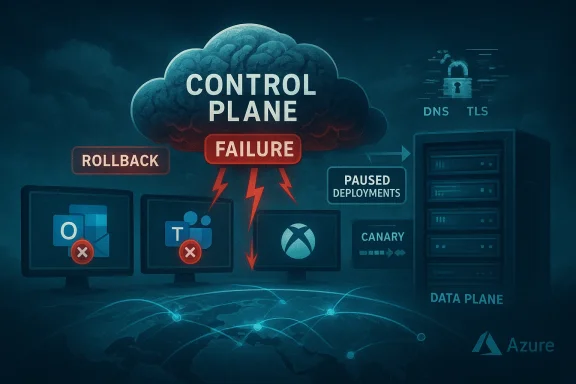
On October 29, 2025, Microsoft experienced a large‑scale outage triggered by an inadvertent configuration change in Azure Front Door (AFD), Microsoft’s global edge and application delivery fabric. The change introduced an invalid or inconsistent configuration state that caused many AFD nodes to fail to load, producing high latencies, TLS and DNS anomalies, and gateway errors that blocked authentication and management flows across Microsoft 365, Azure Portal, Xbox services and thousands of customer applications. Microsoft froze further AFD changes, rolled back to a “last known good” configuration, and rebalanced traffic across healthy Points of Presence (PoPs) to restore service over several hours. This sequence and root‑cause framing has been corroborated by Microsoft’s status updates and independent technical reconstructions.
The Tom’s Guide piece you supplied frames the outage as history repeating: a centralized dependency on a single region or control surface can paralyze large parts of the internet. It compares Microsoft’s failure to the October AWS US‑EAST‑1 DNS/DynamoDB incident that similarly caused massive worldwide disruptions and argues the cloud ecosystem still lacks a credible “Plan B” when core service brains fail mirrors the public narrative and community assessments, though some downstream consequences reported in early social posts require careful attribution.
Simple redundancy at the data level (multiple servers or multiple AZs) doesn’t help if the control plane is a single logical point of failure that coordinates those servers. Put another way: you can have many limbs, but a single nervous system still disables them all if it’s poisoned.
Caveat: explicit claims that a single vendor has already completed a global “cell” transformation for all first‑party services are generally unverifiable in the public domain; provider roadmaps and partial deployments exist, but the full transition and its effectiveness will only be visible over time and through subsequent incidents. Treat such vendor promises as commitments, not instant cures.
Microsoft’s outage proved the headline: the cloud is only one glitch away from chaos when its brains are centralized. The remedy is neither simple nor cheap, but it is obvious — stop building global systems with a single “brain,” practice the failovers you hope will work, and force transparency and accountability where public reliance is highest. The internet has recovered from these incidents before; the hard question now is whether architects and leaders will make the durable structural changes required to ensure the recovery is easier the next time.
Source: Tom's Guide https://www.tomsguide.com/computing...dont-yet-have-a-backup-plan-for-the-internet/
 Background / Overview
On October 29, 2025, Microsoft experienced a large‑scale outage triggered by an inadvertent configuration change in Azure Front Door (AFD), Microsoft’s global edge and application delivery fabric. The change introduced an invalid or inconsistent configuration state that caused many AFD nodes to fail to load, producing high latencies, TLS and DNS anomalies, and gateway errors that blocked authentication and management flows across Microsoft 365, Azure Portal, Xbox services and thousands of customer applications. Microsoft froze further AFD changes, rolled back to a “last known good” configuration, and rebalanced traffic across healthy Points of Presence (PoPs) to restore service over several hours. This sequence and root‑cause framing has been corroborated by Microsoft’s status updates and independent technical reconstructions. The Tom’s Guide piece you supplied frames the outage as history repeating: a centralized dependency on a single region or control surface can paralyze large parts of the internet. It compares Microsoft’s failure to the October AWS US‑EAST‑1 DNS/DynamoDB incident that similarly caused massive worldwide disruptions and argues the cloud ecosystem still lacks a credible “Plan B” when core service brains fail mirrors the public narrative and community assessments, though some downstream consequences reported in early social posts require careful attribution.
The incidents in context: Microsoft (Oct 29, 2025) and AWS (Oct 20, 2025)
Microsoft — Azure Front Door (AFD): what happened, in plain terms
- Trigger: an inadvertent tenant configuration change in Azure Front Door’s control plane.
- Immediate symptom: large numbers of AFD nodes failed to load correctly, producing HTTP 5xx gateway errors, authentication timeouts and DNS/routing anomalies.
- Amplifier: because AFD fronts identity and management surfaces (Entra ID / Azure AD tokens, Microsoft 365 admin panels) the outage blocked both user sign‑in and admin access in many cases.
- Mitigation: Microsoft halted AFD configuration rollouts, pushed a rollback to the last known good configuration, failed administrative portals away from the affected fabric where possible, and progressively rebalanced traffic to healthy PoPs. Services were largely restored within hours though some tenant‑specific tails persisted due to DNS TTLs and cache convergence.
AWS — US‑EAST‑1 DNS / DynamoDB disruption (October 20, 2025): why the internet “caught a cold”
- Trigger: a DNS resolution failure related to DynamoDB endpoints inside AWS’s us‑east‑1 region.
- Amplifier: DynamoDB is a foundational service used for metadata, session stores, and service discovery by dozens of AWS services; when it became unreachable or returned DNS errors, many dependent services (Lambda, EC2 features, managed AWS services) failed to operate normally.
- Result: broad service outages and degraded performance across multiple popular consumer platforms and enterprise services; AWS performed a rollback/patch, manual interventions, and phased recovery that took many hours for full restoration.
The anatomy of the problem: control plane vs data plane (and why redundancy can be an illusion)
To analyze why these outages matter, it helps to separate two layers that run every distributed service:- Data plane — the forwarding and execution layer: servers that store data, execute code, and serve requests. Data‑plane redundancy is typically handled through Availability Zones, replicas and failover replicas; when one data node fails, another can pick up the load.
- Control plane — the brain and configuration layer: systems that decide where requests should go, issue tokens, update routing tables, and push configuration changes. The control plane builds and maintains the global “map” the data plane follows.
Simple redundancy at the data level (multiple servers or multiple AZs) doesn’t help if the control plane is a single logical point of failure that coordinates those servers. Put another way: you can have many limbs, but a single nervous system still disables them all if it’s poisoned.
Why the “obvious” fixes are hard
The Tom’s Guide piece suggests two high‑level mitigations: decentralize the control plane (break the “monolithic brain” into many independent brains or “cells”) and build true external redundancies. The industry is moving in that direction, but the engineering cost and operational complexity are enormous.- Consistency vs. isolation tradeoffs: control planes must keep thousands or millions of objects (accounts, keys, tokens) consistent globally. Strongly partitioning the control plane into independent cells reduces blast radius but increases complexity in global consistency, metadata replication, and identity issuance.
- Cross‑cell state: operations like password changes, token revocations or license entitlements typically must be visible globally. Making these changes atomic across thousands of independently operating cells is a distributed systems problem at massive scale.
- Legacy and migration debt: systems like Microsoft 365 evolved over 15+ years; refactoring to a cell‑based design risks introducing new bugs and requires phased migration with exhaustive canarying and test harnesses. That’s nontrivial and takes time and investment.
Cell architectures, static stability and blast‑radius reduction — what those terms mean in practice
- Cell / cellular architecture: the idea is to partition a large region or platform into many smaller, independent operational units (cells). Each cell can operate autonomously, so a failure or misconfiguration in one cell doesn’t rip through the global system. Cells isolate state and control‑plane changes to a limited scope, reducing blast radius.
- Static stability: an SRE concept where, if the control plane becomes unavailable, the data plane continues serving requests based on the last known good state (cached routes, stale tokens, local replicas). The system remains functionally usable for a period even without fresh control‑plane decisions.
- Blast‑radius control: engineering and operational measures that intentionally limit how far a failure can propagate — using canary rollouts, quotas, feature flags, tenancy isolation and other mechanisms.
Caveat: explicit claims that a single vendor has already completed a global “cell” transformation for all first‑party services are generally unverifiable in the public domain; provider roadmaps and partial deployments exist, but the full transition and its effectiveness will only be visible over time and through subsequent incidents. Treat such vendor promises as commitments, not instant cures.
The practical stakes: why this matters beyond annoyances
If you think outages are a nuisance only for gamers and email users, consider how dependent entire industries have become on cloud continuity:- Financial services use cloud APIs for payments and identity management.
- Airlines and retail use cloud‑fronted checkout and check‑in flows.
- Healthcare increasingly relies on cloud identity and collaborative documents for scheduling and records.
- Governments and critical infrastructure vendors sometimes depend on public cloud routing for citizen services.
What Microsoft and AWS are promising and what they should do next
Public post‑incident reviews and analyst writeups recommend and record similar priorities:- Harden deployment validation: stronger simulated canaries, automated pre‑deployment checks and guaranteed rollback paths when validators detect anomalies. Microsoft’s early post‑incident communications said validation and rollback controls are being reviewed and tightened.
- Localize sensitive control‑plane functions: reduce cross‑region coupling for identity issuance and management surfaces so an edge fabric misconfiguration cannot simultaneously block identity for unrelated user populations.
- Provide explicit, documented fallback modes: for example, documented CLI or API‑based administrative entrypoints that avoid the same public ingress paths, and operator toolkits for customers to programmatically fail over from AFD to origin or to alternate CDNs.
- Invest in cell‑oriented designs and limit global propagation of tenant configuration changes until they’re validated across all safety gates.
What Windows users and IT teams should do right now
Short‑term practical steps you can implement today to reduce exposure:- Review dependencies:
- Map which external cloud services, identity providers and edge routing products your org depends on.
- Enforce multi‑path access:
- Ensure critical admin tasks can be performed via an out‑of‑band tool (CLI with locally cached credentials, VPN to a private management plane, or jump host).
- Implement multi‑provider redundancy:
- Where feasible, plan cross‑cloud or hybrid‑on‑prem failover for mission‑critical workloads (DNS redundancy, secondary CDNs, replicated data stores).
- Harden DNS and TTL practices:
- Use shorter TTLs for critical records you may need to repoint quickly, but test the operational cost of increased query loads.
- Test and rehearse:
- Run chaos exercises that simulate control‑plane failures (not just data‑plane node losses) so playbooks are practiced and scripts validated.
- Use static or offline modes for end users:
- Encourage local copies of essential documents (desktop Office files, cached mail, local password managers) for short outages.
Policy and market implications
The recurring pattern of hyperscaler outages is prompting three consequential shifts:- Enterprise procurement will increasingly require explicit mapping of control‑plane dependencies and stronger contractual SLAs that address control‑plane incidents (not just compute availability).
- Regulators and national governments will accelerate interest in digital sovereignty and sovereign clouds for critical services, driven by the geopolitical and systemic risk highlighted by outages that cross borders.
- Cloud customers will make harder architectural choices: multi‑cloud is expensive and complex, but concentration risk is real. Organizations must weigh convenience against resilience and, where necessary, adopt hybrid or multi‑provider architectures for critical systems.
Strengths, risks and the honest bottom line
- Strengths observed in both incidents:
- Hyperscalers have mature incident response playbooks (freeze, rollback, rehydrate) and the engineering capacity to restore service at scale within hours.
- Post‑incident transparency and public PIRs provide operational learning for the industry.
- Key risks that remain:
- Control‑plane centralization creates systemic fragility. The same architectural choices that power scale and manageability also concentrate risk.
- Migration to cell‑based control planes is necessary but expensive and slow; until it completes, similar outage patterns will recur.
- The push for cloud‑only end‑user computing (cloud PCs) raises the stakes dramatically: the loss of local device autonomy multiplies the impact of cloud outages.
Conclusion — demands we can make, and responsibilities we must accept
The Microsoft and AWS outages are not isolated “bad days” — they are recurring wake‑up calls about architectural choices that trade manageability and scale for systemic concentration. The sensible path forward is a shared one:- Providers must accelerate control‑plane hardening: better validation, staged rollouts, and structural isolation.
- Enterprises must demand clearer SLA language around control‑plane failures and must architect for survivability rather than convenience alone.
- Users and IT teams must retain some local, offline-capable workflows for critical tasks and test failovers actively.
Microsoft’s outage proved the headline: the cloud is only one glitch away from chaos when its brains are centralized. The remedy is neither simple nor cheap, but it is obvious — stop building global systems with a single “brain,” practice the failovers you hope will work, and force transparency and accountability where public reliance is highest. The internet has recovered from these incidents before; the hard question now is whether architects and leaders will make the durable structural changes required to ensure the recovery is easier the next time.
Source: Tom's Guide https://www.tomsguide.com/computing...dont-yet-have-a-backup-plan-for-the-internet/
