• Thread Author
Microsoft’s latest quarterly numbers give investors reason to breathe—Azure’s cloud momentum remains real—but the biggest variable in the equation is getting messier: the reworked OpenAI relationship and the accounting fallout that followed. The short version is straightforward: Azure is growing quickly and winning deals, but Microsoft’s early and deep bet on OpenAI now carries renewed operational and financial complexity that could pressure margins, capital spending, and the narrative that AI is an immediate profit engine rather than a multi‑year cost centre. This was the core argument in the Finimize brief you shared, which framed Azure’s beat and the OpenAI caveats as a single, intertwined story. / Overview
Microsoft’s most recent earnings cycle showed robust top‑line results driven by cloud and AI adoption. The company reported revenue of roughly $77.7 billion for the quarter and said that Azure and other cloud services grew about 40% year‑over‑year in the period referenced, with Microsoft Cloud revenue surpassing $49 billion. These figures come straight from Microsoft’s own earnings release and accompanying call materials.
At the same time, Microsoft disclosed a material accounting charge related to its investment in OpenAI: a $3.1 billion reduction in reported net income, booked under the equity‑method investment accounting, which reflects Microsoft’s proportionate share of OpenAI’s profit or loss. Microsoft presented a non‑GAAP reconciliation that excluded this impact to show underlying operational performance.
Parallel to these corporate disclosures, OpenAI and a group of partners have continued to push an industry‑scale infrastructure program—often referred to as the Stargate Project—targeting hundreds of billions of dollars of AI‑optimised data‑center capacity. OpenAI’s public statements and partner announcements outline very large multi‑year commitments that will reshape where and how frontier models are trained and deployed.
Taken together, the story is now a three‑way calculation for investors and customers: (1) Azure demand and pricing; (2) Microsoft’s capital spending and margin trajectory as it builds GPU‑dense capacity; and (3) the economics and governance of OpenAI, including who hosts its compute and how OpenAI’s losses (or profits) flow through partner balance sheets.
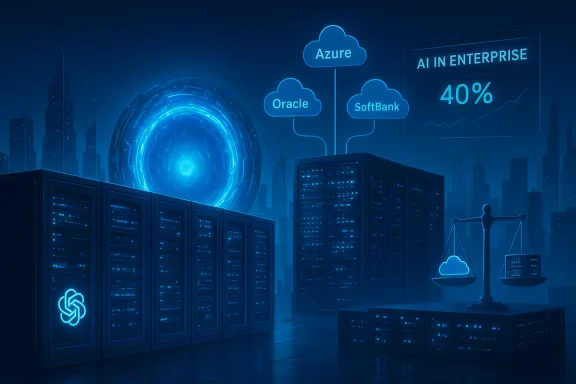
Futuristic data center with cloud icons for Azure, Oracle and SoftBank, highlighting AI-driven enterprise analytics.What the numbers actually say​

Azure growth: headline strength, nuance underneath​

Microsoft’s earnings release spells out the headline: Azure and other cloud services grew 39–40% in the referenced quarter, a pace that materially outpaced most consensus forecasts and helped drive overall Intelligent Cloud strength. Management emphasized continued capacity constraints—demand exceeded supply—and said it is rapidly adding datacenter capacity. Those details are important because they connect revenue growth directly to capital intensity.
Why that matters:
  • Growth at that rate is rare for a business of Azure’s size and validates the market’s appetite for AI‑enabled cloud services.
  • But capacity constraints mean Microsoft is accelerating capex, which will depress gross margins in the near term even if it ultimately supports higher revenue longer term. Microsoft disclosed roughly $34.9 billion of capital expenditures in the quarter, with about half directed to short‑lived assets (GPUs/CPUs) that are necessary to support AI workloads.
Independent coverage of the quarter echoed the same picture: a beat on top line and demand that outstrips supply, offset by large and rising capital investment to scale GPU capacity. CNBC, market reports, and analyst notes all recorded the same interplay between Azure demand and capex pressure.

The OpenAI accounting effect: a headline loss that needs careful reading​

Microsoft’s release included a specific non‑GAAP carve‑out: an “impact from investments in OpenAI” of roughly $3.1 billion for the quarter, reducing reported net income and EPS by a material amount. That is a real number in Microsoft’s GAAP disclosure and is intended to reflect Microsoft’s equity‑method share of OpenAI’s losses in the period. Microsoft published a reconciliation showing the GAAP and non‑GAAP results, which explicitly isolates the OpenAI impact.
The arithmetic often reported in market commentary is: dividing Microsoft’s $3.1 billion hit by its percentage ownership implies an even larger headline loss at OpenAI as a whole (the commonly quoted implication is an approximate $11.5 billion quarterly loss for OpenAI assuming a ~27% Microsoft stake). That arithmetic is technically correct as an implication of equity accounting, but it has important caveats:
  • The implied loss figure is an estimate derived from Microsoft’s reported share and the equity‑method charge; it is not a direct OpenAI disclosure. Different press pieces use slightly different stake denominators and accounting line items, producing variation in the implied OpenAI loss number. Treat the implied total loss as an inference from Microsoft’s filing rather than as an independently confirmed OpenAI figure.
Independent reporting and market commentary highlighted both the size of the charge and the fact that the $3.1 billion is Microsoft’s account entry under GAAP; analysts noted that the underlying drivers include high training and inference costs, valuation adjustments, and other non‑cash components that can make quarter‑to‑quarter comparisons noisy.

How the partnership has changed — and why it matters​

From exclusivity to preferential partnership​

When Microsoft first invested in OpenAI it gained privileged distribution and deep technical integration with Azure. Recent restructuring of the relationship shifted those lines. Under the new arrangement OpenAI restructured as a public‑benefit entity and agreed to a set of commercial terms that preserve important Microsoft rights (extended IP windows, revenue‑sharing on certain surfaces) while also giving OpenAI greater flexibility to source compute from other providers and to scale infrastructure through initiatives like Stargate. The practical result: Microsoft retains significant commercial ties and API exclusivity in some areas but no longer enjoys blanket exclusivity as the sole compute provider.
Concrete points emerging from public disclosures and reporting:
  • OpenAI announced the Stargate Project and formalised partnerships with Oracle, SoftBank and others to build multi‑gigawatt AI data center capacity. That program targets up to $500 billion of investment across multiple sites and partners. The existence and scale of Stargate is confirmed in OpenAI’s and partner announcements.
  • Microsoft’s recent deal and subsequent filing indicate it will continue to be a large OpenAI partner—there are explicit Azure purchase commitments reported in the restructuring narrative—but the right of first refusal on OpenAI’s entire compute demand was relaxed in favour of a more flexible, multi‑partner approach. Multiple outlets summarised the new terms in broadly consistent ways.

Why exclusivity mattered — and why losing it changes the calculus​

Exclusivity had two clear benefits for Microsoft:
  • It guaranteed a predictable base of high‑margin model training and inference consumption that could be monetized through Azure.
  • It was a sales and marketing differentiator: Microsoft could claim to be the strategic cloud of the leading frontier model developer.
Dropping absolute exclusivity means Microsoft must now compete for more of OpenAI’s incremental compute capacity on performance, cost, and execution. In short: the company’s AI advantage is less about locked access and more about making Azure the easiest, most cost‑effective place to run those models at scale.

The math investors care about: revenue lift versus bill size​

Investors are now judging three linked metrics as one story:
  • Cloud revenue growth (does Azure keep accelerating or at least sustain high‑teens/30%+ growth?). Microsoft’s recent quarter checked the “growth” box; management repeated that Azure remained capacity constrained but growing rapidly.
  • AI pricing and margins (can Microsoft earn attractive margins from inference and value‑added AI services, or will the cost of GPUs and power overwhelm the pricing power?). Microsoft’s gross margins showed pressure from AI infrastructure investment even as efficiency gains were flagged.
  • Cost discipline / capex trajectory (how many billions does Microsoft need to spend to keep capacity ahead of demand, and when will those investments produce sustainable margin expansion?). Microsoft disclosed very large quarterly capex and finance leases, signalling that the buildout is in heavy phase.
Analysts and macro commentators have begun to put big‑picture numbers on industry spending. Multiple estimates from major outlets put hyperscaler AI and cloud capex in the hundreds of billions annually (estimates vary: some sources cite $300–$400 billion in a single year for the biggest players; other projections that account for multi‑year buildouts push towards $500 billion). The variance is large because these are forward estimates and because companies disclose capex in varying forms, so cite them as indicative rather than definitive.

Strengths: what Microsoft still has going for it​

  • Scale and integration. Azure is already a leader with global datacenter footprint and deep product integration across Microsoft 365, Dynamics, and Windows — that creates sticky, cross‑sell opportunities for AI services.
  • Product distribution. Microsoft can embed Copilot features across a vast installed base (Windows, Office, GitHub, cloud), turning model capabilities into product‑level monetization. That distribution is harder for newer cloud entrants to replicate.
  • Deep pockets for capex. Microsoft has the balance sheet and cash flow to fund large datacenter commitments over multiple years; that matters in a hardware‑intensive race where first‑mover scale helps lower per‑token costs.
  • Commercial tie‑ins with OpenAI. Despite the relaxation of exclusivity, Microsoft still holds business and IP arrangements that can produce durable revenue streams—if those arrangements are executed as intended.

Risks and downside scenarios​

  • Sustained operating losses at OpenAI could keep dragging Microsoft’s reported earnings. Microsoft’s GAAP line will reflect its proportionate share of OpenAI’s quarterly results under equity accounting—meaning volatile losses at OpenAI will flow to Microsoft’s P&L unless agreements or ownership percentages change. The $3.1 billion hit is a real example of that mechanism.
  • Capex and depreciation squeeze. Large capital commitments, short‑lived GPU assets, and finance leases can compress margins for several quarters or years. If AI pricing compresses or customers push for cheaper alternatives, the payback window lengthens.
  • Multi‑cloud OpenAI execution. If OpenAI increasingly relies on non‑Azure capacity (Oracle/SoftBank/other Stargate partners, or bespoke builds), Microsoft may not capture as much of the downstream inference value as investors previously assumed. That would force Microsoft to rely more on enterprise Copilot revenue and other internal AI monetization to justify its AI capex.
  • Regulatory and competition pressure. As governments look at market concentration, preferential arrangements and pricing practices could attract scrutiny. Meanwhile, aggressive capex by rivals with lower cost bases or favourable local factors could change competitive dynamics.

What this means for Windows users, developers, and IT buyers​

  • For most Windows users, the practical outcome is likely more AI features integrated into everyday apps (Copilot in Office, deeper Windows AI assistance), not fewer. Microsoft’s product roadmap remains committed to embedding models where they can add productivity value.
  • For enterprise IT teams, the message is: expect strong Azure features for AI workloads, but plan for a multicloud world. OpenAI’s flexibility makes hybrid and multi‑cloud strategies more likely for teams that want model redundancy or different cost profiles.
  • For developers, Azure will remain a very attractive place to build thanks to integration, enterprise tooling, and Microsoft’s developer ecosystem—yet the economics of running at scale will become a more important design consideration as inference costs and token pricing remain visible.

Four practical questions for investors and CIOs to watch next​

  • Will Azure growth decelerate meaningfully if capacity constraints are resolved (i.e., does demand drop once supply matches it), or will new scale unlock further enterprise adoption?
  • How fast can Microsoft push down per‑token costs (tokens per dollar per watt) through software and hardware co‑design—not just by adding GPUs but by achieving higher utilization of those GPUs across models and workloads?
  • How transparent will OpenAI be about its cash burn and operating losses going forward, and how will Microsoft’s proportionate share of that volatility be documented in future filings? (Note: the $3.1 billion equity‑method hit is a prior example of the mechanism.)
  • Will the Stargate buildouts reduce entry‑level pricing for training and inference (good for customers) but also increase the bargaining power of non‑Microsoft cloud providers (bad for Azure market share)?

Bottom line: growth is real, but the profitability story is nooft delivered a reassuring cloud and AI growth quarter, validating Azure’s central place in enterprise AI adoption. But the next and harder question for markets is whether the revenue lift from AI will outpace the exploding bill for GPUs, power, and datacenter infrastructure—and whether partner economics, notably the evolving OpenAI relationship, will leave Microsoft capturing the value or merely sharing the bill.​

In short:
  • Azure growth is a strength, and Microsoft’s distribution and product footprint remain powerful advantages.
  • OpenAI’s financials and the broader buildout (Stargate and partner capacity) inject a new layer of uncertainty, both because of direct accounting impacts and because the compute sourcing model has become more multicloud and partnership‑driven.
For WindowsForum readers and enterprise technologists, the practical takeaway is pragmatic: expect more AI in Windows and Microsoft apps, but design cloud strategies with multicloud resilience and cost‑optimization in mind. For investors, the trade is between growth powered by AI and the war of capex and losses that may be necessary to get to that growth—the math hasn’t flipped to guaranteed profits yet, and Microsoft’s OpenAI exposure means that volatility will show up on the P&L until the industry’s cost curve shifts materially.

Final assessment — strengths, red flags, and watchlist​

  • Strengths: scale, distribution, deep enterprise integration, and continued demand for Azure AI services.
  • Red flags: large equity‑method hits can recur if OpenAI or similar partners continue to post operating losses; capex intensity is very high; the competitive dynamic is shifting toward multi‑party infrastructure (Stargate) that weakens single‑vendor exclusivity.
  • Watchlist for the next two quarters:
  • Microsoft’s disclosure on the frequency and size of OpenAI‑related equity adjustments.
  • Azure gross margin trajectory as short‑lived GPU capex transitions to longer‑lived, depreciable assets.
  • Progress and transparency around Stargate or other large AI‑infrastructure partnerships that could shift where frontier models are trained and hosted.
The Finimize framing you brought in—Azure numbers are “good” but the OpenAI bet “gets messier”—is an accurate and useful short‑hand for the current market tension. Microsoft’s cloud engine is firing on all cylinders, but whether that engine converts an enormous AI bill into durable margin expansion remains the central, unresolved question of the next several reporting cycles.

Source: Finimize https://finimize.com/content/microsofts-azure-numbers-look-good-but-the-openai-bet-gets-messier/
 

Microsoft’s latest quarterly report crystallized a paradox: the company is simultaneously sitting on an unprecedented backlog of contracted demand and wrestling with a capacity problem that threatens near‑term execution and investor confidence.

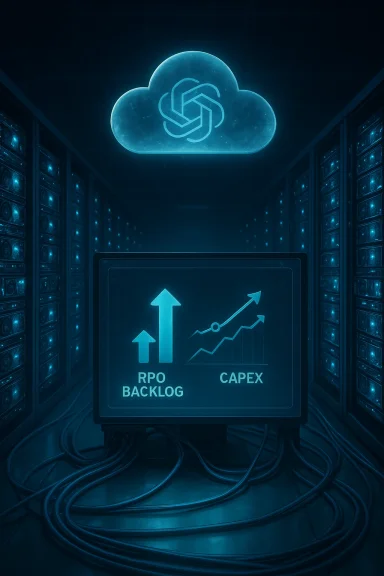
Blue-toned data center with a glowing cloud icon and a chart showing rising backlog and CAPEX.Background​

Microsoft reported revenue of $81.3 billion for the quarter ended December 31, 2025, driven by strong cloud results but overshadowed by a spike in capital spending and a dramatic jump in contracted bookings. The company’s disclosed remaining performance obligations (RPO) — its commercial backlog of contracted but not-yet-recognized revenue — surged to $625 billion, an increase that management tied in large part to commitments from frontier AI labs. Microsoft said that roughly 45% of that RPO is attributable to OpenAI, a disclosure that reframes the firm’s cloud narrative and puts the OpenAI partnership squarely at the center of Azure’s growth story.
The numbers are real and consequential: the RPO and public comments by Microsoft leaders confirm a multi‑quarter, capital‑intensive scaling effort for GPU‑dense infrastructure to support generative AI workloads. At the same time, CFO Amy Hood and CEO Satya Nadella emphasized diversification and internal prioritization — language meant to reassure markets but which also makes the operational tradeoffs explicit.

The numbers that matter: revenue, RPO, Azure growth and capex​

What Microsoft reported (verified)​

  • Revenue: $81.3 billion for the quarter.
  • Intelligent Cloud (Azure and related services) growth: roughly 39% year‑over‑year in the quarter, a headline figure that still left some analysts wanting more.
  • Remaining performance obligations (RPO): $625 billion, up about 110% from the prior quarter. Microsoft attributed roughly 45% of this backlog to OpenAI commitments — an implication that OpenAI represents a very large slice of Microsoft’s forward‑looking, contracted cloud demand.
  • Capital expenditures (CapEx): $37.5 billion for the quarter, a jump of about 66% year‑over‑year, with management saying roughly two‑thirds of that spend was on short‑lived compute inventory (GPUs and CPUs) to support AI workloads.
These are not projections — they are audited, public figures in Microsoft’s filings and earnings commentary. The RPO figure and the stated OpenAI share are particularly load‑bearing for investors and customers because they tie future revenue visibility to a small set of relationships and to Microsoft’s ability to convert GPU investment into recurring, profitable services.

Cross‑checking the key claims​

I verified the headline figures against Microsoft’s own press materials and multiple independent outlets reporting on the earnings call. Microsoft’s press release and investor deck list the $81.3 billion revenue and the $625 billion RPO, while outlets such as TechCrunch and GeekWire reported the OpenAI share and the $37.5 billion capex figure; MarketBeat captured the key CFO commentary about capacity allocation and product prioritization. Using multiple, independent sources reduces the risk of mistranscription or misinterpretation of management’s remarks.

Why OpenAI accounts for 45% of the backlog and why that matters​

The arithmetic and the strategic mechanics​

When Microsoft says OpenAI represents about 45% of the $625 billion RPO, it is quantifying a contractual commitment — not instant cash — that will be recognized as revenue as services are delivered. That math implies roughly $280–$285 billion in future Azure services attributable to OpenAI under the current arrangements. Microsoft’s earlier restructuring of the OpenAI relationship included large, incremental commitments by OpenAI to purchase Azure services; those commitments are reflected in the RPO and were highlighted during the earnings discussion.
This level of concentration is unusual for a hyperscaler: cloud backlogs are often widely distributed across thousands of enterprise contracts. A near‑50% share tied to a single partner means Microsoft has a sizeable anchor customer — with the upside of predictable demand and the downside of concentrated counterparty risk. If OpenAI changes strategy, funding cadence, or sourcing, Microsoft’s revenue profile could be materially affected. That is the reason markets reacted nervously despite the top‑line beat.

Strategic upside vs. concentration risk​

  • Strategic upside: A committed, large buyer (OpenAI) helps Microsoft smooth utilization, amortize long‑lived investments, and deepen product integration (Copilot, Azure OpenAI Service, model licensing). This has genuine platform leverage: a single frontier partner may drive adoption and product credibility across Microsoft’s broader enterprise base.
  • Concentration risk: Nearly half of the backlog depends on one partner. That creates counterparty and credit exposure, and it amplifies political, regulatory, or contractual shifts into Microsoft’s revenue forecast. Even if OpenAI honors the commitments, timing and operational delivery risks (power, chip supply, permitting) could defer or accelerate revenue in ways that compress margins.
A balanced read is that Microsoft holds both a privileged commercial position and a non‑trivial concentration risk. Management argued that the arrangement extends IP windows and product rights in ways that strengthen Microsoft’s ecosystem; investors will look for clarity on the cadence of RPO conversion to revenue and on the funding mechanics OpenAI will use to meet its commitments. Independent reporting suggests some of those funding and timing details are not fully public and should be treated with caution.

CapEx: the buildout calculus and the margin pressure​

What Microsoft is buying​

Microsoft’s CapEx surge is real and targeted. Management broke out the spending into:
  • Short‑lived compute assets (primarily GPUs and CPUs) for training and inference hardware.
  • Long‑lived datacenter shells, power and energy systems, and networking that underpin future scale.
    CFO Amy Hood said roughly two‑thirds of the quarter’s CapEx was directed to short‑lived compute inventory, the kind of assets that are immediately necessary to run modern LLMs and inference fleets.

Short‑term margin tradeoff​

GPU‑dense infrastructure carries different unit economics than legacy VM hosting. Training and inference for large models raise:
  • Upfront capital intensity (high‑end accelerators are expensive).
  • Operational costs (specialized cooling, higher power draw, complex interconnects).
  • Faster depreciation for short‑lived accelerators compared with datacenter shell assets.
Microsoft acknowledged a short‑term Gross Margin headwind as it prioritizes capacity buildout. That is a conscious tradeoff: accept margin pressure now to secure long‑term, high‑stickiness revenue if demand materializes as contracted. Investors pushed back because the timeline and the utilization rates of those new assets determine whether the tradeoff pays off.

Compute allocation: prioritization, first‑party products, and the “zero‑sum” reality​

Management’s candid framing​

One of the most operationally telling portions of the call was CFO Amy Hood’s description of compute allocation as an allocated capacity guide. In plain terms, Microsoft is prioritizing new GPU capacity for first‑party products (Microsoft 365 Copilot, GitHub Copilot, Security Copilot), internal R&D, and strategic engagements before allocating the remainder to the broader Azure customer base. Hood explicitly said that if the GPUs brought online in the quarter had been allocated entirely to Azure, Azure’s growth KPI would have been higher than reported, indicating that first‑party prioritization suppressed the cloud growth metric that investors track.
This is the operational manifestation of a zero‑sum allocation game: physical GPUs, power, and rack capacity are finite in the short term. When Microsoft elects to reserve capacity for Copilot or for internal experimentation, that choice reduces the capacity available for external Azure customers and for resale to third parties. The rationales are defensible — preserving flagship product performance and maintaining control over critical internal workloads — but they have downstream commercial consequences for Azure customers and for current quarter revenue metrics.

Practical customer impact​

  • Provisioning lead times for GPU‑dense instances may be longer for independent Azure customers.
  • Price and service terms could shift as Microsoft balances utilization and prioritization.
  • Enterprises running latency‑sensitive or regulated workloads may have to negotiate capacity guarantees or adopt hybrid deployments that mix on‑premises and Azure resources.
This is not hypothetical; Microsoft’s own comments and multiple reporting outlets indicate the company is already making these tradeoffs publicly, and customers should plan accordingly.

The partnership dynamic: strategic advantage or dependency?​

Why Microsoft sees OpenAI as a strategic asset​

Microsoft’s public messaging frames OpenAI as a crown jewel for product roadmaps: preferred model access, deep product integration across Microsoft 365 and Copilot, and the potential to anchor platform usage for years. Management also pointed to product and IP arrangements that extend Microsoft’s ability to monetize models and to bundle AI experiences into seat‑based products. Those benefits are real and explain why Microsoft would accept near‑term margin tradeoffs to keep an anchor partner engaged.

The counterpoint: overreliance and external sourcing​

At the same time, the business reality has changed: OpenAI has broadened compute sourcing options (the so‑called Stargate initiatives and other partnerships reported in industry coverage). That means Microsoft cannot assume exclusive hosting of all OpenAI workloads indefinitely, and a portion of OpenAI’s compute needs may migrate to other providers or to self‑hosted infrastructure depending on price, latency, or strategic priorities. The restructuring, the public benefit corporation move, and media reports about OpenAI’s broader infrastructure plans underscore this nuance — Microsoft’s role is privileged but not absolute. Some of those external arrangement details are less than fully transparent and deserve cautious reading.

Competitive and regulatory pressures: the broader landscape​

Who else is competing for GPUs and AI dollars?​

  • Amazon Web Services (AWS): dominant cloud market share, aggressive on price and infrastructure procurement.
  • Google Cloud: strong AI research and model offerings, Vertex AI, and custom silicon ambitions.
  • Specialist capacity providers (CoreWeave, Vantage, Nebius and others): supply GPU racks and fill short‑term capacity gaps.
  • OpenAI and other model providers: can shape where inference and training run through commercial deals or internal builds.
Competition is not simply about matching features — it’s about competing for scarce physical supply (top‑tier accelerators) and for the right to host mission‑critical models. That keeps upward pressure on capex and on supplier pricing, and it creates a multi‑front battle where platform, price, and partnership dynamics all matter.

Regulatory and policy risks​

Large commitments between hyperscalers and model developers will attract scrutiny — procurement fairness, competition policy, national security and data‑sovereignty concerns are already part of the headlines. Microsoft’s global scale increases the probability of regulatory inquiries and compliance costs associated with deploying AI at scale in multiple jurisdictions. Those risks are real, material, and time‑sensitive.

What this means for WindowsForum readers — enterprise IT leaders and power users​

If you run infrastructure, manage Windows‑centric fleets, or plan enterprise AI pilots, here are pragmatic takeaways you should consider:
  • Evaluate capacity guarantees: If your workloads are GPU‑dependent and latency‑sensitive, negotiate explicit capacity or SLA commitments. Microsoft’s prioritization of first‑party products means supply could be constrained during peak rollout phases.
  • Pilot with measurable KPIs: Start with targeted Copilot or inference pilots tied to productivity metrics. That will help justify incremental spend and protect against over‑consumption surprises under consumption pricing.
  • Build hybrid strategies: For regulated or mission‑critical systems, plan hybrid architectures that keep sensitive workloads on prem or in private cloud while using Azure for scale training and burst inference. This hedges availability and policy risk.
  • Monitor cost attribution: Short‑lived GPU assets and consumption‑priced inference can balloon bills; employ governance and quotas to limit runaway costs.
  • Reassess vendor concentration: If your roadmap depends on a single hyperscaler for AI hosting, consider multi‑cloud or specialist partners to reduce single‑point exposure — the same market forces that affect Microsoft now can affect any provider in tight supply environments.

Risks, unanswered questions, and claims that need caution​

  • Funding mechanics for OpenAI’s commitments: Microsoft’s RPO disclosure reflects contractual commitments but not the granular timing or funding sources OpenAI will use to pay for those services. Press reports and Microsoft commentary imply large multi‑year commitments, but the precise cash mechanics are not fully public and should be treated with caution.
  • RPO conversion timing: $625 billion of RPO is a headline figure; the cadence of recognition matters (how much becomes revenue in the next 12, 24, or 36 months). Microsoft provided some guidance on average duration, but the detailed conversion schedule will materially affect cash flow and margin dynamics.
  • Market reaction sensitivity: The stock market’s near‑term reactions reflect not only the scale of the investments but uncertainty about utilization and monetization speed. If Azure utilization doesn’t keep pace with capex, margins and free cash flow could be pressured. That is a clear and present risk articulated by analysts.
Where claims are unverifiable — especially those that involve third‑party financing arrangements or off‑balance‑sheet commitments by non‑public entities — I flag them explicitly and advise readers to treat them as reported commitments rather than settled cash flows.

The strategic bottom line​

Microsoft’s latest quarter both validates the company’s central wager on AI and exposes the operational friction of scaling that bet. The massive RPO and the disclosed 45% share tied to OpenAI make Microsoft a primary infrastructure partner for frontier models — a position that can deliver durable, sticky revenue if execution and demand sequencing align. But the near‑term reality is clear: compute is scarce, capital spending is large, and Microsoft is making allocation decisions that prioritize internal product experiences alongside external customers. That mix is smart strategically but complex operationally.
For technology leaders and Windows users, the immediate implication is simple: expect continued innovation, but also expect capacity and cost management to be central to procurement conversations for the next several quarters. For investors, the question remains timing: can Microsoft translate enormous contracted demand and aggressive CapEx into sustainable, margin‑accretive growth at a pace that satisfies market expectations?
Microsoft’s answer will be revealed in utilization metrics, conversion of RPO to recognized revenue, and the company’s ability to bring GPU‑dense capacity online without sustained margin erosion. Until then, the company occupies a rare position: at once the backbone for a new AI economy and a firm feeling the growing pains of building it.

In short: Microsoft’s earnings reveal a high‑stakes trade — buy the market leadership and platform integration that comes with being OpenAI’s primary cloud partner, but accept concentrated backlog, elevated capital intensity, and near‑term allocation decisions that will shape Azure’s growth profile for quarters to come.

Source: Tech Times Microsoft's Azure Capacity Crunch Highlights Growing Dependence on OpenAI
 

A blue-lit data center with rows of server racks and glowing cloud data streams.
Microsoft’s latest quarter revealed a stark new truth about the cloud-era balance of power: the OpenAI relationship now represents a foundational, concentrated source of future Azure demand — and Microsoft is building an industrial-scale datacenter machine to satisfy it.

Background / Overview​

Microsoft reported $81.3 billion in revenue for the quarter ended December 31, 2025, with Intelligent Cloud and Microsoft Cloud continuing to drive growth even as capital spending surged. The company disclosed a commercial remaining performance obligation (RPO) — its contracted but not-yet-recognized revenue backlog — of approximately $625 billion, and said that roughly 45% of that backlog is attributable to OpenAI, implying roughly $280–$285 billion of contracted Azure services tied to a single partner. These headline numbers are drawn from Microsoft’s investor materials and wereple independent outlets.
Two other facts changed the market conversation this quarter. First, Microsoft recorded $37.5 billion in capital expenditures for the quarter — a dramatic, step‑change spike predominantly described as investments in short-lived compute assets (GPUs/CPUs) and long-lived datacenter shells. Second, Microsoft’s corporate restructuring with OpenAI gave the company a material equity stake (around 27%) and redefined product and commercial rights between the parties — details that follow.
This combination — massive forward bookings concentrated in a single frontier-AI partner, and a capex program targeted at GPU-dense infrastructure — frames the strategic question every IT buyer and investor is asking: can Microsoft convert enormous upfront hardware spending into durable, diversified, and profitable revenue growth, and how exposed is Azure to a change in OpenAI’s strategy or funding?

Why the 45% OpenAI figure matters​

The arithmetic and concentration risk​

When management states that OpenAI constitutes about 45% of the $625 billion RPO, that is a contractual declaration, not a speculative projection. On paper, it equates to roughly $280–$285 billion of future Azure consumption tied to OpenAI under the current commercial framework. That concentration is exceptional for a hyperscaler that historically parcels future bookings across thousands of enterprise customers. The practical effects are twofold:
  • Upside: a long, visible runway of high‑volume demand for GPU capacity helps Microsoft plan capacity, amortize long-lived datacenter investments, and secure product integration advantages with front-line LLM technology.
  • Downside: counterparty and timing risk. If OpenAI alters its consumption strategy, secures cheaper or more diverse capacity from other suppliers, or staggers spend differently than currently contracted, Microsoft’s topline conversion timing and cash flows could shift materially.
Both the company and analysts emphasized that a substantial portion of the revenue in Microsoft’s backlog is diversified and grew meaningfully in the quarter; the non‑OpenAI portion of the RPO expanded as well. Nevertheless, the absolute size of the OpenAI commitment elevates concentration risk above what investors usually accept for cloud backlogs.

What the RPO actually is — and is not​

RPO (Remaining Performance Obligations) is a forward-looking accounting construct: contracted revenue that the seller expects to recognize as it delivers goods or services. It is not cash on the balance sheet, and it can be stretched over years. Microsoft’s disclosure provides revenue visibility, but the conversion cadence — what hits annual revenue and free cash flow in any given fiscal year — depends on delivery timing, hardware availability, and customer invoicing terms. Treat the $625 billion as a multi-year pipeline that can materially accelerate, decelerate, or be renegotiated.

The capex shock: building AI datacenters at hyperscale​

Short-lived compute vs. long-lived infrastructure​

Microsoft’s $37.5 billion capex in the quarter was described as heavily weighted toward short-lived compute assets — principally GPUs and supporting accelerators — as well as long-lived datacenter buildup (shells, power, network). Short-lived compute is capitalized and depreciated on a shorter timetable and is sensitive to vendor supply and price cycles. The company said roughly two‑thirds of the quarter’s spend went into this sort of fast‑deprecating compute inventory.
This spending pattern creates a unique industrial dynamic:
  • Microsoft must buy high volumes of silicon (primarily GPUs) to train and serve large models.
  • The company needs power, cooling, and real estate buildouts that will amortize over a decade.
  • Utilization is everything: low utilization or lower-than-expected monetization per GPU quickly compresses margins.

Capex math and the break‑even horizon​

Several institutional analystsnvestments with a 3–6 year payback window for high-utilization scenarios. That math rests on two assumptions: (1) steady, high-density consumption by model providers and enterprise inference workloads, and (2) the ability to monetize premium GPU cycles at prices that recover both the hardware burn rate and the amortized datacenter costs. Microsoft management argues it can recoup investments as enterprises adopt Copilot and other GenAI services; the market response shows skepticism that the conversion will be fast and broad enough to offset the capex spike in the near term.

The restructured OpenAI relationship: rights, equity, and uncertainty​

What changed​

OpenAI reorganized into a public benefit corporation and recapitalized in late 2025. Under the new arrangement Microsoft acquired a roughly 27% interest in the OpenAI Group PBC (valued by participants at tens of billions), and OpenAI committed to an incremental multi‑hundred‑billion-dollar plan for Azure services — commonly discussed as an approximate $250 billion commitment in market reporting. Microsoft’s public statements and multiple independent news reports confirm these elements, though the legal detail and the timing of revenue recognition are complex.
Microsoft also retained extended licensing and product rights to OpenAI models for certain periods (including long horizons for commercialization inside Microsoft products), while losing an absolute right of first refusal to be the exclusive compute provider — that is, OpenAI can now place workloads on other clouds or infrastructure partners as it sees fit. That shift is strategic: Microsoft got equity and license certainty, OpenAI gained operational flexibility.

The funding question​

How will OpenAI fund a $250 billion Azure commitment? Public reporting shows a combination of OpenAI raising equity and strategic financing, partnerships with chip suppliers and cloud providers, and third‑party capital injections (including discussions involving SoftBank, Nvidia and others). The exact mechanics — timing, tranche structure, and whether some commitments are conditional or contingent — are not fully disclosed in public filings. That opacity matters: large-scale funding sources can materially affect the pace of Azure consumption. Treat headline commitment numbers as strategic signals rather than fixed cash flows with precise timing.

What this means for Azure, Microsoft’s margins, and enterprise customers​

Azure growth and profitability dynamics​

Azure and other cloud services grew about 39% year-over-year in the quarter, which is still impressive but flagged as slightly lower than previous runs. Microsoft’s Intelligent Cloud reported strong operating income expansion, but margins were impacted by the increased investments in AI infrastructure. Microsoft acknowledged it had allocated a significant portion of GPU capacity to internal priorities and to OpenAI, which reduced the capacity available for customer-facing Azure rentals and slightly damped external Azure revenue growth.
The underlying margin dynamics are nuanced:
  • Software-embedded AI (Copilot seats, M365 upgrades) is high-margin once deployed.
  • Raw GPU compute sold on Azure is lower-margin in the short run, especially when introductory or partner pricing is used to lock in demand.
  • Over time, if Microsoft succeeds in convertinat-based AI into broad paid adoption, product margins may offset infrastructure costs.

For enterprise customers and IT leaders​

  • Expect increasing product bundling: Microsoft is positioning Copilot experiences inside Windows, M365 and Dynamics as a core upsell lever. Organizations should expect seat-based pricing changes and new AI consumption metrics on invoices.
  • Governance and multi‑model strategies matter: OpenAI’s loss of exclusivity means enterprises leveraging Azure for Copilot or directly consuming OpenAI models should plan for multi-cloud model operations and vendor risk assessments.
  • Procurement timing: Some GPU capacity is already committed out to the stated useful life of installed servers. This may limit Azure’s ability to scale incremental third‑party capacity in the short term, making early reservations or long-term commitments for critica---

The competitive landscape: who benefits, who competes​

Microsoft’s posture is not without rivals. Google (Gemini), Anthropic (Claude), and other providers are actively courting enterprise and research customers, and infrastructure specialists (Oracle, CoreWeave, and regionals) are building alternatives to Azure for dense GPU workloads. At the same time, Microsoft’s equity stake and product links with OpenAI provide a commercial moat that is difficult for pure-play cloud rivals to replicate quickly.
Key points for readers:
  • Multi‑cloud is now practical for model operators: OpenAI and others have more freedom to shop compute across providers, and model deployments are increasingly orchestrated across clouds and specialized providers.
  • Hardware suppliers and semiconductor duopoly dynamics remain critical: Microsoft’s capex is a demand driver for Nvidia, AMD, and the ecosystem; supply constraints or pricing moves at component suppliers will shape Azure unit economics.

Accounting, gains, and the market reaction​

Microsoft reported an accounting gain tied to its OpenAI investment that materially affected GAAP net income in the quarter — the company recorded a roughly $7.6 billion gain from its stake in OpenAI in Q2 F2026, while earlier quarters had seen different one-off OpenAI-related impacts. These non-operational accounting items introduce volatility into GAAP figures and complicate year‑over‑year operating comparisons. Microsoft emphasized non‑GAAP measures that strip out OpenAI accounting effects to provide an organic picture of operations.
Investors reacted quickly: despite revenue and EPS beats, Microsoft’s stock slid after hours as markets digested the capex figure and the concentrated RPO. The logic is straightforward — investors price for the timing and certainty of payoff, not simply the presence of a multi‑hundred‑billion backlog.

Strategic scenarios: how this could play out​

  • Aggressive conversion (bull case)
  • OpenAI honors its Azure consumption cadence; enterprises accelerate Copilot seat purchases and uptake.
  • Microsoft achieves high utilization of GPU fcapacity at favorable margins, and folds AI into high-margin software franchises.
  • Capex is amortized within a 3–5 year window and Microsoft’s free cash flow recovers quickly.
  • Staggered conversion (base case)
  • OpenAI consumes on Azure but also runs workloads elsewhere; timing of purchases is lumpy.
  • Microsoft monetizes productized AI features slower than hoped, leading to a multi-year capex payback and higher near-term margin pressure.
  • Dislocation (bear case)
  • OpenAI’s model of multi-cloud sourcing accelerates, or funding constraints slow its purchases.
  • GPU pricing falls sharply or competition forces Microsoft to lower Azure GPU prices, lengthening payback periods and compressing margins.
Each scenario depends on three variables: OpenAI’s funding and sourcing strategy, broader enterprise adoption of paid AI features, and the evolution of GPU supply and price curves. These are the core levers IT leaders and investors should track. (finance.yahoo.com)

Practical advice for enterprise IT leaders and procurement​

  • Audit vendor contracts and licensing: clarify where AI workloads run, the SLA and data sovereignty consequences, and whether Microsoft’s Copilot or OpenAI APIs ical workflows.
  • Prepare for seat-based pricing changes: include Copilot and other AI bundles in renewal negotiations and forecast budget impacts.
  • Design for model portability: adopt abstractions (model-routing, tokenization wrappers, and cost telemetry) that let you switch models/providers without massive refactors.
  • Treat vendor commitments as conditional: large public commitments are meaningful for capacity planning but should not replace coulti-cloud or on-prem alternatives.

Strengths and risks — a balanced journalistic read​

Notable strengths​

  • Microsoft owns a unique combination: massive enterprise distribution (Microsoft 365, Windows), a large public cloud (Azure), and preferential integration with OpenAI models that accelerates productization. Those levers create multiple monetization paths beyond raw GPU selling.
  • The company has balance-sheet flexibility to sustain large multi-year capex while executing simultaneous buybacks and dividends — a rare advantage for a platform-scale industrial pivot.

Material risks​

  • Revenue concentration: nearly half of a $625 billion RPO linked to one partner introduces unusual counterparty risk for a public cloud operator. The timing of conversion matters as much as the headline amount.
  • Capex intensity: heavy short-lived compute purchases expose Microsoft to hardware price cycles and utilization risk; low utilization or aggressive discounting would extend payback materially.
  • Operational execution: delivering hundreds of billions in contracted cloud services requires scaling supply chains, power and permitting, and workforce operations reliably across multiple geographies — a non-trivial program risk.
Where claims appear uncertain or not fully disclosed (for example, the precise mechanics of OpenAI’s $250B commitment and the tranche timing), readers sholines as directional signals and seek contractual disclosures or follow-on investor communications for actionable detail.

The bottom line for WindowsForum readers​

Microsoft is no longer merely a software-and-cloud company pivoting toward AI; it is executing an industrial plan to become a primary provider of frontier-model compute, financed by a mix of internal investment and very large, contractually visible demand commitments. For enterprises, the immediate implication is pragmatic: expect new AI price and licensing dynamics, prioritize governance and model portability, and treat Microsoft as strategically aligned with — but not exclusively tethered to — the OpenAI ecosystem. For investors, the calculus is about timing: Microsoft has the scale to win the multi-year race, but that path requires patient capital and flawless execution on data center scale-out and price discipline.
Microsoft’s Q2 figures and the disclosed OpenAI linkage are real, consequential, and verifiable in company documents and independent reporting. The new era will be decided not by announcements alone but by the daily unit economics of GPUs, the cadence of OpenAI’s purchases, and the enterprise market’s willingness to pay for AI-embedded productivity. Prepare for turbulence — and for opportunity — as the AI cloud market matures.

Source: The Next Platform Microsoft Is More Dependent On OpenAI Than The Converse
 

Microsoft's disclosure that roughly 45% of its $625 billion commercial bookings backlog is tied to OpenAI crystallizes a new reality: Microsoft's Azure growth story is now inseparable from the fortunes — and the compute appetite — of one of the most influential AI startups in the world.

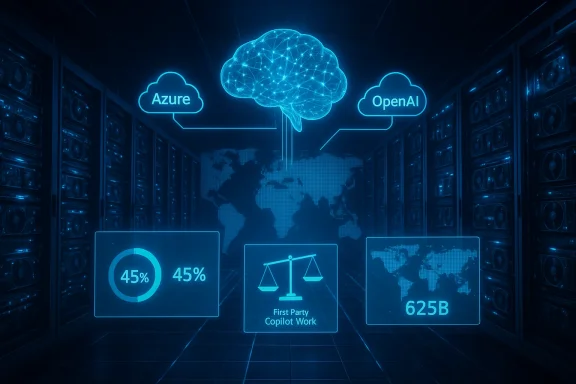
Blue neon data center with a glowing brain cloud connecting Azure and OpenAI, plus world-map metrics.Background​

Over the latest fiscal quarter, Microsoft reported revenue of $81.3 billion and an operating income increase that beat expectations, yet investors focused less on the headline beat and more on the company's balance between investment and near-term monetization. Microsoft’s commercial remaining performance obligations (RPO) climbed to $625 billion, a jump roughly 110% year‑over‑year that signals enormous forward‑looking contractual demand for cloud compute and services.
That backlog number drew immediate attention because Microsoft said OpenAI accounts for about 45% of the total — an eye‑watering concentration of future contracted Azure usage that few analysts saw broken out publicly before this call. At the same time Microsoft disclosed that capital expenditures rose 66% year‑over‑year to $37.5 billion, driven largely by GPU‑dense data center builds and finance leases to secure short‑lived accelerator inventory. The combination of large RPOs and accelerated capex underpins the "AI‑factory" narrative Microsoft has promoted, but it also creates acute operational and investor questions.

What Microsoft actually said — verified figures and remarks​

The headline numbers​

  • Revenue: $81.3 billion (up 17% year‑over‑year).
  • Remaining performance obligations (commercial RPO): $625 billion, up roughly 110% year‑over‑year.
  • OpenAI share of RPO: ~45% of the $625 billion backlog.
  • Capital expenditures (capex): $37.5 billion, a 66% increase year‑over‑year.
  • Azure / Intelligent Cloud growth: reported at about 39% year‑over‑year for the quarter.
These are company‑reported or earnings‑call figures and were reiterated on the earnings webcast and in the official press release. Where Microsoft spokespeople provided color — for example, how GPUs are being allocated — those comments are summarized from the call transcript and contemporaneous reporting.

Executive framing​

  • Satya Nadella emphasized that Microsoft is not over‑optimizing around any one partner or product, stressing diversification across Microsoft 365, GitHub, and multiple Copilot offerings as parallel franchises that matter to the company's long‑term strategy.
  • Amy Hood (CFO) described the current environment as an allocated capacity problem: new GPU/CPU capacity is prioritized for first‑party products (Copilots), R&D, and strategic initiatives; Azure receives the remainder. That allocation logic is a key operational shift investors needed to hear.

Why these disclosures matter: scale, concentration, and operational trade‑offs​

Scale is now breathtaking​

A $625 billion RPO is not just large — it reframes Microsoft’s revenue pipeline for multiple years. RPO captures contracted, multiyear customer commitments that will convert into revenue over time. When a single counterparty is credited with nearly half of that number, the company’s future revenue shape becomes significantly policy‑dependent on how that relationship evolves. The sheer scale forces Microsoft to build GPU‑heavy capacity at pace, and that takes money, time, and supply‑chain muscle.

Concentration risk is real​

Concentration risk works in two directions: if OpenAI scales and pays as contracted, Microsoft stands to realize enormous, high‑margin (eventually) revenue; if OpenAI pivots, scales more slowly, renegotiates, or chooses alternative suppliers down the line, Microsoft would face a sudden recognition shortfall against expectations. The market’s reaction — an after‑hours drop in Microsoft shares — reflects precisely this investor unease.

Operational trade‑offs: GPUs are zero‑sum today​

Modern large‑scale generative AI workloads run on specialized accelerators (GPUs, newer AI ASICs). Supply of these devices and the data‑center capacity to host them is constrained. Microsoft’s own guidance makes the resource allocation explicit: newly installed GPUs go first to first‑party initiatives (Copilot family, internal model training, R&D), and what remains is offered to Azure customers. That turns compute allocation into a near‑zero‑sum game while supply remains tight. For enterprise customers, that means Azure capacity should no longer be thought of as infinitely fungible; it will, at times, be rationed based on corporate priorities.

The OpenAI effect: strategic upside and structural risk​

The upside: product and go‑to‑market acceleration​

Microsoft’s early, deep partnership with OpenAI positioned the company to embed foundation models across its product stack — from Microsoft 365 to GitHub and Windows integrations. Those synergies create new, sticky monetization paths (Copilot subscriptions, developer workflows, enterprise SaaS add‑ons) and establish Microsoft as the default cloud partner for many next‑generation AI deployments. The account also generated a one‑time recognized gain in the quarter tied to OpenAI’s recapitalization, which buoyed profit metrics.

The structural risk: dependency and asymmetric bargaining​

However, the risk profile is asymmetric. Microsoft has long been OpenAI’s primary compute partner and investor, but the new disclosures show Microsoft depends on OpenAI’s contracted spend to drive large parts of its RPO. When a vendor represents nearly half of a multiyear backlog, Microsoft’s negotiation leverage, future margin profile, and business planning all become more sensitive to that partner’s decisions. If OpenAI secures diversified supply from other hyperscalers or accelerates internal investment in custom silicon that can be hosted elsewhere, Microsoft’s long‑term assumptions around Azure demand could shift materially. Multiple industry actors — including Anthropic and Oracle — are also pushing large compute pacts that complicate the landscape.

Financial and market implications​

Capex and margin pressure​

A 66% year‑over‑year capex increase to $37.5 billion burns cash up front and depresses near‑term free cash flow and gross margins for cloud operations, even if those investments eventually pay off. Microsoft told investors that much of the capex is tied to assets with contracted revenue across their useful life, which mitigates some risk; still, there is an accounting and timing mismatch between heavy upfront capital spending and revenue recognition that will make quarter‑to‑quarter comparisons noisy. Investors interpreted this uncertainty as earnings risk, contributing to the stock decline.

Revenue recognition timing​

Microsoft said approximately one‑quarter of the RPO should be recognized as revenue in the next 12 months, with the rest spread out over multiple years. That tempo matters: it determines whether the massive contract backlog translates into a near‑term revenue growth lift or a more glacial, multi‑year realization. For Microsoft’s peers and customers, that pace also signals how quickly capacity needs to be provisioned.

The investor calculus​

Investors tend to price companies on forward‑looking revenue and margin profiles. Microsoft’s management pushed back against reading the capex number as reckless spending, framing it as necessary for long‑lived, contracted capacity. Nevertheless, markets reacted to the combined messaging of decelerating Azure growth (from 40% to 39% in one quarter) and sharply higher capex — a classic growth vs. investment trade. Historically, if capex grows faster than revenue for extended periods, valuation multiples contract unless investors see credible paths to margin recovery.

The operational reality inside the data centers​

GPUs, procurement, and 'short‑lived compute inventory'​

Microsoft characterized a sizable chunk of capex as spent on short‑lived compute inventory — the high‑turnover, high‑value accelerator cards and associated racks that power large language models. Those assets have shorter economic lives than traditional server infrastructure because model sizes, software optimizations, and next‑generation accelerators quickly change the efficiency curve. That fast obsolescence raises the question: how do you amortize and monetize assets that may be materially surpassed within 12–24 months?

Allocation hierarchy: first party, R&D, Azure​

Amy Hood’s description of the allocation hierarchy is a pivotal operational policy shift for a hyperscaler that historically treated cloud customers as the primary usage priority. Microsoft is making a strategic choice to reserve capacity for first‑party Copilot products and internal model work when supply is constrained. That will slow Azure’s capacity growth in tight periods but — management argues — protect higher LTV (lifetime value) internal businesses that could generate broader software platform monetization. For enterprises evaluating cloud providers, this signals a more complex procurement landscape for GPU‑heavy contracts.

Competitive dynamics and industry context​

Other hyperscalers are also racing for GPUs​

Nvidia remains the fulcrum of GPU supply, and every major cloud provider is competing for the same accelerators and interconnects. Anthropic inked significant Azure capacity commitments rivaling OpenAI’s in aggregate size, while Oracle and other providers have struck large compute deals of their own. These competing commitments reduce the degree to which any single cloud provider can assume exclusive access to future GPU supply. The industry now resembles a five‑way tug‑of‑war over finite silicon, real estate, and power.

Custom silicon and vertical integration​

Microsoft, like other hyperscalers, has signaled interest in custom silicon and software co‑design to boost tokens per dollar per watt. That approach can blunt reliance on off‑the‑shelf GPUs, but it requires time, capital, and successful systems integration. Until custom solutions scale, hyperscalers remain hostage to the cadence of general‑purpose AI accelerators and the roadmaps of silicon vendors.

Strategic analysis: strengths, risks, and blind spots​

Strengths​

  • First‑mover commercial alignment with OpenAI has given Microsoft privileged access to early, large model deployments and go‑to‑market integration across widely used products. That creates durable monetization vectors beyond raw compute hours.
  • Financial firepower and global footprint let Microsoft build GPU‑dense data centers and secure supply chains in ways most enterprises cannot. The company can also smooth supply shortages by using its balance sheet to purchase capacity or secure vendor pipelines.
  • Product synergy between Azure, Microsoft 365 Copilot, GitHub Copilot, and other Copilot offerings increases cross‑sell opportunities and customer stickiness.

Risks​

  • Concentration risk tied to OpenAI’s 45% share of RPO is the clearest vulnerability. Any change in OpenAI’s strategy — whether to diversify providers, re‑platform, or change its capital allocation — could reduce Microsoft’s future revenue realization.
  • Capital intensity and margin drag. Sustained capex at current run‑rates could compress gross margins and free cash flow unless revenue realization accelerates materially. The market already priced in that worry.
  • Operational prioritization friction. Enterprise customers may not tolerate implicit deprioritization when competing against Microsoft’s own first‑party needs; that could push some customers to multi‑cloud strategies or alternative providers promising capacity guarantees.

Potential blind spots in Microsoft’s messaging​

  • Public comments stressed the diversification of the remaining 55% of RPO as reassurance, but the company’s slides and commentary also referenced other large, multi‑year commitments (e.g., Anthropic) that mean the cloud backlog is still heavily AI‑driven overall. The effect is less about a single counterparty and more about a single workload class — GPU‑heavy generative AI — dominating contracted demand. That workload concentration may be underestimated by investors focusing only on named partners.

What this means for customers, partners, and competitors​

For enterprise Azure customers​

  • Expect stochastic capacity in back halves of quarters; plan for possible queuing or prioritization scenarios for GPU‑heavy projects. Contracts with capacity guarantees may become more valuable and more expensive. Enterprises should explicitly negotiate service‑level commitments for GPU provisioning and consider fallback plans (on‑prem, hybrid, or multi‑cloud) for critical workloads.

For OpenAI and models vendors​

  • OpenAI’s leverage is high today but so is its dependence on Microsoft for integrated product distribution. OpenAI faces the same compute constraints it has long acknowledged; a successful long‑term path will require diversified procurement, cost discipline, or deeper vertical integration. Microsoft’s disclosure makes these constraints visible in a new way.

For competitors and the broader market​

  • Other hyperscalers and cloud vendors can use Microsoft’s prioritization policy to differentiate by promising different tradeoffs: guaranteed capacity, better short‑term pricing, or specialized offerings. That will fragment the large AI workload market into different performance and price tiers.

Practical steps Microsoft should consider (and what customers can demand)​

  • Publicly formalize a capacity allocation policy so enterprise customers can understand how GPU prioritization will be governed during shortages. Transparency reduces surprise and churn.
  • Offer tiered capacity contracts with explicit SLAs and pricing for reserved accelerators versus best‑effort allocations.
  • Accelerate investments in software efficiency (tokens per dollar per watt) and model compression so existing fleet capacity can run more workloads.
  • Expand multi‑vendor procurement to avoid single‑supply dependence and secure long‑term GPU commitments across vendors and form factors.
  • For enterprise customers: negotiate capacity reservation clauses and multi‑cloud escape hatches into procurement contracts. These contract terms will be a strategic procurement lever in the AI era.
These steps are designed to balance Microsoft’s need to serve first‑party innovation with the market’s expectation that Azure remain a dependable platform for third‑party workloads.

Ethical, regulatory, and geopolitical implications​

As hyperscalers and AI model developers sign billion‑dollar commitments and build global GPU infrastructure, nontechnical risks grow in importance. Governments are increasingly scrutinizing AI supply chains, export controls, data residency, and model governance. Large, centralized capacity under a single provider raises geopolitical questions about control, data sovereignty, and national industrial policy — particularly where governments want local control over sensitive workloads. Microsoft will have to simultaneously manage commercial concentration while addressing regulatory expectations and national security concerns.

Where this leaves Microsoft: a balanced appraisal​

Microsoft retains many advantages — product distribution, a massive enterprise installed base, and unmatched balance‑sheet scale — that make it uniquely positioned to win in the AI era. Its strategy of prioritizing first‑party AI products alongside Azure is defensible: the Copilot family could create recurring, high‑value revenue streams that justify short‑term tradeoffs in Azure allocation.
But the disclosures also raise legitimate concerns. When nearly half of your multi‑year backlog is tied to a single external partner, the company’s future is tethered to that partner’s execution and procurement choices. That creates both operational fragility during supply stress and a political dynamic inside the company: are decisions being made to maximize platform value or to protect internal franchises? Investors and customers are rightly asking for clearer, operationally actionable commitments about allocation, pricing, and SLAs.

Final analysis — risks to monitor, and what to watch next​

  • Will Microsoft operationalize capacity allocation with clear, contractable tiers and SLAs? If so, enterprise trust will increase. If not, multi‑cloud momentum could accelerate.
  • How quickly will the RPO convert to revenue? Monitor quarterly recognition cadence and the share of RPO expected to convert within 12 months. Large mismatches between capex timing and revenue recognition will pressure margins.
  • Can Microsoft diversify supply via custom silicon, software efficiency gains, or broader vendor arrangements to reduce the zero‑sum nature of GPUs? Progress here would materially de‑risk the current posture.
  • Will OpenAI sign additional multi‑cloud or alternative provider contracts as it scales? Any move to diversify compute suppliers would have outsized implications for Microsoft’s long‑term Azure trajectory.

Microsoft’s earnings disclosure pulled back the curtain on how the AI revolution is reshaping hyperscaler economics: enormous opportunity paired with acute concentration and operational tradeoffs. For customers and competitors, the message is now clear — cloud capacity for generative AI is a scarce, strategic resource, not a commodity. For investors, Microsoft remains a heavyweight with an enviable product portfolio, but the valuation calculus must now price in heavier capex, slower margin recovery in the near term, and the risk that a handful of AI workloads will dominate future cloud demand.
Microsoft can and should win this era — but the path demands transparency, contractual innovations for customers, and an urgent push on efficiency and diversified supply. The earnings call was a candid acknowledgement of those tensions; whether Microsoft balances them successfully will define the next chapter of cloud computing.

Source: International Business Times https://www.ibtimes.com/microsofts-...highlights-growing-dependence-openai-3796461/
 

Back
Top