

Microsoft’s latest quarter offered a study in contrasts: robust cloud and AI-driven revenue growth on one hand, and record-breaking capital spending that left investors skittish on the other — a tension that now defines the market’s mood toward every hyperscaler racing to build AI infrastructure. The company posted a strong top line and standout Azure momentum, but capital expenditures approaching $35 billion in a single quarter raised immediate questions about pacing, utilization and how long it will take for those investments to pay off.
Conclusion
Microsoft’s earnings showcased both the prize and the price of the AI era: rapid, high‑value cloud growth powered by Azure, and unprecedented capital investment to secure leadership in AI infrastructure. The strategic logic for the spend is defensible — platform leverage, long‑lived assets and strong booking momentum — but the timetable for returns is lengthy and the margin for error is small. Investors’ nervousness reflects a rational focus on near‑term returns and utilization risk; Microsoft’s challenge will be to demonstrate over the next several quarters that its vast CapEx commitment is translating into predictable, high‑margin revenue growth rather than long‑term capacity the market won’t fully use. The winners in this decade will be those hyperscalers that marry scale with efficient monetization — and the coming quarters will reveal whether Microsoft can deliver that balance.
Source: IT Pro Microsoft’s huge AI spending still has investors sweating despite solid cloud growth
 Background
Microsoft’s pivot: cloud to AI
Microsoft’s transformation over the last decade — from software and licensing to cloud platform and AI ecosystem — is now visible in every earnings line. Azure and AI services have shifted Microsoft’s revenue mix, moving more value into consumption-based and infrastructure-heavy models tied to GPU hours, inference calls and enterprise Copilot deployments. That transition amplifies revenue upside but also increases capital intensity and operational complexity.Why the quarter matters
The most consequential facts from the quarter are straightforward and interlocking:- Total revenue beat estimates and rose materially year-over-year.
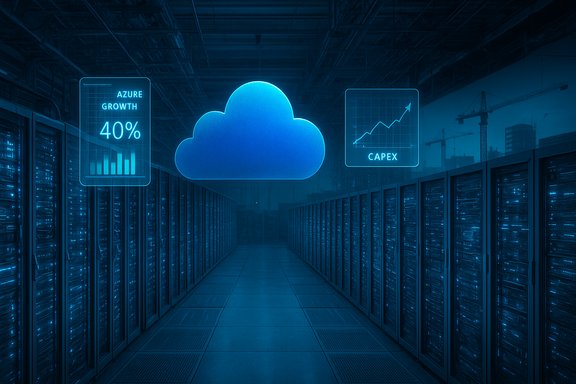
- Azure growth accelerated into the 40% range, a sign that enterprise AI demand is real and substantial.
- Capital expenditures (CapEx) jumped to roughly $34.9–$35.0 billion in the quarter, a record level that outstripped street expectations and made headlines by itself.
- Management warned that capacity constraints remain, limiting how much faster Azure could have grown absent supply-side bottlenecks.
The numbers: growth versus spend
Revenue and Azure: the bright side
Microsoft reported quarterly revenue that exceeded consensus and posted earnings that topped expectations. The standout metric was Azure, which grew roughly 40% year-over-year in the period, substantially ahead of many forecasts and demonstrating how AI workloads are changing consumption patterns in cloud. Azure’s growth is now a principal engine of Microsoft’s corporate growth thesis, reinforcing cross-selling opportunities into Microsoft 365, GitHub, Dynamics and first‑party SaaS.CapEx: record buildout for AI infrastructure
The other headline was the scale of Microsoft’s capital investment. CapEx for the quarter came in at approximately $34.9 billion, driven largely by data center land, buildouts and AI compute kit (GPUs, networking, racks and related systems). Management described a split where roughly half of recent CapEx is tied to long‑lived assets — land, construction and leases — that “will be monetized over 15 years and beyond,” with the remainder focused on servers and accelerators deployed in response to demand. That phrasing underscores a long payback horizon for a meaningful share of the spending.Market reaction
Investors reacted quickly: despite the beat on revenue and EPS, the stock moved lower in after‑hours trading. The sell‑off was not a direct rebuke of Azure growth — rather, it reflected concern over capital intensity, near‑term free cash flow implications, and the question of utilization: what fraction of this newly built capacity will be actively used by paying customers in the next 12–24 months?Why CapEx spooked the market
1) Payback horizon and return-on-capital
Investors price hyperscalers not just on growth but on expected long-term returns. When a company spends tens of billions in a single quarter, it raises the bar for future revenue and margin improvement: those assets must be well utilized for years to justify the outlay. Microsoft’s public comment that a significant portion of CapEx will be monetized over 15 years reframes some of the investment as long‑duration infrastructure — correct strategically, but naturally uncomfortable for investors focused on shorter‑term return timelines.2) Utilization risk and demand normalization
There are three possibilities when supply ramps fast: utilization quickly catches up, utilization lags but eventually recovers, or demand normalizes and leaves idle capacity. The market’s worry is the second and third scenarios. Enterprise AI adoption is real but uneven: some verticals and use cases have moved quickly, while many customers remain in POC or limited pilot stages. Analysts and industry observers note that average enterprise AI spend today is lower than some forecasts assumed, because production‑ready use cases are still being engineered and validated. That gap between installed infrastructure and monetized usage creates short‑term earnings risk.3) Competitive pricing pressure and commoditization
As cloud providers scale AI inference, pricing dynamics could shift. If lower‑cost models or on‑prem solutions emerge, revenue per GPU-hour can fall while the hyperscalers still carry fixed costs for those GPUs and data centers. Competitors and new entrants aiming for cost efficiency — and even open‑source model forks — can push margins down on pure compute, forcing hyperscalers to monetize higher layers (platform features, value‑added services) to sustain margins. This structural risk compounds the investor sensitivity to CapEx.4) Supply chain and vendor concentration
AI infrastructure is tied to a small set of suppliers, most notably GPU vendors. Shortages, pricing power for chip vendors, or geopolitical constraints can cause unit cost volatility and extend lead times, amplifying the risk of over‑ or under‑building capacity. Microsoft’s scale reduces some supplier risk through bargaining power, but it does not eliminate it.The strategic case for heavy investment
Scale is defensible — for now
There is a coherent strategic logic behind Microsoft’s spending:- Platform symbiosis: owning the cloud layer while productizing AI across Microsoft 365, GitHub, and Dynamics creates multiple monetization levers that make large infrastructure investments more defensible.
- Commercial bookings and backlog: management disclosed materially higher commercial bookings and a growing remaining performance obligation (RPO) backlog, which offers future revenue visibility and helps justify long‑lead investments.
- Control and optimization: owning capacity reduces dependency on third parties, allowing Microsoft to tune latency, security and cost per inference — critical competitive differentiators for enterprise customers.
The time‑shift argument
Microsoft and many peers stress that today’s spending is analogous to the cloud‑buildout era: big initial bills that enabled recurring, high‑margin revenue later. CFO commentary that data center and land investments are long‑lived assets supports a time‑shift argument: returns materialize over a decade-plus, and the company is buying optionality at scale. This is defensible strategy, but it requires investor patience and disciplined capital allocation over many reporting cycles.What management said — and what it means
Capacity constraints and moderating growth
Management acknowledged capacity constraints during the earnings call and said Azure growth would have been higher without them. That admission does two things: it explains why demand is not the limiting factor today, and it signals continued near‑term CapEx to relieve those constraints. In short, Microsoft is responding to demand — not inventing it — but the financial optics are currently painful.Long-lived assets and the 15‑year horizon
The CFO’s remark that many of the new assets “will be monetized over 15 years and beyond” reframes much of the spend as durable infrastructure, akin to utility-like assets. Strategically this is sound: land and builds are assets that can support many product cycles. The investor take: durable, but heavy and slow to pay back. Expect scrutiny of utilization metrics and attach rates for platform services in subsequent quarters.Analysts, industry voices and the broader hyperscaler trend
Analyst concerns: AI hype vs enterprise readiness
Some analysts and industry practitioners warn that enterprise AI budgets and production deployments are not yet broad enough to match the scale of hyperscaler investments. That view is reflected in comments captured in the reporting around the quarter: while AI hype keeps attention high, average enterprise spend per customer is still maturing and production‑grade use cases remain limited across many industries. That hesitancy rationalizes measured adoption and slows monetization relative to infrastructure deployment timelines.Forrester and other advisory voices
Independent industry analysts echoed the theme: Forrester observers highlighted investor unease about whether enterprise adoption will scale quickly enough to match the hyperscalers’ capital intensity. The cautionary voice is far from an argument against investment; it simply reframes the timing and risk around adoption curves and use‑case readiness.Hyperscaler capex is an industry story
Microsoft’s spike in CapEx is not unique. Competing hyperscalers have also been bumping up budgets:- Alphabet/Google raised projected capital spending into a range north of $90 billion for the year, reflecting its own AI and cloud infrastructure buildout.
- Meta likewise moved its annual CapEx outlook into the tens of billions — figures in the $70B range were discussed as the company underlined continuing investment in AI‑centric systems.
Strengths, risks and how to judge progress
Notable strengths
- Revenue engine: Azure’s accelerated growth shows Microsoft is capturing meaningful enterprise demand for AI compute and platform services.
- Ecosystem leverage: Microsoft can monetize AI via many channels — per‑seat Copilot, platform meters, Azure OpenAI services and embedded enterprise features — giving it diversified monetization paths.
- Balance sheet and scale: Microsoft’s financial position allows it to sustain a multi‑quarter, even multi‑year buildout without immediate solvency concerns.
Principal risks
- Underutilized capacity: If enterprise AI adoption stalls or evolves more slowly than expected, Microsoft could carry underutilized, expensive assets for quarters or years.
- Margin compression: Aggressive pricing competition or a shift of compute to lower‑cost vendors could reduce revenue-per-unit compute, pressuring margins.
- Timing mismatch: Management’s 15‑year monetization framing is strategically honest but compresses near‑term investor patience, making quarterly metrics susceptible to outsized reactions.
- Execution complexity: Building, provisioning and managing global GPU‑dense infrastructure at scale is operationally difficult; execution missteps can compound financial impacts.
How to judge future progress (metrics to watch)
- Azure growth rate and its contribution from AI workloads (separate AI contribution signal).
- Utilization metrics or efficiency — e.g., revenue per GPU‑hour, RPO versus capacity added.
- Commercial bookings and multi‑year commitments that convert backlog into realized revenue.
- CapEx trajectory and the split between long‑lived land/build spend and short‑lived kit (servers/GPUs).
- Gross margin and free cash flow trends as inference and platform monetization scale.
Practical takeaways for investors and enterprise customers
- Investors should normalize for longer payback periods in hyperscaler AI investments and focus on leading indicators (bookings, RPO duration, attach rates for Copilot/AI features) rather than raw CapEx alone.
- Enterprise IT buyers can use Microsoft’s capacity constraints as both a signal of demand and a negotiation lever: high demand suggests robustness of services, but capacity pressure can be an opportunity to lock in longer‑term terms or hybrid deployment strategies.
- Watch GPU vendor dynamics closely: the hyperscaler arms race benefits a handful of chipmakers; component pricing and availability materially affect hyperscaler margins and build timing.
Final assessment: bold, necessary — but timing remains everything
Microsoft’s quarter tells a coherent strategic story: the company is doubling down on an AI‑first future by expanding Azure and building the underlying infrastructure required to host and monetize large models and enterprise Copilots. The revenue signals are strong — Azure’s 40% growth is real, and commercial traction exists — yet the headline CapEx number forces a sober re‑calculation of time horizons and risk tolerance. That reassessment does not mean Microsoft is wrong to invest. It means investors and observers must calibrate expectations: this is now a multi‑decade infrastructure play with multi‑quarter volatility. The core judgment will be whether Microsoft can convert installed capacity into durable, sticky revenue streams at attractive margins before short‑term investor patience runs thin. For now, the company’s scale, ecosystem advantages and healthy bookings back the strategy — but the market will demand clearer evidence of efficient monetization, improved utilization and margin recovery in the quarters ahead.Conclusion
Microsoft’s earnings showcased both the prize and the price of the AI era: rapid, high‑value cloud growth powered by Azure, and unprecedented capital investment to secure leadership in AI infrastructure. The strategic logic for the spend is defensible — platform leverage, long‑lived assets and strong booking momentum — but the timetable for returns is lengthy and the margin for error is small. Investors’ nervousness reflects a rational focus on near‑term returns and utilization risk; Microsoft’s challenge will be to demonstrate over the next several quarters that its vast CapEx commitment is translating into predictable, high‑margin revenue growth rather than long‑term capacity the market won’t fully use. The winners in this decade will be those hyperscalers that marry scale with efficient monetization — and the coming quarters will reveal whether Microsoft can deliver that balance.
Source: IT Pro Microsoft’s huge AI spending still has investors sweating despite solid cloud growth
