

Microsoft and AMD’s co‑designed EPYC 9V64H — the custom CPU at the heart of Azure’s HBv5 virtual machines — rewrites the rules for memory‑bound HPC in the cloud by pairing Zen 4 compute chiplets with hundreds of gigabytes of on‑package HBM3 and delivering nearly an order‑of‑magnitude uplift in sustained streaming memory bandwidth for real‑world workloads.
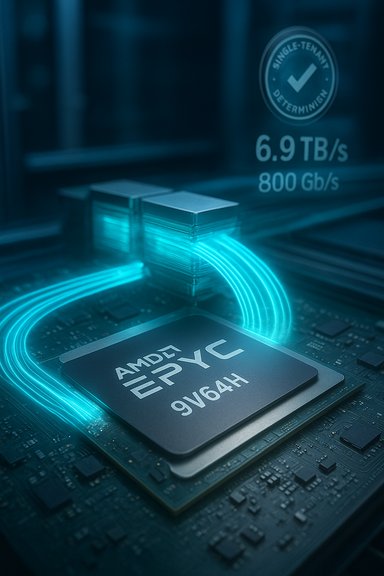
Azure HBv5 is a purpose‑built cloud node family aimed squarely at memory‑bound high‑performance computing (HPC) problems: computational fluid dynamics (CFD), weather and climate modeling, molecular dynamics, finite element analysis, and other simulation workloads where memory streaming throughput, not raw FLOPS, is the limiting factor. Microsoft’s HBv5 specification centers on a custom AMD EPYC part, the EPYC 9V64H, that integrates HBM3 on‑package, aggregates multiple dies to form large memory pools, and ships as single‑tenant, SMT‑disabled nodes to maximize determinism for HPC runs. Key vendor headline numbers are clear and consistent across the documentation and early independent testing: approximately 6.7–6.9 TB/s of sustained memory bandwidth across ~400–450 GB of HBM3 per node, and up to 352–368 Zen 4 cores per node with SMT disabled by default. The platform bundles high‑speed networking (800 Gb/s InfiniBand) and large local NVMe for balanced I/O and scaling.
Source: Phoronix Linux Performance, Benchmarks & Open-Source News - Phoronix
 Background / Overview
Azure HBv5 is a purpose‑built cloud node family aimed squarely at memory‑bound high‑performance computing (HPC) problems: computational fluid dynamics (CFD), weather and climate modeling, molecular dynamics, finite element analysis, and other simulation workloads where memory streaming throughput, not raw FLOPS, is the limiting factor. Microsoft’s HBv5 specification centers on a custom AMD EPYC part, the EPYC 9V64H, that integrates HBM3 on‑package, aggregates multiple dies to form large memory pools, and ships as single‑tenant, SMT‑disabled nodes to maximize determinism for HPC runs. Key vendor headline numbers are clear and consistent across the documentation and early independent testing: approximately 6.7–6.9 TB/s of sustained memory bandwidth across ~400–450 GB of HBM3 per node, and up to 352–368 Zen 4 cores per node with SMT disabled by default. The platform bundles high‑speed networking (800 Gb/s InfiniBand) and large local NVMe for balanced I/O and scaling. What’s new in the EPYC 9V64H + HBM3 design
On‑package HBM3: closing the memory gap
The defining hardware shift is placing HBM3 adjacent to CPU chiplets on the same package instead of relying on DIMM channels and DDR5. That physical proximity (interposer/chiplet stacking and package routing) turns memory from a bottleneck into a throughput resource, measured in terabytes per second rather than gigabytes per second in typical DDR5 servers. The result: workloads that previously stalled waiting for memory can now keep Zen 4 cores fed and deliver far lower time‑to‑solution.- Benefit: Sustained streaming bandwidth climbs into the multiple‑TB/s range.
- Trade‑off: HBM costs more per GB and is constrained in absolute capacity compared with large DRAM banks.
Multi‑die stitching and node construction
Azure’s HBv5 nodes are implemented as multi‑chip configurations — several EPYC 9V64H dies combined to reach the per‑node HBM capacity and bandwidth Microsoft advertises. That chiplet approach is how the platform delivers the headline TB/s figures and the large aggregated core counts per VM. It’s a pragmatic route: modular dies reduce manufacturing risk while enabling a bespoke package tailored for large streaming datasets.Zen 4 compute, SMT disabled, deterministic HPC
Despite Zen 5 being on the market, HBv5 uses Zen 4 cores for this custom part. Microsoft opted for a proven core microarchitecture where achievable high all‑core clocks and existing tooling reduce deployment risk. Crucially, HBv5 disables SMT by default to prioritize deterministic, single‑thread behavior — a familiar configuration for production HPC where jitter and reproducibility matter more than aggregate thread counts.What the independent benchmarks show (Phoronix and early tests)
Phoronix was given early access to HBv5 nodes and ran side‑by‑side comparisons against Azure’s prior HBv4 (Genoa‑X with 3D V‑Cache), using representative HPC kernels and streaming tests (Ubuntu 24.04 LTS, Linux 6.14, GCC 13.3). The headline empirical takeaways are straightforward and practically important:- Massive wins on streaming and memory‑bound kernels: STREAM‑like tests, CFD kernels, molecular dynamics loops and other memory‑limited workloads often saw multiple‑times faster performance on HBv5 versus HBv4. The elimination of DDR5 channel limits and placing HBM3 on package is the proximate cause of these gains.
- Mixed or modest gains on compute‑bound tasks: workloads dominated by compute, large aggregated cache needs, or those that benefit from Zen 5’s full 512‑bit AVX path show smaller or mixed advantages. In some vector‑heavy cases, a Zen 5 + DDR5 design may be competitive or superior depending on instruction throughput and code vectorization.
- Deterministic behavior matters: by defaulting to single‑tenant nodes and disabling SMT, HBv5 removes noisy neighbor effects and thread jitter that can otherwise obscure performance comparisons. That design yields more predictable scaling for MPI jobs and production HPC pipelines.
Strengths: where HBv5 redefines cloud HPC
- Sustained memory bandwidth at scale. The primary technical win is the shift from DDR‑centric designs to HBM3 on‑package, delivering vendor‑published ~6.9 TB/s STREAM‑class bandwidth across the node and practical sustained numbers in tuned runs. This can shorten run times for streaming HPC workloads dramatically.
- Single‑tenant, deterministic nodes. HBv5’s default single‑tenant model with SMT disabled is aligned to production HPC needs: reproducibility, minimal jitter, and predictable per‑job performance. That reduces the engineering burden of repeated numerical verification.
- System co‑design for scaling. Microsoft pairs HBM‑rich CPUs with high‑speed NVMe, 800 Gb/s InfiniBand, and DPU/accelerated networking features in the stack — ensuring that node‑level bandwidth wins can be matched by fabric and storage when scaling MPI jobs across many nodes.
- No wholesale software rewrite required. Many HPC teams have validated CPU codebases. HBv5 lets those teams reap bandwidth‑driven gains without large‑scale porting to accelerators, reducing time‑to‑benefit and verification risk.
Risks, trade‑offs, and practical caveats
1) Capacity vs bandwidth
HBM3 delivers extraordinary bandwidth per byte, but it remains expensive and limited in per‑package capacity compared with DIMM banks. HBv5’s ~400–450 GB HBM3 per node is optimized for working sets and streaming kernels — but not for enormous, capacity‑dominated in‑memory datasets measured in terabytes. Teams with capacity‑heavy workloads will need hybrid architectures or consider different VM families.2) Vendor exclusivity and lock‑in
The EPYC 9V64H is a custom, Azure‑exclusive part engineered through Microsoft and AMD collaboration. That exclusivity is a strategic advantage for Azure but an operational and procurement consideration for customers: identical hardware won’t be available on other clouds or off‑the‑shelf bare‑metal boxes, complicating portability, reproducibility, and procurement tactics. Budget and long‑term vendor negotiation strategies should reflect this bespoke nature.3) Thermals, repairability, and lifecycle
HBM stacks and dense chiplet packages alter thermal envelopes and failure modes compared to standard DDR servers. On‑package memory complicates field repair and incremental upgrades; hyperscalers design for module‑level replacement, but on‑prem teams should expect different maintenance and replacement models. Power and cooling must be added to TCO calculations.4) Software mismatch and tuning work
Not every application will automatically benefit. Compiler flags, memory allocators, MPI tuning, and NUMA placement matter more when HBM replaces DDR channels. Engineers must validate and retune — streaming kernel performance depends on how code reads/writes memory and whether it exploits the high bandwidth working set. Phoronix’s tests used stock compilers and kernels as a conservative baseline; production deployments should include tuned builds and STREAM‑style tests for realistic expectations.5) Price and availability
Early coverage and Phoronix’s price‑performance notes emphasize that headline speedups must be considered against hour‑rates, availability (preview till GA), and how often the workload will truly extract the HBM advantage. For many organizations, cost‑per‑job is the decisive metric; raw throughput is only one side of the equation.Claims that need caution: what is still speculative
- MI300C lineage: multiple industry writeups have speculated the EPYC 9V64H repurposes or derives from AMD’s cancelled or repurposed MI300C APU packaging, but that lineage is not officially confirmed by AMD or Microsoft in public die maps. Treat the MI300C reuse narrative as plausible industry rumour until vendors release explicit design documentation.
- Exact STREAM numbers: different outlets quote 6.7 TB/s vs 6.9 TB/s. That variance is explainable by measurement methodology (vendor STREAM estimates vs tuned independent runs) and unit conversion (TB vs TiB). When planning procurement or SLAs, rely on Microsoft published Learn/docs numbers for contractual figures and run your own STREAM tests to understand real workload behavior.
Practical guidance: how to evaluate HBv5 for your workloads
The following checklist will help teams determine whether HBv5 is a fit and how to validate it empirically:- Identify whether your workload is bandwidth‑bound or capacity‑bound. Run microbenchmarks (STREAM triad, memory bandwidth tests) on a representative input set.
- Run a cost‑per‑job analysis. Measure time‑to‑solution on HBv5 preview/GA instances and estimate total cost (including compute hours and storage/networking). Compare against HBv4, Turin EPYC, or GPU‑accelerated alternatives.
- Reproduce Phoronix‑style streaming tests with your code. Use tuned compiler flags, OMP/MPI settings, and memory allocators that reflect production builds.
- Validate multi‑node scaling. Use MPI scaling runs to ensure that node‑level bandwidth gains are not bottlenecked by fabric or I/O in your end‑to‑end workflow.
- Plan for operational differences. Update runbooks for different thermal, repair, and lifecycle expectations of HBM‑packed nodes.
A deeper look at tuning and benchmarking tips
Use STREAM and application‑level profiling first
STREAM Triad is the canonical microbenchmark for sustained memory bandwidth. It’s useful to:- Establish a baseline of what the hardware can deliver on a per‑node basis.
- Measure the impact of compiler optimizations (vectorization, alignment).
- Validate that your code’s working set maps to HBM rather than to cache.
Compiler flags and vectorization
On Zen 4 microarchitecture, proper vectorization and alignment pay off. For real applications:- Enable auto‑vectorization and inspect generated assembly for hot loops.
- Use architecture‑tuned flags (for GCC or Intel compilers) but validate results numerically.
- For mixed FLOAT/DOUBLE workloads, verify whether your code is bandwidth‑bound (memory ops) or compute‑bound (FLOPS). Bandwidth‑bound kernels gain much more from HBv5 than compute‑bound kernels.
Memory allocation and NUMA awareness
Although HBM is on‑package, the multi‑die layout and chiplet stitching mean that locality matters. Use NUMA‑aware allocators (numactl, jemalloc tuned for locality) and pin threads to cores in NUMA‑friendly topologies to ensure the working set resides where the core expects. Incorrect placement can negate HBM advantages.Strategic and market implications
For cloud providers and hyperscalers
Azure’s co‑design with AMD signals a trend: hyperscalers will increasingly commission bespoke silicon when the performance delta for targeted workloads justifies the engineering and procurement cost. This is about competitive differentiation: offering VM classes that effectively close the memory gap without forcing customers into hardware ports to accelerators. Expect other hyperscalers to respond with specialized packages or different approaches to memory‑rich nodes.For HPC customers and research labs
HBv5 offers a pragmatic path to near‑accelerator memory performance while retaining CPU execution models and legacy codebases. For organizations with validated CPU codes and limited appetite for porting to GPUs, HBv5 reduces the software migration burden while delivering significant runtime improvements for the right workloads. However, long‑term procurement strategies must weigh vendor exclusivity and potential lock‑in.For CPU and memory technology roadmaps
HBv5 confirms that HBM integration into CPU‑class packages is commercially viable for niche, high‑value HPC segments. The move raises downstream questions about DRAM usage models — hybrid designs (HBM for hot working set + DDR for colder capacity) may become a mainstream architecture style for balanced workloads. This also accelerates conversations around packaging, interposer economics, and thermal engineering.Conclusion: who should care, and what to do next
Azure HBv5 and the EPYC 9V64H represent a targeted engineering choice: if your workloads are memory‑bandwidth‑limited and you are constrained from porting code to accelerators, HBv5 delivers a substantial and measurable advantage. For many CFD, molecular dynamics, and weather/climate models, the time‑to‑solution improvements are large enough to justify evaluation. That said, HBv5 is not a universal upgrade. Teams with TB‑scale in‑memory datasets, workloads tuned to Zen 5 microarchitectural advantages, or those seeking vendor‑agnostic hardware should benchmark carefully and consider hybrid strategies. Validate using STREAM and application‑level tests, quantify cost‑per‑job, and plan for the operational differences that HBM‑packed nodes introduce. Taken together, HBv5 is an important inflection point: it shifts the cloud HPC design conversation from pure core counts and cache hierarchies to memory bandwidth as a first‑class design axis. For practitioners who understand their workload’s memory profile, HBv5 is a tool worth adding to the performance toolbox — but one to use only after careful validation and cost analysis.Source: Phoronix Linux Performance, Benchmarks & Open-Source News - Phoronix
