

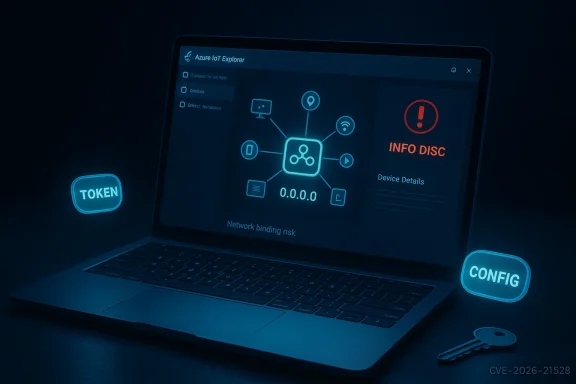
Microsoft’s public tracking and independent feeds point to an Azure IoT Explorer information‑disclosure advisory in February 2026 — but the identifier you supplied (CVE‑2026‑23664) does not appear in vendor or major aggregator records for Azure IoT Explorer; instead the event universally surfaces as an information‑disclosure issue tracked under CVE‑2026‑21528. (app.opencve.io)
Azure IoT Explorer is a Microsoft‑distributed client utility that helps developers and operators inspect, provision, and interact with devices connected to Azure IoT Hub. It is widely used for debugging device telemetry, exploring direct methods and device twins, and exercising device‑to‑cloud messaging during development and small‑scale operations. Because it frequently runs on development and operations hosts that have credentials, tokens, or network access to production IoT resources, any vulnerability in the client can create outsized operational risk.
In February 2026 Microsoft and multiple vulnerability aggregators recorded an information‑disclosure vulnerability affecting Azure IoT Explorer. The public advisories classify the issue as information disclosure — an exposure of data that could include sensitive configuration, tokens, telemetry, or other secrets — and assign a medium severity level in the published CVSS summary. The most consistent record for the advisory appears under CVE‑2026‑21528, which lists affected Azure IoT Explorer versions prior to the vendor‑fixed release.
These are not theoretical: multiple incident‑response playbooks prioritize secrets harvesting as the first stage of cloud compromise, and Microsoft’s own Patch Tuesday ecosystem calls out information‑disclosure classes as high‑priority for defenders to harden until a patch is applied.
Because the initial advisories are deliberately concise, operators should follow a conservative, layered response: patch affected clients now, restrict network exposure, rotate secrets where they may have been exposed, and enrich detection. Use Microsoft’s published confidence metadata and independent aggregator records to guide the pace of response: act decisively to reduce exposure, but avoid disruptive mass changes until exploitation mechanics are confirmed. Finally, confirm the CVE mapping in your vulnerability inventory — if you were given CVE‑2026‑23664, verify whether that identifier is a transcription error or a separate advisory; in the absence of vendor confirmation, treat CVE‑2026‑21528 as the actionable identifier.
Source: MSRC Security Update Guide - Microsoft Security Response Center
 Background / Overview
Azure IoT Explorer is a Microsoft‑distributed client utility that helps developers and operators inspect, provision, and interact with devices connected to Azure IoT Hub. It is widely used for debugging device telemetry, exploring direct methods and device twins, and exercising device‑to‑cloud messaging during development and small‑scale operations. Because it frequently runs on development and operations hosts that have credentials, tokens, or network access to production IoT resources, any vulnerability in the client can create outsized operational risk.In February 2026 Microsoft and multiple vulnerability aggregators recorded an information‑disclosure vulnerability affecting Azure IoT Explorer. The public advisories classify the issue as information disclosure — an exposure of data that could include sensitive configuration, tokens, telemetry, or other secrets — and assign a medium severity level in the published CVSS summary. The most consistent record for the advisory appears under CVE‑2026‑21528, which lists affected Azure IoT Explorer versions prior to the vendor‑fixed release.
What the public advisory actually says
- The canonical advisory entries assembled by independent trackers show the problem described as “binding to an unrestricted IP address in Azure IoT SDK allows an unauthorized attacker to disclose information over a network.” That phrasing captures a classic design weakness: an application listening on an unrestricted interface or IP address can unintentionally make admin APIs or local resources reachable to remote actors.
- OpenCVE and similar aggregators list a CVSS v3.1 base score of 6.5 (Medium) for the entry as published, with the attack vector labeled as network‑accessible and confidentiality impact limited. The published affected‑versions field indicates Azure IoT Explorer versions before the fixed release (the vendor metadata lists versions prior to 0.15.13 as affected). These are the load‑bearing technical facts defenders should act on first.
- Multiple community and security‑news feeds that track Patch Tuesday and Microsoft advisories also include Azure IoT Explorer in their February 2026 rollups, citing the same information‑disclosure classification and stressing patching as the recommended remediation.
Why this matters: threat model and real‑world impact
An information‑disclosure vulnerability in a developer/ops tool like Azure IoT Explorer matters for three reasons:- Tool placement: Azure IoT Explorer often runs on workstations and jump hosts that are richly credentialed — they hold Azure CLI contexts, device connection strings, or cached tokens that can be repurposed if exposed.
- Attack surface: The root cause described (binding to an unrestricted IP) typically turns a local debugging or admin endpoint into one reachable from other machines — including container hosts, developer laptops on the corporate network, or, in misconfigured environments, the public internet.
- Amplification: Even limited confidentiality leakage (for example, a token or telemetry payload) can be chained into broader access: stolen tokens can be used to impersonate devices or escalate to cloud resource access, and telemetry or config files can reveal secrets or network topology that make follow‑on intrusion easier.
These are not theoretical: multiple incident‑response playbooks prioritize secrets harvesting as the first stage of cloud compromise, and Microsoft’s own Patch Tuesday ecosystem calls out information‑disclosure classes as high‑priority for defenders to harden until a patch is applied.
Technical analysis — what the public record does and does not disclose
What is clearly published
- The vulnerability is categorized as information disclosure and is associated with a network‑accessible binding problem in the Azure IoT SDK used by Azure IoT Explorer. The public description indicates that the application can bind to an unrestricted IP address, which permits an attacker to connect over the network and retrieve information that should have been kept local.
- Affected versions are reported in vendor metadata (as published through CVE aggregators) as versions of Azure IoT Explorer released prior to the fixed build. The practical remediation is to update to the vendor‑released fixed version.
- The published CVSS v3.1 vector and base score (6.5) reflect a network vector with limited integrity/availability impact and primarily a confidentiality impact. That aligns with an attacker‑accessible but not remotely‑executable class of flaw.
What the public record does not (yet) disclose
- Low‑level exploit primitives: the advisory does not include sample exploit code, packet captures, or step‑by‑step leverage details. This means defenders must treat exploitation mechanics as potentially straightforward but not yet documented to the point of immediate mass weaponization.
- Specific payloads and exact data elements at risk: the vendor text stops short of listing which files, tokens, or telemetry fields are directly exposed — which is why detection and containment guidance must be broad and assume the worst.
- Proof‑of‑concept (PoC) availability: at the time of publication there was no public, authoritative PoC widely mirrored in third‑party repositories, reducing the immediate risk of automated exploitation but not eliminating it.
The CVE‑number mismatch: CVE‑2026‑23664 vs CVE‑2026‑21528
You mentioned CVE‑2026‑23664. Our checks across Microsoft tracking feeds and independent aggregators did not surface CVE‑2026‑23664 as the Azure IoT Explorer advisory; every corroborating aggregator (OpenCVE, CVEFeed, CVE Details and several Patch Tuesday trackers) references the Azure IoT Explorer issue under CVE‑2026‑21528. This strongly suggests one of three possibilities:- There is a simple transcription error in the CVE you were given.
- CVE‑2026‑23664 is a different advisory not publicly indexed yet (rare), or
- CVE‑2026‑23664 was reserved/redirected or otherwise not propagated to the public aggregators at time of checking.
Practical steps for defenders (prioritized)
Below is an actionable playbook designed for immediate operational use. Apply items in the listed order; the first three items materially reduce risk quickly.- Patch now (or validate patch status).
- Update Azure IoT Explorer installations to the vendor fixed version. Aggregated advisories list the fixed build and mark versions prior to the fix as affected; updating is the primary mitigation. If you manage images or golden developer VMs, rebuild with the fixed client baked in.
- Limit network reachability to management clients.
- Restrict network access to hosts running Azure IoT Explorer using host‑based firewalls and network segmentation. Only allow trusted workstation subnets to reach management hosts; block inbound access from untrusted networks.
- Rotate secrets and ephemeral tokens where feasible.
- If IoT Hub device connection strings, SAS tokens, or management credentials were present on hosts running affected client versions, rotate those secrets after patching. Assume tokens may be compromised if exposed. This is particularly important for keys used by automation or CI/CD pipelines.
- Hunt for indicators.
- Look for unusual local HTTP/listener endpoints on developer hosts, unexpected processes binding to ephemeral ports, and network connections from non‑standard sources to developer/jump hosts. Enrich telemetry with process‑to‑network correlation and search endpoint logs for unexpected inbound connections during the window when the vulnerable client was installed.
- Apply principle of least privilege to tooling.
- Ensure developer tools and CLI contexts do not run with elevated persistent credentials. Use ephemeral, short‑lived tokens and device‑scoped credentials where possible.
- Document and communicate.
- Add the CVE (use CVE‑2026‑21528 unless and until your vendor confirmation says otherwise) to your incident register, and notify developer teams to update local machines and images. Provide clear, stepwise instructions for update and rotation of credentials.
- Prepare detection signatures but avoid overly specific blocking.
- Create temporary detection rules that flag unusual listeners or remote retrieval of configuration files, but avoid broad automated blocks that risk breaking essential developer workflows. Tune thresholds and roll out detection in monitoring tiers first.
Detection recipes and practical KQL / hunting ideas
The public information does not publish a PoC, so detection must be behavior‑driven and host‑centric.- Host process to network mapping:
- Flag instances where the Azure IoT Explorer process or its parent is listening on non‑loopback addresses (0.0.0.0 or 0.0.0.0
 ort). On Windows, search for netstat/PowerShell output where LocalAddress is 0.0.0.0 and the owning executable matches the IoT Explorer binary.
 - Endpoint log searches:
- Hunt for unexpected file reads of credential files, keys, or cached tokens by processes that are not typically privileged.
- Monitor for outbound connections from developer workstations to unexpected endpoints shortly after developer tools start.
- Cloud telemetry:
- Use Azure Monitor / Sentinel to search for device tokens used from unusual IP addresses, or for unusual device identity actions following developer workstation access.
- Timeline correlation:
- If a vulnerable host is identified, correlate timeline with other suspicious activity — e.g., token misuse, new device registrations, or unusual direct method calls to IoT Hub.
The role of Microsoft’s “confidence” metadata and how to interpret it
Microsoft’s Security Update Guide and other vendor pages increasingly include a short confidence/exploitability signal to tell operators how certain the vendor is about the reported flaw and the credibility/completeness of public technical details. This is a practical, tactical control — not a replacement for full technical disclosure.- High confidence / Corroborated: Vendor has strong evidence or has reproduced the issue; third‑party researchers corroborate technical specifics. Act quickly with remediation and detection because exploitability is better understood.
- Medium / Reasonable: The vendor believes the issue exists and may provide limited details. Prioritize patching and telemetry, and plan for follow‑up actions as new information emerges.
- Low / Uncorroborated: The vendor has limited evidence or the report is preliminary. Use conservative hardening and monitoring rather than immediate disruptive measures.
Risk assessment: likelihood and impact
- Likelihood: Medium in short term. Without widespread PoC code or mass exploitation reports, the immediate likelihood of opportunistic mass exploitation is lower than for fully disclosed remote code exploits. However, because the flaw relates to network binding — a simple misconfiguration class — the ease of discovery for attackers with internal access is relatively high.
- Impact: Medium to High depending on what data is present on the host. If a compromised host stores persistent IoT Hub primary keys, service principals, or long‑lived tokens, the impact can escalate to cross‑tenant device impersonation and lateral cloud compromise. For simple telemetry exposure, the impact is lower, but organizations must assume secrets may be exposed until proven otherwise.
- Strategic risk: Tools with a developer or ops footprint often blur the boundary between test and production. The strategic risk arises when such a tool introduces a vector that bypasses established perimeter and identity controls.
What defenders should not do
- Don’t ignore: Treat any vendor advisory about information disclosure seriously, especially for tools that handle secrets.
- Don’t overreact by removing all developer tools from the environment overnight; instead, apply updates and isolate hosts while you validate telemetry and rotate credentials as needed.
- Don’t assume the CVE identifier in informal communications is correct. As we’ve shown above, mismatched CVE IDs (e.g., the CVE you quoted vs. the published CVE) happen, and automated patch systems can be misdriven by incorrect identifiers. Confirm the CVE mapping against vendor KBs and trusted aggregators before running bulk actions.
Long‑term recommendations (beyond immediate patching)
- Adopt ephemeral authentication patterns for developer and CI tooling so a single exposed token has limited value. Short‑lived tokens and managed identities significantly reduce blast radius.
- Harden developer images and golden builds: ensure developer machines do not persist long‑lived production credentials by default.
- Inventory and policy: maintain a canonical inventory of developer and tooling CVEs mapped to deployed versions. Cross‑reference vendor advisories and aggregator feeds to catch CVE mismatches early.
- Detection engineering: bake behavioral detections for local listeners that bind to global addresses into your XDR/EDR rules. This class of misconfiguration appears repeatedly across tooling and third‑party clients.
- Communication: keep developer and operations teams informed and practiced in emergency rotation and patch workflows. A rehearsed, low‑friction secret rotation capability is a force multiplier during post‑exposure remediation.
Conclusion
The Azure IoT Explorer issue announced in February 2026 is an information‑disclosure vulnerability that — according to the public advisory record aggregated by multiple trackers — is most reliably tracked as CVE‑2026‑21528 and carries a medium CVSS v3.1 score with a network attack vector. The practical risks come not from immediate remote code execution but from the exposure of credentials, tokens, or configuration data that can be chained into larger cloud compromises.Because the initial advisories are deliberately concise, operators should follow a conservative, layered response: patch affected clients now, restrict network exposure, rotate secrets where they may have been exposed, and enrich detection. Use Microsoft’s published confidence metadata and independent aggregator records to guide the pace of response: act decisively to reduce exposure, but avoid disruptive mass changes until exploitation mechanics are confirmed. Finally, confirm the CVE mapping in your vulnerability inventory — if you were given CVE‑2026‑23664, verify whether that identifier is a transcription error or a separate advisory; in the absence of vendor confirmation, treat CVE‑2026‑21528 as the actionable identifier.
Source: MSRC Security Update Guide - Microsoft Security Response Center
