

Overview
What makes this class of advisory important is that Microsoft is not only classifying impact, but also telegraphing the quality of the underlying evidence. A vulnerability can sit in a gray zone for weeks or months when a vendor has enough signal to believe it exists, but not enough public detail to fully explain the root cause, exploit path, or prerequisites. That is particularly relevant for cloud services like Azure IoT Central, where the service boundary, user roles, and device-management workflows can all interact in ways that are hard to summarize in a short advisory.
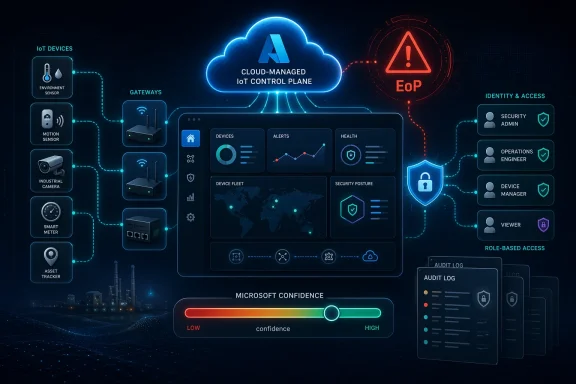
IoT Central sits at the intersection of cloud identity, device onboarding, telemetry, and operational control. That makes privilege boundaries especially sensitive, because a weakness in authorization or role handling can move an attacker from low-value access into administrative control over device fleets, dashboards, integrations, or data exports. In other words, an EoP flaw in this space is not merely a local bug; it can become a platform-level trust problem for an entire connected-environment estate.
Microsoft’s modern cloud-service disclosures are also part of a broader transparency effort. The company has spent the last few years publishing more structured vulnerability metadata, including tighter categorization and root-cause reporting where possible. That has improved the ability of defenders to triage risk quickly, but it has also created a habit of reading between the lines: when a service CVE is published with limited technical detail, the absence of specifics is itself a signal that Microsoft believes the issue is real enough to merit coordinated remediation.
The practical upshot is that CVE-2026-21515 should be treated as an operational event, not an academic one. Even when public exploit details are sparse, cloud-service privilege escalation can still matter immediately because access control flaws often require only legitimate tenant credentials, a misused role, or a workflow that crosses a trust boundary in an unintended way. That is why the confidence metric in the advisory matters just as much as the named impact.
Background
Microsoft has increasingly used CVEs to describe cloud-service flaws that previously might have been handled through quieter service-side fixes. That shift reflects how central Azure services have become to enterprise identity, device management, and security operations. A vulnerability in a cloud control plane or management service can affect not just one machine, but the orchestration layer that governs many machines at once.
Azure IoT Central is designed to simplify IoT application management by abstracting device connectivity, telemetry ingestion, rules, and dashboarding behind a managed SaaS interface. That convenience comes with a tradeoff: the platform becomes a high-value target because it aggregates operational data and authorization decisions that can reach far beyond a single device. An elevation-of-privilege issue in such a service can expose a fleet, not just an endpoint.
Microsoft’s own security response posture has also evolved toward more explicit cloud-service disclosure. The company has publicly described its commitment to trust, transparency, and better vulnerability classification in cloud and AI systems, including a move toward clearer vulnerability categorization and more consistent publication of root-cause data when possible. That trend makes a terse advisory more meaningful, not less, because it is being issued within a framework where Microsoft has decided a public CVE is warranted.
The confidence metric quoted in your prompt is therefore best understood as a maturity indicator. It helps distinguish among three scenarios: an issue that is merely suspected, one that has been corroborated by research but not fully confirmed, and one that has been acknowledged by the vendor with enough certainty to justify a formal CVE. For defenders, that is a critical distinction because the urgency of response rises sharply when certainty rises.
In cloud and IoT contexts, attack chains often depend on identity abuse rather than flashy memory corruption. A misapplied role, an authorization bypass, or a service-side assumption about tenant boundaries can all produce privilege escalation without the attacker needing code execution in the traditional sense. That is why service CVEs often arrive with fewer dramatic technical details but equally serious operational consequences.
Why cloud EoP is different
A local Windows privilege escalation usually threatens one host. A cloud-service EoP can threaten a control plane, a tenant boundary, or an entire workflow. That changes the remediation calculus because the blast radius may include data, automation, device fleet policy, and downstream integrations.
- Tenant-wide impact is more likely when authorization fails in a SaaS management plane.
- Operational trust can be undermined even if the bug does not expose raw secrets.
- Identity and role design become as important as the patch itself.
- Audit logs may be the only early evidence of abuse.
- Limited public detail does not mean limited risk.
What Microsoft’s confidence metric means
The description in your prompt is essentially Microsoft explaining that the advisory’s value is not just the CVE number, but the confidence level behind it. The vendor is saying how sure it is that the weakness exists and how credible the technical description is. That matters because defenders often face a choice between waiting for a public proof-of-concept and acting on first-party confirmation.
A high-confidence advisory generally means Microsoft has corroborating evidence from internal analysis, telemetry, or trusted reporting. It does not necessarily mean the exploit is widespread, but it does mean the issue is not speculative. In a cloud setting, that distinction is huge because privileged service abuse can be difficult to reverse once an attacker has altered roles, tokens, or application permissions.
The phrase “level of technical knowledge available to would-be attackers” is equally important. A vulnerability that is publicly understood in detail is easier to weaponize, automate, and scan for. A vulnerability acknowledged with sparse detail is still dangerous, but its exploitation curve may be steeper until researchers or attackers publish methods or observables.
Reading between the lines
Microsoft rarely publishes everything it knows immediately, especially for cloud services. That means the advisory page itself often functions as a risk indicator rather than a technical how-to guide. Security teams should treat that as a reason to prioritize verification and containment, not as a reason to wait.
- Confidence up means operational urgency rises.
- Detail down means the attack surface may still be poorly understood publicly.
- Vendor acknowledgment is stronger than rumor or third-party inference.
- Limited exploit detail often buys defenders time, but not much.
- The safe assumption is that the issue is real until proven otherwise.
Why Azure IoT Central matters
Azure IoT Central is not an isolated utility; it is a cloud-managed fabric for connected devices and telemetry-driven operations. That makes its privilege model more consequential than the label “management portal” might suggest. If an attacker can move from normal access to elevated access, they may be able to manipulate device templates, integration settings, alerts, or data visibility.
The service also tends to sit close to operational technology-adjacent environments, where people are using cloud dashboards to manage physical devices, sensors, and business processes. That raises the stakes because the consequences of unauthorized control can extend beyond data theft into physical operations, availability, or safety-adjacent workflows. Even when the vulnerability is “just” elevation of privilege, the impact can cascade.
There is also a broader ecosystem angle. Organizations often connect IoT Central to Azure identities, downstream analytics, automation runbooks, and third-party systems. A privilege boundary failure can therefore become a pivot point into other services, especially if roles or service principals are over-permissioned. The more integrated the environment, the more a single authorization flaw can matter.
Enterprise versus consumer implications
For enterprises, the concern is governance: who can administer devices, modify telemetry rules, export data, and alter integrations. For consumers or smaller teams using IoT platforms in a more lightweight way, the main issue is still trust, but the scale is smaller. In both cases, the same bug class can have very different blast radii.
- Enterprises may face fleet-wide exposure and audit obligations.
- Smaller deployments may still lose device trust or data integrity.
- Managed integrations can extend compromise outside the primary service.
- Identity misconfiguration can amplify the vulnerability’s effect.
- IoT convenience features often hide the hardest security boundaries.
Patch posture and defensive priorities
The first response to a cloud EoP advisory is often straightforward: apply the vendor fix or wait for the service-side remediation that Microsoft has already rolled out. But in practice, patching cloud services also requires checking for configuration drift, stale tokens, excessive permissions, and downstream access paths. The fix may close the hole, yet attackers may already have used it to alter settings or create persistence.
This is where defenders should think beyond “install update” and toward post-remediation validation. That means reviewing privileged roles, service principals, application registrations, recent administrative changes, and any anomalous access to IoT Central resources. If the vulnerability affected an access boundary rather than a code path on one machine, the most important question may be whether anything was already touched.
Because Microsoft’s public detail is likely intentionally sparse, defenders should also watch for follow-on intelligence from ecosystem partners. Independent vulnerability databases, threat intelligence vendors, and incident-response writeups often fill in the gaps after first disclosure. But those secondary sources should be used to enrich verification, not replace the vendor’s own advisory.
Immediate response checklist
- Confirm whether your tenant or subscription uses Azure IoT Central.
- Review admin and application-level role assignments.
- Check for unusual changes in device templates, integrations, or exports.
- Inspect sign-in and audit logs for suspicious privilege transitions.
- Validate whether Microsoft has already deployed a service-side fix.
- Rotate or reissue credentials if compromise is plausible.
- Document the exposure window for incident-response purposes.
Historical context: cloud CVEs are becoming the norm
A few years ago, many cloud-service issues were handled behind the scenes, with customers receiving quiet mitigations and little public naming. That has changed. Microsoft has published a growing number of cloud service CVEs, along with blog posts explaining how the company thinks about cloud vulnerability disclosure and why it now treats these issues as first-class security events. That is a good thing for transparency, but it also means defenders must keep up with a faster, broader advisory stream.
The important historical shift is that cloud services now behave more like software platforms with distinct attack surfaces, not just hosted products. When those services fail, the consequences can be broader than a traditional application bug because they are entangled with identity, multi-tenancy, and centralized administration. In an Azure context, that can turn a single CVE into a governance event.
Microsoft has also been more open about the fact that cloud-service vulnerabilities can exist even when the underlying platform is already being operated securely by the customer. That is a subtle but important point. Customers often assume a SaaS service inherits all security responsibility from the vendor, but privilege escalation in cloud management software can still be exploitable through tenant actions, legitimate credentials, or access misuse.
The security model has shifted
The old perimeter model assumed the app was inside the trust boundary. The modern model assumes the service itself is a dynamic trust boundary that can fail in subtle ways. That is why role integrity, token handling, and service authorization have become core security issues, not administrative details.
- Cloud CVEs can affect many tenants at once.
- Service-side fixes can be invisible to customers.
- Auditability is as important as patching.
- Authorization bugs are often harder to notice than code-execution bugs.
- The more managed the service, the more important the vendor’s disclosure quality becomes.
Likely attack paths and technical significance
Without full exploit details, the safest analysis is architectural rather than speculative. In a service like Azure IoT Central, elevation of privilege could emerge from broken authorization checks, role confusion, tenant-isolation mistakes, or logic errors in workflows that process device or user actions. Any of those would let an attacker do more than their current role should allow.
The attacker value is obvious. Elevated access could permit administrative changes, access to telemetry or configuration data, creation of persistence, or movement into connected services. In some environments, even limited privilege escalation can unlock cascading access if administrators have reused credentials or granted broad Azure permissions elsewhere.
It is also possible that the vulnerability’s real-world exploitation is constrained to specific workflows or user states. That is common with cloud bugs: the issue may be serious, but the entry conditions can be narrow. That is why the confidence metric and public severity classification matter so much; they help defenders prioritize even when the technical root cause remains opaque.
What defenders should assume
The right working assumption is not that attackers need a “movie-style exploit.” It is that they may only need an ordinary account, a malformed request, a misconfigured role, or a workflow edge case. That is why least privilege and continuous log review are not generic best practices here; they are the most practical mitigations.
- Privilege escalation may involve authorization logic, not memory corruption.
- Legitimate accounts can still be abused if roles are too broad.
- Connected Azure services may widen the impact.
- Abuse may show up first in logs, not alerts.
- Small changes in identity policy can have big consequences.
Enterprise response strategy
For enterprise teams, the key question is how to turn a CVE like this into an action plan. The answer is to treat it as both a patching task and an access-governance review. If IoT Central is in use, teams should confirm the service’s role assignments, linked identities, application integrations, and any unusual administrative activity from the relevant window.
This is also a good moment to test whether security ownership is clear. In many organizations, IoT services sit between OT, cloud, appdev, and security teams, which can create blind spots. If nobody owns the audit logs or role reviews, the organization may technically be “patched” while still remaining vulnerable to the aftermath of abuse.
Enterprise customers should also think in terms of detection engineering. A cloud EoP may not generate malware signatures, but it can produce administrative events, token anomalies, or changes in service configuration. Those are the events worth hunting for because they are behavioral indicators of privilege abuse rather than direct exploit traces.
Priority controls
- Tighten role-based access control.
- Review service principals and app permissions.
- Enable and retain audit logs long enough for investigation.
- Revalidate device-to-cloud integrations.
- Watch for unexpected admin actions.
- Assume compromise if the exposure window is unclear.
Consumer and small-team impact
Smaller teams often think cloud privilege issues are only an enterprise problem, but that is not true. Smaller deployments may have fewer users, yet they often have weaker separation of duties, broader administrator access, and less mature monitoring. That combination can make a seemingly niche cloud bug easier to exploit and harder to notice.
In a small environment, the practical impact may be less about fleet-scale control and more about loss of trust in dashboards, telemetry, or automation. If an attacker escalates privileges, they may be able to tamper with device data or disrupt the workflows a small business depends on. For a smaller operation, that can still be business-critical.
The remediation advice is broadly the same, but the implementation should be simpler and faster. Verify every admin account, remove unnecessary privileges, rotate shared credentials, and check whether any integrations are over-scoped. If the service is not needed, turn it off or reduce its surface area until the advisory is fully understood.
Practical small-team actions
- Audit every active administrator.
- Remove shared accounts where possible.
- Minimize integrations with unnecessary write access.
- Use conditional access and MFA consistently.
- Document any unusual changes around the disclosure date.
- Less complexity usually means less attack surface.
Strengths and Opportunities
The strongest feature of Microsoft’s disclosure model here is that it provides a formal risk signal even when the technical root cause is not yet public. That lets defenders act on a vendor-confirmed event rather than waiting for the broader internet to catch up. It also reinforces a healthier norm in cloud security: acknowledge the bug, patch the service, and then explain more when you can.
- The CVE gives defenders a concrete tracking handle.
- The confidence metric helps prioritize triage.
- Service-side remediation can protect customers quickly.
- Microsoft’s transparency trend improves incident response.
- Cloud advisories encourage better log and role hygiene.
- Acknowledged cloud bugs can drive stronger governance.
- Public disclosure can still be operationally useful even when details are sparse.
Risks and Concerns
The biggest risk is that sparse technical detail leaves customers underestimating the issue. If organizations assume “no exploit writeup” means “low urgency,” they may delay containment or skip review of permissions and audit trails. That would be a mistake, especially in a cloud management service where privilege abuse can have outsized consequences.
- Attackers may exploit the issue through ordinary accounts.
- Downstream integrations can expand the blast radius.
- Logs may be overwritten before investigators look.
- Misconfigured roles can turn a small flaw into a major incident.
- The service may already be fixed while compromise persists.
- Public silence about details does not equal low severity.
- Cloud privilege issues are often more dangerous after the initial breach than before it.
Looking Ahead
The next thing to watch is whether Microsoft publishes more detail, including any changes to the advisory language, severity notes, or linked fixes. Security vendors may also begin correlating the issue with exploit activity, proof-of-concept code, or related authorization bugs in adjacent Azure services. If that happens, the advisory will move from being a vendor-confirmed concern to a more fully characterized threat.
It will also be worth watching whether the issue is treated as a one-off flaw or as part of a broader pattern in Azure service security. Microsoft has been steadily increasing cloud CVE transparency, and that means each new disclosure contributes to a larger picture of where the service fabric is most fragile. For defenders, the lesson is not just to patch this one CVE, but to harden the surrounding identity and governance model so the next cloud-service EoP has less room to move.
Watch points
- Any Microsoft advisory update or revised language.
- Reports of active exploitation or proof-of-concept code.
- Additional CVEs in adjacent Azure IoT or identity services.
- Changes to role recommendations or service guidance.
- New guidance from security vendors on detection and hunting.
CVE-2026-21515 is the kind of advisory that rewards disciplined caution: treat Microsoft’s confidence signal as real, assume the privilege boundary matters, and do not let sparse public detail lull you into waiting for a more dramatic headline. In cloud security, the most consequential bugs are often the ones that look quiet at first, because their real impact shows up in trust, control, and administration rather than in a single crashing process.