

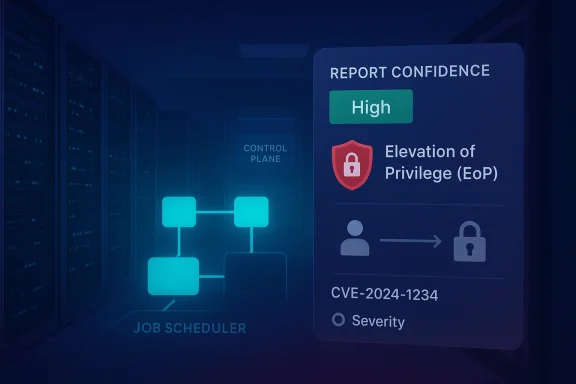
Microsoft’s CVE-2026-32184 entry matters less for a flashy exploit narrative than for what it says about confidence, certainty, and patch priority. In Microsoft’s own framing, the Security Update Guide uses a report confidence metric to show how sure the company is that a vulnerability exists and how credible the technical details are, which is a strong signal that defenders should take the entry seriously even when public exploitation details are sparse. That is exactly the kind of advisory that often gets overlooked until it has already become a favorite local privilege-escalation target. 026-32184 is listed by Microsoft as a High Performance Compute (HPC) Pack Elevation of Privilege Vulnerability, which places it squarely in the category of flaws that can turn a foothold into meaningful control. Microsoft’s Security Update Guide has increasingly emphasized metadata-rich entries for vulnerabilities and advisories, including severity, exploitability context, and confidence signals, so the absence of a long technical writeup does not mean the risk is low. If anything, it usually means Microsoft is signaling certainty without full public detail, which is a familiar pattern in modern disclosure.
That distinction maton of privilege bugs are not just theoretical escalation pathways. They are often the bridge between a low-value compromise and an environment-wide incident, especially in server and cluster administration contexts where privileged service accounts, orchestration tooling, and automation pipelines are already in play. A bug in HPC Pack, by definition, is not a consumer desktop issue; it is an enterprise and infrastructure issue with potential consequences for compute fleets, job orchestration, and the systems that move sensitive workloads through them.
Microsoft’s broader public security workfl advisory deserves attention. The company has documented that the Security Update Guide is meant to be a unified source for CVEs, advisories, and machine-readable metadata, and it has also explained that its newer advisory system is designed to help customers understand issues that do not always arrive with full exploit detail on day one. In practical terms, that means defenders are expected to act on the signal, not wait for a proof-of-concept blog post to validate the risk.
The public record available here does not expose the root causeofor CVE-2026-32184. But that is not the same as saying the issue is uncertain. Microsoft’s own confidence model exists precisely because some disclosures are backed by strong internal evidence while still being presented conservatively to the public. In other words, confidence metadata is itself part of the vulnerability story.
Microsoft HPC Pack has long occupied a specialized place in the Windows ecosystem. It is thuling layer that helps organizations coordinate compute-intensive work across clusters, head nodes, and compute nodes, often in environments where throughput, job scheduling, and administrative control matter more than polish. That makes the software indispensable in certain labs, engineering teams, and technical organizations, but it also gives attackers a highly attractive target if privilege boundaries are porous.
The security significance of HPC software has risen over time because modern high-performance environments rarely exist in isolation. They are frequently tied to identity systems, file shares, management consoles, virtualization layers, and remote administration tools. If a local or authenticated attacker can cross a privilege boundary in that environment, the outcome may not be limited to one host. It can become a stepping-stone into cluster-wide administrative workflows, task queues, and scheduled workloads.
Microsoft’s choice to publish CVE metadata with explicit confidence language reflects a broader industry shift. The company has said its Security Update Guide provides centralized information for CVEs and advisories, and that it uses machine-readable standards to improve transparency. That evolution is important because older security bulletins often forced administrators to infer urgency from a terse bulletin title alone. Today, Microsoft is signaling that how certain it is can matter almost as much as what component is named.
That is especially relevant for a product like HPC Pack, where deployment patterns vary widely. Some organizations run tightly ihers expose management endpoints, supporting services, or supporting systems in ways that create unexpected privilege surfaces. A vulnerability in that stack may therefore have very different operational impact depending on how the environment is built, but the core risk remains the same: a privilege escalation inside infrastructure software can unlock a much broader blast radius than the title alone suggests.
The result is that even a seemingly narrow local elevation-of-privilege flaw can have strategic consequences. Attackers do not need a flashy browser exploit if they can abuse an HPC service, administrative helper, or management component to jump from ordinary user status to a role that can touch jobs, configs, or service identities.
That makes the advisory more actionable than a generic “watch this space” notice. In security operations, certainty matters because it influences whether teams create tickets, accelerate mainte the item into emergency change control. A high-confidence advisory justifies earlier operational decisions, even if the public disclosure is sparse.
Microsoft has previously used similar public disclosure patterns for issues that required patching before the technical ecosystem fully caught up. The company’s broader security communications have emphasized that CVE entries and advisories can be intentionally concise while still being authoritative. This is one reason many defenders treat Microsoft’s own metadata as the first triage layer, not the last one.
Even so, in practice, a confirmed local EoP can be just as urgent as a publicly exploited flaw when it affects a privileged server-side component. Many intrusions begin with low-level access and then rely on local escalation to finish the compromise. In that sense, the confidence metric is an operational cue, not a measure of headline value.
If the affected HPC Pack component participates in job scheduling, service control, node enrollment, or management-plane operations, an EoP bug could let an attacker tamper with those functions. Even a modest privilege jump might be enough to read sensitive configuration files, alter service behavior, or impersonate an administrative workflow. That is why administrators should treat these advisories as control-plane risk, not merely endpoint risk.
The history of Windows privilege escalation bugs shows why local matters. A local flaw is often dismissed because it is not remotely wormable in the traditional sense. But that view can be dangerously incomplete. Once an attacker has phishing access, stolen credentials, a compromised service account, or a foothold through a separate vulnerability, local escalation can be the difference between containment and full compromise.
That means the impact may include operational downtime, job integrity issues, unauthorized access to clustered resources, or compromise of adjacent management infrastructure. The most worrying part is that the privilege boundary may exist in one component, but the impact can cascade into several.
The first step is inventory. Identify where HPC Pack is installed, which versions are present, and whether any nodes or management systems are exposed to broader administrative populations than expected. The second step is remediation planning: determine whether the fix can be applied through normal change windows or whether the advisory’s confidence level justifies accelerated handling.
The third step is validation. In environments that use privileged service accounts or cluster automation, confirm that the update does not break scheduling, node communication, or management operations. The best patch is the one that lands cleanly and stays landed. Silent drift after patching is where many enterprise rollouts fail.
For enterprises, the main concern is that HPC Pack may sit in environments already rich with privileged accounts, automation scripts, and trust relationships. That can make a local EoP much more consequential than it would appear from the short advisory title. It may also mean that a compromised cluster admin workstation or supporting service can become the launch point for broader compromise.
For consumers, the direct relevance is low, but the indirect lesson is still important. Microsoft’s confidence-based disclosure model is becoming a standard way of signaling urgency across the ecosystem. Even if a given CVE does not affect a household PC, the methodology behind the disclosure is increasingly shaping how administrators, vendors, and security teams decide what to patch first.
That shift is significant because many organizations are now overwhelmed by vulnerability volume. The ability to prioritize based on Microsoft’s own confidence language may help separate truly actionable items from advisories that remain speculative or low-confidence. In that sense, CVE-2026-32184 is part of a wider evolution in how Windows security information is consumed.
That posture is not just administrative. It reflects a recognition that security teams need to move faster than the disclosure cycle of the old bulletin era. For years, defenders complained that they were forced to wait for exploit analysis, public writeups, or third-party aggregation before they could justify action. Microsoft’s confidence signal is a direct an e technical questions unanswered.
The same approach also reduces the risk of overexposure. By not oversharing root-cause detail on day one, Microsoft can give defenders enough information to patch while avoiding unnecessary operational noise. The tradeoff is obvious: less detail, more ambiguity. But in a world where many enterprise vulnerabilities are weaponized after disclosure in days, ambiguity is often the price of speed.
In parallel, security tea-32184 as a reminder to review how they handle niche-but-powerful infrastructure software. These are the products most likely to be missed by generic patching dashboards and the most likely to matter once an attacker is already inside. That combination is exactly why they deserve outsized attention.
Source: MSRC Security Update Guide - Microsoft Security Response Center
That distinction maton of privilege bugs are not just theoretical escalation pathways. They are often the bridge between a low-value compromise and an environment-wide incident, especially in server and cluster administration contexts where privileged service accounts, orchestration tooling, and automation pipelines are already in play. A bug in HPC Pack, by definition, is not a consumer desktop issue; it is an enterprise and infrastructure issue with potential consequences for compute fleets, job orchestration, and the systems that move sensitive workloads through them.
Microsoft’s broader public security workfl advisory deserves attention. The company has documented that the Security Update Guide is meant to be a unified source for CVEs, advisories, and machine-readable metadata, and it has also explained that its newer advisory system is designed to help customers understand issues that do not always arrive with full exploit detail on day one. In practical terms, that means defenders are expected to act on the signal, not wait for a proof-of-concept blog post to validate the risk.
The public record available here does not expose the root causeofor CVE-2026-32184. But that is not the same as saying the issue is uncertain. Microsoft’s own confidence model exists precisely because some disclosures are backed by strong internal evidence while still being presented conservatively to the public. In other words, confidence metadata is itself part of the vulnerability story.
 Background
Microsoft HPC Pack has long occupied a specialized place in the Windows ecosystem. It is thuling layer that helps organizations coordinate compute-intensive work across clusters, head nodes, and compute nodes, often in environments where throughput, job scheduling, and administrative control matter more than polish. That makes the software indispensable in certain labs, engineering teams, and technical organizations, but it also gives attackers a highly attractive target if privilege boundaries are porous.The security significance of HPC software has risen over time because modern high-performance environments rarely exist in isolation. They are frequently tied to identity systems, file shares, management consoles, virtualization layers, and remote administration tools. If a local or authenticated attacker can cross a privilege boundary in that environment, the outcome may not be limited to one host. It can become a stepping-stone into cluster-wide administrative workflows, task queues, and scheduled workloads.
Microsoft’s choice to publish CVE metadata with explicit confidence language reflects a broader industry shift. The company has said its Security Update Guide provides centralized information for CVEs and advisories, and that it uses machine-readable standards to improve transparency. That evolution is important because older security bulletins often forced administrators to infer urgency from a terse bulletin title alone. Today, Microsoft is signaling that how certain it is can matter almost as much as what component is named.
That is especially relevant for a product like HPC Pack, where deployment patterns vary widely. Some organizations run tightly ihers expose management endpoints, supporting services, or supporting systems in ways that create unexpected privilege surfaces. A vulnerability in that stack may therefore have very different operational impact depending on how the environment is built, but the core risk remains the same: a privilege escalation inside infrastructure software can unlock a much broader blast radius than the title alone suggests.
Why HPC software is a special case
HPC environments are built around trust assumptions. Administrators typically assume that job submission, scheduling, node management, and credential handling occur in a controlled boundary with relatively few users. That assumption is fragile once an attacker gains any foothold, because orchestrators and cluster services often run with elevated privileges by design.The result is that even a seemingly narrow local elevation-of-privilege flaw can have strategic consequences. Attackers do not need a flashy browser exploit if they can abuse an HPC service, administrative helper, or management component to jump from ordinary user status to a role that can touch jobs, configs, or service identities.
- HPC Pack sits close to privileged control planes.
- Cluster environments often concentrate valuable data and compute.
- Administrative automation can amplify the value of a local escalation.
- A successful EoP can become a pivot to lateral movement.
- The operational impact can exceed the vulnerability’s immediate technical scope.
What Microsoft’s confidence metric really tells defenders
Microsoft’s report confidence concept is the most important clue in this advisory’s public framing. The ate the degree of confidence in the vulnerability’s existence and the credibility of the technical details, which means Microsoft is not merely saying “this might exist.” It is saying, in effect, “we believe this is real enough to publish and patch, even if we are not publishing every supporting detail.”That makes the advisory more actionable than a generic “watch this space” notice. In security operations, certainty matters because it influences whether teams create tickets, accelerate mainte the item into emergency change control. A high-confidence advisory justifies earlier operational decisions, even if the public disclosure is sparse.
Microsoft has previously used similar public disclosure patterns for issues that required patching before the technical ecosystem fully caught up. The company’s broader security communications have emphasized that CVE entries and advisories can be intentionally concise while still being authoritative. This is one reason many defenders treat Microsoft’s own metadata as the first triage layer, not the last one.
Why confidence is not the same as exploitability
A high confidence score does not automatically mean active exploitation. It means the company is confident the flaw exists and the technical account is crediblun because defenders should not conflate certainty with weaponization.Even so, in practice, a confirmed local EoP can be just as urgent as a publicly exploited flaw when it affects a privileged server-side component. Many intrusions begin with low-level access and then rely on local escalation to finish the compromise. In that sense, the confidence metric is an operational cue, not a measure of headline value.
- Confidence speaks to certainty, not popularity.
- A sparse advisory can still be highly actionable.
- Local EoP often precedes bigger intrusions.
- Cluster software can magnify modest flaws.
- The absence of exploit details should not delay patching.
Why elevation of privilege in HPC Pack is dangerous
The phrase elevation of privilege sounds generic, but in Windows infrastructure it is one of the most important words Microsoft can publish. It implies an attacker already has some level of accessy allows that attacker to gain more powerful rights than intended. In server and cluster tooling, that upgrade can be decisive.If the affected HPC Pack component participates in job scheduling, service control, node enrollment, or management-plane operations, an EoP bug could let an attacker tamper with those functions. Even a modest privilege jump might be enough to read sensitive configuration files, alter service behavior, or impersonate an administrative workflow. That is why administrators should treat these advisories as control-plane risk, not merely endpoint risk.
The history of Windows privilege escalation bugs shows why local matters. A local flaw is often dismissed because it is not remotely wormable in the traditional sense. But that view can be dangerously incomplete. Once an attacker has phishing access, stolen credentials, a compromised service account, or a foothold through a separate vulnerability, local escalation can be the difference between containment and full compromise.
The likely enterprise impact pattern
In the enterprise, the value of an HPC Pack EoP vulnerability is not just in the host it affects. It is in the workflow it can disturb. HPC systems often host expensive compute jobs, sensitive scientific or engineering data, and privileged automation that is difficult to monitor manually at scale.That means the impact may include operational downtime, job integrity issues, unauthorized access to clustered resources, or compromise of adjacent management infrastructure. The most worrying part is that the privilege boundary may exist in one component, but the impact can cascade into several.
- Exposure is highest where administrators share cluster tooling.
- Service accounts can become escalation targets.
- Job orchestration can amplify unauthorized control.
- Sensitive workloads may be stored or processed nearby.
- Audit trails can become harder to trust after privilege escalation.
What defenders should do now
Security teams should treat CVE-2026-32184 as a patch-priority item until proven otherwise in their own environment. Because the public advisory text is thin, the right immediate response is not forensic speculation; it is asset discovery, uexposure mapping. The question is not whether you can explain the exploit chain today, but whether you can ensure the vulnerable component is removed from the attack path.The first step is inventory. Identify where HPC Pack is installed, which versions are present, and whether any nodes or management systems are exposed to broader administrative populations than expected. The second step is remediation planning: determine whether the fix can be applied through normal change windows or whether the advisory’s confidence level justifies accelerated handling.
The third step is validation. In environments that use privileged service accounts or cluster automation, confirm that the update does not break scheduling, node communication, or management operations. The best patch is the one that lands cleanly and stays landed. Silent drift after patching is where many enterprise rollouts fail.
Recommended response checklist
- Inventory all HPC Pack installations and associated nodes.
- Confirm whether the advisory applies to your exact build.
- Prioritize update testing in a staging cluster.
- Accelerate deployment on management-plane systems first.
- Verify service accounts, jobs, and node health after patching.
- Reassess any temporary admin access paths or exceptions.
- Treat the advisory as real even without exploit detail.
- Focus on privileged management systems first.
- Confirm exposure across the whole cluster, not just one host.
- Validate update behavior under real workloads.
- Review whether any local user accounts are overprivileged.
Enterprise vs. consumer relevance
This vulnerability is an enterprise story, not a consumer one. Most home users will never touch HPC Pack, and that is precisely why defenders can underestimate it. Specialized infrastructure products often slip through patch prioritization frameworks because theyet when they are present they often carry outsized authority.For enterprises, the main concern is that HPC Pack may sit in environments already rich with privileged accounts, automation scripts, and trust relationships. That can make a local EoP much more consequential than it would appear from the short advisory title. It may also mean that a compromised cluster admin workstation or supporting service can become the launch point for broader compromise.
For consumers, the direct relevance is low, but the indirect lesson is still important. Microsoft’s confidence-based disclosure model is becoming a standard way of signaling urgency across the ecosystem. Even if a given CVE does not affect a household PC, the methodology behind the disclosure is increasingly shaping how administrators, vendors, and security teams decide what to patch first.
Why this still matters outside HPC shops
Even if you never run a cluster, the advisory reflects how Microsoft wants security teams to read its public guidance. The company is telling the market that metadata is operational intelligence. Confidence, severity, and affected product naming all serve as triage cues when the technical detail is incomplete.That shift is significant because many organizations are now overwhelmed by vulnerability volume. The ability to prioritize based on Microsoft’s own confidence language may help separate truly actionable items from advisories that remain speculative or low-confidence. In that sense, CVE-2026-32184 is part of a wider evolution in how Windows security information is consumed.
- Enterprise admins should prioritize immediately.
- Consumer exposure is likely negligible.
- The disclosure model itself is the bigger trend.
- Confidence-based triage is becoming normal.
- Specialized infrastructure needs special attention.
How this fits Microsoft’s broader security posture
Microsoft has been steadily tightening the structure of its security disclosures, from the Security Update Guide to advisory tabs and machine-readable formats. The company has said these changes are meant to improve centralized access to vulnerability data and help 2026-32184 fits that model: a terse public entry with enough metadata to drive remediation, but not necessarily enough detail to satisfy curiosity.That posture is not just administrative. It reflects a recognition that security teams need to move faster than the disclosure cycle of the old bulletin era. For years, defenders complained that they were forced to wait for exploit analysis, public writeups, or third-party aggregation before they could justify action. Microsoft’s confidence signal is a direct an e technical questions unanswered.
The same approach also reduces the risk of overexposure. By not oversharing root-cause detail on day one, Microsoft can give defenders enough information to patch while avoiding unnecessary operational noise. The tradeoff is obvious: less detail, more ambiguity. But in a world where many enterprise vulnerabilities are weaponized after disclosure in days, ambiguity is often the price of speed.
What this means for patch management teams
Patch teams should not wait for a “better description” before scheduling work. The presence of a named product, a clear vulnerability class, and Microsoft’s own confidence framing is enough to justify action. Teams that already use update-guide feeds, vulnerability management platforms, or centralized risk dashboards should make sure this CVE is not buried under more familiar Windows kernel issues.- Use the advisory metadata as a triage trigger.
- Do not overvalue the lack of exploit details.
- Map the CVE to your asset inventory quickly.
- Align maintenance windows with operational criticality.
- Revalidate remediation after deployment.
The bigger security lesson from sparse advisories
Sparse advisories are becoming a fact of life, especially when the vendor believes the threat is real but does not want to reveal unnecessary attack mechanics. That can frustrate administrators, but it also forces a healthier discipline: patch based on trust in the vendor’s evidence, not on internet drama. In this case, Microsoft’s confidence metric she lesson extends beyond this one CVE. Enterprises should be building workflows that assume some advisories will arrive with minimal detail. Those workflows need to incorporate asset discovery, prioritization rules, and rollback-ready deployment plans. If a team cannot act without a long exploit narrative, it is already behind.Practical policy implications
A mature vulnerability program should handle this kind of disclosure cleanly. It should be able to classify a Microsoft EoP advisory as high priority, connect it to affected software automatically, and route it to the right owners without waiting for manual interpretation. The more specialized the software, the more important that automation becomes.- Build triage around confidence and severity.
- Tie update guide alerts to asset inventories.
- Separate patch urgency from exploit publicity.
- Test rollback plans before emergencies arise.
- Train teams to act on incomplete but authoritative data.
Strengths and Opportunities
The good news is that Microsoft’s current disclosure model gives defenders more to work with than older bulletin systems ever did. Even when technical details are limited, the combination of product naming, vulnerability class, and confidence signal provides a strong enough basis for action. That helps security teams reduce hesitation and prioritize a fix before attackers can use the issue as a stepping-stone.- ister asset mapping.
- Confidence metadata helps teams gauge certainty quickly.
- EoP classification tells defenders the flaw is likely operationally meaningful.
- Update Guide centralization reduces time spent hunting for authoritative information.
- Machine-readable advisories improve automation and reporting.
- Enterprise focus helps security teams target the right systems.
- Minimal public detail can limit premature speculation while patches roll out.
Risks and Concerns
The main concern is that sparse technical detail can cause some organizations to underreact, especially if they do not run HPC Pack directly or do not recognize how privileged their affected systems are. Another risk is that administrators may delay patching while waiting for a more complete explanation, even though Microsoft’s own confidence framing already indicates the issue is credible. In security, waiting for perfect information is often just another way of Uh remediation.- Local privilege escalation can still enable major compromise.
- Cluster environments can magnify the blast radius.
- Overreliance on public exploit detail can slow patching.
- Service-account sprawl may complicate exposure analysis.
- Incomplete inventories can hide vulnerable systems.
- Testing delays can become excuses if not time-boxed carefully.
Looking Ahead
The key thing to watch next is whether Microsoft expands the advisory with more detail, whether third-party tracking services map the issue to a specific root cause, and whether any proof-of-concept material appears in the wild. Until then, the operational default should remain conservative: assume the vulnerability is real, assume it matters in any HPC Pack deployment, and assume patching should proceed on an accelerated timeline. The confidence signal alone is enough to move this from curiosity to action.In parallel, security tea-32184 as a reminder to review how they handle niche-but-powerful infrastructure software. These are the products most likely to be missed by generic patching dashboards and the most likely to matter once an attacker is already inside. That combination is exactly why they deserve outsized attention.
- Watch for an updated Microsoft advisory page.
- Track whether third-party vulnerability databases add technical detail.
- Confirm whether exploit chatter appears after disclosure.
- Recheck cluster-node inventories after patch deployment.
- Audit any unusual privilege assignments around HPC administration.
Source: MSRC Security Update Guide - Microsoft Security Response Center
