

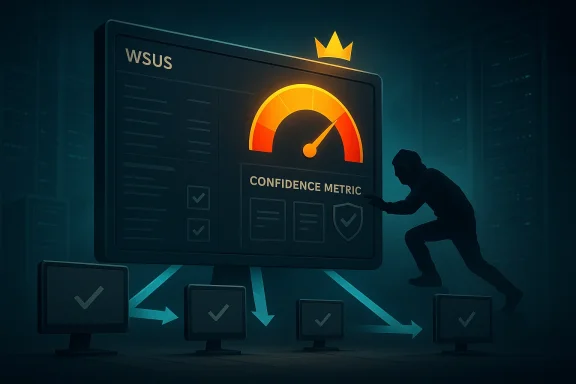
Microsoft’s CVE-2026-26174 is a Windows Server Update Service (WSUS) Elevation of Privilege issue, and the key signal in Microsoft’s confidence metric is that the vendor is publicly acknowledging the vulnerability as real while keeping the low-level mechanics intentionally sparse. That combination usually means defenders should treat the issue as credible and actionable, even if the exploit path has not been fully disclosed. In practical terms, Microsoft is not asking customers to speculate; it is signaling that the flaw exists with enough certainty to justify patching and operational attention. The broader lesson is the same one Windows administrators have learned for years: when a privileged management component is implicated, the impact can extend far beyond a single server.
WSUS is not just another Windows role. It is one of the central trust anchors many enterprises use to approve, stage, and distribute Microsoft updates, which makes it a particularly sensitive piece of infrastructure. A vulnerability in that layer is more serious than an ordinary server bug because it can affect how an organization validates, delivers, and reports patch status across an entire fleet. Microsoft’s own guidance around vulnerability reporting has long emphasized the value of structured security metadata so administrators can distinguish confirmed defects from uncertain reports, and that context matters a great deal here. c you quoted is important because it separates two questions that are often conflated: how sure Microsoft is that a vulnerability exists, and how much technical detail it is willing to reveal in public. The first part affects urgency; the second affects attacker visibility. Microsoft’s public posture around modern advisories is designed to give defenders enough information to act without turning the advisory into an exploitation guide. That is especially true for infrastructure bugs, where a few extra details can materially help attackers.
Historically, Microsisclosure language to steer organizations toward rapid response when the affected component sits inside a privileged or widely trusted part of the platform. In prior security guidance, the company has repeatedly framed management-plane or update-plane issues as high-consequence because a compromise there can become a force multiplier for lateral movement, persistence, or patch suppression. A WSUS flaw fits that pattern neatly: it may not be flashy, but it can be devastating to enterprise trust.
There is also a broader supply-chain anglee is built on trust, and WSUS is specifically designed to be a source that clients accept as authoritative. That means tampering, corruption, or privilege escalation inside the WSUS ecosystem is not just a local server problem; it is a control-plane problem. When the control plane is compromised, endpoint defenses can become reactive instead of preventative, because they may be acting on poisoned or incomplete information.
For that reason, the most useful way to read CVE-2026-26174 is nevel defect but as a signal about the integrity of the update ecosystem. Microsoft has published enough to tell defenders that the issue is credible. What it has not published publicly, at least in the accessible material here, is the full low-level exploit narrative, and that omission is a feature, not a bug. It slows attacker learning while still enabling customer remediation.
That distinction matters because attackers do not need a public write-up to start researching a CVE once Miged it. The publication of a named issue in a sensitive service is already enough to focus attention, and security teams know from experience that exploit development often follows disclosure, not the other way around. In other words, a confirmed advisory is not merely informational; it can be a catalyst.
For WSUS specifically, the risk profile is amplified by the role the service plays in enterprise patch orchestration. Even if the attack requires locative proximity, the consequence of successful abuse can still be broad because the affected host influences many other machines. That is exactly why local EoP bugs in management components often demand more urgency than their “local” label implies.
A sparse advisory can still be a strong operational signal. In fact, the absence of a fully disclosed trigger path often means the vendor believes the issue is real enough to patch but sensitively at a higher level. That is the exact situation where defenders should lean on patch management, inventory accuracy, and privileged access review rather than waiting for a later research paper.
The danger is not limited to a single host. If an attacker can interfere with WSUS integrity, they may be able to create blind spots, suppress updates, alter metadata, or make the environment appear healthier than it really is. That kind more damaging than a one-off crash because it undermines the organization’s ability to respond to everything else happening in the network.
That shift in perspective matters for incident response. If the update source itself is suspect, then endpoint status reports, compliance dashboards, and normal remediation workflows may all become less reliable. In a mature compromise, the attacker’s win is not merely code executadation.
That makes the business impact broader than the technical label suggests. A machine that serves as the update source may be only one server on the asset list, but it can influence dozens, hundreds, or thousands of downstream systems. In that sense, a WSUS issue can behave like a governance problem as much as a vulnerabilitckers Gain From This Class of Bug
Elevation of privilege is a classic attacker multiplier. Once an intruder has some foothold, even a local one, the ability to climb to a higher privilege level can convert a limited intrusion into full system control. That is why EoP vulnerabilities in trusted Windows components remain so valuen when they are not remote.
In the WSUS context, the payoff can be especially attractive because the target itself is a management hub. If the attacker can leverage the bug to reach administrative control or tamper with the update process, they may gain a route to persistence, stealth, or wide-area manipulation of the update workflow. That is a very different prize from a single compromised woal abuse outcomes
Even without public exploit mechanics, defenders can reason about the likely end states. The attacker’s goal is often not dramatic destruction but quiet leverage. They want to alter trust, delay remediation, and create opportunities to move laterally while the organization believes its maintenance pipeline is healthy.
Common abuse patterns in this class of bting clients toward unsafe or unapproved content.
The organization may think it has visibility because update jobs are completing and reports are flowing. But if the source of tse signals are only useful if someone independently validates them. That is why incident response for WSUS concerns often has to start upstream, not on the endpoints themselves.
A simple response sequence is useful here:
The biggest risk is not just the patch itself. It is knowing where the patch belongs, who is responsible for validating it, and whether the infrastructure is still trustworthy enough to coordinate remediation. For smaller organizal discipline can matter more than the technical details of the flaw.
They should also review any gold images, templates, or cloned systems that might still contain the vulnerable service build. A patched production server does not help if the next deployment wave is built from an outdated template. That kind of drift is one of the most ched it” turns out not to be true.
The company’s strategy also reflects a balancing act. It needs to tell defenders enough to act quickly, but it cannot always publish a full exploit narrative without also helping attackers. That is particularly sensier management component, where a public step-by-step description would have immediate downstream risk. The tension between transparency and safety is not unique to Microsoft, but it is especially visible in infrastructure advisories.
For WSUS-related issues, automation can be a double-edged sword. It improves speed, but it also means the trust in the update system is intertwined with the trust in the tooling that consumes the advisory. That is another reason why validation should include out-of-band checks and not rely only on the same infrastructure under suspicion.
A second concern is trust contamination. If WSUS behavior is altered, defenders may receive misleading signals about patch state, compliance, or synchronization success. That can delay response and create a false sense of security precisely when the environment needs scrutiny.
For organizations running WSUS, the practical question is not whether the issue is interesting. It is whether the update pipeline can still be trusted end to end after patching and validation. That means inventories, logs, permissions, and client behavior all matter, because a trust-path bug is only fully addressed when the trust path itself is reestablished.
Source: MSRC Security Update Guide - Microsoft Security Response Center
 Background
WSUS is not just another Windows role. It is one of the central trust anchors many enterprises use to approve, stage, and distribute Microsoft updates, which makes it a particularly sensitive piece of infrastructure. A vulnerability in that layer is more serious than an ordinary server bug because it can affect how an organization validates, delivers, and reports patch status across an entire fleet. Microsoft’s own guidance around vulnerability reporting has long emphasized the value of structured security metadata so administrators can distinguish confirmed defects from uncertain reports, and that context matters a great deal here. c you quoted is important because it separates two questions that are often conflated: how sure Microsoft is that a vulnerability exists, and how much technical detail it is willing to reveal in public. The first part affects urgency; the second affects attacker visibility. Microsoft’s public posture around modern advisories is designed to give defenders enough information to act without turning the advisory into an exploitation guide. That is especially true for infrastructure bugs, where a few extra details can materially help attackers.Historically, Microsisclosure language to steer organizations toward rapid response when the affected component sits inside a privileged or widely trusted part of the platform. In prior security guidance, the company has repeatedly framed management-plane or update-plane issues as high-consequence because a compromise there can become a force multiplier for lateral movement, persistence, or patch suppression. A WSUS flaw fits that pattern neatly: it may not be flashy, but it can be devastating to enterprise trust.
There is also a broader supply-chain anglee is built on trust, and WSUS is specifically designed to be a source that clients accept as authoritative. That means tampering, corruption, or privilege escalation inside the WSUS ecosystem is not just a local server problem; it is a control-plane problem. When the control plane is compromised, endpoint defenses can become reactive instead of preventative, because they may be acting on poisoned or incomplete information.
For that reason, the most useful way to read CVE-2026-26174 is nevel defect but as a signal about the integrity of the update ecosystem. Microsoft has published enough to tell defenders that the issue is credible. What it has not published publicly, at least in the accessible material here, is the full low-level exploit narrative, and that omission is a feature, not a bug. It slows attacker learning while still enabling customer remediation.
What Microsoft’s Confidence Metric Really Means
The confidence metric is oftvague “maybe” score, but that is not what Microsoft is doing. In practice, it is a measure of how confident the vendor is in the vulnerability’s existence and how credible the surrounding technical details are. The higher that confidence, the more defenders should assume the issue is real and not wait for an external proof-of-concept to validate what Microsoft already knows.That distinction matters because attackers do not need a public write-up to start researching a CVE once Miged it. The publication of a named issue in a sensitive service is already enough to focus attention, and security teams know from experience that exploit development often follows disclosure, not the other way around. In other words, a confirmed advisory is not merely informational; it can be a catalyst.
Confidence is not the same as exploitability
A vulnerability can be highly credible without having a public exploit. It caneal while remaining difficult to weaponize at scale. Microsoft’s confidence language helps defenders avoid false comfort on both sides of that equation. The right response is to treat confirmed, high-confidence flaws as operationally important even when the public technical story is incomplete.For WSUS specifically, the risk profile is amplified by the role the service plays in enterprise patch orchestration. Even if the attack requires locative proximity, the consequence of successful abuse can still be broad because the affected host influences many other machines. That is exactly why local EoP bugs in management components often demand more urgency than their “local” label implies.
Why sparse detail is normal
Microsoft often withholds lower-level exploitation details in early public guidance to reduce the chance of immediate weaponization. That r analysts who want deeper root-cause information, but it is a defensible practice for a service like WSUS, where trust and reach matter more than public transparency at the byte level. The key point is that sparsity should not be mistaken for uncertainty.A sparse advisory can still be a strong operational signal. In fact, the absence of a fully disclosed trigger path often means the vendor believes the issue is real enough to patch but sensitively at a higher level. That is the exact situation where defenders should lean on patch management, inventory accuracy, and privileged access review rather than waiting for a later research paper.
Why WSUS Issues Matter More Than They Look
WSUS sits in the update pipeline, and that makes it different from a typical application server. Clients are designed to trust it, and administrators are designed tsted status means a flaw in WSUS can distort not just the software update process, but also the organization’s understanding of whether patching is actually working.The danger is not limited to a single host. If an attacker can interfere with WSUS integrity, they may be able to create blind spots, suppress updates, alter metadata, or make the environment appear healthier than it really is. That kind more damaging than a one-off crash because it undermines the organization’s ability to respond to everything else happening in the network.
Control plane, not just data plane
Security teams often think first about endpoint infection, but WSUS vulnerabilities belong to a different class of problem. They target the control plane that governs how updates are authorized and distributed. That mean need to own every endpoint if they can instead compromise the mechanism that tells endpoints what to trust.That shift in perspective matters for incident response. If the update source itself is suspect, then endpoint status reports, compliance dashboards, and normal remediation workflows may all become less reliable. In a mature compromise, the attacker’s win is not merely code executadation.
Enterprise blast radius
For enterprise administrators, WSUS is often part of the backbone of maintenance operations. A tampering or privilege escalation issue can therefore ripple outward into patch cadence, compliance evidence, and recovery planning. If the issue affects synchronization or contetion may need to validate the update chain before resuming ordinary patch operations.That makes the business impact broader than the technical label suggests. A machine that serves as the update source may be only one server on the asset list, but it can influence dozens, hundreds, or thousands of downstream systems. In that sense, a WSUS issue can behave like a governance problem as much as a vulnerabilitckers Gain From This Class of Bug
Elevation of privilege is a classic attacker multiplier. Once an intruder has some foothold, even a local one, the ability to climb to a higher privilege level can convert a limited intrusion into full system control. That is why EoP vulnerabilities in trusted Windows components remain so valuen when they are not remote.
In the WSUS context, the payoff can be especially attractive because the target itself is a management hub. If the attacker can leverage the bug to reach administrative control or tamper with the update process, they may gain a route to persistence, stealth, or wide-area manipulation of the update workflow. That is a very different prize from a single compromised woal abuse outcomes
Even without public exploit mechanics, defenders can reason about the likely end states. The attacker’s goal is often not dramatic destruction but quiet leverage. They want to alter trust, delay remediation, and create opportunities to move laterally while the organization believes its maintenance pipeline is healthy.
Common abuse patterns in this class of bting clients toward unsafe or unapproved content.
- Preventing critical updates from reaching endpoints.
- Making patch reporting look more complete than it is.
- Hiding persistence inside ordinary maintenance traffic.
- Creating a blind spot for later movement or credential theft.
- Forcing defenders to rebuild confidence in the update source itseic outcomes, not merely technical ones. A compromise that changes what defenders believe is installed can be as dangerous as one that drops malware directly.
Why “local” does not mean low risk
A local vulnerability often gets mentally downgraded because it does not sound internet-facing. That is a mistake. In real-world intrusions, attackers frequently start with low privileges, stolen credentials, or malicious code execution in a user context and then look for the fastest route upward. A local EoP in WSUS can be exactly the step that transforms a noisy foothold into an enterprisis is especially true on systems that cache privileged sessions, service tokens, or administrative credentials. Once an attacker is inside a management server, the value of privilege escalation rises sharply because the machine may already sit near the center of the environment’s trust structure. That is why defenders should not let the word local lull them into complacency.Enterprise Impact and Operational Risk
Enterprises are the maidisclosure like this because WSUS itself is usually an enterprise tool. That means the first thing defenders should do is confirm whether the service exists, whether it is exposed in the expected way, and whether the affected version or configuration is actually in play. Asset inventory errors are common enough that even a single forgotten instance can become a security weak point.nfirmed, the practical issue becomes trust validation. If the organization relies on WSUS for deployment approvals and reporting, then any suspicion of tampering can force a much deeper review than a routine patch cycle. This is one of the reasons update infrastructure should be treated as critical infrastructure rather than a background utility.Why compliance can become misleading
A compromised WSUS server can produce reassuring metrics that are wrong. That is one ofpects of a tampering or trust-boundary vulnerability: the dashboards may continue to say “successful” while the underlying delivery chain is quietly compromised. In that scenario, false confidence is almost as dangerous as a direct exploit.The organization may think it has visibility because update jobs are completing and reports are flowing. But if the source of tse signals are only useful if someone independently validates them. That is why incident response for WSUS concerns often has to start upstream, not on the endpoints themselves.
What enterprise teams should prioritize
The initial response should focus on patch status, server exposure, and privilege boundaries around the update role. Security teams should also review who can administer, what service accounts are in use, and whether logs are retained long enough to reconstruct update behavior if needed. That is the minimum bar for a trust-sensitive service.A simple response sequence is useful here:
- Confirm whether WSUS is deployed and where it is reachable.
- Verify Microsoft’s current patch status for3. Review synchronization and approval logs for anomalies.
- Validate administrative access and service permissions.
- Inspect client-side update consistency for mismatches.
- Isolate or rebuild the server if compromise is suspected.
Consumerusers are unlikely to run WSUS directly, so the direct consumer impact is limited. This is not the kind of vulnerability that most people will encounter on a personal PC unless they happen to be administering a server role in a small lab or business environment. Even so, the issue still matters indirectly because it affects the broader Windows ecosystem and the organizations that keep many endpoints patched.
Small and midsize businesses are in a more sensitive position. They may have one or two Windows Server systems acting as file servers, remote admin points,ure, and those systems often carry more responsibility than the asset count suggests. In a thinly staffed environment, a WSUS issue can become a disproportionate headache because there is less slack for forensic work, rebuilds, or validation.Why SMBs should not dismiss this
SMBs often rely on centralized update processes because they simplify management. That convenience is useful, but it also means the trust in the update path may be underh larger enterprises. A flaw in WSUS can therefore create confusion about what has been patched and what remains exposed, which is the worst possible place to be after a security disclosure.The biggest risk is not just the patch itself. It is knowing where the patch belongs, who is responsible for validating it, and whether the infrastructure is still trustworthy enough to coordinate remediation. For smaller organizal discipline can matter more than the technical details of the flaw.
What smaller teams should do first
SMBs should inventory every Windows Server instance that participates in update distribution or administrative servicing. They should then confirm whether the relevant Microsoft update is installed, and if not, accelerate deployment rather than waiting for a maintenance window that may come too late. Early paer in a small environment than in a sprawling one.They should also review any gold images, templates, or cloned systems that might still contain the vulnerable service build. A patched production server does not help if the next deployment wave is built from an outdated template. That kind of drift is one of the most ched it” turns out not to be true.
Microsoft’s Disclosure Strategy and the Bigger Security Picture
Microsoft’s modern vulnerability disclosure approach is increasingly structured, machine-readable, and designed for automation. That matters because large organizations now ingest security data into dashboards, ticketing systems, SIEMs, and orchestration tools rather than reading advisories by hand. A clear CVE entriented framing is therefore more than a press release; it is a data point that helps operational teams move.The company’s strategy also reflects a balancing act. It needs to tell defenders enough to act quickly, but it cannot always publish a full exploit narrative without also helping attackers. That is particularly sensier management component, where a public step-by-step description would have immediate downstream risk. The tension between transparency and safety is not unique to Microsoft, but it is especially visible in infrastructure advisories.
The role of machine-readable advisories
Structured advisory data makes it easier for organizations to automate exposure checks and remediation workflows. That is increasingly important because security teams rarely have the luxury of manually reviewing each bulletin in isolation. Ter a CVE maps to an asset they own, whether that asset is exposed, and whether the patch is already in place.For WSUS-related issues, automation can be a double-edged sword. It improves speed, but it also means the trust in the update system is intertwined with the trust in the tooling that consumes the advisory. That is another reason why validation should include out-of-band checks and not rely only on the same infrastructure under suspicion.
Why this mattersarger lesson is that Microsoft’s security publication model is increasingly trying to help defenders make faster decisions without overexposing the mechanics of a flaw. That is a good thing for customers, and it is especially valuable in a case like WSUS where the potential blast radius is large. The confidence metric is part of that decision-making fabric, and defenders should treat it as a practical signal rather th
At a broader level, this also reinforces a familiar truth: any system that distributes trust must itself be treated as a high-value target. That applies to WSUS, to configuration management, to endpoint orchestration, and to the entire chain of administrative dependencies that modern Windows environments rely on.Strengths and Oongest part of Microsoft’s disclosure posture is that it gives defenders a confirmed issue with enough context to make a decision quickly. Even without a public exploit narrative, the CVE naming, service classification, and confidence framing provide a usable operational signal. That helps enterprises move before a vulnerability becomes a larger ecosystem story.
There is also an opportunity here to improve update infrastructure hygiene. Many organizations still treat WSUS as plumbt is a trust anchor that deserves the same care as identity or certificate systems. A disclosure like this can justify better segmentation, tighter admin controls, and stronger log retention.- Confirmed vendor acknowledgement helps prioritize response.
- Structured advisory data supports automation and trbility** reduces uncertainty for defenders.
- Trust-chain focus encourages better infrastructure hardening.
- Inventory review can uncover hidden WSUS instances.
- Logging improvements can strengthen future incident response.
- Least-privilege controls can reduce post-exploitation value.
Risks and Concerns
The biggest concern is that organizations may underestimate the issue because it is framed as local privilege escalation rather than as a remote wormable flaw. That would be a mistake. In a real intrusion, local EoP is often the a foothold into a machine-level compromise or a platform for broader movement.A second concern is trust contamination. If WSUS behavior is altered, defenders may receive misleading signals about patch state, compliance, or synchronization success. That can delay response and create a false sense of security precisely when the environment needs scrutiny.
- Delayed patching can leave a dangerous window open.
- False compliance reports can hide real exposure.
- Silent tampering may be harder to detect than malware.
- Broad server trust increases blast radius.
- Legacy dependencies may complicate remediation.
- *Sparse detailsigations.
- Overreliance on one update source can magnify failure.
There is also a practical concern around recovery. If administrators discover that the update server itself is untrusted, they may have to isolate, rebuild, and revalidate much more than they expected. That consumes time, people, and maintenance windows, and it can ripple into unrelated
Looking Ahead
The next phase will depend less on the CVE record and more on how quickly defenders confirm exposure in their own environments. If Microsoft publishes additional technical detail or if researchers begin analyzing the fix, the urgency will rise again. Untilumption is that this is a real, vendor-confirmed flaw in a high-value management component that deserves immediate attention.For organizations running WSUS, the practical question is not whether the issue is interesting. It is whether the update pipeline can still be trusted end to end after patching and validation. That means inventories, logs, permissions, and client behavior all matter, because a trust-path bug is only fully addressed when the trust path itself is reestablished.
- Verify the patch status on all WSUS hosts.
- Check gold images and deployment templates.
- Review synchronization and approval logs.
- Audit privileged access to the update server.
- Validate client-side updpare for rebuilds if tampering is suspected.
Source: MSRC Security Update Guide - Microsoft Security Response Center
Last edited:
