

Microsoft’s CVE-2026-32155 entry for the Desktop Window Manager (DWM) Elevation of Privilege Vulnerability is notable less for dramatic exploit details than for what Microsoft is signaling through its advisory metadata: this is a real, vendor-tracked Windows privilege boundary issue that defenders should treat as actionable. The public description emphasizes Microsoft’s confidence model, which is meant to communicate how certain the company is that a vulnerability exists and how credible the technical details are, even when the public root cause remains sparse. In other words, the advisory is telling administrators to read the signal, not wait for the exploit write-up. *Desktop Window Manager** has long been one of Windows’ most security-sensitive graphics components because it sits between user interactions, desktop composition, and low-level system rendering. That makes it a prime target for local privilege escalation bugs: if an attacker can manipulate DWM or its related paths, they may be able to cross from a limited user context into something far more powerful. Microsoft and the broader security community have repeatedly seen this pattern in the Windows graphics stack, where a single memory corruption or logic flaw can become a reliable route to SYSTEM-level access.
What makes CVE-2026-ortant is the way Microsoft now frames vulnerability disclosure. The company’s Security Update Guide does more than label severity; it also provides exploitability and confidence cues that help defenders prioritize when the public technical story is still incomplete. That approach exists because not every vulnerability arrives with a polished exploit proof-of-concept or a full root-cause explanation, and in those cases the vendor’s confidence becomes part of the risk picture.
This is not the first time DWM has appearerity catalog. Recent Windows security reporting has already highlighted other DWM flaws, including use-after-free and privilege escalation issues, reinforcing that this component remains a recurring attack surface rather than an occasional outlier. The broader lesson is that graphics infrastructure is not just about visual polish; it is a privileged subsystem with a long history of bugs that matter operationally.
For administrators, that history changes how a sparse advisory . A vague public description does not mean low risk. In practice, it often means the vendor knows enough to ship a fix and enough to warn defenders, but not enough—or not yet enough—to publish the technical mechanics that adversaries could reuse immediately. That is why Microsoft’s confidence metric is so relevant here: it is designed to help translate uncertainty into patch priority.
The strongest reading of CVE-2026-32155 is simpes the flaw exists**, believes it is meaningful enough to catalog, and believes the public details are sufficiently credible to merit a security update. That may sound obvious, but in vulnerability management it is an important distinction. A record with sparse technical data can still represent a very real local privilege escalation threat, especially when it affects a core subsystem like DWM.
The confidence framing matters because it reduces false comfort. Security teams sometimes deprioritize advisories when the public narrative is thin, assuming that a lack of detail implies weak evidence. Microsoft’s own guidance argues the opposite: the vulnerability’s existence and the credibility of the known technical details are part of the risk signal, and those signals can be strong even before exploit mechanics become public knowledge.
The recurring theme across DWM-related CVEs is not necessarily one single flaw type, but rather a class of risk: trusted system code processing attacker-influenced state. When a local attacker can influence window states, object lifetimes, adata, a use-after-free, out-of-bounds read, or logic bug can become a reliable escalation path. This is why DWM vulnerabilities tend to be treated as high-value by both defenders and attackers.
The practical enterprise issue is time. Most organizations do not get compromised only by brand-new zero-days; they get hurt when a low-severity-seeming issue is left sitting in the queue while attackers chain it with another weakness. A DWM EoP patch therefore belongs in the same operational category as other privilege escalation fixes that close the gap between “we detected something” and “they own the endpoint.”
The problem with consumer security is that the point of compromise is often invisible. Users do not usually notice when a process quietly gains extra rights, and they may not connect a later ransomware event to a prior unpatched local vulnerability. That is why patch hygiene matters more than the specific severity label suggests. “Local” does not mean harmless.
That context matters because not all vulnerabilities are equally actionable from a threat-intelligence perspective. Some arrive with clear exploit narratives, while others are published with minimal technical detail because the vendor wants to minimize attacker advantage. Microsoft’s confidence model is designed to bridge that gap. It tells customers, in effect, that a sparse advisory can still be the most important thing on the patch list.
That translation often benefits defenders, but it also creates room for confusion. Some third-party trackers will overstate exploitability, while others may underplay a local EoP because it lacks remote attack characteristics. The result is that security teams need to separate technical severity from operational urgency. For DWM, those are very often not the same thing.
In Windows security practice, local EoP flaws are often the bridge between foothold and full compromise. A user-space process with limited rights may interact with system components in ways that expose memory safety issues, handle confusion, object lifetime problems, or authorization logic errors. Even if the exact flaw type is not public here, the category alone is enough to justify urgent attention.
Security teams should also watch for signs that DWM-related bugs are becoming a repeat pattern in 2026. Repeated advisories against the same subsystem often indicate either a particularly difficult code base to harden or a component that remains attractive to exploit developers. In either case, the operational response should be the same: prioritize remediation and look for chains, not just isolated CVEs.
CVE-2026-32155 is exactly the kind of Windows vulnerability that rewards disciplined, fast remediation and punishes hesitation. Even with thin public detail, the combination of DWM’s privileged role, Microsoft’s confidence framing, and the well-known danger of local elevation-of-privilege bugs makes this an issue worth treating as operationally urgent. The safest posture is simple: assume the vulnerability is real, patch it promptly, and look at it as part of a larger strategy for reducing the blast radius of every future foothold.
Source: MSRC Security Update Guide - Microsoft Security Response Center
What makes CVE-2026-ortant is the way Microsoft now frames vulnerability disclosure. The company’s Security Update Guide does more than label severity; it also provides exploitability and confidence cues that help defenders prioritize when the public technical story is still incomplete. That approach exists because not every vulnerability arrives with a polished exploit proof-of-concept or a full root-cause explanation, and in those cases the vendor’s confidence becomes part of the risk picture.
This is not the first time DWM has appearerity catalog. Recent Windows security reporting has already highlighted other DWM flaws, including use-after-free and privilege escalation issues, reinforcing that this component remains a recurring attack surface rather than an occasional outlier. The broader lesson is that graphics infrastructure is not just about visual polish; it is a privileged subsystem with a long history of bugs that matter operationally.
For administrators, that history changes how a sparse advisory . A vague public description does not mean low risk. In practice, it often means the vendor knows enough to ship a fix and enough to warn defenders, but not enough—or not yet enough—to publish the technical mechanics that adversaries could reuse immediately. That is why Microsoft’s confidence metric is so relevant here: it is designed to help translate uncertainty into patch priority.
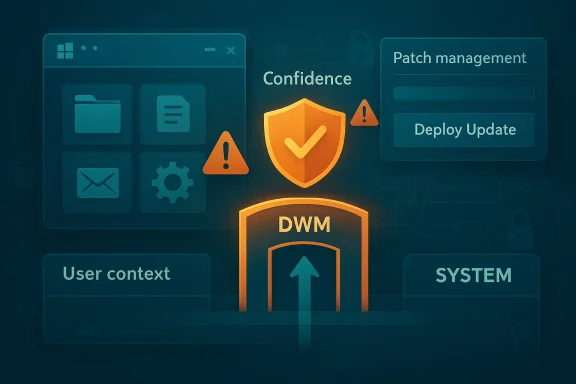 What Microsoft Is Signaling
The strongest reading of CVE-2026-32155 is simpes the flaw exists**, believes it is meaningful enough to catalog, and believes the public details are sufficiently credible to merit a security update. That may sound obvious, but in vulnerability management it is an important distinction. A record with sparse technical data can still represent a very real local privilege escalation threat, especially when it affects a core subsystem like DWM.The confidence framing matters because it reduces false comfort. Security teams sometimes deprioritize advisories when the public narrative is thin, assuming that a lack of detail implies weak evidence. Microsoft’s own guidance argues the opposite: the vulnerability’s existence and the credibility of the known technical details are part of the risk signal, and those signals can be strong even before exploit mechanics become public knowledge.
Why confidence is not just metadata
Confidence is operationally useful because it helps triage. When a local privilege escalation flaw lands in a privileged component, defenders need to know whether they are dealing with a speculative issue, a corroborated bug, or a fully confirmed vulnerability already suitable for exploitation. Microsoft’s model is meant to compress that judgment into something teams can act on quickly.- High confidence usually means the vendor is certain enough to publish and patch.
- Sparse public detail does not imply low urgency.
- Core Windows components deserve elevated attention because they are often abused after an initial foothold.
- Local EoP bugs are especially valuable to attackers in enterprise environments.
- A quiet advisory can still be a dangerous advisory.
Why Desktop Window Manager Keeps Coming Up
DWM is a natural candidate for repeated security attention because it sits in a complicated part of Windows architecture. It handles composition, desktop rendering, and interactions that touch both user-mode and kernel-adjacent behaviors, which means it must mediate between performance, compatibility, and security. That complexity is exactly what makes it hard to harden completely.The recurring theme across DWM-related CVEs is not necessarily one single flaw type, but rather a class of risk: trusted system code processing attacker-influenced state. When a local attacker can influence window states, object lifetimes, adata, a use-after-free, out-of-bounds read, or logic bug can become a reliable escalation path. This is why DWM vulnerabilities tend to be treated as high-value by both defenders and attackers.
The security value of a graphics component
Graphics subsystems are often underestimated because users think of them as visual layers. In reality, they are privilege-bearing services that sit close to core OS behavior. That makes them attractive to attackers who already have a foothold, because even a small flaw can yield a major jump in privilege.- DWM is deeply integrated into the Windows desktop experience.
- Its code path processes complex state and timing-sensitive operations.
- Memory safety bugs in such components are often exploit-friendly.
- Local attackers can use EoP bugs to move from standard user to SYSTEM.
- That is why evan be enterprise-critical.
How This Affects Enterprises
Enterprises should read CVE-2026-32155 as a post-exploitation accelerator risk. A local privilege escalation in DWM is not usually the first move in a campaign, but it is often the move that lets an intruder turn an initial access vector—phishing, credential theft, remote management misuse, or a low-privileged foothold—into broader administrative control. That makes the patch highly relevant even if exploit proofs are not public yet.The practical enterprise issue is time. Most organizations do not get compromised only by brand-new zero-days; they get hurt when a low-severity-seeming issue is left sitting in the queue while attackers chain it with another weakness. A DWM EoP patch therefore belongs in the same operational category as other privilege escalation fixes that close the gap between “we detected something” and “they own the endpoint.”
Patch priority in the real world
Security teams should not ask whether the public exploit code exists today. They should ask whether a local privilege escalation in a core Windows component can materially increase blast radius inside the environment. For DWM, the answer is almost always yes.- Inventory all Windows endpoints and servers that receive DWM-related security updates.
- Validate which builds are affected before broad deployment.
- Prioritize devices with user access, developer tooling, or elevated administrative exposure.
- Coordinate patching with reboot windows to avoid partial remediation.
- Monitor for signs of suspicious local privilege escalation attempts after deployment.
Consumer Impact: What Home Users Should Know
For home users, CVE-2026-32155 is less about enterprise compromise chains and more about the general principle that Windows patching matters even when the threat sounds “local.” A privilege escalation bug can still be abused on personal machines if malware gets in through a browser download, a malicious attachment, a rogue installer, or another foothold. Once any low-privilege code is running, an EoP flaw can become the bridge to full control.The problem with consumer security is that the point of compromise is often invisible. Users do not usually notice when a process quietly gains extra rights, and they may not connect a later ransomware event to a prior unpatched local vulnerability. That is why patch hygiene matters more than the specific severity label suggests. “Local” does not mean harmless.
What typical users should do
Home users do not need exploit mechanics to protect themselves. They need rapid update adoption and reasonable hygiene. The DWM advisory is a reminder that built-in Windows components are part of the security perimeter, even if they rarely appear in user-facing security discussions.- Install Windows security updates promptly.
- Reboot when prompted rather than deferring indefinitely.
- Avoid running unknown executables or cracked software.
- Keep Defender and browser protections active.
- Treat unexpected elevation prompts as suspicious.
Microsoft’s Broader Vulnerability Messaging
CVE-2026-32155 also fits into Microsoft’s increasingly structured approach to vulnerability communication. The company has been explicit that its Security Update Guide is meant to help customers understand not just whether a flaw is patched, but how confident Microsoft is about the vulnerability and how useful the public details are to attackers. That gives defenders an extra layer of context that used to be unavailable in traditional patch notes.That context matters because not all vulnerabilities are equally actionable from a threat-intelligence perspective. Some arrive with clear exploit narratives, while others are published with minimal technical detail because the vendor wants to minimize attacker advantage. Microsoft’s confidence model is designed to bridge that gap. It tells customers, in effect, that a sparse advisory can still be the most important thing on the patch list.
Why sparse does not mean speculative
A public advisory that lacks a root-cause write-up is not a sign of weakness; it is often a sign of responsible restraint. Microsoft may know enough to patch and classify, but not enough to disclose exploit mechanics without increasing risk. That tension is part of modern coordinated vulnerability disclosure.- Vendors often suppress exploitable details until patching is widespread.
- Confidence data helps readers distinguish real issues from ambiguous reports.
- The absence of a proof-of-concept does not reduce the need to patch.
- Security teams should correlate CVEs with component criticality.
- The more central the component, the less you should wait for certainty.
Competitive and Ecosystem Implications
A DWM vulnerability is not just a Microsoft problem; it is an ecosystem problem. Endpoint security vendors, patch orchestration platforms, vulnerability scanners, and managed service providers all have to interpret the same sparse advisory and decide how loudly to recommend remediation. That creates a familiar but important market dynamic: when Microsoft is conservative with details, the surrounding ecosystem has to translate the risk for customers.That translation often benefits defenders, but it also creates room for confusion. Some third-party trackers will overstate exploitability, while others may underplay a local EoP because it lacks remote attack characteristics. The result is that security teams need to separate technical severity from operational urgency. For DWM, those are very often not the same thing.
Why the market reacts quickly
Windows ecosystem vendors know that privilege escalation bugs are frequently chained and often weaponized in later stages of intrusion. That means EDR tuning, patch compliance reporting, and threat-hunting rules may need adjustment shortly after disclosure. Even without public exploit code, a DWM bug can become a detection prrs tend to reuse patterns once the patch exists.- Security vendors may update detections around suspicious token manipulation or unusual DWM activity.
- Patch-management tools may flag the CVE as high-priority due to component criticality.
- Incident responders may use the disclosure as a hunting prompt.
- MSPs will likely advise accelerated deployment.
- The advisory changes operational behavior before it changes exploit behavior.
Technical Context Without the Exploit Recipe
It is possible to discuss CVE-2026-32155 responsibly without turning the article into an exploit tutorial. The important technical point is that elevation of privilege means a lower-privileged actor can gain stronger rights on the same system, usually by abusing a bug in trusted code. When that trusted code belongs to DWM, the exploit value rises because DWM is part of the Windows desktop trust chain.In Windows security practice, local EoP flaws are often the bridge between foothold and full compromise. A user-space process with limited rights may interact with system components in ways that expose memory safety issues, handle confusion, object lifetime problems, or authorization logic errors. Even if the exact flaw type is not public here, the category alone is enough to justify urgent attention.
Why attackers care about local EoP
Attackers prefer privilege escalation because it turns persistence into power. If they can run code as a normal user, they can often wait until a higher-privileged service, scheduled task, or system component gives them leverage. A DWM flaw fits neatly into that strategy because it is a trusted Windows process with broad system relevance.- Local EoP bugs are ideal after initial compromise.
- They help attackers defeat least-privilege designs.
- They can enable credential theft, persistence, and defense evasion.
- They are often used in chained exploits.
- Their real value is multiplying the damage of another bug.
Strengths and Opportunities
The good news is that Microsoft’s advisory structure gives defenders more useful context than a simple CVE label. A patchable, vendor-confirmed DWM issue with a confidence signal is much easier to operationalize than a vague rumor, and it gives security teams a concrete basis for prioritization. That context also allows organizations to align patching, detection, and communication in a more disciplined way.- Clear vendor ownership of the issue.
- High-value component with obvious security relevance.
- Patchable through standard Windows servicing.
- Useful confidence signal for prioritization.
- Opportunity to improve privilege-escalation monitoring.
- Chance to test enterprise reboot and compliance workflows.
- Reinforces patch discipline across endpoints and servers.
Risks and Concerns
The main concern is that sparse public detail can lull some organizations into delay. If a security team equates “limited technical write-up” with “limited threat,” it may miss the fact that local privilege escalation bugs are often the most valuable bugs in a mature intrusion. That mistake is especially costly in environments where a single endpoint compromise can cascade into broader administrative reach.- Delayed patching because exploit mechanics are not public.
- Underestimation of local attack paths after an initial foothold.
- Patch fatigue in organizations facing many April 2026 advisories.
- Incomplete inventory of affected Windows builds.
- Potential chaining with other malware or post-exploitation tools.
- False reassurance if no active exploitation is yet reported publicly.
- Operational disruption if patching is rushed without testing.
Looking Ahead
The next thing to watch is whether Microsoft, third-party researchers, or incident responders publish more detail about the flaw’s nature. If additional technical information appears, it may clarify whether the issue resembles a memory-safety bug, a logic error, or a handle/state confusion problem. Until then, the safest assumption is that the patch addresses a meaningful privilege boundary weakness in a sensitive Windows component.Security teams should also watch for signs that DWM-related bugs are becoming a repeat pattern in 2026. Repeated advisories against the same subsystem often indicate either a particularly difficult code base to harden or a component that remains attractive to exploit developers. In either case, the operational response should be the same: prioritize remediation and look for chains, not just isolated CVEs.
Items to monitor next
- Any updated Microsoft advisory details for CVE-2026-32155.
- Patch availability and build-number mappings across supported Windows releases.
- Reports from incident responders or threat researchers about exploit chaining.
- Enterprise telemetry showing suspicious local privilege escalation activity.
- Whether Microsoft’s confidence/exploitability guidance changes in follow-up notes.
CVE-2026-32155 is exactly the kind of Windows vulnerability that rewards disciplined, fast remediation and punishes hesitation. Even with thin public detail, the combination of DWM’s privileged role, Microsoft’s confidence framing, and the well-known danger of local elevation-of-privilege bugs makes this an issue worth treating as operationally urgent. The safest posture is simple: assume the vulnerability is real, patch it promptly, and look at it as part of a larger strategy for reducing the blast radius of every future foothold.
Source: MSRC Security Update Guide - Microsoft Security Response Center
