Microsoft announced the public preview of Azure Linux 4.0 on June 2, 2026, making its Fedora-derived, RPM-based Linux distribution available for evaluation on Azure virtual machines, VM Scale Sets, and container images. The news is not that Microsoft now “has a Linux distro”; it has had one for years under the CBL-Mariner and Azure Linux names. The news is that Microsoft is turning that internal cloud substrate into something customers can test directly, and it is doing so with a technical base that pulls it closer to the wider Fedora ecosystem. Azure Linux 4.0 is less a sentimental open-source milestone than a statement about where Microsoft thinks operating systems belong in the cloud era: tightly integrated, centrally maintained, and optimized for a single hyperscaler’s control plane.
For most of the last decade, Microsoft’s public Linux posture has been framed as a reversal story. The old antagonist embraced Linux on Azure, shipped WSL for developers, joined foundations, open-sourced tools, and learned to sell cloud infrastructure to people who did not want Windows Server. That narrative is true enough, but it now feels incomplete.
Azure Linux 4.0 shows a more mature phase of the same shift. Microsoft is no longer merely making Azure hospitable to Linux distributions maintained by others. It is offering its own first-party Linux platform for customers who want the operational comfort of buying the whole stack from one vendor.
That does not make Azure Linux a Windows replacement, nor does it turn Microsoft into Red Hat overnight. The distribution is explicitly built for Azure workloads rather than desktops, hobbyist machines, or arbitrary bare-metal fleets. But it does mark a meaningful expansion of Microsoft’s operating-system ambitions beyond Windows-branded environments.
This is the cloud logic finally reaching the OS layer. Azure already abstracts compute, storage, identity, networking, monitoring, patching, and security posture into Microsoft-managed services. A Microsoft-maintained Linux base fits that pattern neatly: fewer moving parts for customers, more control for Microsoft, and a cleaner story for regulated enterprises that want consistency more than distro pluralism.
That distinction matters. Azure Linux 4.0 is not Fedora with a Microsoft wallpaper, and treating it that way obscures what Microsoft is trying to build. Fedora provides a modern RPM ecosystem and a fast-moving source base; Microsoft then curates the result into a platform that serves Azure’s needs first.
In practical terms, that means administrators should expect familiar RPM concepts and tooling, including DNF-era package management, but not the same assumptions they might carry from Fedora Server or downstream enterprise distributions. Microsoft controls what ships, how it is configured, how updates are staged, and what Azure services are expected to integrate with it. The value proposition is not community breadth; it is cloud-specific predictability.
The Fedora relationship is also politically interesting. For years, enterprise Linux strategy has often flowed through the Fedora-to-RHEL ecosystem, with clones, rebuilds, and derivatives reacting to Red Hat’s moves. Microsoft is not positioning Azure Linux as a RHEL clone, but by basing its new platform on Fedora sources, it is tapping into the same upstream energy that has long powered enterprise Linux innovation.
That gives Azure Linux a more credible technical foundation than a fully isolated in-house package universe would provide. It also reduces the risk that Microsoft’s distro becomes an oddball environment where every package decision is bespoke. The catch is that customers must still understand who owns the final product: Fedora is the source stream, but Azure is the destination.
This is why the comparison to Amazon Linux is useful, but imperfect. Both distributions exist because hyperscalers want a first-party Linux environment aligned with their infrastructure and support models. Both reduce ambiguity for customers who prefer to run on the provider’s defaults. Both also create a subtle gravity well around the provider’s own cloud.
Azure Linux 4.0’s preview availability through the Azure Marketplace makes that point concrete. The easiest path is not downloading an ISO and installing it wherever one pleases. It is deploying a Microsoft-published image into Microsoft’s cloud and letting Azure’s surrounding services do the work.
That is not a defect; it is the product. Azure Linux is designed for people who already accept Azure as the operating environment and want the guest OS to feel like part of that environment rather than a foreign component. The more deeply a workload depends on Azure Monitor, Defender for Cloud, Azure Migrate, AKS, managed identities, and Azure’s patching assumptions, the more attractive a Microsoft-maintained Linux base becomes.
The flip side is obvious. If your organization values cross-cloud symmetry above all else, Azure Linux may be a poor strategic fit. A distribution optimized for one provider’s operational model can simplify life inside that provider while making exit paths less elegant.
Preview status matters especially because operating systems are dependency magnets. Once an image becomes the basis for automation, security baselines, golden images, CI/CD assumptions, package mirrors, compliance scans, and backup procedures, changing course is painful. A preview Linux distribution can be useful precisely because it gives teams time to test those edges before the stable release lands.
For WindowsForum readers, this should feel familiar. Windows administrators have learned the hard way that servicing models, driver assumptions, feature flags, and enterprise readiness are not theoretical details. The same is true in Linux fleets, where kernel behavior, package cadence, SELinux policy, FIPS posture, and agent compatibility can determine whether an OS is boring in production or a source of recurring incidents.
The practical recommendation is conservative: test Azure Linux 4.0 as a candidate platform, not as a migration mandate. Build a VM, deploy a scale set, run representative containers, validate your monitoring and endpoint tooling, and see where your assumptions break. The preview is a chance to learn cheaply.
It is also a chance to interrogate Microsoft’s promises. Faster provisioning, smaller package footprints, Azure-tuned kernels, predictable updates, and security integration all sound appealing. They only matter if they survive contact with your workload, your compliance team, and your incident response playbooks.
Microsoft’s Azure Linux pitch cuts in the opposite direction. It argues that the problem is not too little Linux freedom but too much operational variation. One distribution for VMs, another for Kubernetes nodes, another for containers, and another for developer machines can create patching complexity, inconsistent baselines, and security drift.
This is not wrong. At enterprise scale, heterogeneity often becomes a tax. Every additional supported OS version multiplies the work required for vulnerability management, image hardening, compliance attestation, incident response, and lifecycle planning.
But the cure is also a kind of centralization. Azure Linux asks customers to trade some distro independence for Microsoft’s promise of a coherent Azure-native base. That may be a rational trade for organizations that are already heavily committed to Azure, but it should not be mistaken for a neutral technical upgrade.
A Microsoft-controlled Linux baseline gives Microsoft more influence over the lower layers of Azure workloads. It can tune for its infrastructure, integrate with its security products, and shape the lifecycle around its cloud services. Customers get simplification; Microsoft gets alignment.
That history matters because cloud operating systems succeed on trust and repetition, not novelty. Administrators are not looking for an exciting guest OS. They are looking for one that patches predictably, boots reliably, supports their agents, avoids surprise regressions, and disappears into the background.
AKS has been a natural proving ground. Kubernetes nodes are ideal candidates for a minimal, provider-tuned OS because their job is not to be lovingly administered by hand. They exist to run containers, rotate through scale events, receive updates, and participate in a managed control-plane model.
Azure Linux 4.0 broadens that idea toward VMs and VM Scale Sets. That is a more demanding arena because VM workloads are often messier than Kubernetes nodes. They carry legacy scripts, hand-installed packages, vendor agents, cron jobs, local assumptions, and long-lived configuration patterns.
If Microsoft can make Azure Linux boring in that world, it will have achieved something significant. If it cannot, customers will treat it as an AKS-adjacent curiosity rather than a serious default for general Azure compute.
A smaller package footprint reduces the number of components that need patching and monitoring. A predictable update cadence helps security teams plan instead of lurching from emergency to emergency. A first-party supply chain allows Microsoft to tie build, validation, publication, and support into its Azure operating model.
This is where Azure Linux may prove most compelling. Many enterprises do not want to become Linux distribution experts. They want defensible defaults, vendor accountability, and a support path that does not turn every incident into a three-way conversation among the cloud provider, OS vendor, and security-tool vendor.
Microsoft can exploit that desire. Defender for Cloud, Azure Monitor, vulnerability assessment, and managed image workflows become more compelling when the guest OS is also part of the Microsoft stack. The security story becomes simpler to buy, even if the technical reality still requires scrutiny.
There is a risk, however, in confusing integration with immunity. A Microsoft-maintained Linux distribution will still have CVEs, kernel bugs, package regressions, and configuration mistakes. The question is not whether Azure Linux eliminates the ordinary problems of Linux administration. It is whether Microsoft can handle those problems with less friction for Azure customers than third-party distributions can.
If you administer Azure, you are already in Linux’s orbit. You may manage Linux VMs through Azure Policy, collect logs through Azure Monitor, secure workloads through Defender, administer Kubernetes nodes, or troubleshoot application stacks where Windows and Linux components share the same network and identity fabric. Azure Linux 4.0 makes that convergence more explicit.
The distribution also reinforces a broader Microsoft strategy: Windows is no longer the only operating system that matters to Microsoft’s platform business. Windows remains central on the desktop and in many server environments, but Azure’s growth depends on making Linux workloads first-class citizens. Owning a Linux baseline gives Microsoft another way to do that.
For Windows Server shops, the immediate implication is not panic. Azure Linux is not a signal that Windows Server is being abandoned. It is a signal that Microsoft will increasingly treat operating systems as workload-specific substrates inside Azure rather than as ideological camps.
That distinction is important. The future Microsoft wants is not Windows versus Linux. It is Azure as the plane above both, with the guest OS chosen according to workload fit and managed through Microsoft’s cloud tooling.
But the WSL angle should not dominate the interpretation of Azure Linux 4.0. This is not primarily a developer convenience feature. It is a cloud infrastructure move.
A WSL image could help bridge local development and cloud deployment by giving developers a closer approximation of the Azure Linux environment on Windows machines. That matters for teams that want fewer “works on my machine” surprises when packaging services, testing scripts, or building container images. It also fits Microsoft’s long-running effort to make Windows a comfortable workstation for cloud-native development.
Still, the center of gravity is Azure compute. VMs, scale sets, containers, and eventually AKS support are where Azure Linux 4.0 has strategic weight. WSL would be the developer doorway into that environment, not the reason the environment exists.
That could be good for Fedora if Microsoft contributes fixes, testing, engineering attention, and visibility upstream. Large downstream consumers can strengthen open-source projects when they participate responsibly. They can also strain expectations if they mostly extract value while keeping product decisions downstream.
The early framing suggests Microsoft wants to be clear that Azure Linux is open source but Azure-supported only in Azure scenarios. That is a pragmatic boundary, yet it also underscores that this is not a community distribution in the Fedora sense. Users can inspect sources and experiment, but Microsoft’s support promise is tied to Microsoft’s cloud.
That makes Azure Linux a fascinating hybrid. It is open-source software shaped by a proprietary cloud business model. Its packages may originate in a community ecosystem, but its product identity is hyperscaler-specific.
This is not inherently sinister. Much of modern cloud infrastructure works this way. But it does mean the open-source label alone does not tell users what kind of power relationship they are entering.
That is how cloud platforms reshape infrastructure. They do not need to ban alternatives. They make the integrated path easier, cheaper, better documented, and more supportable. Over time, the path of least resistance becomes the standard.
Azure already offers many Linux images, including widely used enterprise and community distributions. Those will remain necessary because customers bring existing estates, vendor requirements, application certifications, and staff expertise. Azure Linux does not erase that diversity.
But it does introduce a new center of gravity. For greenfield Azure workloads without a strong distro dependency, a no-additional-license-cost Microsoft-supported Linux image will be tempting. If it integrates cleanly with Azure’s security and monitoring stack, the argument becomes stronger.
That is why the public preview is strategically important even before production readiness. Microsoft is training the market to consider Azure Linux as a normal choice for Azure compute. Once that mental shift happens, the stable release has a runway.
For some users, that will be perfectly acceptable. If an organization runs primarily in Azure, unsupported bare-metal or other-cloud use may be irrelevant. The whole point is to standardize within Azure.
For others, it will be a red flag. Many enterprises prefer distributions that can span on-premises, multiple clouds, and edge environments with a consistent support model. In those cases, RHEL, Ubuntu, SUSE, or other established platforms may remain more attractive.
This is where Azure Linux’s identity as a cloud-provider distribution becomes both strength and limitation. Its focus allows Microsoft to optimize aggressively for Azure. That same focus narrows its usefulness outside Azure.
IT leaders should treat that boundary as a design constraint, not a footnote. If you adopt Azure Linux because it simplifies Azure operations, document that assumption clearly. Do not quietly let it become a general-purpose Linux standard unless the support model matches the deployment reality.
The general-purpose Azure Linux track gives administrators package management, flexibility, and a more familiar VM-oriented model. Azure Container Linux points in the opposite direction: image-based, locked-down, minimal, and designed for environments where mutability itself is a liability. That mirrors the broader industry split between traditional servers and cattle-like container hosts.
For customers, this creates a useful but important choice. A database VM, a legacy service, or a general application host may need the manageability of a conventional distribution. A Kubernetes node pool in a high-security environment may be better served by an immutable host that resists drift.
Microsoft’s advantage is that both can sit under the Azure umbrella. The company can offer a family of Linux foundations instead of forcing every workload into the same OS personality. That is more credible than pretending cloud Linux has only one job.
It also suggests where the market is heading. The OS is becoming less a user-visible environment and more a workload contract. Some contracts require package flexibility; others require immutability and aggressive minimization.
That matters because it keeps the strategic picture clean. Microsoft’s Linux interest is economic and infrastructural, not sentimental. Azure runs enormous Linux workloads because customers run enormous Linux workloads. Microsoft wants those workloads to run well, stay secure, and remain inside Azure.
The desktop remains Windows territory for Microsoft, with WSL acting as a bridge for developers rather than a surrender flag. Azure Linux strengthens that bridge only insofar as it gives developers and cloud teams a Microsoft-maintained Linux target. It does not imply a consumer Linux push.
If anything, Azure Linux 4.0 reinforces the bifurcation of Microsoft’s OS strategy. Windows is the client and enterprise desktop platform, plus a major server platform where it remains appropriate. Linux is the cloud-native substrate Microsoft must master because Azure cannot grow on Windows workloads alone.
That is not hypocrisy. It is adaptation.
Package availability is one obvious area. A minimal cloud distribution may not include every library, tool, language runtime, or agent an application expects. Adding packages may be straightforward, but the supported package universe and update cadence matter.
Security tooling is another. Vulnerability scanners, endpoint detection agents, compliance scripts, backup tools, configuration management systems, and logging agents all need validation. The Microsoft-native path may be smooth, but many organizations operate mixed tooling stacks.
Performance assumptions deserve attention too. Azure-tuned images may boot quickly and run efficiently, but every workload has its own bottlenecks. Storage latency, network behavior, kernel defaults, cgroup behavior, crypto settings, and filesystem choices can all matter.
The most important test may be organizational rather than technical. If adopting Azure Linux means changing who owns images, patches, exceptions, and incident escalation, the OS choice becomes a process change. Successful standardization requires more than a Marketplace image.
The immediate facts are straightforward:
The preview will rise or fall on whether Azure Linux can become boring in the best enterprise sense: predictable, supportable, secure enough, and easy to automate at scale. If Microsoft delivers that, Azure Linux 4.0 will not need to win culture-war arguments about Linux purity or Windows decline. It will simply become another Azure default, and in cloud infrastructure, defaults have a way of becoming destiny.
 Microsoft’s Linux Story Has Moved From Accommodation to Ownership
For most of the last decade, Microsoft’s public Linux posture has been framed as a reversal story. The old antagonist embraced Linux on Azure, shipped WSL for developers, joined foundations, open-sourced tools, and learned to sell cloud infrastructure to people who did not want Windows Server. That narrative is true enough, but it now feels incomplete.Azure Linux 4.0 shows a more mature phase of the same shift. Microsoft is no longer merely making Azure hospitable to Linux distributions maintained by others. It is offering its own first-party Linux platform for customers who want the operational comfort of buying the whole stack from one vendor.
That does not make Azure Linux a Windows replacement, nor does it turn Microsoft into Red Hat overnight. The distribution is explicitly built for Azure workloads rather than desktops, hobbyist machines, or arbitrary bare-metal fleets. But it does mark a meaningful expansion of Microsoft’s operating-system ambitions beyond Windows-branded environments.
This is the cloud logic finally reaching the OS layer. Azure already abstracts compute, storage, identity, networking, monitoring, patching, and security posture into Microsoft-managed services. A Microsoft-maintained Linux base fits that pattern neatly: fewer moving parts for customers, more control for Microsoft, and a cleaner story for regulated enterprises that want consistency more than distro pluralism.
The Fedora Base Is the Architectural Headline, Not a Branding Detail
The most consequential technical change in Azure Linux 4.0 is its Fedora-derived foundation. Previous Azure Linux releases descended from CBL-Mariner, Microsoft’s own minimal Linux distribution designed for cloud infrastructure and internal services. With 4.0, Microsoft says it is drawing sources from Fedora while applying Azure-specific overlays, policy decisions, package choices, and integration work.That distinction matters. Azure Linux 4.0 is not Fedora with a Microsoft wallpaper, and treating it that way obscures what Microsoft is trying to build. Fedora provides a modern RPM ecosystem and a fast-moving source base; Microsoft then curates the result into a platform that serves Azure’s needs first.
In practical terms, that means administrators should expect familiar RPM concepts and tooling, including DNF-era package management, but not the same assumptions they might carry from Fedora Server or downstream enterprise distributions. Microsoft controls what ships, how it is configured, how updates are staged, and what Azure services are expected to integrate with it. The value proposition is not community breadth; it is cloud-specific predictability.
The Fedora relationship is also politically interesting. For years, enterprise Linux strategy has often flowed through the Fedora-to-RHEL ecosystem, with clones, rebuilds, and derivatives reacting to Red Hat’s moves. Microsoft is not positioning Azure Linux as a RHEL clone, but by basing its new platform on Fedora sources, it is tapping into the same upstream energy that has long powered enterprise Linux innovation.
That gives Azure Linux a more credible technical foundation than a fully isolated in-house package universe would provide. It also reduces the risk that Microsoft’s distro becomes an oddball environment where every package decision is bespoke. The catch is that customers must still understand who owns the final product: Fedora is the source stream, but Azure is the destination.
Azure Linux Is a Cloud Appliance Wearing a General-Purpose Suit
Microsoft describes Azure Linux 4.0 as suitable for Azure workloads including virtual machines, VM Scale Sets, container images, and Kubernetes-related scenarios. That sounds broad, and in cloud terms it is. But the distribution’s boundaries are equally important: it is not meant for desktop use, GUI workloads, unsupported bare-metal deployments, or general multi-cloud portability.This is why the comparison to Amazon Linux is useful, but imperfect. Both distributions exist because hyperscalers want a first-party Linux environment aligned with their infrastructure and support models. Both reduce ambiguity for customers who prefer to run on the provider’s defaults. Both also create a subtle gravity well around the provider’s own cloud.
Azure Linux 4.0’s preview availability through the Azure Marketplace makes that point concrete. The easiest path is not downloading an ISO and installing it wherever one pleases. It is deploying a Microsoft-published image into Microsoft’s cloud and letting Azure’s surrounding services do the work.
That is not a defect; it is the product. Azure Linux is designed for people who already accept Azure as the operating environment and want the guest OS to feel like part of that environment rather than a foreign component. The more deeply a workload depends on Azure Monitor, Defender for Cloud, Azure Migrate, AKS, managed identities, and Azure’s patching assumptions, the more attractive a Microsoft-maintained Linux base becomes.
The flip side is obvious. If your organization values cross-cloud symmetry above all else, Azure Linux may be a poor strategic fit. A distribution optimized for one provider’s operational model can simplify life inside that provider while making exit paths less elegant.
The Preview Label Is Doing Real Work
Microsoft is careful to call Azure Linux 4.0 a public preview, and administrators should take that literally. The release is intended for evaluation and testing, not production deployment. That warning is not boilerplate; it is the difference between kicking the tires on a future fleet baseline and betting a business service on a still-moving platform.Preview status matters especially because operating systems are dependency magnets. Once an image becomes the basis for automation, security baselines, golden images, CI/CD assumptions, package mirrors, compliance scans, and backup procedures, changing course is painful. A preview Linux distribution can be useful precisely because it gives teams time to test those edges before the stable release lands.
For WindowsForum readers, this should feel familiar. Windows administrators have learned the hard way that servicing models, driver assumptions, feature flags, and enterprise readiness are not theoretical details. The same is true in Linux fleets, where kernel behavior, package cadence, SELinux policy, FIPS posture, and agent compatibility can determine whether an OS is boring in production or a source of recurring incidents.
The practical recommendation is conservative: test Azure Linux 4.0 as a candidate platform, not as a migration mandate. Build a VM, deploy a scale set, run representative containers, validate your monitoring and endpoint tooling, and see where your assumptions break. The preview is a chance to learn cheaply.
It is also a chance to interrogate Microsoft’s promises. Faster provisioning, smaller package footprints, Azure-tuned kernels, predictable updates, and security integration all sound appealing. They only matter if they survive contact with your workload, your compliance team, and your incident response playbooks.
Microsoft Is Selling Fewer Linux Choices as an Enterprise Feature
The traditional Linux advantage has been choice. Pick Ubuntu, Debian, Fedora, RHEL, SUSE, AlmaLinux, Rocky Linux, Oracle Linux, Amazon Linux, Flatcar, Bottlerocket, or a purpose-built container host. Choose your release cadence, support vendor, package ecosystem, security posture, and community culture.Microsoft’s Azure Linux pitch cuts in the opposite direction. It argues that the problem is not too little Linux freedom but too much operational variation. One distribution for VMs, another for Kubernetes nodes, another for containers, and another for developer machines can create patching complexity, inconsistent baselines, and security drift.
This is not wrong. At enterprise scale, heterogeneity often becomes a tax. Every additional supported OS version multiplies the work required for vulnerability management, image hardening, compliance attestation, incident response, and lifecycle planning.
But the cure is also a kind of centralization. Azure Linux asks customers to trade some distro independence for Microsoft’s promise of a coherent Azure-native base. That may be a rational trade for organizations that are already heavily committed to Azure, but it should not be mistaken for a neutral technical upgrade.
A Microsoft-controlled Linux baseline gives Microsoft more influence over the lower layers of Azure workloads. It can tune for its infrastructure, integrate with its security products, and shape the lifecycle around its cloud services. Customers get simplification; Microsoft gets alignment.
AKS Made Azure Linux Credible Before the VM Preview Arrived
Azure Linux did not appear out of nowhere. Its predecessor lineage, including CBL-Mariner, has been used inside Microsoft and in Azure Kubernetes Service contexts for years. Microsoft has said Azure Linux powers major internal services and large-scale production environments, which gives the 4.0 preview a different flavor from a brand-new distribution launched into the void.That history matters because cloud operating systems succeed on trust and repetition, not novelty. Administrators are not looking for an exciting guest OS. They are looking for one that patches predictably, boots reliably, supports their agents, avoids surprise regressions, and disappears into the background.
AKS has been a natural proving ground. Kubernetes nodes are ideal candidates for a minimal, provider-tuned OS because their job is not to be lovingly administered by hand. They exist to run containers, rotate through scale events, receive updates, and participate in a managed control-plane model.
Azure Linux 4.0 broadens that idea toward VMs and VM Scale Sets. That is a more demanding arena because VM workloads are often messier than Kubernetes nodes. They carry legacy scripts, hand-installed packages, vendor agents, cron jobs, local assumptions, and long-lived configuration patterns.
If Microsoft can make Azure Linux boring in that world, it will have achieved something significant. If it cannot, customers will treat it as an AKS-adjacent curiosity rather than a serious default for general Azure compute.
The Security Pitch Is About Surface Area and Supply Chain Control
Microsoft’s security argument for Azure Linux 4.0 rests on several familiar pillars: a minimal package set, predictable updates, Azure-tuned configurations, and integration with Microsoft’s cloud security tooling. None of those ideas is revolutionary. Together, they form a persuasive enterprise story.A smaller package footprint reduces the number of components that need patching and monitoring. A predictable update cadence helps security teams plan instead of lurching from emergency to emergency. A first-party supply chain allows Microsoft to tie build, validation, publication, and support into its Azure operating model.
This is where Azure Linux may prove most compelling. Many enterprises do not want to become Linux distribution experts. They want defensible defaults, vendor accountability, and a support path that does not turn every incident into a three-way conversation among the cloud provider, OS vendor, and security-tool vendor.
Microsoft can exploit that desire. Defender for Cloud, Azure Monitor, vulnerability assessment, and managed image workflows become more compelling when the guest OS is also part of the Microsoft stack. The security story becomes simpler to buy, even if the technical reality still requires scrutiny.
There is a risk, however, in confusing integration with immunity. A Microsoft-maintained Linux distribution will still have CVEs, kernel bugs, package regressions, and configuration mistakes. The question is not whether Azure Linux eliminates the ordinary problems of Linux administration. It is whether Microsoft can handle those problems with less friction for Azure customers than third-party distributions can.
Windows Administrators Should Pay Attention, Even If They Never Deploy It
At first glance, Azure Linux 4.0 sounds like news for Linux admins and cloud architects, not Windows professionals. That is an outdated way to read the enterprise. Windows administrators increasingly manage mixed estates where identity, endpoint security, monitoring, storage, networking, and automation cross operating-system boundaries.If you administer Azure, you are already in Linux’s orbit. You may manage Linux VMs through Azure Policy, collect logs through Azure Monitor, secure workloads through Defender, administer Kubernetes nodes, or troubleshoot application stacks where Windows and Linux components share the same network and identity fabric. Azure Linux 4.0 makes that convergence more explicit.
The distribution also reinforces a broader Microsoft strategy: Windows is no longer the only operating system that matters to Microsoft’s platform business. Windows remains central on the desktop and in many server environments, but Azure’s growth depends on making Linux workloads first-class citizens. Owning a Linux baseline gives Microsoft another way to do that.
For Windows Server shops, the immediate implication is not panic. Azure Linux is not a signal that Windows Server is being abandoned. It is a signal that Microsoft will increasingly treat operating systems as workload-specific substrates inside Azure rather than as ideological camps.
That distinction is important. The future Microsoft wants is not Windows versus Linux. It is Azure as the plane above both, with the guest OS chosen according to workload fit and managed through Microsoft’s cloud tooling.
The WSL Angle Is Interesting, but It Is Not the Main Event
Microsoft has indicated that Windows Subsystem for Linux support is part of the Azure Linux 4.0 roadmap, though not the core of the public preview story. That will draw attention because WSL is the place where many Windows users experience Linux most directly. A Microsoft-maintained Azure Linux image inside WSL would make sense for developers building against Azure-native environments.But the WSL angle should not dominate the interpretation of Azure Linux 4.0. This is not primarily a developer convenience feature. It is a cloud infrastructure move.
A WSL image could help bridge local development and cloud deployment by giving developers a closer approximation of the Azure Linux environment on Windows machines. That matters for teams that want fewer “works on my machine” surprises when packaging services, testing scripts, or building container images. It also fits Microsoft’s long-running effort to make Windows a comfortable workstation for cloud-native development.
Still, the center of gravity is Azure compute. VMs, scale sets, containers, and eventually AKS support are where Azure Linux 4.0 has strategic weight. WSL would be the developer doorway into that environment, not the reason the environment exists.
Fedora Gains a Powerful Downstream, but Not a Simple One
The Fedora-derived base creates an intriguing relationship between Microsoft and the Fedora ecosystem. Fedora has long functioned as a fast-moving upstream for technologies that later influence enterprise Linux. Microsoft now benefits from that ecosystem’s package flow, tooling, and development velocity.That could be good for Fedora if Microsoft contributes fixes, testing, engineering attention, and visibility upstream. Large downstream consumers can strengthen open-source projects when they participate responsibly. They can also strain expectations if they mostly extract value while keeping product decisions downstream.
The early framing suggests Microsoft wants to be clear that Azure Linux is open source but Azure-supported only in Azure scenarios. That is a pragmatic boundary, yet it also underscores that this is not a community distribution in the Fedora sense. Users can inspect sources and experiment, but Microsoft’s support promise is tied to Microsoft’s cloud.
That makes Azure Linux a fascinating hybrid. It is open-source software shaped by a proprietary cloud business model. Its packages may originate in a community ecosystem, but its product identity is hyperscaler-specific.
This is not inherently sinister. Much of modern cloud infrastructure works this way. But it does mean the open-source label alone does not tell users what kind of power relationship they are entering.
The Real Competition Is Operational Default, Not Distro Loyalty
Linux distributions often inspire tribal debates, but Azure Linux 4.0 will not win by converting Fedora, Ubuntu, or RHEL loyalists on philosophical grounds. It will win if Azure customers start selecting it by default because it is the least surprising choice inside Microsoft’s cloud. Defaults are more powerful than arguments.That is how cloud platforms reshape infrastructure. They do not need to ban alternatives. They make the integrated path easier, cheaper, better documented, and more supportable. Over time, the path of least resistance becomes the standard.
Azure already offers many Linux images, including widely used enterprise and community distributions. Those will remain necessary because customers bring existing estates, vendor requirements, application certifications, and staff expertise. Azure Linux does not erase that diversity.
But it does introduce a new center of gravity. For greenfield Azure workloads without a strong distro dependency, a no-additional-license-cost Microsoft-supported Linux image will be tempting. If it integrates cleanly with Azure’s security and monitoring stack, the argument becomes stronger.
That is why the public preview is strategically important even before production readiness. Microsoft is training the market to consider Azure Linux as a normal choice for Azure compute. Once that mental shift happens, the stable release has a runway.
Support Boundaries Will Decide How Far Customers Trust It
Microsoft’s documentation and messaging draw a sharp support line: Azure Linux is built for Azure, and Microsoft support and lifecycle commitments apply to Azure scenarios. Images and source code may be usable elsewhere, but that does not make those deployments supported products.For some users, that will be perfectly acceptable. If an organization runs primarily in Azure, unsupported bare-metal or other-cloud use may be irrelevant. The whole point is to standardize within Azure.
For others, it will be a red flag. Many enterprises prefer distributions that can span on-premises, multiple clouds, and edge environments with a consistent support model. In those cases, RHEL, Ubuntu, SUSE, or other established platforms may remain more attractive.
This is where Azure Linux’s identity as a cloud-provider distribution becomes both strength and limitation. Its focus allows Microsoft to optimize aggressively for Azure. That same focus narrows its usefulness outside Azure.
IT leaders should treat that boundary as a design constraint, not a footnote. If you adopt Azure Linux because it simplifies Azure operations, document that assumption clearly. Do not quietly let it become a general-purpose Linux standard unless the support model matches the deployment reality.
Azure Container Linux Reveals the Split Inside Microsoft’s Strategy
Alongside Azure Linux 4.0, Microsoft has been developing Azure Container Linux, an immutable, container-optimized variant aimed at stricter security and compliance use cases. The split is telling. Microsoft does not see one Linux shape serving every cloud workload.The general-purpose Azure Linux track gives administrators package management, flexibility, and a more familiar VM-oriented model. Azure Container Linux points in the opposite direction: image-based, locked-down, minimal, and designed for environments where mutability itself is a liability. That mirrors the broader industry split between traditional servers and cattle-like container hosts.
For customers, this creates a useful but important choice. A database VM, a legacy service, or a general application host may need the manageability of a conventional distribution. A Kubernetes node pool in a high-security environment may be better served by an immutable host that resists drift.
Microsoft’s advantage is that both can sit under the Azure umbrella. The company can offer a family of Linux foundations instead of forcing every workload into the same OS personality. That is more credible than pretending cloud Linux has only one job.
It also suggests where the market is heading. The OS is becoming less a user-visible environment and more a workload contract. Some contracts require package flexibility; others require immutability and aggressive minimization.
The Linux Desktop Was Never the Point
Every time Microsoft does something conspicuous with Linux, someone asks whether this changes the desktop story. Azure Linux 4.0 does not. Microsoft is not launching a Fedora-based Windows rival, and the distribution is explicitly not intended for desktop or GUI use.That matters because it keeps the strategic picture clean. Microsoft’s Linux interest is economic and infrastructural, not sentimental. Azure runs enormous Linux workloads because customers run enormous Linux workloads. Microsoft wants those workloads to run well, stay secure, and remain inside Azure.
The desktop remains Windows territory for Microsoft, with WSL acting as a bridge for developers rather than a surrender flag. Azure Linux strengthens that bridge only insofar as it gives developers and cloud teams a Microsoft-maintained Linux target. It does not imply a consumer Linux push.
If anything, Azure Linux 4.0 reinforces the bifurcation of Microsoft’s OS strategy. Windows is the client and enterprise desktop platform, plus a major server platform where it remains appropriate. Linux is the cloud-native substrate Microsoft must master because Azure cannot grow on Windows workloads alone.
That is not hypocrisy. It is adaptation.
Enterprises Should Test the Boring Parts First
The temptation with a new distribution is to focus on the headline: Fedora-derived, Microsoft-maintained, Azure-optimized. The useful work is more mundane. Enterprises should test whether Azure Linux 4.0 behaves predictably in the dull corners where production systems actually fail.Package availability is one obvious area. A minimal cloud distribution may not include every library, tool, language runtime, or agent an application expects. Adding packages may be straightforward, but the supported package universe and update cadence matter.
Security tooling is another. Vulnerability scanners, endpoint detection agents, compliance scripts, backup tools, configuration management systems, and logging agents all need validation. The Microsoft-native path may be smooth, but many organizations operate mixed tooling stacks.
Performance assumptions deserve attention too. Azure-tuned images may boot quickly and run efficiently, but every workload has its own bottlenecks. Storage latency, network behavior, kernel defaults, cgroup behavior, crypto settings, and filesystem choices can all matter.
The most important test may be organizational rather than technical. If adopting Azure Linux means changing who owns images, patches, exceptions, and incident escalation, the OS choice becomes a process change. Successful standardization requires more than a Marketplace image.
The Azure Linux 4.0 Preview Narrows the Bet
Azure Linux 4.0 is not trying to be everything to everyone, and that is why it matters. Microsoft is making a narrower bet: that enough Azure customers want a first-party Linux environment optimized for Microsoft’s cloud to justify a dedicated distribution with a Fedora-derived base.The immediate facts are straightforward:
- Azure Linux 4.0 is in public preview and should be treated as an evaluation release rather than a production platform.
- The distribution is Fedora-derived and RPM-based, but Microsoft controls the final package set, configuration, security posture, and Azure integrations.
- The preview targets Azure virtual machines, VM Scale Sets, and container images, with broader Kubernetes and WSL scenarios expected to develop around the platform.
- Microsoft’s support story is centered on Azure environments, not bare-metal desktops, other clouds, or general-purpose Linux experimentation.
- The strategic value is operational consistency across Azure workloads, especially for teams already invested in Microsoft’s monitoring, security, and lifecycle tooling.
The preview will rise or fall on whether Azure Linux can become boring in the best enterprise sense: predictable, supportable, secure enough, and easy to automate at scale. If Microsoft delivers that, Azure Linux 4.0 will not need to win culture-war arguments about Linux purity or Windows decline. It will simply become another Azure default, and in cloud infrastructure, defaults have a way of becoming destiny.
References
- Primary source: Linuxiac
Published: Fri, 05 Jun 2026 11:11:34 GMT

Microsoft Opens the Door to Azure Linux 4.0 Testing
Azure Linux 4.0 is now in public preview, giving users an early look at Microsoft’s Fedora-based Linux system for Azure. linuxiac.com
- Official source: techcommunity.microsoft.com
Announcing Azure Linux 4.0: Purpose-Built for Azure, Now in Public Preview | Microsoft Community Hub
Today at Microsoft Build, we're announcing the public preview of Azure Linux 4.0 - Microsoft's first party Linux distribution, purpose-built for Azure. Azure... techcommunity.microsoft.com
- Official source: learn.microsoft.com

Overview of Azure Linux Deployment Options
Learn about the different deployment options for Azure Linux, including AKS container hosts, Azure Container Linux (ACL), virtual machines, and container images, and how to choose the right option for your workloads.learn.microsoft.com - Related coverage: infoq.com

Microsoft Announces Azure Linux 4.0, Its First General-Purpose Server Linux Distribution
Microsoft announced Azure Linux 4.0 and Azure Container Linux at Open Source Summit. Azure Linux 4.0 is a Fedora-based general-purpose server distribution for Azure VMs, the first time Microsoft has offered a supported Linux beyond container hosting. Azure Container Linux is an immutable...www.infoq.com
- Related coverage: windowsforum.com

Azure Linux 4.0 Public Preview: Microsoft’s Fedora-Based VM OS Explained
Microsoft announced on May 18, 2026 that Azure Linux 4.0 is headed to public preview on Azure Virtual Machines, while Azure Container Linux is becoming generally available as Microsoft’s immutable, container-optimized operating system for cloud workloads. The timing matters because this is no... windowsforum.com
- Related coverage: itsfoss.com

Wow! Microsoft Now Has a Fedora-based Linux Distro
Azure Linux 4.0 is on the way, and its GitHub repo quietly confirms it's built on Fedora. itsfoss.com
- Related coverage: phoronix.com
- Related coverage: akril.net

Azure Linux 4.0 : Microsoft n'a pas changé d'avis sur Linux, il a juste fini son virage - AKRIL.NET
Microsoft sort Azure Linux 4.0, sa distribution Linux basée sur Fedora. Pas un revirement, mais l'aboutissement logique d'une stratégie de 15 ans. akril.net
- Related coverage: it-connect.fr

Azure Linux 4.0 : Microsoft officialise sa première distribution Linux basée sur Fedora
Microsoft a dévoilé Azure Linux 4.0, sa distribution Linux open source et gratuite. Elle peut tourner sur Windows 11 par l'intermédiaire de WSL. www.it-connect.fr
- Related coverage: gihyo.jp
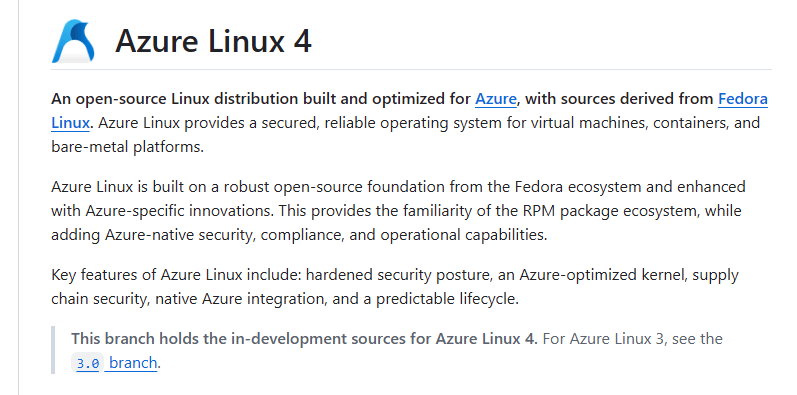
Microsoft、Fedoraベースの「Azure Linux 4」ソースコードをGitHubで公開 | gihyo.jp
5月18日~20日の3日間に渡って米ミネアポリスで開催された「Open Source Summit North America 2026」で、Linuxコミュニティからもっとも注目されたトピックのひとつがMicrosoftによる「Azure Linux 4」のパブリックプレビュー開始のニュースだった。gihyo.jp
- Related coverage: byteiota.com

Azure Linux 4.0 Preview: Microsoft Splits Its Linux Strategy
Microsoft ships Azure Linux 4.0 preview (Fedora-based, for VMs) and Azure Container Linux GA (for AKS). Here is the two-track split, migration steps, and what to do now. byteiota.com
- Related coverage: tutos-informatique.com

Azure Linux 4.0 : Microsoft prépare sa distribution Linux
Microsoft annonce Azure Linux 4.0, une distribution Linux pensée pour Azure, les VM cloud et les développeurs sous WSL.www.tutos-informatique.com - Related coverage: buzzarena.com

Microsoft surprend tout le monde avec sa distribution Linux pour Windows 11
Microsoft a lancé sa première distribution Linux avec Azure Linux 4.0. La distribution est basée sur Fedora Linux et publiée en open source sur GitHub. www.buzzarena.com
- Related coverage: docs.redhat.com
Deploying RHEL 9 on Microsoft Azure | Red Hat Enterprise Linux | 9 | Red Hat Documentation
Deploying RHEL 9 on Microsoft Azure | Red Hat Enterprise Linux | 9 | Red Hat Documentationdocs.redhat.com - Official source: download.microsoft.com
- Related coverage: access.redhat.com