

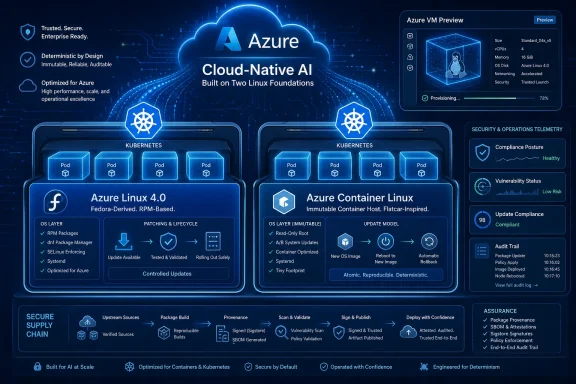
At Open Source Summit North America 2026, Microsoft announced Azure Linux 4.0, an upcoming public preview for Azure virtual machines, and made Azure Container Linux generally available, positioning both as hardened Linux foundations for cloud-native and AI workloads across Azure. The headline is not simply that Microsoft has another Linux distribution. It is that Microsoft now treats Linux as a first-party control surface for the parts of Azure where growth, security, and AI infrastructure collide. For Windows people, the story is less betrayal than inevitability: the company that once sold the operating system as the platform is increasingly selling the cloud as the platform, and Linux is one of the tools it needs to make that platform predictable.
For years, “Microsoft loves Linux” was a useful shorthand for a corporate reversal. It captured a real change, but it also made the shift sound softer than it was. Love was never the point; operational necessity was.
Azure Linux 4.0 makes that clearer. Microsoft is not merely supporting Linux guests on Azure, nor merely contributing drivers so other distributions run better on Hyper-V. It is building and maintaining a Linux distribution for its own cloud, and now it is preparing to expose that work more directly to customers through Azure virtual machines.
That matters because the operating system layer still matters, even in an era that insists everything is just containers, APIs, and managed services. Someone still patches the kernel. Someone still chooses the package set. Someone still decides how quickly security fixes move from upstream disclosure to customer deployment.
With Azure Linux, Microsoft wants that someone to be Microsoft.
Fedora lineage gives Microsoft a modern Linux base and familiar packaging model without positioning Azure Linux as a clone of one of the enterprise incumbents. RPM packaging keeps it legible to Linux administrators who already live in Red Hat-adjacent ecosystems. The Azure optimization language tells cloud buyers the distribution is not trying to be everything to everyone.
That last point is the key. Azure Linux is not a desktop Linux play, no matter how quickly the internet will imagine a “Microsoft Linux” laptop. It is a cloud substrate, designed for the workloads Microsoft cares most about: Kubernetes, containers, AI training and inference, and the managed platforms sitting above them.
The more Microsoft standardizes that substrate, the more it can shrink the distance between the operating system and the cloud control plane. That is valuable for performance, telemetry, patching, compliance, and support. It is also valuable for lock-in, though Microsoft will not use that word.
That is where modern infrastructure has been heading for a decade. The classic server model assumed administrators would log in, install packages, tune services, and treat the machine as a durable pet. The container host model assumes the OS should be small, replaceable, and boring.
Immutable systems push that logic further. If the host is not meant to be manually modified, then drift becomes harder, rollback becomes cleaner, and the attack surface can be reduced. For Kubernetes operators, that trade is often attractive: fewer moving parts on the node, more discipline in the deployment pipeline.
Azure Container Linux being based on the Flatcar project also tells us something about Microsoft’s current open source strategy. The company is not pretending every foundational layer must be invented in Redmond. It is adopting, hardening, integrating, and contributing where doing so advances Azure’s operational needs.
But the AI angle is not empty. Large-scale AI workloads put unusual pressure on the stack beneath them. They need dense compute, fast networking, predictable scheduling, reproducible environments, and rapid security response across enormous fleets. They also tend to combine open source frameworks, proprietary models, GPU vendors, orchestration layers, and internal tooling in ways that are hard to support when the base OS is a black box or a moving target controlled by someone else.
Microsoft’s argument is that Azure Linux and Azure Container Linux provide a hardened, consistent layer for these workloads. That is plausible. The more exotic the workload becomes at the top of the stack, the more conservative and controlled the bottom of the stack needs to be.
This is the paradox of the AI era. The user-facing product looks magical and fluid, but the infrastructure underneath has to become more deterministic. Microsoft is betting that owning more of the Linux layer helps make that possible.
The deeper issue is supply chain control. Cloud customers increasingly want to know where packages came from, how they were built, how quickly vulnerabilities are patched, and who is accountable when something goes wrong. In that environment, simply saying “we support popular Linux distributions” is not enough for every workload.
A Microsoft-maintained Linux distribution lets Azure’s operator and Azure’s customer point to the same chain of custody. It gives Microsoft a cleaner story around provenance, hardening, and patch cadence. It also lets the company align host behavior with Azure services in ways that would be harder if it depended entirely on outside distribution schedules.
That does not make Azure Linux automatically more secure than every alternative. Security is a process, not a sticker. But it does make Microsoft more directly accountable for the OS layer in workloads that choose it, and that accountability is increasingly what regulated and security-sensitive customers are buying.
But the center of gravity has shifted. New cloud-native workloads are more likely to be Linux-based. Kubernetes is a Linux-first world, even when Windows containers have a role. AI infrastructure overwhelmingly depends on Linux tooling, Linux drivers, and Linux operational patterns.
That leaves Windows Server in a different position than it occupied in the 2000s. It is no longer the default answer to “what does Microsoft infrastructure run on?” It is one answer among several, and for some of the fastest-growing categories of infrastructure, it is not the most natural answer.
This is not failure. It is adaptation. Microsoft’s business is healthier when Azure runs the workloads customers actually deploy, not the workloads Microsoft once wished they would deploy.
That reversal did not happen because Microsoft became sentimental about open source. It happened because the economics changed. Cloud services reward usage, scale, and operational efficiency more than they reward operating system license purity. If Linux helps Azure consume more compute, host more containers, and serve more AI workloads, then Linux is not the enemy of Microsoft’s business. It is part of the machinery.
The company has also learned that open source credibility is built through contribution, not press releases. Microsoft’s work in Kubernetes, containerd, Dapr, OpenTelemetry, Cilium-related ecosystems, and other cloud-native projects is not charity. It is the price of admission for influencing infrastructure that no single vendor controls.
Azure Linux fits that pattern. It gives Microsoft a first-party base while still letting the company argue that improvements flow back into the broader ecosystem. Whether the community sees that as healthy participation or strategic enclosure will depend on how open the development process remains over time.
If you already standardize on Red Hat Enterprise Linux, Ubuntu, SUSE, or another enterprise distribution, Azure Linux 4.0 will not automatically displace that investment. Existing support contracts, internal skills, compliance documentation, automation, and application certification all matter. A distribution optimized for Azure is not necessarily the right distribution for every hybrid estate.
But for greenfield Azure workloads, especially Kubernetes-heavy and AI-adjacent deployments, the calculation is different. If Microsoft can offer a smaller, hardened, well-supported image that lines up tightly with Azure services, many teams will at least test it. The convenience argument becomes stronger when the host is supposed to disappear into the platform.
That is why the VM preview matters. Once Azure Linux is available as a more visible customer choice, administrators can evaluate it like any other enterprise platform: patch behavior, package availability, documentation, support boundaries, observability hooks, compliance posture, and failure modes. The marketing phrase purpose-built then has to survive contact with production.
There is real value there. Modern application teams already spend too much energy reconciling dependencies, base images, container host behavior, and CI/CD assumptions. A Microsoft-maintained stack that reduces that friction could be useful, especially for teams already committed to Azure Kubernetes Service and adjacent Azure tooling.
The trade-off is that convenience often narrows the path. The more a team builds around Azure-specific assumptions, the less portable its operational model may become, even if the application code remains nominally containerized. Containers help with portability, but they do not erase differences in identity, networking, storage, policy, monitoring, and host lifecycle.
That does not mean teams should avoid Azure Linux. It means they should be honest about what they are buying. A smoother Azure path is still a path, and paths have direction.
The difference is that Microsoft owns the cloud platform on which Azure Linux is optimized. That gives it an advantage no independent distribution vendor can fully match inside Azure. It can connect OS engineering directly to fleet operations, cloud telemetry, managed Kubernetes, security services, and hardware deployment plans.
At the same time, Microsoft still needs those partners. Azure’s appeal depends partly on being a credible home for the Linux distributions enterprises already use. If Azure Linux becomes too aggressive as a default, Microsoft risks making partners nervous and customers wary.
Expect the company to walk that line carefully. Azure Linux will be framed as an option for Azure-optimized workloads, not as a universal replacement for enterprise Linux. The strategic pressure, however, is obvious: the more Microsoft can standardize on its own base for high-scale workloads, the more control it has over the economics and reliability of Azure.
That distinction explains a lot of otherwise confusing product decisions. Windows gets Copilot integration, cloud identity hooks, developer bridges, WSL improvements, and management features that connect PCs to Microsoft’s broader service layer. Azure gets the operating system work needed to run the world’s cloud and AI workloads, even when that work is Linux.
The two are not separate stories. WSL, Azure Linux, GitHub, Dev Box, containers, and Microsoft’s AI tooling are all part of a larger attempt to make Microsoft relevant wherever developers and workloads happen to live. Sometimes that is Windows. Often it is Linux. Increasingly it is both.
This is why the old tribal framing fails. Microsoft does not need Windows to win every layer. It needs Microsoft services, developer tools, cloud infrastructure, and identity systems to remain central across layers.
Still, the announcement is strategically loud. Microsoft is saying that the OS layer for cloud-native and AI workloads is too important to outsource entirely. It is saying that Azure needs its own hardened Linux foundation. It is saying that the future of Microsoft infrastructure includes first-party Linux not as a compatibility concession, but as a design principle.
For IT pros, the immediate action is evaluation, not panic. Watch the preview. Read the lifecycle promises when Microsoft publishes them in full. Test patching, observability, package availability, and support escalation. Compare Azure Linux against the distributions you already trust rather than against a nostalgic idea of what Microsoft used to be.
The most interesting Microsoft announcements are often the ones that look boring at first. A Linux distribution for Azure VMs and an immutable container host are not consumer spectacles. But they sit underneath the services Microsoft expects to define its next decade.
 Microsoft’s Linux Moment Is No Longer Symbolic
For years, “Microsoft loves Linux” was a useful shorthand for a corporate reversal. It captured a real change, but it also made the shift sound softer than it was. Love was never the point; operational necessity was.Azure Linux 4.0 makes that clearer. Microsoft is not merely supporting Linux guests on Azure, nor merely contributing drivers so other distributions run better on Hyper-V. It is building and maintaining a Linux distribution for its own cloud, and now it is preparing to expose that work more directly to customers through Azure virtual machines.
That matters because the operating system layer still matters, even in an era that insists everything is just containers, APIs, and managed services. Someone still patches the kernel. Someone still chooses the package set. Someone still decides how quickly security fixes move from upstream disclosure to customer deployment.
With Azure Linux, Microsoft wants that someone to be Microsoft.
Azure Linux 4.0 Turns the Host Into a Product
Azure Linux has existed in Microsoft’s infrastructure story for some time, but version 4.0 changes the posture. The company describes Azure Linux 4.0 as Fedora-derived, RPM-based, open source, free to use, and optimized specifically for Azure infrastructure. That combination is carefully chosen.Fedora lineage gives Microsoft a modern Linux base and familiar packaging model without positioning Azure Linux as a clone of one of the enterprise incumbents. RPM packaging keeps it legible to Linux administrators who already live in Red Hat-adjacent ecosystems. The Azure optimization language tells cloud buyers the distribution is not trying to be everything to everyone.
That last point is the key. Azure Linux is not a desktop Linux play, no matter how quickly the internet will imagine a “Microsoft Linux” laptop. It is a cloud substrate, designed for the workloads Microsoft cares most about: Kubernetes, containers, AI training and inference, and the managed platforms sitting above them.
The more Microsoft standardizes that substrate, the more it can shrink the distance between the operating system and the cloud control plane. That is valuable for performance, telemetry, patching, compliance, and support. It is also valuable for lock-in, though Microsoft will not use that word.
Azure Container Linux Shows Where the Industry Already Moved
The other half of the announcement, Azure Container Linux reaching general availability, is arguably the more practical news for many customers. Microsoft describes it as an immutable, container-optimized Linux-based operating system, built for the narrower job of hosting containers rather than behaving like a general-purpose server.That is where modern infrastructure has been heading for a decade. The classic server model assumed administrators would log in, install packages, tune services, and treat the machine as a durable pet. The container host model assumes the OS should be small, replaceable, and boring.
Immutable systems push that logic further. If the host is not meant to be manually modified, then drift becomes harder, rollback becomes cleaner, and the attack surface can be reduced. For Kubernetes operators, that trade is often attractive: fewer moving parts on the node, more discipline in the deployment pipeline.
Azure Container Linux being based on the Flatcar project also tells us something about Microsoft’s current open source strategy. The company is not pretending every foundational layer must be invented in Redmond. It is adopting, hardening, integrating, and contributing where doing so advances Azure’s operational needs.
The AI Framing Is Marketing, but Not Only Marketing
Microsoft wrapped the announcement in the language of AI-native systems, agents, and open source foundations. Some of that is inevitable 2026 conference rhetoric. Every cloud platform now has to explain itself as AI infrastructure, because that is where customer budgets and investor patience are being directed.But the AI angle is not empty. Large-scale AI workloads put unusual pressure on the stack beneath them. They need dense compute, fast networking, predictable scheduling, reproducible environments, and rapid security response across enormous fleets. They also tend to combine open source frameworks, proprietary models, GPU vendors, orchestration layers, and internal tooling in ways that are hard to support when the base OS is a black box or a moving target controlled by someone else.
Microsoft’s argument is that Azure Linux and Azure Container Linux provide a hardened, consistent layer for these workloads. That is plausible. The more exotic the workload becomes at the top of the stack, the more conservative and controlled the bottom of the stack needs to be.
This is the paradox of the AI era. The user-facing product looks magical and fluid, but the infrastructure underneath has to become more deterministic. Microsoft is betting that owning more of the Linux layer helps make that possible.
The Security Case Is Really a Supply Chain Case
Microsoft’s language around a reduced package footprint and smaller attack surface will sound familiar to anyone who has followed container host operating systems. Less code means fewer things to patch, fewer services to misconfigure, and fewer surprises when auditors come calling. That is the easy part of the pitch.The deeper issue is supply chain control. Cloud customers increasingly want to know where packages came from, how they were built, how quickly vulnerabilities are patched, and who is accountable when something goes wrong. In that environment, simply saying “we support popular Linux distributions” is not enough for every workload.
A Microsoft-maintained Linux distribution lets Azure’s operator and Azure’s customer point to the same chain of custody. It gives Microsoft a cleaner story around provenance, hardening, and patch cadence. It also lets the company align host behavior with Azure services in ways that would be harder if it depended entirely on outside distribution schedules.
That does not make Azure Linux automatically more secure than every alternative. Security is a process, not a sticker. But it does make Microsoft more directly accountable for the OS layer in workloads that choose it, and that accountability is increasingly what regulated and security-sensitive customers are buying.
Windows Server Is Not Being Replaced, but Its Center of Gravity Has Shifted
Whenever Microsoft announces anything Linux-related, a familiar question appears: is Windows Server being pushed aside? The answer is no, at least not in the simplistic sense. Windows Server remains essential for Active Directory environments, Windows-native applications, Microsoft enterprise estates, and legacy workloads that are not vanishing on anyone’s preferred schedule.But the center of gravity has shifted. New cloud-native workloads are more likely to be Linux-based. Kubernetes is a Linux-first world, even when Windows containers have a role. AI infrastructure overwhelmingly depends on Linux tooling, Linux drivers, and Linux operational patterns.
That leaves Windows Server in a different position than it occupied in the 2000s. It is no longer the default answer to “what does Microsoft infrastructure run on?” It is one answer among several, and for some of the fastest-growing categories of infrastructure, it is not the most natural answer.
This is not failure. It is adaptation. Microsoft’s business is healthier when Azure runs the workloads customers actually deploy, not the workloads Microsoft once wished they would deploy.
The Old Microsoft Would Have Seen This as a Threat
The historical contrast is impossible to ignore. Microsoft once treated Linux as an existential challenge to the Windows business model. Today, it is presenting a Microsoft-built Linux distribution as a foundation for Azure’s future.That reversal did not happen because Microsoft became sentimental about open source. It happened because the economics changed. Cloud services reward usage, scale, and operational efficiency more than they reward operating system license purity. If Linux helps Azure consume more compute, host more containers, and serve more AI workloads, then Linux is not the enemy of Microsoft’s business. It is part of the machinery.
The company has also learned that open source credibility is built through contribution, not press releases. Microsoft’s work in Kubernetes, containerd, Dapr, OpenTelemetry, Cilium-related ecosystems, and other cloud-native projects is not charity. It is the price of admission for influencing infrastructure that no single vendor controls.
Azure Linux fits that pattern. It gives Microsoft a first-party base while still letting the company argue that improvements flow back into the broader ecosystem. Whether the community sees that as healthy participation or strategic enclosure will depend on how open the development process remains over time.
The Practical Question for IT Is Not Ideology
For administrators and architects, the important question is not whether Microsoft “should” have a Linux distribution. That debate ended when the cloud did. The important question is where Azure Linux belongs in a real estate.If you already standardize on Red Hat Enterprise Linux, Ubuntu, SUSE, or another enterprise distribution, Azure Linux 4.0 will not automatically displace that investment. Existing support contracts, internal skills, compliance documentation, automation, and application certification all matter. A distribution optimized for Azure is not necessarily the right distribution for every hybrid estate.
But for greenfield Azure workloads, especially Kubernetes-heavy and AI-adjacent deployments, the calculation is different. If Microsoft can offer a smaller, hardened, well-supported image that lines up tightly with Azure services, many teams will at least test it. The convenience argument becomes stronger when the host is supposed to disappear into the platform.
That is why the VM preview matters. Once Azure Linux is available as a more visible customer choice, administrators can evaluate it like any other enterprise platform: patch behavior, package availability, documentation, support boundaries, observability hooks, compliance posture, and failure modes. The marketing phrase purpose-built then has to survive contact with production.
Developers Get a Cleaner Path, but Also a Narrower One
Developers may be the group most tempted by Microsoft’s framing. A consistent Linux base across local development, containers, and Azure-hosted infrastructure promises fewer environmental mysteries. In theory, that means less time debugging differences between what ran in the pipeline and what failed in production.There is real value there. Modern application teams already spend too much energy reconciling dependencies, base images, container host behavior, and CI/CD assumptions. A Microsoft-maintained stack that reduces that friction could be useful, especially for teams already committed to Azure Kubernetes Service and adjacent Azure tooling.
The trade-off is that convenience often narrows the path. The more a team builds around Azure-specific assumptions, the less portable its operational model may become, even if the application code remains nominally containerized. Containers help with portability, but they do not erase differences in identity, networking, storage, policy, monitoring, and host lifecycle.
That does not mean teams should avoid Azure Linux. It means they should be honest about what they are buying. A smoother Azure path is still a path, and paths have direction.
The Competitive Message Lands Squarely on Red Hat, Canonical, and SUSE
Microsoft’s Linux move also lands in a competitive market that already has strong players. Red Hat, Canonical, and SUSE have spent years turning Linux into enterprise products with support models, certifications, lifecycle guarantees, and ecosystems around them. Microsoft is not entering an empty room.The difference is that Microsoft owns the cloud platform on which Azure Linux is optimized. That gives it an advantage no independent distribution vendor can fully match inside Azure. It can connect OS engineering directly to fleet operations, cloud telemetry, managed Kubernetes, security services, and hardware deployment plans.
At the same time, Microsoft still needs those partners. Azure’s appeal depends partly on being a credible home for the Linux distributions enterprises already use. If Azure Linux becomes too aggressive as a default, Microsoft risks making partners nervous and customers wary.
Expect the company to walk that line carefully. Azure Linux will be framed as an option for Azure-optimized workloads, not as a universal replacement for enterprise Linux. The strategic pressure, however, is obvious: the more Microsoft can standardize on its own base for high-scale workloads, the more control it has over the economics and reliability of Azure.
The WindowsForum Angle Is Bigger Than Linux
For a Windows-focused audience, this announcement is a reminder that Microsoft’s platform identity has permanently changed. Windows remains a huge business and a critical client platform, but Microsoft’s infrastructure future is not Windows-shaped in the old sense. It is Azure-shaped.That distinction explains a lot of otherwise confusing product decisions. Windows gets Copilot integration, cloud identity hooks, developer bridges, WSL improvements, and management features that connect PCs to Microsoft’s broader service layer. Azure gets the operating system work needed to run the world’s cloud and AI workloads, even when that work is Linux.
The two are not separate stories. WSL, Azure Linux, GitHub, Dev Box, containers, and Microsoft’s AI tooling are all part of a larger attempt to make Microsoft relevant wherever developers and workloads happen to live. Sometimes that is Windows. Often it is Linux. Increasingly it is both.
This is why the old tribal framing fails. Microsoft does not need Windows to win every layer. It needs Microsoft services, developer tools, cloud infrastructure, and identity systems to remain central across layers.
The Announcement Is Small; the Direction Is Not
Azure Linux 4.0 is not going to cause desktop Linux adoption to surge. Azure Container Linux going GA will not make Windows Server disappear. Most end users will never knowingly touch either product.Still, the announcement is strategically loud. Microsoft is saying that the OS layer for cloud-native and AI workloads is too important to outsource entirely. It is saying that Azure needs its own hardened Linux foundation. It is saying that the future of Microsoft infrastructure includes first-party Linux not as a compatibility concession, but as a design principle.
For IT pros, the immediate action is evaluation, not panic. Watch the preview. Read the lifecycle promises when Microsoft publishes them in full. Test patching, observability, package availability, and support escalation. Compare Azure Linux against the distributions you already trust rather than against a nostalgic idea of what Microsoft used to be.
The most interesting Microsoft announcements are often the ones that look boring at first. A Linux distribution for Azure VMs and an immutable container host are not consumer spectacles. But they sit underneath the services Microsoft expects to define its next decade.
The Signal Buried Under the Penguin
The near-term message is practical: Microsoft wants a smaller, more controlled, more Azure-native Linux base for the workloads that matter most to its cloud strategy. The longer-term message is cultural: Microsoft’s infrastructure future is no longer organized around defending Windows at every layer.- Azure Linux 4.0 is headed for public preview on Azure virtual machines, giving customers a more direct way to run Microsoft’s own Linux distribution.
- Azure Container Linux is now generally available as an immutable, container-optimized operating system for modern cloud workloads.
- Microsoft is tying both systems to cloud-native and AI workloads, where consistency, patch speed, and supply chain control matter more than traditional server customization.
- Windows Server is not being replaced, but it is no longer the assumed center of Microsoft’s infrastructure story.
- Enterprise customers should evaluate Azure Linux as an Azure-optimized option, not as a universal substitute for established Linux distributions.
- The broader strategic move is about control of the cloud substrate, not about Microsoft trying to win a desktop Linux popularity contest.
References
- Primary source: thurrott.com
Published: Wed, 20 May 2026 06:40:51 GMT
azure-linux - Thurrott.com
 www.thurrott.com
- Official source: opensource.microsoft.com
From open source to agentic systems: Microsoft at Open Source Summit North America 2026 | Microsoft Open Source Blog
Discover how Azure Linux 4.0 and Azure Container Linux deliver a secure, scalable Linux foundation for cloud native apps, containers, and AI workloads.opensource.microsoft.com - Official source: learn.microsoft.com
Overview of the Azure Linux Container Host for Azure Kubernetes Service (AKS) | Microsoft Learn
Learn about the Azure Linux Container Host, a lightweight and secure operating system image optimized for running container workloads on Azure Kubernetes Service (AKS), including its key benefits and supported GPU VM sizes.learn.microsoft.com - Official source: azure.microsoft.com
Linux on Azure | Microsoft Azure
Run Linux on Azure with your preferred distributions. Deploy Linux virtual machines (VMs), containers, and cloud-native workloads with Azure infrastructure.azure.microsoft.com
- Related coverage: pureinfotech.com
Microsoft just built its own Linux – So what does that mean for Windows? - Pureinfotech
Microsoft launches Azure Linux 4.0 and Azure Container Linux for cloud and AI workloads, reinforcing Linux as core to Azure infrastructure. pureinfotech.com
- Related coverage: redmondmag.com
Microsoft Pushes Further Into Linux with Azure Linux 4.0 Rollout -- Redmondmag.com
Microsoft is now accelerating its Linux strategy with the debut of Azure Linux 4.0 and the general availability of Azure Container Linux.redmondmag.com
- Related coverage: tutos-informatique.com
Azure Linux 4.0 : Microsoft prépare sa distribution Linux
Microsoft annonce Azure Linux 4.0, une distribution Linux pensée pour Azure, les VM cloud et les développeurs sous WSL.www.tutos-informatique.com - Official source: azure-int.microsoft.com
- Related coverage: itsfoss.com
Wow! Microsoft Now Has a Fedora-based Linux Distro
Azure Linux 4.0 is on the way, and its GitHub repo quietly confirms it's built on Fedora. itsfoss.com
- Related coverage: cloudnativenow.com
Azure Linux 4.0 Signals Microsoft’s Commitment to Open Source AI Infrastructure - Cloud Native Now
Microsoft is widening its Linux strategy as AI infrastructure drives Azure’s growth, announcing Azure Linux 4.0.cloudnativenow.com - Related coverage: windowscentral.com
Microsoft announces Litebox, a Rust‑based security OS | Windows Central
LiteBox offers developers a new way to sandbox apps while reducing the system's attack surface.www.windowscentral.com - Official source: download.microsoft.com
- Related coverage: nec.com
EXPRESSCLUSTER X 4.0 HA Cluster Configuration Guide for Microsoft Azure (Linux)
3rd Editionwww.nec.com
- Related coverage: docs.nvidia.com
- Related coverage: docs.redhat.com
