Microsoft used Build 2026 to push Azure Linux 4.0 into public preview on Azure virtual machines and VM Scale Sets, turning a once-internal cloud operating system into a free, Microsoft-maintained Linux distribution for customers to test. The historical irony is irresistible, but the more important story is strategic. Microsoft is not trying to become Canonical, Fedora, or Red Hat for the desktop. It is trying to own more of the operating-system layer beneath Azure’s cloud, Kubernetes, and AI infrastructure.
The easiest version of this story begins with Steve Ballmer’s famous “Linux is a cancer” line from 2001 and ends with Microsoft shipping a Linux distro of its own. That arc is satisfying because it is so clean: old Microsoft feared open source, new Microsoft packages it, signs it, documents it, and asks customers to deploy it.
But that framing undersells what has actually changed. Microsoft’s Linux work is not a sudden ideological conversion and not a novelty project designed to make developers clap at a conference keynote. Azure Linux grew out of the unglamorous reality that modern cloud infrastructure runs on Linux whether Microsoft likes it or not.
Azure has long supported Ubuntu, Red Hat Enterprise Linux, SUSE, Debian, Oracle Linux, and other distributions. The new step is that Microsoft is offering a Microsoft-controlled Linux base as a first-class Azure option, with its own lifecycle, package choices, hardening model, and support story. That is a different kind of bet from merely tolerating Linux workloads.
It also says something uncomfortable about Windows Server’s role in the cloud era. Windows remains indispensable for many enterprise workloads, identity stacks, management environments, and legacy applications. But the growth engine of hyperscale cloud — containers, Kubernetes, AI training, inference, and fleet automation — increasingly assumes Linux as the default substrate.
Microsoft has used Azure Linux beneath Azure Kubernetes Service, Azure SQL, Cosmos DB, and other large-scale internal services. LinkedIn and Databricks have also been cited as major users of earlier Azure Linux generations, which matters because it moves the product out of the realm of conferenceware. This is not Microsoft’s Linux science project; it is the operating system the company has already trusted inside its own cloud machinery.
That origin explains why Azure Linux 4.0 feels so unlike Ubuntu Desktop, Linux Mint, or Fedora Workstation. It is not trying to win hearts with a slick installer, a polished GNOME session, or a preloaded app catalog. It is trying to be small, reproducible, fast to patch, and boring in the way infrastructure teams mean as a compliment.
For enthusiasts, that can be disappointing. A Microsoft Linux distro sounds like it ought to be weird, controversial, or at least visually interesting. Instead, Azure Linux is closer to a cloud appliance foundation: minimal packages, console-first operation, RPM tooling, Azure integration, and a design center that assumes the user is automation.
That decision is pragmatic. Fedora gives Microsoft access to a modern RPM-based stack, familiar tooling, current compiler and library versions, and a path that feels intelligible to administrators who already know Red Hat-style systems. It also reduces the weirdness tax of adopting a Microsoft Linux distribution, because dnf5, RPM packaging, systemd, glibc, and Fedora-derived workflows are not exotic in enterprise Linux.
The move does not make Azure Linux “Fedora with a Microsoft wallpaper,” because there is no wallpaper and no desktop. Microsoft controls the package set, kernel configuration, Azure-specific integration, hardening, and lifecycle decisions. Fedora is the upstream ecosystem; Azure Linux is the curated cloud product.
That distinction matters for trust. The more Microsoft can show its deviations from Fedora clearly, the easier it becomes for administrators to reason about what they are actually running. A cloud distribution does not need to be expansive; it needs to be inspectable.
tdnf made sense for a purpose-built lightweight distribution, but it marked Azure Linux as something slightly off the main enterprise Linux path. dnf5 pulls it closer to the Fedora and Red Hat world. That means faster dependency resolution and lower memory use, but the larger benefit is predictability.
For administrators, this reduces friction. Existing RPM instincts carry over. Repository configuration looks familiar. Commands and workflows feel less like a Microsoft-specific dialect and more like a modern Linux system that happens to be tuned for Azure.
There will still be migration work. Scripts and Dockerfiles that refer explicitly to tdnf need adjustment, and edge cases always appear when packaging tools change under automation. But the direction is clear: Microsoft wants Azure Linux to look less like an internal platform artifact and more like a distribution enterprise teams can evaluate without learning a private language first.
That absence is not an oversight. Azure Linux is built for cloud servers, virtual machines, VM Scale Sets, containers, and eventually tighter development-to-production flows through WSL. Its value proposition is not comfort; it is control. Fewer packages mean fewer moving parts, fewer CVEs, less patch churn, and a smaller base image to reason about.
This is where Azure Linux diverges from the Linux discourse most users see. Desktop Linux culture often values choice, customizability, and visible user experience. Cloud Linux values repeatability, small surfaces, security posture, and compatibility with automation. Azure Linux belongs firmly to the second world.
That does not make it inherently better than Ubuntu Server, Debian, Fedora Server, or RHEL. It makes it narrower. A narrow operating system can be very powerful when the environment around it is also narrow, and Azure is exactly that kind of environment.
Azure Linux gives Microsoft a way to collapse more of that stack into its own portfolio. The pitch is not merely “use our cloud.” It becomes “use our cloud, our kernel tuning, our OS packages, our security update pipeline, our container base, our Kubernetes integration, our monitoring hooks, and our support boundary.” That is an attractive proposition for Microsoft and a potentially attractive one for enterprises that already want fewer vendors in the incident bridge.
This is also why the supply-chain language matters. Microsoft talks about signed packages, controlled repositories, security hardening, SBOMs, and compliance work because enterprise Linux adoption is no longer just about whether the kernel boots. It is about whether the platform can survive procurement, audit, regulatory review, vulnerability management, and incident response.
The cloud providers have all learned the same lesson. Amazon has Amazon Linux. Google has Container-Optimized OS. Microsoft was never going to remain content as the hyperscaler without a serious homegrown Linux distribution for its own platform. Azure Linux 4.0 is less a surprise than the delayed arrival of an obvious piece of cloud infrastructure.
That distinction is increasingly important. Traditional Linux administration assumes a living system that changes over time through package installation, configuration drift, emergency fixes, and local troubleshooting. Immutable infrastructure assumes the running machine is disposable, the image is the artifact, and recovery means rollback or replacement rather than hand repair.
Microsoft is clearly serving both worlds, but the gravitational pull is toward immutability. Kubernetes clusters, AI fleets, and large-scale container hosts do not benefit from snowflake nodes. They benefit from identical images, predictable rollouts, and rollback behavior that does not depend on a human remembering what changed at 2:13 a.m.
Azure Container Linux being generally available while Azure Linux 4.0 remains in preview is telling. The container host story is already mature enough for Microsoft to productize aggressively. The broader cloud VM story is catching up, and Azure Linux 4.0 is the bridge between old-school server administration and the image-driven infrastructure Microsoft expects more customers to adopt.
The preview status still matters. FIPS 140-3 certification is not something regulated organizations can hand-wave into existence, and Microsoft’s own documentation frames Azure Linux 4.0 preview as unsuitable for production use. For government, financial services, healthcare, and other compliance-heavy sectors, the practical answer is still “evaluate, don’t standardize.”
But the direction is significant. Microsoft is not merely offering a free Linux image because developers like free things. It is preparing an enterprise cloud OS with the compliance hooks and audit posture needed to compete with paid Linux offerings in serious environments.
That will make some administrators skeptical, and rightly so. A Microsoft-maintained Linux distribution creates questions about transparency, lifecycle guarantees, support boundaries, and lock-in. But those are now the right questions. The old question — whether Microsoft is serious about Linux — has been answered by production reality.
That is a classic Microsoft move: make the developer workflow convenient, then make the production target feel like the path of least resistance. If a developer can test against the same base OS locally, build containers against the same package assumptions, and deploy to Azure without environmental surprises, Azure Linux becomes less of an infrastructure mandate and more of a default.
The promise is particularly relevant for Windows-heavy shops that already use WSL as the compromise layer between corporate Windows endpoints and Linux-native development stacks. Today, those developers often use Ubuntu in WSL because it is familiar, well documented, and widely supported. Azure Linux gives Microsoft a chance to replace “Ubuntu because it is easy” with “Azure Linux because it matches production.”
That is not guaranteed. Developer distributions succeed when ecosystems form around them, and Microsoft will need documentation, images, package availability, examples, and tooling polish. A minimal server OS is not automatically a pleasant developer environment. But if WSL Containers and Azure Linux mature together, Microsoft will have a credible local-to-cloud story that no third-party Linux vendor can tell quite as tightly on Windows.
But Windows Server’s role was already changing. The real shift happened when applications moved from server-centric deployment to service-centric deployment, and from pets to cattle. Azure Linux is not the cause of that shift; it is Microsoft’s acknowledgment that the shift is permanent.
Windows Server remains central for Active Directory-adjacent environments, .NET Framework legacy applications, Remote Desktop Services, Windows-specific enterprise software, and workloads that depend on the Windows API surface. It also remains a major product with an installed base that will not vanish because Azure Linux 4.0 exists.
The psychological change is bigger than the immediate product impact. Microsoft no longer needs Windows Server to be the default answer to “what operating system should a Microsoft customer run?” In Azure, the default can be Linux when the workload demands Linux. That is a deeper strategic surrender than any single distro announcement.
Microsoft’s advantage is platform gravity. It can integrate Azure Linux deeply with Azure services, tune it for Azure hardware, validate it against Azure VM SKUs, and make it cheap or free at the operating-system line item. For customers already trying to reduce subscription complexity, that is compelling.
The competitors’ advantage is independence. Red Hat, Canonical, and SUSE can credibly say their distributions run across clouds, on premises, at the edge, and in hybrid environments without being optimized primarily for one hyperscaler’s business model. For enterprises pursuing multicloud leverage, that neutrality still matters.
Azure Linux’s “cloud-only” posture is therefore both strength and weakness. It lets Microsoft optimize ruthlessly for Azure, but it also makes the product less attractive as a universal enterprise standard. The more a company values portability, the more Azure Linux looks like a convenience with strings attached.
That does not make the preview unimportant. This is the phase where platform teams should inspect package availability, automation compatibility, image behavior, monitoring integration, security controls, patch cadence, and support assumptions. The right audience is not someone looking for a new desktop distro; it is the infrastructure engineer wondering whether Azure Linux can become a standard base image in 2027.
The biggest unknown is not whether Azure Linux can boot and run workloads. It already has a production heritage inside Microsoft and major services. The bigger question is whether Microsoft can build the ecosystem expectations that enterprise Linux buyers take for granted: predictable lifecycle commitments, broad ISV confidence, clear documentation, fast security response, and support that does not collapse into “try another image.”
Preview programs are where those promises begin to meet reality. If Microsoft wants Azure Linux to be more than a free curiosity, it has to make administrators trust the boring parts.
 Microsoft’s Linux Turn Is No Longer a Punchline
The easiest version of this story begins with Steve Ballmer’s famous “Linux is a cancer” line from 2001 and ends with Microsoft shipping a Linux distro of its own. That arc is satisfying because it is so clean: old Microsoft feared open source, new Microsoft packages it, signs it, documents it, and asks customers to deploy it.But that framing undersells what has actually changed. Microsoft’s Linux work is not a sudden ideological conversion and not a novelty project designed to make developers clap at a conference keynote. Azure Linux grew out of the unglamorous reality that modern cloud infrastructure runs on Linux whether Microsoft likes it or not.
Azure has long supported Ubuntu, Red Hat Enterprise Linux, SUSE, Debian, Oracle Linux, and other distributions. The new step is that Microsoft is offering a Microsoft-controlled Linux base as a first-class Azure option, with its own lifecycle, package choices, hardening model, and support story. That is a different kind of bet from merely tolerating Linux workloads.
It also says something uncomfortable about Windows Server’s role in the cloud era. Windows remains indispensable for many enterprise workloads, identity stacks, management environments, and legacy applications. But the growth engine of hyperscale cloud — containers, Kubernetes, AI training, inference, and fleet automation — increasingly assumes Linux as the default substrate.
Azure Linux Was Built for Fleets, Not Fans
Azure Linux did not appear out of nowhere in 2026. It began life as CBL-Mariner, short for Common Base Linux Mariner, an internal Microsoft distribution built to provide a lightweight, consistent, security-hardened Linux layer for Microsoft’s own services. The name was obscure, but the operating system was not small in consequence.Microsoft has used Azure Linux beneath Azure Kubernetes Service, Azure SQL, Cosmos DB, and other large-scale internal services. LinkedIn and Databricks have also been cited as major users of earlier Azure Linux generations, which matters because it moves the product out of the realm of conferenceware. This is not Microsoft’s Linux science project; it is the operating system the company has already trusted inside its own cloud machinery.
That origin explains why Azure Linux 4.0 feels so unlike Ubuntu Desktop, Linux Mint, or Fedora Workstation. It is not trying to win hearts with a slick installer, a polished GNOME session, or a preloaded app catalog. It is trying to be small, reproducible, fast to patch, and boring in the way infrastructure teams mean as a compliment.
For enthusiasts, that can be disappointing. A Microsoft Linux distro sounds like it ought to be weird, controversial, or at least visually interesting. Instead, Azure Linux is closer to a cloud appliance foundation: minimal packages, console-first operation, RPM tooling, Azure integration, and a design center that assumes the user is automation.
The Fedora Base Makes Microsoft’s Linux Less Strange, Not More
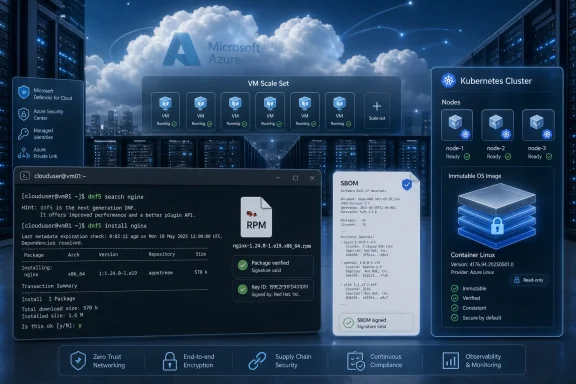
The most important technical shift in Azure Linux 4.0 is its move to a Fedora-derived foundation. Earlier Azure Linux releases were assembled more directly by Microsoft engineers, package by package, with Microsoft maintaining its own spec files and internal curation process. Version 4.0 changes that model by layering Microsoft’s distribution choices over a Fedora ecosystem base.That decision is pragmatic. Fedora gives Microsoft access to a modern RPM-based stack, familiar tooling, current compiler and library versions, and a path that feels intelligible to administrators who already know Red Hat-style systems. It also reduces the weirdness tax of adopting a Microsoft Linux distribution, because dnf5, RPM packaging, systemd, glibc, and Fedora-derived workflows are not exotic in enterprise Linux.
The move does not make Azure Linux “Fedora with a Microsoft wallpaper,” because there is no wallpaper and no desktop. Microsoft controls the package set, kernel configuration, Azure-specific integration, hardening, and lifecycle decisions. Fedora is the upstream ecosystem; Azure Linux is the curated cloud product.
That distinction matters for trust. The more Microsoft can show its deviations from Fedora clearly, the easier it becomes for administrators to reason about what they are actually running. A cloud distribution does not need to be expansive; it needs to be inspectable.
The Package Manager Change Is a Signal to Administrators
Azure Linux 4.0’s switch from tdnf to dnf5 looks like a small implementation detail until you imagine maintaining scripts, images, and CI pipelines across thousands of systems. Package managers are muscle memory. They are also automation interfaces, and automation interfaces become political very quickly inside large IT shops.tdnf made sense for a purpose-built lightweight distribution, but it marked Azure Linux as something slightly off the main enterprise Linux path. dnf5 pulls it closer to the Fedora and Red Hat world. That means faster dependency resolution and lower memory use, but the larger benefit is predictability.
For administrators, this reduces friction. Existing RPM instincts carry over. Repository configuration looks familiar. Commands and workflows feel less like a Microsoft-specific dialect and more like a modern Linux system that happens to be tuned for Azure.
There will still be migration work. Scripts and Dockerfiles that refer explicitly to tdnf need adjustment, and edge cases always appear when packaging tools change under automation. But the direction is clear: Microsoft wants Azure Linux to look less like an internal platform artifact and more like a distribution enterprise teams can evaluate without learning a private language first.
Minimalism Is the Product, Not a Missing Feature
The most common misunderstanding about Azure Linux 4.0 will be that it is Microsoft’s answer to Ubuntu. It is not. There is no desktop environment, no graphical welcome tour, no consumer app story, and no pitch to replace the Linux distribution on a developer’s laptop.That absence is not an oversight. Azure Linux is built for cloud servers, virtual machines, VM Scale Sets, containers, and eventually tighter development-to-production flows through WSL. Its value proposition is not comfort; it is control. Fewer packages mean fewer moving parts, fewer CVEs, less patch churn, and a smaller base image to reason about.
This is where Azure Linux diverges from the Linux discourse most users see. Desktop Linux culture often values choice, customizability, and visible user experience. Cloud Linux values repeatability, small surfaces, security posture, and compatibility with automation. Azure Linux belongs firmly to the second world.
That does not make it inherently better than Ubuntu Server, Debian, Fedora Server, or RHEL. It makes it narrower. A narrow operating system can be very powerful when the environment around it is also narrow, and Azure is exactly that kind of environment.
Microsoft Wants the Whole Azure Stack Under One Roof
The business logic is not subtle. If a customer runs Red Hat Enterprise Linux on Azure, Microsoft sells compute, storage, networking, and platform services, but Red Hat remains a major operating-system vendor in the customer relationship. The same basic dynamic applies, in different forms, to Canonical, SUSE, and other Linux vendors.Azure Linux gives Microsoft a way to collapse more of that stack into its own portfolio. The pitch is not merely “use our cloud.” It becomes “use our cloud, our kernel tuning, our OS packages, our security update pipeline, our container base, our Kubernetes integration, our monitoring hooks, and our support boundary.” That is an attractive proposition for Microsoft and a potentially attractive one for enterprises that already want fewer vendors in the incident bridge.
This is also why the supply-chain language matters. Microsoft talks about signed packages, controlled repositories, security hardening, SBOMs, and compliance work because enterprise Linux adoption is no longer just about whether the kernel boots. It is about whether the platform can survive procurement, audit, regulatory review, vulnerability management, and incident response.
The cloud providers have all learned the same lesson. Amazon has Amazon Linux. Google has Container-Optimized OS. Microsoft was never going to remain content as the hyperscaler without a serious homegrown Linux distribution for its own platform. Azure Linux 4.0 is less a surprise than the delayed arrival of an obvious piece of cloud infrastructure.
Azure Container Linux Shows the Immutable Future Microsoft Prefers
Azure Linux 4.0 arrived alongside Azure Container Linux, and the pairing reveals more than either product does alone. Azure Linux is the mutable server distribution: you can install packages, update components, and treat it like a conventional Linux host. Azure Container Linux is the immutable counterpart, designed for Kubernetes nodes and container-centric environments where the operating system image is replaced rather than modified in place.That distinction is increasingly important. Traditional Linux administration assumes a living system that changes over time through package installation, configuration drift, emergency fixes, and local troubleshooting. Immutable infrastructure assumes the running machine is disposable, the image is the artifact, and recovery means rollback or replacement rather than hand repair.
Microsoft is clearly serving both worlds, but the gravitational pull is toward immutability. Kubernetes clusters, AI fleets, and large-scale container hosts do not benefit from snowflake nodes. They benefit from identical images, predictable rollouts, and rollback behavior that does not depend on a human remembering what changed at 2:13 a.m.
Azure Container Linux being generally available while Azure Linux 4.0 remains in preview is telling. The container host story is already mature enough for Microsoft to productize aggressively. The broader cloud VM story is catching up, and Azure Linux 4.0 is the bridge between old-school server administration and the image-driven infrastructure Microsoft expects more customers to adopt.
Security Hardening Is Where the Sales Pitch Gets Serious
Every Linux distribution claims to care about security. Azure Linux’s pitch is more specific: minimal package footprint, Azure-tuned kernel work, SELinux enforcement, signed packages, centralized cryptographic policy, and a supply chain Microsoft can present as coherent from source to deployed image. That is the language of enterprise risk management, not hobbyist operating-system preference.The preview status still matters. FIPS 140-3 certification is not something regulated organizations can hand-wave into existence, and Microsoft’s own documentation frames Azure Linux 4.0 preview as unsuitable for production use. For government, financial services, healthcare, and other compliance-heavy sectors, the practical answer is still “evaluate, don’t standardize.”
But the direction is significant. Microsoft is not merely offering a free Linux image because developers like free things. It is preparing an enterprise cloud OS with the compliance hooks and audit posture needed to compete with paid Linux offerings in serious environments.
That will make some administrators skeptical, and rightly so. A Microsoft-maintained Linux distribution creates questions about transparency, lifecycle guarantees, support boundaries, and lock-in. But those are now the right questions. The old question — whether Microsoft is serious about Linux — has been answered by production reality.
The WSL Angle Is the Developer Wedge
The most interesting future use case may not begin in an Azure portal at all. It may begin on a Windows developer workstation. Microsoft has been positioning Azure Linux as a distribution that can run in WSL for local development and then map cleanly to Azure production environments.That is a classic Microsoft move: make the developer workflow convenient, then make the production target feel like the path of least resistance. If a developer can test against the same base OS locally, build containers against the same package assumptions, and deploy to Azure without environmental surprises, Azure Linux becomes less of an infrastructure mandate and more of a default.
The promise is particularly relevant for Windows-heavy shops that already use WSL as the compromise layer between corporate Windows endpoints and Linux-native development stacks. Today, those developers often use Ubuntu in WSL because it is familiar, well documented, and widely supported. Azure Linux gives Microsoft a chance to replace “Ubuntu because it is easy” with “Azure Linux because it matches production.”
That is not guaranteed. Developer distributions succeed when ecosystems form around them, and Microsoft will need documentation, images, package availability, examples, and tooling polish. A minimal server OS is not automatically a pleasant developer environment. But if WSL Containers and Azure Linux mature together, Microsoft will have a credible local-to-cloud story that no third-party Linux vendor can tell quite as tightly on Windows.
Windows Server Is Not Being Replaced, but Its Default Status Is Gone
It is tempting to cast Azure Linux as a threat to Windows Server. In some narrow cases, it is. If a workload is cloud-native, containerized, stateless, horizontally scaled, and built around Linux tooling, there is little reason to force Windows Server into the architecture merely because the cloud provider is Microsoft.But Windows Server’s role was already changing. The real shift happened when applications moved from server-centric deployment to service-centric deployment, and from pets to cattle. Azure Linux is not the cause of that shift; it is Microsoft’s acknowledgment that the shift is permanent.
Windows Server remains central for Active Directory-adjacent environments, .NET Framework legacy applications, Remote Desktop Services, Windows-specific enterprise software, and workloads that depend on the Windows API surface. It also remains a major product with an installed base that will not vanish because Azure Linux 4.0 exists.
The psychological change is bigger than the immediate product impact. Microsoft no longer needs Windows Server to be the default answer to “what operating system should a Microsoft customer run?” In Azure, the default can be Linux when the workload demands Linux. That is a deeper strategic surrender than any single distro announcement.
The Real Competition Is Red Hat, Canonical, and Cloud Gravity
Azure Linux 4.0 will not displace Ubuntu on laptops or Fedora among enthusiasts. It is not aimed there. The competition is the paid and supported Linux footprint inside Azure: RHEL, Ubuntu Pro, SUSE, and other enterprise distributions that already have customer trust, third-party certification, and application compatibility.Microsoft’s advantage is platform gravity. It can integrate Azure Linux deeply with Azure services, tune it for Azure hardware, validate it against Azure VM SKUs, and make it cheap or free at the operating-system line item. For customers already trying to reduce subscription complexity, that is compelling.
The competitors’ advantage is independence. Red Hat, Canonical, and SUSE can credibly say their distributions run across clouds, on premises, at the edge, and in hybrid environments without being optimized primarily for one hyperscaler’s business model. For enterprises pursuing multicloud leverage, that neutrality still matters.
Azure Linux’s “cloud-only” posture is therefore both strength and weakness. It lets Microsoft optimize ruthlessly for Azure, but it also makes the product less attractive as a universal enterprise standard. The more a company values portability, the more Azure Linux looks like a convenience with strings attached.
The Preview Label Should Slow Down the Hype
The practical advice today is simple: do not rebuild your production estate around Azure Linux 4.0 yet. Public preview is an invitation to test, not a permission slip to migrate regulated or mission-critical workloads. Microsoft is explicit that the preview is for evaluation.That does not make the preview unimportant. This is the phase where platform teams should inspect package availability, automation compatibility, image behavior, monitoring integration, security controls, patch cadence, and support assumptions. The right audience is not someone looking for a new desktop distro; it is the infrastructure engineer wondering whether Azure Linux can become a standard base image in 2027.
The biggest unknown is not whether Azure Linux can boot and run workloads. It already has a production heritage inside Microsoft and major services. The bigger question is whether Microsoft can build the ecosystem expectations that enterprise Linux buyers take for granted: predictable lifecycle commitments, broad ISV confidence, clear documentation, fast security response, and support that does not collapse into “try another image.”
Preview programs are where those promises begin to meet reality. If Microsoft wants Azure Linux to be more than a free curiosity, it has to make administrators trust the boring parts.
The Microsoft Distro That Only Makes Sense in Microsoft’s Cloud
Azure Linux 4.0 is worth paying attention to precisely because it is not trying to be everything. It is a targeted operating system for a targeted platform, and that focus makes its implications clearer.- Azure Linux 4.0 is a Microsoft-maintained, Fedora-derived Linux distribution now available in public preview for Azure virtual machines and VM Scale Sets.
- The distribution is built for Azure cloud workloads, not desktop use, and its minimal design intentionally omits the graphical comforts associated with mainstream consumer Linux distributions.
- The move to dnf5 and RPM tooling makes Azure Linux more familiar to administrators from Fedora and Red Hat environments.
- Azure Container Linux serves a different role as an immutable OS for Kubernetes and container hosts, showing Microsoft’s preference for image-based infrastructure at scale.
- The preview is not suitable for production standardization yet, especially for organizations with strict compliance requirements.
- The strategic point is that Microsoft now wants to control more of the Linux layer inside Azure rather than merely hosting other vendors’ distributions.
References
- Primary source: Windows Latest
Published: Sun, 28 Jun 2026 22:01:42 GMT
Microsoft called Linux a cancer, now ships its own free distro that's nothing like Ubuntu or Fedora
Azure Linux 4.0 is Microsoft's own Fedora-derived Linux distro for Azure cloud workloads. Here is how it compares to Ubuntu, Fedora, and RHEL www.windowslatest.com
- Official source: opensource.microsoft.com
From open source to agentic systems: Microsoft at Open Source Summit North America 2026 | Microsoft Open Source Blog
Discover how Azure Linux 4.0 and Azure Container Linux deliver a secure, scalable Linux foundation for cloud native apps, containers, and AI workloads.opensource.microsoft.com - Official source: learn.microsoft.com
Overview of Package Management on Azure Linux | Microsoft Learn
Overview of how package management works on Azure Linux, including DNF5, RPM packages, and compatibility with YUM-era tooling.learn.microsoft.com - Official source: directionsonmicrosoft.com
Microsoft To Make Azure Linux a Full Commercial Distribution - Directions on Microsoft
In a move some may find surprising — and others not so much — Microsoft plans to make Azure Linux 4.0 a full, commercially available Linux distribution optimized for Azure. Microsoft officials revealed their new plans for Azure Linux on May 18 at the Open Source Summit North America...www.directionsonmicrosoft.com - Related coverage: techzine.eu
Microsoft positions open source as the foundation for AI agents - Techzine Global
Microsoft presented new plans regarding Linux, containers, and AI agents during Open Source Summit North America 2026. www.techzine.eu
- Related coverage: nec.com
EXPRESSCLUSTER X 4.0 HA Cluster Configuration Guide for Microsoft Azure (Linux)
3rd Editionwww.nec.com
- Official source: marketingassets.microsoft.com
1552881556
Tablet, designer and serious woman research in business startup office at night on deadline. Technology, creative professional or Indian entrepreneur reading information, email or app in neon companymarketingassets.microsoft.com
- Official source: info.microsoft.com