

Microsoft’s short advisory that “Azure Linux includes this open‑source library and is therefore potentially affected” is accurate — but it is a product‑scoped attestation, not a proof that no other Microsoft product or artifact could contain the same vulnerable btrfs code. The upstream CVE (CVE‑2025‑37931) is a Linux kernel btrfs metadata correctness bug that can produce tree‑log corruption and metadata write failures on certain page/node/sector size combinations; the vulnerability and its technical details are recorded by mainstream vulnerability trackers and distribution advisories.
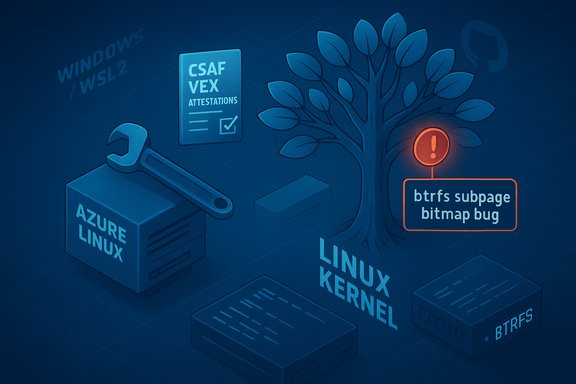
CVE‑2025‑37931 was published as a fix in the Linux kernel addressing a btrfs subpage bitmap indexing error. The defect occurs in a corner case where page size, node size and sector size interact (for example a 64 KiB page size, 16 KiB nodesize and 4 KiB sector size). Under these conditions the code that scans the subpage bitmap can advance its bit index incorrectly and skip writes, which in practice caused tree log corruption and missed dirty metadata writes. The problem affects metadata write correctness and therefore availability/data integrity rather than being an obvious remote code‑execution primitive. Microsoft’s MSRC noted in its product mapping language that Azure Linux includes the implicated open‑source library and is therefore potentially affected, and also announced a programmatic rollout of machine‑readable CSAF/VEX attestations that began with Azure Linux. That public commitment means Microsoft has completed an inventory for the Azure Linux product family and published the result first, and will expand attestations to additional Microsoft products over time.
Long answer: Azure Linux is the only Microsoft product Microsoft has publicly attested (via MSRC VEX/CSAF outputs) so far to include the implicated btrfs code for CVE‑2025‑37931. However, the presence of the same upstream source files or compiled module in other Microsoft‑distributed artifacts (for example the WSL2 kernel images, linux‑azure kernel builds, Azure Marketplace images, AKS node images or other custom images Microsoft distributes) is a per‑artifact, build‑time property and therefore remains an operational unknown until either Microsoft publishes additional attestations or the artifacts are inspected directly. Why that nuance matters:
Source: MSRC Security Update Guide - Microsoft Security Response Center
 Background / Overview
CVE‑2025‑37931 was published as a fix in the Linux kernel addressing a btrfs subpage bitmap indexing error. The defect occurs in a corner case where page size, node size and sector size interact (for example a 64 KiB page size, 16 KiB nodesize and 4 KiB sector size). Under these conditions the code that scans the subpage bitmap can advance its bit index incorrectly and skip writes, which in practice caused tree log corruption and missed dirty metadata writes. The problem affects metadata write correctness and therefore availability/data integrity rather than being an obvious remote code‑execution primitive. Microsoft’s MSRC noted in its product mapping language that Azure Linux includes the implicated open‑source library and is therefore potentially affected, and also announced a programmatic rollout of machine‑readable CSAF/VEX attestations that began with Azure Linux. That public commitment means Microsoft has completed an inventory for the Azure Linux product family and published the result first, and will expand attestations to additional Microsoft products over time. What Microsoft actually wrote — parsing the wording
Microsoft’s advisory language is intentionally compact and procedural:- The statement that “Azure Linux includes this open‑source library and is therefore potentially affected” is a factual product‑inventory claim for Azure Linux — Microsoft checked that distribution and found the upstream component(s) in that product, and therefore marked it in scope.
- Microsoft’s public commitment to publish CSAF/VEX attestations starting in October 2025 means the company will add more product attestations over time rather than doing a single global inventory sweep across every Microsoft artifact immediately. That is a documented, phased approach.
Is Azure Linux the only Microsoft product that includes the library and could be affected?
Short answer: No — not necessarily.Long answer: Azure Linux is the only Microsoft product Microsoft has publicly attested (via MSRC VEX/CSAF outputs) so far to include the implicated btrfs code for CVE‑2025‑37931. However, the presence of the same upstream source files or compiled module in other Microsoft‑distributed artifacts (for example the WSL2 kernel images, linux‑azure kernel builds, Azure Marketplace images, AKS node images or other custom images Microsoft distributes) is a per‑artifact, build‑time property and therefore remains an operational unknown until either Microsoft publishes additional attestations or the artifacts are inspected directly. Why that nuance matters:
- A CSAF/VEX attestation applies to a named product family and its covered artifacts. It is an authoritative, machine‑readable inventory for that product set — and precisely what defenders need to automate triage for Azure Linux.
- Absence of an attestation for another Microsoft product is absence of evidence, not evidence of absence. Microsoft’s phased approach deliberately avoids declaring every product “not affected” until it has a verifiable inventory for each one.
Where the same btrfs code could appear inside Microsoft’s ecosystem
Understanding where to look outside Azure Linux helps operations teams prioritize verification. The plausible Microsoft artifact families that can include the Linux kernel btrfs code are:- WSL2 kernel images: Microsoft publishes the WSL2 kernel source and ships prebuilt WSL kernels for Windows via a public GitHub repository (WSL2‑Linux‑Kernel). Those sources are upstream Linux branches and include filesystem trees such as fs/btrfs; whether any shipped WSL kernel build is compiled with btrfs support depends on the kernel config used for that release.
- linux‑azure / kernel‑azure builds: some Azure VM images and vendor integrations use cloud‑optimized kernel packages that may be built from upstream trees or patched kernels. Those kernels can include btrfs depending on the upstream revision and build configuration used by the packager. Distribution advisories routinely refer to linux‑azure or linux‑azure‑<version> kernel packages in their cloud‑targeted advisories.
- Azure Marketplace VM images and AKS node images: Marketplace or partner images are assembled artifacts that can embed a kernel. Unless a Marketplace image is part of Microsoft’s explicit VEX/CSAF attestation set, it must be inventoried separately by the image owner.
- Microsoft‑distributed appliance images or curated host images: any static or packaged kernel binary Microsoft distributes can carry the vulnerable code if it was built from an upstream revision predating the fix.
- Windows core images without WSL and plain Windows installs: these do not ship the Linux kernel code and so are outside the scope for this particular CVE (unless a third‑party product adds a Linux kernel or a driver reimplementation).
How to verify whether a specific Microsoft artifact is affected (practical checks)
The operational task is artifact-level inventory. Below are concrete steps defenders should use to determine whether an in‑scope artifact contains the vulnerable btrfs code and whether it needs a patch.1) For Linux VMs and VM images (Azure, AKS node pools, Marketplace images)
- Determine the running kernel version:
- uname -a
- Check kernel config for built‑in btrfs support:
- grep -i CONFIG_BTRFS /boot/config-$(uname -r) OR
- zgrep CONFIG_BTRFS /proc/config.gz
- Check whether the btrfs module is available/loaded:
- lsmod | grep btrfs
- modinfo btrfs
- test for /lib/modules/$(uname -r)/kernel/fs/btrfs
- Inspect distro or vendor advisories for fixed kernel package versions and apply patches/reboot if advised. Use vendor security pages and NVD/OSV entries to find fixed package numbers.
2) For WSL2 instances (Windows Subsystem for Linux)
- Inside WSL2, check kernel release:
- uname -r
- If you’re using the Microsoft‑supplied WSL kernel, compare the release to WSL GitHub releases (microsoft/WSL2‑Linux‑Kernel). Microsoft publishes the kernel source and release tags there; you can check whether the downstream WSL build includes the upstream fix.
- If using a custom WSL kernel (configured via .wslconfig kernel=…), inspect that kernel build’s config for CONFIG_BTRFS and whether its source includes the relevant upstream commit.
3) For container images and hosts
- Containers do not ship the host kernel. Focus on the host kernel (container host, orchestration node) rather than the container image itself, unless you are packaging a VM image that contains a kernel.
4) For Marketplace, appliance, and third‑party images
- Ask the publisher for an SBOM, CSAF/VEX attestation, or kernel package metadata. If none is provided, perform offline inspection by booting a copy of the image and applying the steps above.
Quick commands operators can copy/paste
- Check kernel config for btrfs:
- grep -i CONFIG_BTRFS /boot/config-$(uname -r) || (zcat /proc/config.gz | grep -i CONFIG_BTRFS)
- Is the module present?
- ls /lib/modules/$(uname -r)/kernel/fs/btrfs || modinfo btrfs
- Is the module loaded?
- lsmod | grep btrfs
- In WSL2:
- uname -r (then compare to microsoft/WSL2-Linux-Kernel releases on GitHub)
Risk assessment — what the CVE means in practice
- Primary impact: metadata corruption / availability. The fix addresses a logic error in bitmap indexing that can cause metadata writes to be skipped under specific page/node/sector size combinations, producing tree‑log corruption and metadata inconsistencies. This typically yields reliability/availability problems and data integrity risks on affected hosts rather than an immediate remote code execution vector.
- Exploitability: exploitation requires the environment with the particular combinations described by the upstream patch (e.g., 64 KiB page size with 16 KiB nodesize and 4 KiB sectorsize) or perhaps crafted workloads that trigger the code path, which reduces the general remote‑exploit surface — but data corruption and stability issues are serious for any host running btrfs metadata workloads.
- Blast radius inside Microsoft‑supplied artifacts: the highest‑confidence in‑scope set is Azure Linux (Microsoft’s attested product). Other Microsoft artifacts that ship a Linux kernel could be in scope depending on kernel revision and config; until Microsoft publishes further attestations for those products, each artifact must be verified individually.
- Operational impact: remediation typically requires updated kernel packages and reboots. In the cloud, applying fixed node images or updated kernel packages plus rolling reboots will be the remediation path; in desktop or appliance scenarios where a custom kernel is embedded, rebuilds or vendor updates are required.
Recommended immediate actions (prioritized checklist)
- Treat Azure Linux images as in‑scope and patch immediately per Microsoft’s guidance and your patch window. Microsoft has already published the VEX/CSAF attestation for Azure Linux to trigger automated triage for customers who run it.
- Inventory your estate for other Microsoft‑supplied Linux artifacts:
- WSL2 instances (inside Windows): check uname -r and kernel config; if WSL is shipping a kernel in your environment that has btrfs enabled and is older than the fixed commit range, plan to update the WSL kernel or apply the vendor/publisher patch.
- Azure Marketplace images, AKS node pools, and custom marketplace appliances: verify the kernel package and config, or request a VEX/CSAF attestation or SBOM from the publisher.
- Run the quick artifact checks (commands listed above) across VM fleets and orchestration nodes to find kernels that have btrfs compiled in or the btrfs module present. If found, match kernel versions to the fixed ranges listed in distro advisories (Ubuntu, Debian, Red Hat, SUSE, etc..
- Patch and reboot nodes in a controlled rolling manner; validate after reboot that the kernel now matches vendor fixed versions.
- Subscribe to MSRC/MSRC blog VEX/CSAF feeds and your distribution’s security trackers so you get machine‑readable attestations and package fix metadata as they are published. Microsoft’s blog about VEX announced the October 2025 phased rollout and explains how the VEX/CSAF model will be used.
- When vendor attestations are absent for a given artifact, require SBOM/kernel metadata from the image publisher or perform offline artifact inspection before trust.
Strengths and limitations of Microsoft’s approach (critical analysis)
Strengths
- Machine‑readable VEX/CSAF attestations for Azure Linux are a positive, pragmatic step. They give automation consumers a deterministic signal they can use to reduce false positives in vulnerability triage and automate remediation for a named product family. Microsoft’s decision to start with Azure Linux — a product family for which it controls the kernel and packaging end‑to‑end — is sensible and immediately useful to cloud customers who run those images.
- The wording used by MSRC is narrowly accurate and operationally helpful: by explicitly saying Azure Linux includes the library, Microsoft provides a clear, actionable inventory signal for Azure customers.
Limitations / Risks
- Phased coverage creates a verification gap. Microsoft’s rollout means many Microsoft artifacts are in an unattested state until they are inventoried. Large vendors ship hundreds of artifacts; a phased approach necessarily leaves a gap that defenders must manage by independently verifying other artifacts (WSL, linux‑azure, Marketplace images, AKS node images). That gap is not a bug in the VEX approach — it’s a practical consequence of doing inventory product‑by‑product — but defenders must treat unattested artifacts as unknown rather than implicitly safe.
- Artifact heterogeneity increases operational effort. Whether an artifact contains the vulnerable code is a function of kernel revision, local backports, and kernel configuration flags (e.g., CONFIG_BTRFS). This means an organization cannot rely on a single vendor statement to assert global safety: every kernel image must be checked or accompanied by attestation/SBOMs.
- Public advisories don’t always show the exact backport mappings. In certain vendor images, the fix may be backported to a package version that keeps the same kernel version number semantics; operators must rely on vendor security advisories or machine‑readable attestations for accurate mapping. Cross‑checking both distribution advisories and vendor attestations reduces risk.
What defenders should demand from vendors and publishers
- Machine‑readable attestations (CSAF/VEX) for every product family that ships kernels or kernel modules.
- SBOMs or at least deterministic kernel metadata: kernel config, kernel‑commit ids, package changelogs and the presence/absence of specific upstream commits.
- Clear, tested patch rollouts with versioned kernel packages and guidance for rolling updates and reboots.
Conclusion
Microsoft’s MSRC message that “Azure Linux includes this open‑source library and is therefore potentially affected” is correct and actionable for Azure Linux customers: treat Azure Linux as in‑scope and apply Microsoft’s updates. However, the statement is a product‑scoped attestation, not a global exclusionary claim; it does not prove that other Microsoft products (WSL2 kernels, linux‑azure builds, Marketplace or AKS images and other Microsoft‑distributed artifacts) are free of the same upstream btrfs code. Until Microsoft adds additional VEX/CSAF attestations or a publisher provides SBOM/kernel metadata for a specific artifact, defenders must assume an unknown status for other Microsoft artifacts and perform explicit verification using the commands, checks and vendor advisories outlined above. Actionable priorities: patch Azure Linux immediately, inventory other Microsoft‑distributed kernels (WSL2, linux‑azure, Marketplace/AKS images), require attestations or inspect artifacts, and subscribe to VEX/CSAF feeds so future attestations automatically reduce the manual verification workload.Source: MSRC Security Update Guide - Microsoft Security Response Center
