

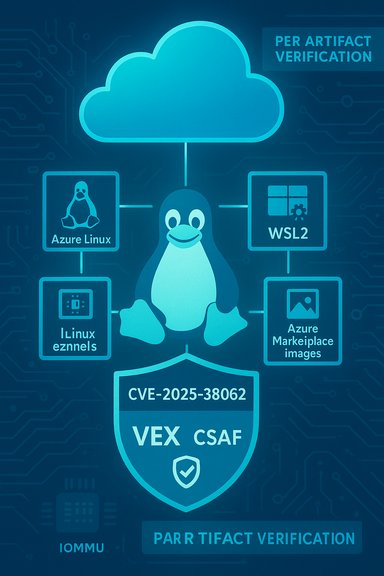
Microsoft’s short, machine‑readable advisory that “Azure Linux includes this open‑source library and is therefore potentially affected” is accurate — but it is an inventory attestation for a single product family, not proof that no other Microsoft artifact can or does contain the same vulnerable Linux kernel code. The Linux kernel bug tracked as CVE‑2025‑38062 is a real, upstream kernel fix that has been merged into stable trees and mapped into vendor kernels; Microsoft’s statement confirms Azure Linux (the Microsoft‑published Linux distribution lineage) contains the implicated component and therefore must be treated as in‑scope, while leaving open the possibility that other Microsoft‑distributed kernel artifacts may also carry the vulnerable code until each artifact has been inventoried or attested.
Background / Overview
CVE‑2025‑38062 is a Linux kernel vulnerability in the generic IRQ / MSI translation path (genirq/msi). The bug stems from a two‑step IOMMU translation process for MSI message addresses: a cookie pointer containing an IOVA address was stored in the MSI descriptor during allocation, and then later used when composing the translated message. That pointer had an implicit lifetime requirement which, under certain changed IOMMU domain conditions (notably when userspace manipulates domains via iommufd and VFIO), could become a use‑after‑free (UAF). Upstream maintainers fixed the issue by removing the cookie pointer and storing the translated IOVA directly in the MSI descriptor, eliminating the lifetime race. The vulnerability was assigned and published in mid‑June 2025 and classified by many distributors as a moderate‑to‑important kernel memory‑corruption risk that needs remediation. Upstream fixes were merged into the stable trees (for example, fixes landed in stable kernel branches such as 6.1.141 and 6.6.93), and vendors have since mapped those commits into their distribution kernel packages or backports. Why this matters in practice: kernel UAFs can in some circumstances be weaponized for local privilege escalation or guest‑escape vectors, depending on platform configuration and available exploitation primitives. The real‑world exploitability depends on the environment (IOMMU usage, VFIO/iommufd configuration, presence of MSI‑capable devices, and whether the kernel build includes the relevant code paths), so operators should focus on known affected products and artifacts and on applying upstream or vendor patches where required.The MSRC Attestation: What Microsoft Actually Said
Microsoft’s Security Response Center (MSRC) announced that it has started publishing machine‑readable Vulnerability Exploitability eXchange (VEX) attestations and Common Security Advisory Framework (CSAF) outputs in a phased rollout, beginning with Azure Linux (the Microsoft‑published distribution previously known as CBL‑Mariner). In that context MSRC’s CVE mappings include targeted product attestations such as “Azure Linux includes this open‑source library and is therefore potentially affected.” Microsoft has also stated it will update VEX/CSAF mappings and CVE records if additional Microsoft products are identified as carriers of the implicated open‑source component. Two important operational points flow from Microsoft’s wording:- The MSRC sentence is a product‑level inventory attestation that tells you what Microsoft has verified for the Azure Linux family.
- The sentence is not an exclusivity guarantee. Absence of an attestation for other Microsoft artifacts is absence of attestation, not proof of absence.
Why Azure Linux ≠ “Only Microsoft Product” (Technical Explanation)
The notion that a single vendor statement about one product equals a global guarantee for all vendor artifacts misunderstands how kernel code is built, packaged and shipped:- Kernel inclusion is an artifact‑level build decision. The same upstream file can be included, omitted, built‑in or compiled as a module depending on CONFIG_* flags chosen when building each kernel binary.
- Microsoft publishes and ships multiple Linux kernel artifacts across its ecosystem: the Azure Linux distribution kernels, linux‑azure / “azure‑tuned” kernels used with certain VM images, the Windows Subsystem for Linux (WSL2) kernel(s) Microsoft publishes and updates, Marketplace/partner images and curated container/VM images. Each artifact is a separate build with independent provenance.
- Microsoft’s VEX rollout deliberately started with Azure Linux as the first product family to be inventoried and attested. That phasing reduces the risk of false attestations but temporarily leaves other artifacts in an “unverified” state pending inventory. Microsoft committed to update the CVE/VEX mapping if further affected products are identified.
Which Microsoft Artifacts Could Also Carry the Vulnerable Code?
Below are the realistic Microsoft product surfaces that could carry the same upstream kernel component and therefore merit verification:- Windows Subsystem for Linux (WSL2) kernel builds — Microsoft publishes the WSL2 kernel source (microsoft/WSL2‑Linux‑Kernel) and ships WSL kernel binaries to Windows clients; those kernel builds can include GPU, device and other drivers depending on how Microsoft configures them. If a WSL kernel build contains the MSI translation code in the affected commit range, that WSL instance could be vulnerable until updated.
- linux‑azure / azure‑tuned kernels used by Azure VM images — some Azure VM images or Azure Marketplace images use kernels that are tuned or packaged specifically for Azure and may be maintained separately; these “linux‑azure” kernels are a plausible carrier for upstream kernel vulnerabilities and must be checked per‑image.
- Azure Marketplace images, AKS node images and vendor appliances — Marketplace or partner images include kernel artifacts provided by third parties or by Microsoft; the kernel version and configuration used determine whether the same code is present.
- Any Microsoft product that bundles or runs a compiled Linux kernel (for example, appliance images or Linux‑based agent containers that include a kernel for specialized appliances).
How to Verify If Your Microsoft‑Provided Artifact Is Affected (Practical Steps)
- Inventory affected artifacts first:
- List Azure Linux images you run in your estate and mark them as priority, because Microsoft explicitly attested Azure Linux as a carrier.
- Identify Windows hosts running WSL2, Azure VMs that use linux‑azure kernels, AKS node images, Marketplace images, and any appliances or vendor images provided by Microsoft or its partners.
- Check kernel version and vendor advisories:
- On a running Linux host: uname -r ; check package manager kernel package versions (e.g., apt list --installed linux-image* or rpm -qa | grep kernel).
- Compare your kernel version to vendor advisories or the upstream stable commits that carry the fix (fixed in stable branches such as 6.1.141, 6.6.93, etc. — verify your distro’s backport mapping).
- For WSL2:
- Check WSL kernel version from a WSL shell (uname -a) or from Windows via wsl --status and the WSL release notes. If your WSL kernel version predates the upstream fix and includes MSI/IOMMU code paths, update using wsl --update or install a patched kernel provided by Microsoft.
- Module and symbol checks:
- Inspect /lib/modules/$(uname -r)/ for modules related to MSI, IOMMU, VFIO and device drivers that use MSI (e.g., vfio, amd_iommu, Intel IOMMU drivers).
- Grep the kernel source in your build artifacts (if available) for the affected msi cookie usage patterns, or search kernel changelogs and vendor security notices for the mapped fix.
- Rely on vendor mapping and VEX attestations:
- Consult Microsoft’s VEX/CSAF output for the given CVE to see which Azure Linux builds were attested and whether Microsoft later expanded that mapping to other products. Also consult your distro vendor’s advisories (Ubuntu, Red Hat, SUSE, Amazon Linux, etc. because they publish kernel package updates tied to upstream commits.
- If in doubt, treat the artifact as unverified and patch or mitigate:
- Apply vendor kernel updates or rebuild images with updated kernels.
- For WSL, use Microsoft’s WSL update mechanism to obtain a patched kernel binary where Microsoft has published a fix.
Remediation and Mitigation Checklist
- Patch: Apply the patched kernel provided by your distribution or by Microsoft (for Azure Linux and Microsoft‑published kernels). Upstream commits were merged into the stable trees and vendors have issued kernel updates and backports.
- Update WSL: Run wsl --update on Windows hosts, or install a WSL kernel that includes the downstream patch if Microsoft has published one for the WSL kernel you use. Check WSL release notes and the microsoft/WSL2‑Linux‑Kernel repo for details.
- Rebuild images: For Marketplace or custom images, rebuild VM images and node pools with patched kernel packages and redeploy.
- Inventory IOMMU/VFIO use: If you use VFIO, device passthrough, or iommufd features, prioritize patching those hosts first — the vulnerability’s exploitation model directly touches IOMMU and VFIO domain switching semantics.
- Monitor MSRC VEX updates: Microsoft committed to expand VEX/CSAF attestations beyond Azure Linux. Subscribe to MSRC feeds and the VEX/CSAF provider endpoints to ingest updates automatically.
- Temporary mitigations (if you cannot patch immediately): limit or control access to privileged userspace that can change IOMMU domains (iommufd/VFIO operations), restrict untrusted tenants’ ability to attach devices that trigger MSI programming races, and tighten host isolation controls where possible. These are stopgaps and not substitutes for patched kernels.
Risks and Limits of the Attestation Approach
Microsoft’s shift to machine‑readable VEX/CSAF attestations is a transparency win: it reduces false positives and enables automated triage for known product families. However, there are practical limits to a phased rollout:- Time gap: inventorying and validating hundreds of product artifacts takes time. The first product (Azure Linux) will be attested earlier than the rest, leaving a temporary coverage gap across other Microsoft artifacts. Administrators must therefore not treat the absence of a VEX entry as a guarantee of safety.
- Artifact variance: the kernel code shipped in WSL, linux‑azure packages, Marketplace images and other artifacts may differ by version and configuration. A vulnerability present in upstream code may be present in some artifacts and absent in others; definitive answers require per‑artifact checks.
- Backport complexity: distribution vendors frequently backport fixes into older kernel trees; this makes comparing simple kernel version numbers insufficient. Always cross‑reference vendor security notices or package changelogs to ensure your deployed kernel contains the upstream fix.
- Automation risk: automated triage that consumes only product‑level VEX attestations may miss un‑attested artifacts. Security teams should augment VEX consumption with artifact‑level discovery (SBOMs, kernel package inventories, and runtime kernel checks).
Recommendations for Enterprise Operators
- Prioritize Azure Linux hosts for immediate remediation because Microsoft has explicitly attested them as potentially affected. Treat MSRC’s Azure Linux entry as a canonical “known affected / in‑scope” signal you must act upon.
- Inventory all Microsoft‑provided artifacts in your estate:
- WSL2 usage on developer desktops and server build hosts.
- Azure VM images and linux‑azure kernels used by your VM fleets and AKS node pools.
- Azure Marketplace images and partner appliances that might include kernel images.
- Automate checks:
- Collect running kernel versions (uname -r) across fleets.
- Cross‑map those versions to vendor advisories for CVE‑2025‑38062.
- For WSL, query the WSL kernel version and adopt Microsoft’s WSL update flow where appropriate.
- Subscribe to and ingest Microsoft’s VEX/CSAF feed and vendor advisories so your vulnerability management platform can accept authoritative attestations and trigger patching workflows.
- If you operate VFIO or device passthrough in multi‑tenant environments, apply patching on those hosts as a priority and consider short‑term mitigations that reduce untrusted reconfiguration of IOMMU domains.
What Remains Unverifiable Today (Flagged Cautions)
- Whether any specific Microsoft product other than Azure Linux currently ships the vulnerable MSI cookie code in a given build is not something that can be answered without per‑artifact inspection or a Microsoft VEX/CSAF attestation for that product. Microsoft explicitly committed to updating its CVE mapping if additional impacted products are discovered; until that happens, claims about other Microsoft product families carrying the code are plausible but unverified. Treat such claims conservatively — assume unverified artifacts are “potentially affected” until proven otherwise.
- Kernel version numbers alone do not always tell the whole story: distribution maintainers can and do backport fixes into older kernel release branches. The only reliable verification method is either (a) a vendor package changelog that explicitly maps the upstream fix into your package version, (b) a VEX/CSAF attestation from the vendor for that product/artifact, or (c) direct inspection of the kernel artifact (source or binary) for the applied fix.
Final Analysis and Conclusions
Microsoft’s MSRC entry that “Azure Linux includes this open‑source library and is therefore potentially affected” is an accurate, actionable attestation: if you run Azure Linux images, treat them as in‑scope and patch accordingly. The MSRC VEX/CSAF rollout — publicly announced and intentionally phased starting in October 2025 — is a deliberate and positive step for vendor transparency and automation. However, the statement should not be read as an exclusive claim that only Azure Linux could ever contain the same upstream kernel code. Microsoft ships multiple kernel artifacts — notably the WSL2 kernel and Azure‑tuned kernels used by some VM images — and the inclusion of a particular upstream driver or code path is an artifact‑level property. Until Microsoft expands its VEX attestations or you verify individual artifacts, assume uncertainty for Microsoft‑distributed kernel artifacts beyond Azure Linux and prioritize inventory, verification, and patching accordingly. For practical purposes:- Treat Azure Linux as confirmed in‑scope and patch now.
- Inventory WSL and Azure VM artifacts you run, map kernel versions to vendor advisories, and update or rebuild images with patched kernels where needed.
- Monitor MSRC’s VEX/CSAF feed for expanded attestations — Microsoft has committed to updating CVE mappings if other products are identified.
Source: MSRC Security Update Guide - Microsoft Security Response Center
