

Microsoft’s public advisory names Azure Linux as the Microsoft product that “includes this open‑source library and is therefore potentially affected,” but that statement is an attestation of scope completed so far — it does not prove that no other Microsoft product can or does include the same kernel code.
The issue tracked as CVE‑2025‑38248 is a Linux kernel bug in the bridge multicast code — summarized as “bridge: mcast: Fix use‑after‑free during router port configuration.” The defect can leave stale router‑port entries in global or per‑VLAN lists, which in certain list‑traversal operations produces a use‑after‑free (UAF) and possible kernel crash. Upstream kernel maintainers fixed the root cause by ensuring ports are removed from the appropriate router‑port lists during context teardown. Microsoft’s MSRC entry for the CVE (and associated machine‑readable CSAF/VEX attestation) explicitly states that Azure Linux includes the implicated upstream code and is therefore “potentially affected,” and Microsoft has pledged to update the CVE attestation if it discovers additional Microsoft products that ship the same open‑source component. That wording is procedural and product‑scoped: it reports the inventory Microsoft has completed at the time of the advisory, not an exclusionary claim about all Microsoft products.
However, the attestation rollout is per product family and incremental. Absence of an attestation for a product is simply absence of a published inventory result — not definitive evidence that the product is safe. Operators should therefore:
Source: MSRC Security Update Guide - Microsoft Security Response Center
 Background / Overview
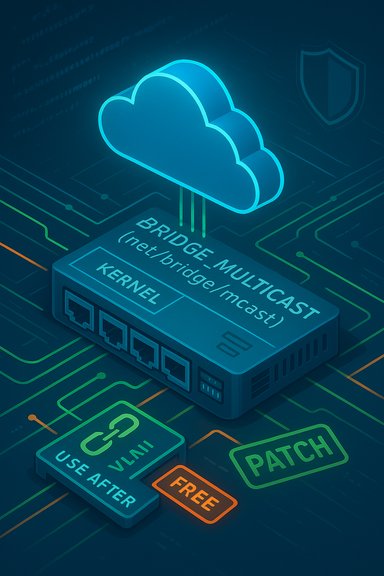
The issue tracked as CVE‑2025‑38248 is a Linux kernel bug in the bridge multicast code — summarized as “bridge: mcast: Fix use‑after‑free during router port configuration.” The defect can leave stale router‑port entries in global or per‑VLAN lists, which in certain list‑traversal operations produces a use‑after‑free (UAF) and possible kernel crash. Upstream kernel maintainers fixed the root cause by ensuring ports are removed from the appropriate router‑port lists during context teardown. Microsoft’s MSRC entry for the CVE (and associated machine‑readable CSAF/VEX attestation) explicitly states that Azure Linux includes the implicated upstream code and is therefore “potentially affected,” and Microsoft has pledged to update the CVE attestation if it discovers additional Microsoft products that ship the same open‑source component. That wording is procedural and product‑scoped: it reports the inventory Microsoft has completed at the time of the advisory, not an exclusionary claim about all Microsoft products.What the CVE actually is — technical summary
- Component: Linux kernel bridge multicast (net/bridge/mcast) code that manages global and per‑VLAN router port lists.
- Fault: use‑after‑free caused by ports not being removed from router port lists when per‑port/per‑VLAN multicast contexts get disabled or when VLANs/ports are deleted.
- Primary impact: availability/reliability — kernel warnings, KASAN traces, oops/panic, and network disruption on affected hosts.
- Attack surface: local or tenant‑adjacent operations that manipulate bridge and VLAN configuration (for example, container orchestration that creates/deletes bridge ports, or platform automation that configures switch-like behavior in VMs). It is not a trivial, unauthenticated remote wormable flaw.
Parsing Microsoft’s statement: “Azure Linux includes the open‑source library and is therefore potentially affected”
Microsoft’s phrasing must be read in the operational context of modern vendor vulnerability attestations:- Vendors increasingly publish CSAF/VEX machine‑readable attestations for specific product families once they have completed a validated inventory for those families. Microsoft began publishing such attestations in recent months and used that mechanism to communicate product‑level impact for several kernel CVEs.
- Saying a product “includes the open‑source library and is therefore potentially affected” is an authoritative inventory statement for that product family only — it confirms the vendor has found the upstream component in that product and is treating it as in‑scope for mitigation. It is not a universal guarantee that other vendor artifacts are free from the same code.
Why that nuance matters to operators and security teams
Kernel components are an artifact‑level property: whether a given Microsoft offering carries a specific kernel subsystem depends on:- The specific kernel binary shipped for that product (kernel version and stable branch).
- The kernel configuration (which CONFIG_* options were enabled at build time, whether the subsystem is built‑in or modular).
- Whether the product ships Microsoft‑built kernel images (for example, Azure Linux or WSL2) or vendor/supplier images (third‑party Marketplace images, upstream distro kernels).
- Packaging and backport choices: vendors often backport fixes into older kernel trees rather than moving to mainline version numbers.
Which Microsoft products you should check (practical list)
- Azure Linux — attested by Microsoft as potentially affected. Treat MSRC/CSAF guidance for Azure Linux as authoritative for Microsoft‑published Azure Linux images.
- Windows Subsystem for Linux (WSL / WSL2) — ships a Microsoft‑built Linux kernel binary that is updated independently. If the WSL kernel version in use predates the upstream fix and includes the bridge multicast code, it could be affected. Verify WSL kernel version and update via Microsoft’s documented flow.
- Azure VM images / AKS node pools / Marketplace images — some images use Azure‑tuned kernels delivered or maintained by Microsoft; others use the distro vendor’s kernel. Any VM or managed node running a kernel build before the backport or fix is potentially vulnerable. Check the kernel version in the image and rely on the image publisher’s advisory.
- Third‑party or partner images hosted in Azure Marketplace — those remain the publisher’s responsibility; do not assume Microsoft’s Azure Linux attestation covers them.
How to verify whether your Microsoft‑supplied artifact is affected (artifact‑level checks)
- On a running kernel (VM, WSL, container host) confirm the kernel and package status:
- uname -r to see the kernel release string.
- Check package changelogs or kernel package upgrade notes for CVE-2025-38248 (or for the upstream commit ID).
- For modular drivers, run modinfo against the relevant module to see version and build info.
- For WSL2:
- Run wsl --update (PowerShell admin) and then wsl --shutdown to restart WSL instances.
- Inside WSL, run uname -r to confirm the kernel binary version matches Microsoft’s patched WSL kernel release. Microsoft publishes WSL kernel updates and a corresponding source tag; cross‑check the version.
- For Azure VMs and AKS:
- Confirm the image SKU and whether it uses an Azure‑tuned kernel (linux‑azure / “azl” builds). If the image uses a Microsoft‑published kernel, consult Microsoft’s advisory and the CSAF/VEX artifact for SKU‑level mapping.
- For managed node pools (AKS), upgrade node pool images to patched SKUs and reboot nodes as required.
- For Marketplace or custom images:
- Treat the image publisher’s advisory as the authority. If you are running customer‑supplied or partner images, ask the image publisher whether they have patched the kernel in their image and which kernel version they ship.
Mitigation and remediation guidance
- The only durable remediation is to apply vendor‑supplied kernel updates that include the upstream fix and then reboot the affected host. Distributors and cloud vendors have integrated the upstream patches into stable trees and published package updates; apply those packages following normal maintenance procedures.
- For WSL2 users: run wsl --update and restart WSL. Confirm kernel version inside WSL.
- For managed services (AKS): upgrade node pools to images that include the patched kernel and drain/reboot nodes as required.
- For Marketplace images: move to patched SKUs published by the marketplace publisher or apply in‑place kernel updates where possible.
- Short‑term mitigations if patching is delayed:
- Restrict capability to change bridge configuration and VLAN attributes to trusted admins only (limit CAP_NET_ADMIN).
- Restrict untrusted workloads that can create/modify bridge ports (e.g., limit container hosts where untrusted containers can call NETLINK operations).
- Monitor for kernel warnings tied to br_multicast list traversals.
Risk assessment — how serious is this in practice?
- Severity is primarily availability related: kernel panics, oopses, or subsystem crashes can disrupt networking and require a host reboot. Public trackers show CVSS/impact assessments in the important range for similar kernel UAFs, and downstream vendors treated the issue as worthy of timely fixes.
- Exploitability: the defect generally requires local or tenant‑adjacent ability to manipulate bridge/VLAN configuration or a workload that triggers the precise list‑traversal race; it is not a straightforward unauthenticated remote exploitation vector. In multi‑tenant clouds, however, local‑to‑host behaviors can have outsized impact because a kernel crash on a host can affect many tenants.
- Operational impact in clouds: higher, because host or VM kernel crashes can cascade across orchestrated services; prompt patching of host and guest kernels reduces blast radius. Cloud vendors and distributors have prioritized backports into maintained kernel streams to shrink exposure windows.
Why Microsoft’s attestation approach is useful — and what to watch for
Microsoft’s phased CSAF/VEX attestations are valuable because they provide machine‑readable inventory statements that automate triage for customers who run those specific Microsoft SKUs (for example, Azure Linux). For operators of those SKUs, the attestation is an authoritative signal you can consume in your vulnerability management pipeline.However, the attestation rollout is per product family and incremental. Absence of an attestation for a product is simply absence of a published inventory result — not definitive evidence that the product is safe. Operators should therefore:
- Treat Microsoft’s Azure Linux attestation as canonical for Azure Linux SKUs, and
- Independently verify other Microsoft artifacts you use (WSL kernels, VM images, AKS node images, Marketplace appliances).
Practical checklist for Windows/Linux operations teams
- Inventory: enumerate all places you run Linux kernels — Azure VMs, AKS nodes, WSL2 instances, on‑prem hosts, appliances, and Marketplace images.
- Identify: map each artifact to its responsible publisher (Microsoft, distro vendor, marketplace publisher) and kernel version.
- Validate: check kernel package change logs or vendor advisories for inclusion of the upstream fix for CVE‑2025‑38248. Use vendor advisories, NVD/OSV, or distro trackers as corroboration.
- Remediate: schedule kernel updates and reboots for affected artifacts; for WSL2 run wsl --update and restart.
- Mitigate: restrict bridge/CAP_NET_ADMIN operations and monitor logs for br_multicast warnings until patched.
Cross‑verification of key claims (two independent checks)
- Upstream and aggregator confirmation: The NVD entry and the linux‑cve‑announce mailing list summarize the same technical fix and remediation path for CVE‑2025‑38248 (description, root cause, and fix commitments). These confirm the vulnerability narrative.
- Distribution tracking: Debian/Ubuntu/ALAS advisories and Rapid7/Ubuntu trackers list affected kernel packages and published fixes/backports for various distribution kernels. Those vendor pages corroborate the practical remediation path (apply patched kernel packages) and the attack/impact model.
Caveats and unverifiable or conditional claims (flagged)
- Exact per‑SKU exposure for every Microsoft artifact is not verifiable unless Microsoft or the image publisher provides an explicit attestation or you inspect the artifact yourself. Microsoft’s attestation confirms Azure Linux; whether any other Microsoft kernel artifact includes the bridged multicast subsystem in the vulnerable commit range must be verified per artifact. This is a procedural limitation, not a substantive denial of risk. Treat any claim that “only Azure Linux is affected” as provisional until Microsoft updates the CVE/VEX mapping or until artifact‑level inspection is completed.
- Some third‑party Marketplace images and partner appliances are managed and patched by their publishers; assuming Microsoft’s attestation covers them is incorrect. Always verify with the image supplier.
Bottom line — direct answer to the question
- Microsoft has publicly attested that Azure Linux includes the open‑source kernel code tied to CVE‑2025‑38248, and that makes Azure Linux the Microsoft product Microsoft has declared as potentially affected in its advisory.
- That attestation does not mean Azure Linux is technically the only Microsoft product that can include the library. Other Microsoft artifacts that ship or run a Linux kernel (for example, WSL2 kernels, Azure‑tuned VM kernels, AKS node images, or some Marketplace images) could include the same upstream code depending on kernel build choices. Those artifacts must be verified individually.
- Operational action: if you run Azure Linux images, follow Microsoft’s advisory and apply the published kernel updates. If you run other Microsoft images or WSL2, verify kernel versions and patch status per the checklist above; do not rely on absence of a published Microsoft attestation as definitive proof of safety.
Conclusion
Microsoft’s public statement is deliberately scoped: it tells Azure Linux users that Microsoft has validated that product and found the upstream component there, while committing to expand VEX/CSAF mappings if other Microsoft artifacts are identified later. That approach increases transparency for the first product validated, but it places a necessary burden on customers to continue artifact‑level verification across the diverse surfaces where Linux kernels are shipped and run. In practical terms, treat the Azure Linux attestation as a definitive signal for Azure Linux — and treat every other Microsoft‑provided kernel image you consume as potentially in scope until you confirm otherwise via vendor advisories or artifact inspection.Source: MSRC Security Update Guide - Microsoft Security Response Center
