

Microsoft’s short, product‑scoped attestation that “Azure Linux includes this open‑source library and is therefore potentially affected” is accurate — but it is not an exclusivity guarantee: Azure Linux is the only Microsoft product Microsoft has publicly attested to include the vulnerable GNU coreutils component so far, yet the presence (or absence) of the same upstream code in other Microsoft artifacts requires independent verification before you can assume they are unaffected.
CVE-2016-2781 is a locally exploitable weakness in the GNU Core Utilities (coreutils) implementation of the chroot utility when used with the --userspec option. The bug arises because an attacker can arrange a crafted TIOCSTI ioctl call that pushes characters into a controlling terminal’s input buffer; under certain conditions that input can cause the parent session to execute commands the attacker injects. Multiple public trackers — including NVD, Debian, and Ubuntu’s security pages — describe the same technical details and rate the issue at a medium level of severity for many packaged distributions.
The practical exploit model is local: an unprivileged user who can interact with a process running chroot --userspec (or otherwise reach the vulnerable code-path) may be able to push characters into the terminal stream and gain control over a parent session. That makes the bug context‑sensitive and primarily relevant to multi‑user systems, containers, or environments where processes with different privilege domains share terminals.
Microsoft’s October 2025 announcement about publishing machine‑readable attestations (CSAF and VEX) makes this approach explicit: the company started with a phased rollout of VEX/CSAF attestations beginning with the Azure Linux distribution so it could provide authoritative machine‑readable statements for one Microsoft‑maintained Linux artifact before expanding coverage. The blog explains the deliberate, phased approach and why the company is starting with Azure Linux.
Put plainly: when MSRC says Azure Linux includes this component and is potentially affected, treat that as an authoritative confirmation for Azure Linux images. It is useful and accurate for customers running that distribution. However, the statement is not a blanket technical warranty that no other Microsoft product or image contains the same vulnerable upstream library — it is a scoped inventory disclosure.
Why this nuance matters:
Source: MSRC Security Update Guide - Microsoft Security Response Center
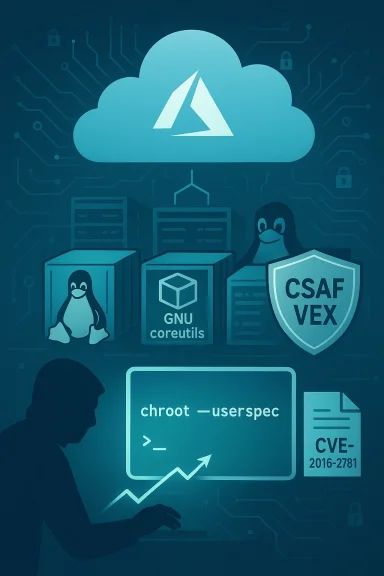 Background / Overview
CVE-2016-2781 is a locally exploitable weakness in the GNU Core Utilities (coreutils) implementation of the chroot utility when used with the --userspec option. The bug arises because an attacker can arrange a crafted TIOCSTI ioctl call that pushes characters into a controlling terminal’s input buffer; under certain conditions that input can cause the parent session to execute commands the attacker injects. Multiple public trackers — including NVD, Debian, and Ubuntu’s security pages — describe the same technical details and rate the issue at a medium level of severity for many packaged distributions.The practical exploit model is local: an unprivileged user who can interact with a process running chroot --userspec (or otherwise reach the vulnerable code-path) may be able to push characters into the terminal stream and gain control over a parent session. That makes the bug context‑sensitive and primarily relevant to multi‑user systems, containers, or environments where processes with different privilege domains share terminals.
What Microsoft has said — and what that wording means
Microsoft’s public vulnerability pages and the MSRC update guide contain a repeated FAQ line across many Linux CVE pages: “Is Azure Linux the only Microsoft product that includes this open-source library and is therefore potentially affected? … One of the main benefits … is the commitment to keep it up to date … we began publishing CSAF/VEX in October 2025. If impact to additional products is identified, we will update the CVE to reflect this.” That phrasing appears on MSRC CVE pages and functions as a product‑level attestation for Azure Linux.Microsoft’s October 2025 announcement about publishing machine‑readable attestations (CSAF and VEX) makes this approach explicit: the company started with a phased rollout of VEX/CSAF attestations beginning with the Azure Linux distribution so it could provide authoritative machine‑readable statements for one Microsoft‑maintained Linux artifact before expanding coverage. The blog explains the deliberate, phased approach and why the company is starting with Azure Linux.
Put plainly: when MSRC says Azure Linux includes this component and is potentially affected, treat that as an authoritative confirmation for Azure Linux images. It is useful and accurate for customers running that distribution. However, the statement is not a blanket technical warranty that no other Microsoft product or image contains the same vulnerable upstream library — it is a scoped inventory disclosure.
Technical verification of CVE-2016-2781 (what the public trackers say)
Multiple independent vulnerability trackers document the same technical behavior and affected component:- NVD’s CVE entry reproduces the canonical description: "chroot in GNU coreutils, when used with --userspec, allows local users to escape to the parent session via a crafted TIOCSTI ioctl call." NVD lists the CVE description and links to other resources.
- Debian’s security tracker includes CVE-2016-2781 in its database, tracks package status and bug numbers, and links to the upstream discussion and Debian bug reports for coreutils. Debian notes the vulnerability and records distribution‑specific remediation status.
- Ubuntu’s security notice and third‑party aggregators (Aqua Security, Vulert, etc.) document both the vulnerability and distribution statuses, confirming the described exploitation vector (TIOCSTI) and recommending updates or mitigations.
Is Azure Linux the only Microsoft product that includes coreutils (and so potentially affected)?
Short answer: No — it is not correct to read Microsoft’s attestation as an exclusivity assurance. Azure Linux is the only Microsoft product Microsoft has publicly inventory‑checked and attested to include the affected open‑source component so far, but that does not prove other Microsoft products do not contain the same upstream code. The MSRC wording intentionally scopes the statement to Azure Linux and signals that Microsoft will update a CVE if it identifies impact to additional products.Why this nuance matters:
- “Includes and is therefore potentially affected” is an attestation about a named product (Azure Linux). It documents that Microsoft has checked the composition of that specific artifact and found the upstream library present. It is accurate and actionable for Azure Linux customers.
- The statement is not a negative inventory statement for all Microsoft products. Microsoft’s inventory and VEX rollout are phased; many other Microsoft artifacts might include the same upstream components (for legitimate reasons — e.g., packaged Linux images, internal appliances, custom runtime images used in cloud services, container images, or third‑party binaries re‑bundled into Microsoft offerings). Those artifacts either have not been attested yet or their attestations are still in progress.
- Independent verification is required to determine whether other Microsoft products ship the vulnerable coreutils variant. Because GNU coreutils is a foundational toolset, it is commonly present in nearly every Linux distribution image — meaning that if a Microsoft product ships a Linux image (or a Linux‑based container) it is plausible the same component could be present, unless Microsoft explicitly patched or removed it. Public attestations are the only authoritative statements Microsoft has committed to publish at scale via CSAF/VEX.
What defenders and customers should do (practical guidance)
If you manage systems, do not assume “not mentioned” equals “not affected.” Treat Microsoft’s Azure Linux attestation as a confirmed hit for that product, and follow these steps to determine impact across your environment:- Inventory first.
- Enumerate all Microsoft‑provided Linux artifacts you run or depend on: Azure Linux images, Azure Marketplace images, Azure Marketplace Marketplace VM images, WSL distributions that Microsoft publishes, containers supplied by Microsoft services, appliances, and any Microsoft management/CI images. Use your asset management tools to map images back to vendor and image tags.
- Check MSRC/CSAF/VEX for attestations.
- Consult Microsoft’s machine‑readable attestation feeds (CSAF/VEX) for each CVE to see product‑level statements. When Microsoft has completed inventory for a product, the VEX file will state whether the product is affected, not affected, or under investigation. Microsoft began publishing these attestations in October 2025 and is expanding coverage over time.
- Verify at the artifact level.
- For any product or image that may contain GNU coreutils, inspect the artifact directly: run package queries (e.g., rpm -q coreutils, dpkg -l coreutils), check binary versions, or compare shipped package checksums. If you cannot access the image internals, treat the artifact as “unknown” and escalate to the vendor for confirmation.
- Patch or mitigate.
- Where coreutils (or other vulnerable packages) are present and unpatched, update the package from a trusted repository. When updates are delayed or not available, consider mitigations such as removing or restricting the use of chroot --userspec in sensitive contexts and restricting access to PTYs and terminal devices where possible.
- Apply containment controls.
- Limit local untrusted user access to systems that run privileged or shared terminals. Use terminal device permission hardening, container runtime restrictions, or SELinux/AppArmor profiles to reduce attack surface when a vulnerable binary cannot be patched quickly.
- Track vendor updates and VEX/CSAF changes.
- Subscribe to Microsoft’s CSAF/VEX feeds and your distribution vendors’ security channels. Microsoft has committed to updating CVE pages and VEX attestations when new product impact is discovered.
Why the phrasing “Azure Linux is potentially affected” is a sensible operational choice
Microsoft’s public disclosure strategy — starting VEX/CSAF with Azure Linux — is operationally pragmatic and defensible for several reasons:- Azure Linux (formerly CBL‑Mariner) is a Microsoft‑maintained Linux distribution that the company can fully inventory and control, making it a logical first target for machine‑readable attestations. Publishing authoritative attestations for a product you fully own reduces false positives for customers and security vendors ingesting vulnerability data. Microsoft’s blog explains this phased approach.
- A phased rollout reduces the risk of incorrectly declaring other complex artifacts “not affected” before inventories and verifications are complete. Microsoft’s approach is conservative: attest what you can confirm, and then expand the coverage. That conservatism is a best practice for supply‑chain visibility programs because incomplete or incorrect attestations create more risk than careful, measured rollouts.
- From a consumer perspective, this phrasing gives immediate, authoritative guidance to Azure Linux customers while signaling that the company is still completing inventory for other products — an honest tradeoff between timeliness and exhaustiveness.
Real‑world impact: how likely is exploitation and who should worry most?
CVE-2016-2781 is a local, context‑dependent vulnerability. The largest risk surface is multi‑user systems and shared execution environments where a can interact with processes that have access to a terminal belonging to another session:- Multi‑user servers (shared shells, academic systems, hosting services)
- Container hosts where a containerized process might access the host’s terminal
- Legacy admin scripts or automation that call chroot --userspec in privileged contexts
- Any environment where an attacker can cause a TIOCSTI ioctl to reach a controlling terminal associated with a higher‑privilege session
Strengths and limitations of Microsoft’s attestation model
Strengths
- Clarity for named products: When Microsoft attests a product (Azure Linux) contains a vulnerable library, that is a clear signal to customers running that product to remediate. The machine‑readable VEX/CSAF approach makes it easier for security tooling to automate decisions.
- Reduced false positives: VEX can tell you when a vulnerability in a widely used upstream project does not apply to a specific product build, which helps defenders prioritize real issues over noise.
Limitations and risks
- Partial coverage during rollout: Because the rollout began with Azure Linux, other Microsoft artifacts may not yet be attested; administrators cannot assume “no mention” means “not affected.”
- Supply‑chain complexity: Microsoft’s ecosystem includes many images, kernels, and service artifacts. Some of these are Microsoft‑maintained; others are third‑party images offered in Azure Marketplace that Microsoft distributes but did not build — these nuances complicaying and require artifact‑level verification.
- Vendor silence is not proof: Security teams must treat an absence of public attestations as an unknown and verify locally or seek vendor confirmation before marking assets as safe.
How to verify Microsoft artifacts (concrete checklist)
- If you run Azure Linux VM images: treat the MSRC attestation as authoritative and apply Microsoft’s update guidance for that CVE.
- If you run other Microsoft‑supplied Linux images (Azure Marketplace, images bundled in services, appliances):
- Pull the image locally and inspect installed packages (rpm/dpkg/apt/yum queries).
- Search the image filesystem for coreutils binaries and their versions (ls --version; stat -c %y /usr/bin/chroot).
- If direct inspection isn’t possible, contact Microsoft support or the image publisher and ask for the CSAF/VEX attestation related to the CVE.
- If you run WSL on Windows: WSL instances are user‑supplied Linux distributions. If you install an Azure Linux image into WSL, apply the same remediation process. If Microsoft supplies a WSL kernel binary, that does not include coreutils by itself; coreutils resides in distribution packages. Confirm the distro image contents.
- For containerized workloads: inspect container images and base layers for coreutils packages and versions. For managed container services (e.g., Azure Container Instances / container registries), request the vendor’s supply‑chain attestations or scan images with trusted SCA tools.
Final assessment and recommendations
- Microsoft has publicly attested that Azure Linux includes the upstream GNU coreutils component and is therefore potentially affected by a vulnerability such as CVE‑2016‑2781; that attestation is authoritative for Azure Linux customers.
- That attestation does not imply exclusivity: absence of a similar attestation for another Microsoft product is not proof that product is unaffected. Administrators should treat un‑attested Microsoft artifacts as unknown and verify artifact contents directly or via vendor attestations.
- Use Microsoft’s CSAF/VEX feeds (published beginning October 2025) as a high‑quality source of machine‑readable product‑level attestations, but complement that with artifact‑level inspection and good patch management practices.
- For CVE‑2016‑2781 specifically, apply available distribution patches for coreutils, restrict use of chroot --userspec where feasible, and harden access to terminal devices and PTYs in multi‑user/shared environments. Corroborate vulnerability existence using NVD, Debian, or Ubuntu advisories where appropriate.
Conclusion
Microsoft’s messaging that “Azure Linux includes this open‑source library and is therefore potentially affected” is a precise, product‑level statement and the right thing to publish early in the CSAF/VEX rollout. For defenders, the practical takeaway is straightforward: treat Azure Linux as confirmed for the component and remediate accordingly; for every other Microsoft artifact, do not assume safety — verify. The combination of Microsoft’s VEX/CSAF attestations, standard Linux distro advisories (Debian, Ubuntu, etc.), and artifact‑level verification is the most reliable path to fast, accurate remediation in your environment.Source: MSRC Security Update Guide - Microsoft Security Response Center
