

Microsoft’s brief MSRC wording that “Azure Linux includes this open‑source library and is therefore potentially affected” is factually correct for the Azure Linux product family, but it is a product‑scoped attestation — not a categorical statement that no other Microsoft product could contain the same vulnerable upstream code.
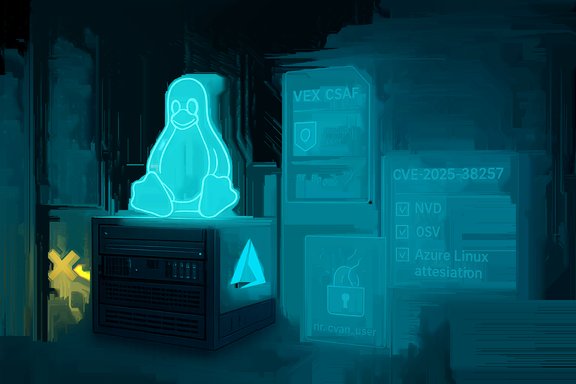
CVE-2025-38257 is a Linux kernel vulnerability described as: s390/pkey: Prevent overflow in size calculation for memdup_user. The issue arises when a user-supplied count (nr_apqns) is multiplied to compute a byte size passed to memdup_user, and that multiplication can overflow. The result may desynchronize the recorded size and the allocated area, creating unpredictable behavior. Upstream maintainers fixed the problem by using safer helpers and overflow-aware allocation helpers. Microsoft’s Security Response Center (MSRC) published an advisory mapping the upstream component to one of its products and wrote, in short form: “Azure Linux includes this open‑source library and is therefore potentially affected by this vulnerability.” Microsoft also announced it began publishing machine‑readable CSAF/VEX attestations in October 2025 and committed to updating CVE/VEX records if additional Microsoft products are found to include the same component. That public wording — and Microsoft’s VEX rollout plan — is central to interpreting what the advisory does and does not assert.
However, when a vendor starts a phased rollout and publishes attestations for a subset of products (Azure Linux first), a transient ambiguity window appears for the rest of the vendor’s SKUs. Customers must either:
If operational certainty is required for non‑Azure Microsoft artifacts, the only two deterministic options are: (a) wait for Microsoft to expand its VEX attestations to cover those artifacts, or (b) perform an artifact‑level inspection (kernel config, SBOM, /lib/modules and uname) to confirm whether the s390 pkey code path is present. Until one of those is done, assume uncertainty and prioritize artifacts that present the highest exposure.
Source: MSRC Security Update Guide - Microsoft Security Response Center
 Background / Overview
CVE-2025-38257 is a Linux kernel vulnerability described as: s390/pkey: Prevent overflow in size calculation for memdup_user. The issue arises when a user-supplied count (nr_apqns) is multiplied to compute a byte size passed to memdup_user, and that multiplication can overflow. The result may desynchronize the recorded size and the allocated area, creating unpredictable behavior. Upstream maintainers fixed the problem by using safer helpers and overflow-aware allocation helpers. Microsoft’s Security Response Center (MSRC) published an advisory mapping the upstream component to one of its products and wrote, in short form: “Azure Linux includes this open‑source library and is therefore potentially affected by this vulnerability.” Microsoft also announced it began publishing machine‑readable CSAF/VEX attestations in October 2025 and committed to updating CVE/VEX records if additional Microsoft products are found to include the same component. That public wording — and Microsoft’s VEX rollout plan — is central to interpreting what the advisory does and does not assert.Short answer up front
- No — Azure Linux is not necessarily the only Microsoft product that could include the vulnerable library.
- Yes — Azure Linux is the only Microsoft product Microsoft has publicly attested (so far) to include that specific upstream component for CVE‑2025‑38257. The attestation is authoritative for Azure Linux but not a technical proof that other Microsoft artifacts cannot carry the same code.
Why the distinction matters: attestation vs exclusivity
What Microsoft’s statement does mean
Microsoft’s one‑line MSRC mapping is a product‑level inventory result: the company inspected the Azure Linux distribution (its builds, kernels, or packages) and found the upstream component mapped to CVE‑2025‑38257. That is valuable and actionable: if you run Azure Linux images, Microsoft’s attestation is a clear instruction to treat those images as in‑scope for remediation and to apply updates promptly.What Microsoft’s statement does not mean
The statement does not mean Microsoft claims that no other Microsoft product contains the same code. Large vendors ship many artifacts — kernels, images, containers, marketplace appliances, WSL kernels, and internally built images — and each artifact’s build configuration and kernel version determine whether an upstream component appears. Absence of a VEX/CSAF attestation for a product is absence of evidence, not evidence of absence. Microsoft has explicitly framed its VEX rollout as phased, starting with Azure Linux, and said it will update CVEs if it finds other affected products.Technical context: why this CVE is architecture‑specific
CVE-2025-38257 is mapped to s390/pkey kernel code — that is, code paths specific to the IBM Z (s390) architecture. The vulnerable pattern is an unchecked arithmetic multiplication used to derive the size of an allocated buffer passed to memdup_user. This kind of defect is an integer overflow / size miscalculation that can lead to out‑of‑sync lengths, allocation errors, and kernel instability. Upstream fixes moved to overflow-aware helpers (for example memdup_array_user or check_add/check_mul helpers) and added defensive validation. The canonical vulnerability metadata (NVD, OSV, distro trackers) confirm the s390 kernel locus and the overflow fix. Key operational consequence: for the majority of Microsoft‑distributed Linux kernels built for x86_64 or arm64 (for example the WSL2 kernels, or typical Azure VM kernels built for those host architectures), an s390‑specific flaw only applies if those artifacts were built with s390‑targeted code or were intended to run on s390 hardware. In other words, an s390‑only kernel defect is only relevant to artifacts that include or run s390 builds. That architecture detail helps narrow the likely carriers — but it does not eliminate the need to check every Microsoft artifact you run.Cross‑checks and verification (what I validated)
- The canonical CVE description and technical summary are recorded in NVD and multiple vulnerability trackers: NVD (CVE‑2025‑38257) and OSV reproduce the same overflow narrative and list upstream commits.
- Distribution trackers (Ubuntu, Debian, Red Hat advisories) have mapped the CVE into kernel package advisories and backports where appropriate, confirming mainstream distros treat the issue as an upstream s390 kernel fix.
- Microsoft’s public attestation in MSRC was examined and interpreted in the context of Microsoft’s published VEX/CSAF rollout; independent community analysis and vendor commentary reinforce that the MSRC line is a product scoped attestation for Azure Linux and does not assert exclusivity for other Microsoft SKUs.
Practical guidance for administrators and operators
If you consume Microsoft artifacts in any form — cloud images, marketplace appliances, WSL kernels, or Microsoft‑distributed containers — treat Microsoft’s VEX/CSAF output as the authoritative machine‑readable mapping for the named product only, and follow these steps to remove ambiguity across your estate.Immediate checklist (high priority)
- Prioritize patches for Azure Linux images and kernels: Microsoft has attested Azure Linux as including the implicated code; apply Microsoft’s kernel updates for Azure Linux as soon as they’re available and validated.
- Inventory Microsoft artifacts you run: identify all Microsoft‑provided kernels, images, Marketplace images, and appliances in your environment. Don’t assume the Azure Linux VEX covers any other artifact automatically.
- Verify per‑artifact architecture and kernel configuration: on each host or image, run uname -a and inspect kernel package metadata and module lists to confirm whether the artifact includes s390 code or the specific pkey component. If you see s390‑targeted builds or explicit pkey/pkey_handler code, treat the artifact as potentially affected.
Detection and verification steps
- Check running kernel architecture and config: uname -m and zcat /proc/config.gz or check /boot/config-* for CONFIG_S390 and relevant pkey flags.
- Inspect module lists and /lib/modules/$(uname -r) for pkey-related modules.
- For images (VM or container): extract the image or boot it in a sandbox and inspect the kernel package and its build metadata / SBOM if available.
- Check Microsoft’s VEX/CSAF feed and MSRC update guide for newly published attestations; Microsoft has committed to update CVEs when other products are discovered to be carriers.
Compensations and mitigations if you can’t patch immediately
- Limit exposure: restrict multi‑tenant, CI/CD, or untrusted workloads from mounting or invoking privileged ioctl calls that touch pkey/pkey_handler code paths.
- Hardening: minimize local unprivileged access that can craft the specific ioctl inputs, and apply strict IAM/network isolation to reduce attacker foothold chance.
- Monitoring: enable kernel OOPS, KASAN, or dmesg alerting and watch for related error patterns indicating memdup_user or pkey path failures.
Why Microsoft’s phased VEX rollout is useful — and why it creates a window of uncertainty
Microsoft’s decision to publish machine‑readable CSAF/VEX attestation files is a positive step toward vendor transparency: it gives enterprise automation reliable signals about which Microsoft products ship a given vulnerable component and whether a product is fixed, not affected, or under investigation. That reduces triage time for customers who run Azure Linux and similar artifacts.However, when a vendor starts a phased rollout and publishes attestations for a subset of products (Azure Linux first), a transient ambiguity window appears for the rest of the vendor’s SKUs. Customers must either:
- Wait for the vendor’s next attestations (which Microsoft said it will publish) or
- Independently verify each artifact they run to confirm presence/absence of the component.
Risk assessment and realistic exploitability
- CVE‑2025‑38257 is an arithmetic/overflow correctness bug in the s390 pkey path. The practical results most likely are robustness and availability impacts — unpredictable behavior, kernel WARNs, allocation failures, or panics. There is no authoritative public evidence this specific CVE has yielded a remote code execution vector in the wild.
- Exploitability depends on two axes: (a) ability to exercise the vulnerable ioctl with crafted inputs; and (b) presence of the vulnerable code in the artifact you run. For most x86_64/arm64 kernel builds that do not include s390 code, the CVE is not directly applicable. For IBM Z hosts, s390 appliances, or images built for s390, the risk is real and should be patched.
- Long‑tail risk: embedded, vendor‑forked kernels and specialized appliances (including enterprise appliances that run on IBM Z) are the likeliest place the vulnerability will linger if vendors do not backport fixes. Inventory those devices first.
How to interpret future Microsoft updates (operational checklist)
- Monitor MSRC’s update guide and VEX/CSAF feed for expanded attestations that name additional Microsoft products as carrying the same upstream component. Microsoft has stated it will update CVEs when it discovers other affected products.
- If a Microsoft product you run gets listed later, treat that product’s attestation as the canonical signal and follow Microsoft’s remediation guidance immediately.
- If a product you run is not listed, continue to verify artifacts locally: check kernel versions, build configs, module lists, and SBOMs. Don’t rely on the absence of a VEX entry as a guarantee of safety.
Summary and final recommendation
Microsoft’s MSRC advisory correctly identifies Azure Linux as a confirmed carrier of the open‑source kernel code implicated in CVE‑2025‑38257 and therefore potentially affected; that statement is a product‑level attestation derived from Microsoft’s inventory work. However, that attestation is not an exclusive claim that no other Microsoft product can include the vulnerable code. The correct operational approach is:- Treat Azure Linux images as in‑scope and patch them promptly.
- Inventory and verify every other Microsoft artifact you run (WSL kernels, Marketplace images, container appliances, linux‑azure kernels). Don’t assume they’re unaffected just because they’re not yet present in Microsoft’s VEX/CSAF output.
- Monitor Microsoft’s VEX/CSAF feed and the MSRC update guide for any expansion of attestations; Microsoft has committed to updating CVEs if additional products are discovered to ship the component.
If operational certainty is required for non‑Azure Microsoft artifacts, the only two deterministic options are: (a) wait for Microsoft to expand its VEX attestations to cover those artifacts, or (b) perform an artifact‑level inspection (kernel config, SBOM, /lib/modules and uname) to confirm whether the s390 pkey code path is present. Until one of those is done, assume uncertainty and prioritize artifacts that present the highest exposure.
Source: MSRC Security Update Guide - Microsoft Security Response Center
