

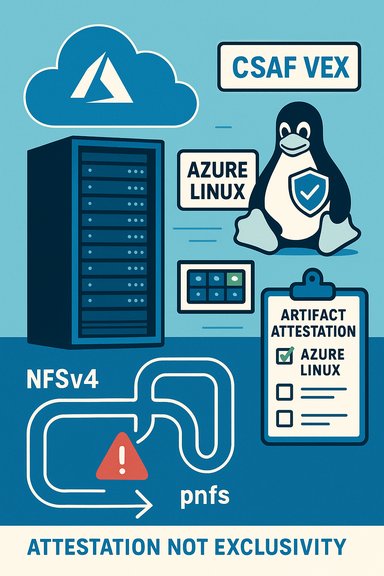
Microsoft’s brief public statement that “Azure Linux includes this open‑source library and is therefore potentially affected” is accurate — but it is a scoped, product‑level attestation rather than an exclusivity guarantee, and it should not be read to mean Azure Linux is the only Microsoft product that could carry the vulnerable NFS code.
The vulnerability in question is a Linux kernel NFSv4 / pNFS race that can lead to kernel oopses or crashes when certain layout‑commit or read/release sequences occur. The root cause is a state‑consistency / race condition inside the nfsd server paths handling pNFS layout state and tracepoint callbacks; upstream kernel maintainers issued narrowly scoped patches that remove the race window and prevent dereferencing freed layout or state objects. Multiple independent trackers and distro advisories mapped the bug to upstream stable commits and packaged fixes.
Microsoft’s Security Response Center (MSRC) published an advisory that explicitly maps the implicated upstream component to the Azure Linux product family and states Microsoft began publishing machine‑readable CSAF/VEX attestations in October 2025; the advisory also promises to update CVE/VEX records if further Microsoft products are found to ship the same component. That wording is procedural and product‑scoped, not a global exclusion for other Microsoft SKUs.
Operators must therefore:
Conclusion
Azure Linux is the only Microsoft product publicly attested so far to include the implicated open‑source kernel component — which makes it the immediate priority for Microsoft customers running those images — but it is not the only possible carrier across Microsoft’s diverse artifact set. The correct operational posture is: patch Azure Linux images immediately, inventory and verify every Microsoft artifact that ships or runs a Linux kernel, and treat Microsoft’s VEX/CSAF feed as a critical automation input while recognizing the phased nature of the rollout.
Source: MSRC Security Update Guide - Microsoft Security Response Center
 Background
The vulnerability in question is a Linux kernel NFSv4 / pNFS race that can lead to kernel oopses or crashes when certain layout‑commit or read/release sequences occur. The root cause is a state‑consistency / race condition inside the nfsd server paths handling pNFS layout state and tracepoint callbacks; upstream kernel maintainers issued narrowly scoped patches that remove the race window and prevent dereferencing freed layout or state objects. Multiple independent trackers and distro advisories mapped the bug to upstream stable commits and packaged fixes.Microsoft’s Security Response Center (MSRC) published an advisory that explicitly maps the implicated upstream component to the Azure Linux product family and states Microsoft began publishing machine‑readable CSAF/VEX attestations in October 2025; the advisory also promises to update CVE/VEX records if further Microsoft products are found to ship the same component. That wording is procedural and product‑scoped, not a global exclusion for other Microsoft SKUs.
What Microsoft actually said — and why the wording matters
Microsoft’s text is best read as a two‑part operational statement:- An authoritative inventory attestation for Azure Linux: Microsoft inspected that product family, found the upstream kernel component in the Azure Linux builds, and therefore marked Azure Linux as potentially affected. This gives Azure Linux customers a deterministic, machine‑readable signal to triage and patch.
- A process commitment: Microsoft began publishing CSAF/VEX attestations starting in October 2025 and will update the CVE/VEX mapping if additional Microsoft products are later discovered to ship the same code. That explicitly signals a phased, product‑by‑product rollout of attestations.
Short answer to the user’s question
No — Azure Linux is not necessarily the only Microsoft product that includes the upstream library and is therefore potentially affected. It is the only product Microsoft has publicly attested to include that component so far, but other Microsoft artifacts that ship a Linux kernel (WSL kernels, linux‑azure kernel packages used in images, Marketplace VM images, AKS node images, partner Marketplace appliances, etc. might also include the same upstream code depending on kernel version, build configuration, and backporting choices. Treat the Azure Linux VEX/CSAF attestation as authoritative for Azure Linux only; treat other Microsoft products as unverified until Microsoft publishes attestations for them or you verify locally.Technical context: why an attestation is not an exclusivity guarantee
A kernel component’s presence is an artifact‑level property determined by build-time choices. Key factors that make per‑artifact verification necessary:- Kernel version and specific upstream commits used when building the kernel determine whether a fix is present or missing. Upstream fixes can be backported to different branch versions, so numeric version alone is not definitive.
- Kernel configuration flags (CONFIG_*) control whether particular subsystems are built in, built as modules, or omitted. The same upstream source tree can produce different feature sets depending on these flags.
- Vendor backport policies: some distributions backport fixes into long‑term kernels; others ship newer trees. Microsoft’s various artifacts are built in separate pipelines and may diverge.
Cross‑checking the record (what independent trackers show)
Multiple independent sources corroborate the technical fix and the operational guidance:- Distribution security trackers and OSV/NVD mirror entries show the upstream stable commits that remedied the pNFS / nfsd races and map fixed package versions for major distributions. These are the canonical references to determine which packaged kernels include the patch.
- Public write‑ups and advisory notes document the crash traces and the precise code paths (tracepoints in nfsd read/release, pnfs_layoutcommit inode handling) that caused the kernel oopses, and they describe the surgical patches that prevent the race. These technical descriptions match the upstream stable commits.
- Vendor advisories (including the MSRC attestation for Azure Linux) describe the product‑scoped inventory and the VEX/CSAF rollout plan. This operational perspective explains why some Microsoft products are attested and others remain unlisted pending inventory completion.
Practical risk model and who should care most
This class of vulnerability is primarily an availability issue: kernel oopses, crashes, or instability caused by races in NFS server code. The practical attack vector and priority model:- High priority: production NFS servers (on‑prem file servers, NAS appliances, cloud file servers) that accept client traffic and expressly support pNFS layouts. Multi‑tenant storage systems or hosts accepting untrusted clients are at highest risk.
- Medium priority: hosts whose kernels include NFSD/NFSv4 code but where NFS is not actively used. Verify the kernel config and whether nfsd is loaded.
- Low priority: systems compiled without nfsd or those that do not export NFS services — practical exposure is low or nil. Still, verification is inexpensive and recommended.
Recommended operator checklist — inventory, detection, patching
Operators should treat Microsoft’s Azure Linux attestation as a high‑priority signal for Azure Linux images but still verify all Microsoft and third‑party artifacts in their estate.- Inventory
- Identify all Linux images, kernels, and appliances in your environment: Azure Linux images, linux‑azure kernels used with Azure VMs, WSL2 kernels on Windows hosts, Marketplace VM images, AKS node images, vendor appliances, and on‑prem hypervisor guests.
- For each artifact, record kernel version and build metadata.
- Verify per‑artifact exposure (commands)
- Check running kernel and config:
- uname -r
- zcat /proc/config.gz | grep -i NFSD
- cat /boot/config-$(uname -r) | grep -i NFSD
- Check whether nfsd is running:
- systemctl status nfs-server
- lsmod | grep nfsd
- Inspect mounts and whether pNFS is negotiated:
- cat /proc/mounts | grep nfs
- nfsstat -s
- Detect and collect telemetry
- Watch kernel logs for OOPS traces referencing nfsd, pnfs_layoutcommit, trace_nfsd_read_done, or other nfsd symbols.
- Preserve vmcore (kdump) and dmesg output if crashes occur.
- Patch and validate
- Apply vendor‑supplied kernel packages that include the upstream stable commit(s) fixing the issue.
- Confirm patched packages reference the upstream commit IDs or CVE in changelogs before rolling out.
- If you manage custom kernels, merge the upstream stable fix and run integration tests before deploying.
- Short‑term mitigations (if you cannot patch immediately)
- Restrict or isolate untrusted NFS clients.
- Disable pNFS on clients or force server proxy mode (appliance command varies by vendor).
- If tracing is not required, disable ftrace/tracepoints on production NFS servers to reduce the race surface.
- Move critical workloads to failover nodes while you remediate.
- Automate
- Ingest Microsoft’s CSAF/VEX feed for Azure Linux and other vendor VEX outputs into your SBOM/triage tooling so product attestations automatically update asset status.
Strengths and weaknesses of Microsoft’s approach
Strengths- Transparency: Publishing CSAF/VEX attestations brings machine‑readable clarity to which Microsoft products include specific upstream components. This materially speeds automated triage for attested products.
- Actionable signal for Azure Linux: Azure Linux customers receive a clear, vendor‑backed notification they should patch, reducing time to remediation for those images.
- Process commitment: Microsoft’s promise to update CVE/VEX mappings when additional products are found to ship the implicated code gives defenders a predictable channel for future clarifications.
- Phased rollout creates temporary visibility gaps: The product‑by‑product approach necessarily leaves many Microsoft artifacts unattested initially. Operators may misinterpret absence of an attestation as safety if they do not understand the distinction.
- Artifact heterogeneity: Microsoft ships multiple Linux artifacts (WSL kernels, linux‑azure, Marketplace images, AKS node images, partner appliances). Each pipeline can include or omit the vulnerable code independently, so central product attestations cannot replace per‑artifact verification.
- Potential customer confusion: Brief, declarative language in vendor advisories can be misread as exclusivity. Clearer phrasing or a brief explainer in the advisory could reduce misconstruals (for example, explicitly saying “attested for Azure Linux; other Microsoft products not yet fully inventoried”).
What operators should tell their stakeholders
- For teams running Azure Linux images: prioritize patching Azure Linux images and node images identified in Microsoft’s VEX/CSAF attestation. Microsoft’s attestation is authoritative for those artifacts.
- For teams running other Microsoft artifacts (WSL2, linux‑azure kernels, Marketplace images, AKS, partner appliances): do not assume these are safe. Treat them as unknown until you verify the kernel build or Microsoft publishes an attestation for those artifacts. Perform the artifact checks and map kernel package versions to upstream commit IDs.
- For mixed environments and Windows-centric shops: remember that Linux kernel bugs matter where Linux guests, hypervisors, NAS appliances, or vendor appliances run NFS/pNFS or act as NFS clients — the vulnerability can cause disruption across heterogeneous estates.
When to call vendor support and what to ask
If you find a Microsoft artifact in your estate that has the vulnerable kernel (or you cannot determine inventory), open a support ticket and ask for:- Confirmation whether the specific image/kernel build is included in Microsoft’s VEX/CSAF inventory for the given CVE.
- If the artifact is not yet attested, request the kernel configuration and full build metadata (commit IDs, changelog entries) to confirm whether the upstream fix is present.
- If the artifact is affected and no patch exists yet, ask for vendor‑supplied backports or guidance for safe mitigations.
Final analysis and takeaways
Microsoft’s public statement that Azure Linux includes the implicated open‑source library and is therefore potentially affected is correct and actionable for Azure Linux customers. The statement is a product‑scoped inventory attestation tied to Microsoft’s phased CSAF/VEX rollout; it is not a categorical claim that Azure Linux is the only Microsoft product that could contain the vulnerable code.Operators must therefore:
- Treat the Azure Linux attestation as authoritative for Azure Linux and patch accordingly.
- Perform per‑artifact verification for all other Microsoft‑supplied kernels, images, and appliances in their estate rather than assuming safety by omission.
- Ingest VEX/CSAF outputs into automated triage tooling to get deterministic signals as Microsoft expands attestations.
- Use the detection, mitigation, and patch guidance above to prioritize and execute remediation.
Conclusion
Azure Linux is the only Microsoft product publicly attested so far to include the implicated open‑source kernel component — which makes it the immediate priority for Microsoft customers running those images — but it is not the only possible carrier across Microsoft’s diverse artifact set. The correct operational posture is: patch Azure Linux images immediately, inventory and verify every Microsoft artifact that ships or runs a Linux kernel, and treat Microsoft’s VEX/CSAF feed as a critical automation input while recognizing the phased nature of the rollout.
Source: MSRC Security Update Guide - Microsoft Security Response Center
