

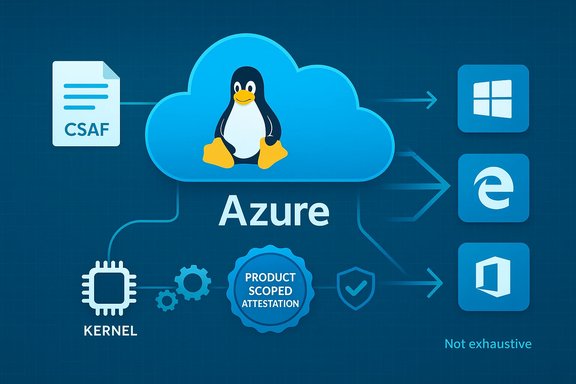
Microsoft’s MSRC advisory for CVE-2025-38491 explicitly states that Azure Linux “includes this open‑source library and is therefore potentially affected,” but that short phrase is a product‑scoped inventory attestation — not a categorical guarantee that Azure Linux is the only Microsoft product that can include the implicated open‑source code. The wording signals what Microsoft has inspected so far and promises to expand those machine‑readable attestations (CSAF/VEX) as more product inventories complete, yet it leaves a practical verification burden on operators who run other Microsoft‑supplied Linux artifacts.
Microsoft’s recent practice of publishing machine‑readable CSAF/VEX attestations began with a phased rollout in October 2025. That program maps upstream open‑source components to Microsoft product artifacts and classifies product status for a given CVE (Known Affected, Not Affected, Under Investigation, Fixed). Microsoft used this mechanism to declare that Azure Linux contains the upstream component tied to a number of Linux kernel CVEs, including the advisory language you quoted.
This approach is valuable: it supplies automation‑friendly signals that security teams can ingest into vulnerability triage and patch orchestration. However, the attestation model is product‑by‑product. A vendor declaring “Azure Linux includes component X” is telling customers what it has verified for that product family — not that it has exhaustively scanned, validated, and excluded every other product, kernel image, Marketplace VM, or appliance Microsoft ships. Multiple independent technical analyses and community writeups make the same point: Microsoft’s Azure Linux attestation is authoritative for Azure Linux, but absence of attestations for other Microsoft products is not proof of absence of the upstream code elsewhere.
Longer, operational answer: Microsoft has publicly attested that Azure Linux contains the implicated open‑source library for the CVE in question — that is a definitive, vendor‑backed signal for Azure Linux images and should be acted on by Azure Linux customers. However, that statement alone does not prove that every other Microsoft product is free of the same code. Other Microsoft artifacts that ship or run Linux kernels could include the same upstream component depending on kernel provenance and configuration. Candidates that warrant verification include, but are not limited to:
Operationally, the safest posture is to assume uncertainty, apply vendor patches where Microsoft has attested impact (Azure Linux first), inventory other images and kernels proactively, and integrate Microsoft’s CSAF/VEX outputs into automation so updates to Microsoft’s attestations are acted on promptly. This pragmatic approach balances the gains of Microsoft’s improved transparency with the practical reality that product‑by‑product attestations never substitute for focused inventory and verification across heterogeneous estates.
If additional product impact is later identified by Microsoft, the CVE and its VEX/CSAF attestations will be updated accordingly; until then, treat Azure Linux’s attestation as definitive for that product, and treat all other Microsoft artifacts as candidates for verification and remediation.
Source: MSRC Security Update Guide - Microsoft Security Response Center
 Background / Overview
Microsoft’s recent practice of publishing machine‑readable CSAF/VEX attestations began with a phased rollout in October 2025. That program maps upstream open‑source components to Microsoft product artifacts and classifies product status for a given CVE (Known Affected, Not Affected, Under Investigation, Fixed). Microsoft used this mechanism to declare that Azure Linux contains the upstream component tied to a number of Linux kernel CVEs, including the advisory language you quoted.This approach is valuable: it supplies automation‑friendly signals that security teams can ingest into vulnerability triage and patch orchestration. However, the attestation model is product‑by‑product. A vendor declaring “Azure Linux includes component X” is telling customers what it has verified for that product family — not that it has exhaustively scanned, validated, and excluded every other product, kernel image, Marketplace VM, or appliance Microsoft ships. Multiple independent technical analyses and community writeups make the same point: Microsoft’s Azure Linux attestation is authoritative for Azure Linux, but absence of attestations for other Microsoft products is not proof of absence of the upstream code elsewhere.
What Microsoft’s wording actually means
Product‑scoped attestation vs. exclusivity
- Product‑scoped attestation: Microsoft inspected the Azure Linux artifacts (the distribution images and kernel builds in that product family), found the implicated open‑source component, and therefore marked Azure Linux as “potentially affected.” That is the operational signal Azure Linux customers should act on immediately.
- Not a universal exclusion: The MSRC phrase should not be read as “Azure Linux is the only Microsoft product that includes this component.” Microsoft explicitly committed to updating CVE/VEX records if additional Microsoft products are later identified as carriers; this reflects an ongoing inventory process rather than a final, exhaustive statement.
Why vendors do this in phases
Large vendors ship many distinct artifacts (kernel builds, VM images, WSL kernels, Marketplace images, AKS node images, appliances). Whether an artifact includes a particular upstream file or subsystem is a build‑time property governed by:- Kernel version and upstream commit range.
- Kernel configuration flags (CONFIG_* options) used when building the binary.
- Packaging and backporting choices made by the vendor.
Is Azure Linux the only Microsoft product that could be affected?
Short answer: No — not necessarily.Longer, operational answer: Microsoft has publicly attested that Azure Linux contains the implicated open‑source library for the CVE in question — that is a definitive, vendor‑backed signal for Azure Linux images and should be acted on by Azure Linux customers. However, that statement alone does not prove that every other Microsoft product is free of the same code. Other Microsoft artifacts that ship or run Linux kernels could include the same upstream component depending on kernel provenance and configuration. Candidates that warrant verification include, but are not limited to:
- linux‑azure / kernel‑azure builds used by some Azure VM SKUs.
- The WSL2 kernel that Microsoft ships with Windows.
- AKS node images and other curated container/node images Microsoft publishes.
- Azure Marketplace images and partner images that include Microsoft‑curated kernels or packages.
- Appliance images and internal kernels used by Microsoft services.
Why the distinction matters for defenders
Interpreting the attestation incorrectly — e.g., assuming “only Azure Linux is affected” — creates a blind spot that attackers can exploit. Kernel and low‑level networking faults (the class most CVE‑2025‑38491‑style bugs belong to) often impact:- Multi‑tenant hosts (cloud VMs, hypervisors, container hosts).
- Network appliances and virtual routers.
- Developer and CI environments that permit BPF or privileged operations.
How to verify whether your Microsoft artifact includes the implicated library
Follow this checklist to determine whether a given VM image, kernel, or image you run includes the vulnerable component:- Check Microsoft’s published CSAF/VEX and MSRC advisory for the CVE to see whether your specific product/artifact is attested as Known Affected, Not Affected, or Under Investigation. Microsoft will update these entries as inventories complete.
- Inspect the running kernel / artifact directly:
- On a Linux VM or image, check the kernel config for relevant flags:
- sudo zgrep CONFIG_MPTCP /proc/config.gz
- Or check /boot/config-$(uname -r): grep -E 'CONFIG_MPTCP|CONFIG_NETFILTER|CONFIG_NFTABLES' /boot/config-$(uname -r)
- Search for installed packages or modules that carry the affected code (example commands):
- rpm -qa | grep kernel
- dpkg -l | grep linux-image
- For images you don’t control (Marketplace images, appliance binaries, WSL2), request or inspect:
- The vendor’s VEX/CSAF attestation (if published).
- The kernel version and build provenance (packaging changelog or kernel package metadata).
- A list of enabled CONFIG_* options if the vendor provides it.
- For enterprise fleets, automate inventory:
- Use configuration management tools to gather kernel versions and /boot/configs across hosts.
- Match upstream commit IDs listed in public advisories or vendor changelogs with your kernel package changelogs.
- If you find the kernel includes the vulnerable subsystem, prioritize patching and rebooting into a fixed kernel once vendor updates are available.
Concrete detection and hunting steps
- Search kernel logs for oops/KASAN traces referencing the vulnerable function names or stack traces shown in public patches. Example:
- journalctl -k | egrep -i 'KASAN|mptcp|mptcp_pm_worker|__timer_delete_sync'
- Enable persistent logging (systemd‑journal persistence) and kdump to retain crash dumps for offline analysis.
- Correlate oopses with recent orchestration events or network changes (netlink/nft rule changes, BPF loads).
- For cloud VM fleets, use inventory telemetry to map kernel versions back to distribution advisories and vendor VEX entries.
Recommended mitigations and operational priorities
- Treat Azure Linux‑tagged attestations as high priority. Apply Microsoft patches for Azure Linux images promptly and reboot hosts into the patched kernel. Microsoft’s attestation is decisive for those images.
- For other Microsoft images (WSL2, linux‑azure, AKS node images, Marketplace), do not assume safety. Instead:
- Inventory the kernel versions and enablement flags.
- Contact the image vendor or Microsoft support for explicit VEX/CSAF attestations if your artifact is business‑critical.
- If you cannot patch immediately, implement containment measures: isolate vulnerable hosts, restrict access to netlink or management interfaces, and disable the affected feature (if that is practical and safe).
- Integrate Microsoft’s CSAF/VEX outputs into your automated triage pipelines so that new attestations automatically adjust remediation priorities as Microsoft updates CVE mappings. Microsoft has begun publishing these files and will expand coverage over time; make use of them.
Critical analysis: strengths, limitations, and risk
Strengths
- Increased transparency through VEX/CSAF: Microsoft’s decision to publish machine‑readable attestations is a significant operational improvement for enterprise defenders. It reduces ambiguity for the products it has inventoried and enables automated triage. The October 2025 rollout is an important baseline for customers who use Azure Linux.
- Clear, actionable guidance for attested products: When Microsoft declares a product “Known Affected,” customers can act with confidence on vendor-supplied patches, package updates, and remediation timelines. That deterministic signal is valuable in large fleets.
Limitations and risks
- Phased coverage can create a false sense of safety: Because attestations are deployed product‑by‑product, customers who only scan MSRC/VEX pages and stop there risk missing affected artifacts that Microsoft hasn’t yet inventoried. Absence of a Microsoft attestation for a product is not proof that the product is unaffected.
- Artifact complexity in large vendors: Microsoft ships many kernels and image variants (linux‑azure, WSL2, Marketplace images, AKS, etc.. Each artifact can differ in kernel version and CONFIG flags, making the mapping problem non‑trivial and time‑consuming.
- Lag between inventory and attestation updates: The time it takes to inspect each artifact and publish a VEX/CSAF attestation introduces a window where operators must make conservative decisions. Microsoft has pledged to update the CVE record if additional products are identified, but that expansion is inherently sequential.
- Unverifiable presence without artifact inspection: Until Microsoft publishes an attestation for a product, the only way to be sure is direct artifact inspection or vendor confirmation. This is operationally expensive for large or distributed estates and must be accounted for in risk calculations. Mark such status “unverified” rather than “safe.”
Practical playbook for operators (step‑by‑step)
- Immediately patch and reboot Azure Linux hosts affected by the CVE based on Microsoft’s guidance. Treat Azure Linux attestations as authoritative.
- Inventory all Microsoft‑provided Linux artifacts in your estate:
- Collect kernel version, package metadata, and /boot/config-$(uname -r) across hosts.
- Flag any artifact built from a kernel branch/timeframe that may contain the upstream commit referenced by the CVE.
- Query MSRC and VEX/CSAF feeds periodically:
- Pull Microsoft’s CSAF/VEX files as part of your vulnerability pipeline to detect when new product attestations appear.
- For unpatched artifacts where vendor fixes are not yet available:
- Implement network segmentation and restrict management access.
- Disable or unload affected modules where safe.
- Increase logging and crash capture (persist journal and enable kdump).
- Document proof of compliance:
- Maintain an evidence trail showing which artifacts were inspected, what kernel config flags were present, and when patches were applied. This supports audit and incident response.
Closing assessment
Microsoft’s statement that Azure Linux “includes this open‑source library and is therefore potentially affected” is an explicit and useful inventory attestation for Azure Linux images, and it should trigger immediate action for customers running those images. At the same time, the phrasing and the underlying CSAF/VEX process are deliberately limited in scope: they report what Microsoft has checked so far and promise to expand coverage as inventories complete. Administrators who run other Microsoft‑supplied Linux artifacts must therefore treat those artifacts as unverified until either Microsoft publishes a VEX attestation for them or the artifact is inspected directly.Operationally, the safest posture is to assume uncertainty, apply vendor patches where Microsoft has attested impact (Azure Linux first), inventory other images and kernels proactively, and integrate Microsoft’s CSAF/VEX outputs into automation so updates to Microsoft’s attestations are acted on promptly. This pragmatic approach balances the gains of Microsoft’s improved transparency with the practical reality that product‑by‑product attestations never substitute for focused inventory and verification across heterogeneous estates.
If additional product impact is later identified by Microsoft, the CVE and its VEX/CSAF attestations will be updated accordingly; until then, treat Azure Linux’s attestation as definitive for that product, and treat all other Microsoft artifacts as candidates for verification and remediation.
Source: MSRC Security Update Guide - Microsoft Security Response Center
