
Microsoft’s brief advisory — “Azure Linux includes this open‑source library and is therefore potentially affected” — is accurate, but it is a product‑scoped attestation, not a statement that Azure Linux is the only Microsoft product that could include the Twisted.web library or be affected by CVE‑2024‑41671.
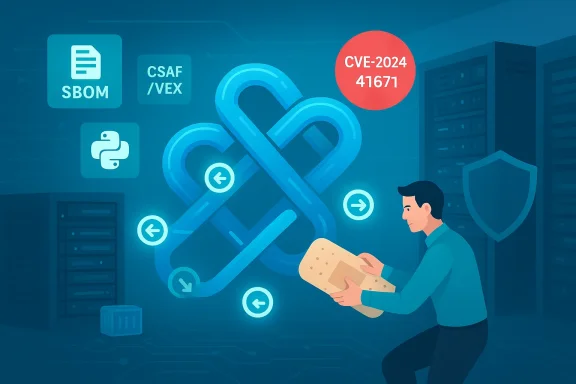
CVE‑2024‑41671 was assigned for a defect described as a disordered HTTP pipeline response in Twisted.web, the HTTP server/client framework within the Twisted Python networking library. The vulnerability affects how Twisted.web orders and associates responses with pipelined HTTP requests, which can cause responses to be returned out of the expected sequence under certain conditions.
Microsoft’s public note specifically calls out Azure Linux as a distribution that includes the implicated open‑source component and therefore may be affected. That phrasing is a deliberate, narrow inventory statement: it confirms Microsoft has inspected Azure Linux artifacts and found the component, but it does not demonstrate that other Microsoft products were investigated and found free of the library. Security practitioners should treat that attestation as useful and authoritative for Azure Linux customers, while understanding its limited scope.
This article explains what that statement means, how defenders should interpret it, what follow‑up actions are necessary across heterogeneous Microsoft artifacts, and practical steps to hunt, patch, or mitigate exposure in both servers and containers.
Potential consequences include:
Source: MSRC Security Update Guide - Microsoft Security Response Center
 Background / Overview
CVE‑2024‑41671 was assigned for a defect described as a disordered HTTP pipeline response in Twisted.web, the HTTP server/client framework within the Twisted Python networking library. The vulnerability affects how Twisted.web orders and associates responses with pipelined HTTP requests, which can cause responses to be returned out of the expected sequence under certain conditions.Microsoft’s public note specifically calls out Azure Linux as a distribution that includes the implicated open‑source component and therefore may be affected. That phrasing is a deliberate, narrow inventory statement: it confirms Microsoft has inspected Azure Linux artifacts and found the component, but it does not demonstrate that other Microsoft products were investigated and found free of the library. Security practitioners should treat that attestation as useful and authoritative for Azure Linux customers, while understanding its limited scope.
This article explains what that statement means, how defenders should interpret it, what follow‑up actions are necessary across heterogeneous Microsoft artifacts, and practical steps to hunt, patch, or mitigate exposure in both servers and containers.
What Microsoft’s Azure Linux attestation actually guarantees
Product‑scoped attestation vs. exclusivity claim
Microsoft’s phrasing — naming a product and stating it “includes this open‑source library and is therefore potentially affected” — is a standard, conservative inventory disclosure. It confirms:- Microsoft evaluated the Azure Linux image(s) and found the implicated component.
- As delivered, Azure Linux must be treated as a remediation priority for this CVE.
- That only Azure Linux contains the vulnerable library.
- That internal Microsoft services, other OS images, or downstream products do not also embed the same library or vulnerable versions.
Why Microsoft uses this wording
Public inventory attestations focused on a named product get two operational goals right:- They immediately inform customers who run that product what action to prioritize.
- They allow Microsoft to be transparent about what has been verified without prematurely asserting outcomes across a broad portfolio while artifact verification is still ongoing.
Why the statement doesn’t mean Azure Linux is the only affected Microsoft product
Shared components, shared risk
Open‑source libraries like Twisted are reused across many projects, images, and containers. Microsoft ships a large portfolio of artifacts that may include:- Officially distributed Linux images (Azure Linux, linux‑azure kernels)
- Container base images used by Azure container services
- Agent and tooling bundles that include Python runtimes
- Internal automation and orchestration tooling
- Customer‑facing services that use open‑source components
Examples of where the same library might show up (non‑exhaustive)
- Container images used in Azure Kubernetes Service (AKS) workloads
- Prebuilt application runtime images in Marketplace offerings
- Tooling installed on management instances or automation agents
- Hosted services that ingest third‑party container images or packages
- Customer VM images built from common base distributions
Technical implications of a “disordered HTTP pipeline response”
What the class of bug means
A disordered HTTP pipeline response in a server framework means that, when the server receives multiple pipelined requests on the same connection, it may return responses in an order that no longer maps one‑to‑one with the request stream.Potential consequences include:
- Clients receiving responses that belong to earlier or later requests, producing corrupt application behavior.
- Proxy or gateway confusion that could be exploited to induce data leakage between requests.
- In some cases, the condition can be coerced into request smuggling, response confusion, or cache poisoning, but that outcome depends heavily on protocol assumptions, intermediaries, and specific application logic.
Caveat: verify the specific CVE details before assuming exploit scenarios
At the time of Microsoft’s advisory, the high‑level description indicates ordering problems in Twisted.web. However, details about exploitability, remote triggerability, and required attacker capabilities are determined by the upstream Twisted advisory and CVE write‑up. Security teams should consult the upstream Twisted project advisory and vendor patches for the precise exploitability assessment before assuming worst‑case scenarios. If the upstream advisory is not yet conclusive, treat the issue conservatively as a correctness/robustness bug with potential for higher impact in complex environments. This conservative posture is recommended in multiple vendor attestation analyses.Practical guidance — how to determine whether you are affected
Phase 1 — Asset discovery and inventory (quick wins)
- Run package audits inside images and VMs:
- For Linux images: use native package managers (rpm, dpkg) to list installed packages.
- For Python environments: list installed Python packages via pip freeze or inspect virtualenv/site‑packages.
- Inspect container images:
- Pull local copies of your base images and search for Twisted or Twisted.web within both the system package tree and Python environments.
- Scan artifacts in artifact registries and CI pipelines:
- Query container registries, build caches, and CI artifacts for the presence of Twisted packages.
- Check orchestration and service images:
- Look at Marketplace images, Azure Marketplace offerings, and custom images used by automation to identify embedded libraries.
Phase 2 — Verification and mapping
- Confirm the exact Twisted version and commit metadata.
- Map the version against the upstream CVE fix or patch file.
- If you find Twisted.web in any Microsoft‑supplied artifact, flag it and track remediation status with the vendor.
Phase 3 — Remediation and mitigation
- Apply vendor patches or rebuild images with an updated Twisted version that contains the fix.
- If a vendor patch isn’t immediately available for a Microsoft product you use, implement defensive mitigations:
- Disable HTTP pipelining if it's not required by the application.
- Insert a reverse proxy or WAF that enforces strict request/response matching and rejects pipelined connections.
- Apply network segmentation and rate limits to reduce exposure to remote triggering.
- For containerized environments, rebuild and redeploy images as part of a controlled change window and rotate keys/secrets as appropriate.
- Track Microsoft’s VEX/CSAF notices for updates to product impact; Microsoft has committed to updating CVE records if other products are identified as carriers.
Hunting for Twisted.web across Microsoft artifacts — prioritized checklist
- Prioritize Azure Linux images — Microsoft has confirmed them. If you run Azure Linux, patch or rebuild immediately.
- Inventory container base images used in Azure services (AKS, App Service containers).
- Inspect Marketplace images and community images referenced in your provisioning templates.
- Audit automation and management tooling (CI runners, deployment agents).
- Review hosted Python‑based services and any microservices that use Twisted as a dependency.
- Ask vendors for VEX/CSAF‑style attestations for products you consume — Microsoft’s VEX program is designed to supply that level of detail over time.
Analyzing Microsoft’s transparency: strengths and gaps
Strengths
- The attestation naming Azure Linux gives immediate, actionable information to a subset of customers. It’s good operational hygiene to say where the company has checked and found the component.
- Microsoft’s commitment to publish CSAF/VEX‑style data improves machine‑readable traceability for organizations that automate remediation and policy enforcement.
- Publishing focused product attestations helps prioritize patching resources quickly for affected customers.
Risks and limitations
- A product‑scoped attestation can create a false sense of safety for customers using other Microsoft artifacts if they misinterpret the wording as an exclusivity guarantee.
- The wording puts the onus on customers to perform artifact‑level verification across all Microsoft images and services they use, which may be operationally challenging for large or distributed teams.
- Until Microsoft updates the CVE/VEX records to list additional products, defenders must assume other artifacts could be affected and treat Microsoft’s statement as a positive identification for Azure Linux only, not a full inventory of impact.
When to escalate to Microsoft and what to ask
If your asset inventory finds Twisted.web in any Microsoft‑supplied product or image beyond Azure Linux, open a support case or security inquiry and request:- Confirmation whether Microsoft has mapped that specific artifact to the CVE.
- The exact patched version or mitigation Microsoft recommends for that product.
- A CSAF/VEX status update or timeline for when Microsoft will publish an attestation covering that product.
- Any compensating controls that Microsoft recommends for customers who cannot immediately patch.
Practical mitigation patterns by deployment type
For standalone Twisted web servers
- Upgrade Twisted to the patched upstream release as soon as it’s available.
- If upgrade is not possible immediately, run Twisted behind a proxy that enforces non‑pipelined connections and validates request/response mapping.
For containerized workloads
- Rebuild base images with patched Twisted packages and redeploy images via your standard CI/CD pipeline.
- Use image scanning gates to block images that contain unpatched Twisted versions from reaching production.
For multi‑tenant hosting or PaaS scenarios
- Use tenancy and request isolation to limit the blast radius of any misordered responses.
- Apply ingress WAF rules to normalize and validate incoming pipelines, and drop pipelined connections if your architecture does not require them.
For managed Microsoft products where you are a customer
- Monitor vendor notices and VEX/CSAF files for status changes.
- Use host‑level detection (e.g., EDR or file integrity checks) to detect suspicious DLLs or Python packages if you run workloads on vendor images.
Communication guidance for security teams and leadership
When reporting exposure to leadership, be explicit about what Microsoft’s attestation does and does not mean. Use plain, operational language:- “Microsoft confirmed the library is present in Azure Linux and that product must be patched; we have scanned our Azure Linux instances and found X impacted images.”
- “We have not found Twisted.web in our Windows Server images or WSL instances yet, but we are actively scanning container registries, automation images, and Marketplace images to validate.”
- “We will escalate to Microsoft support if we find Twisted.web in any other Microsoft‑supplied artifacts and track their VEX/CSAF updates for additional mapping.”
Longer‑term recommendations for supply‑chain resilience
- Require SBOMs for all third‑party images and artifacts you consume; an SBOM makes it dramatically easier to find impacted components quickly.
- Automate CVE‑to‑artifact mapping in your CI/CD pipeline so you can block or flag builds that include vulnerable versions of libraries such as Twisted.
- Push vendors to provide VEX/CSAF status updates for products you use; machine‑readable attestations reduce time‑to‑remediate.
- Maintain a central artifact repository and enforce automated scanning and rebuild policies triggered by high‑severity CVEs.
What defenders should not do
- Do not assume that because Microsoft named only Azure Linux, other Microsoft images are safe.
- Do not wait for a vendor‑wide update before starting your own artifact‑level verification.
- Do not rely on manual, ad‑hoc searches alone — use automated image and package scanning to ensure consistency across thousands of artifacts.
A realistic timeline and expected vendor workflow
- Microsoft publishes product‑scoped attestation (Azure Linux) to alert customers immediately.
- Microsoft and upstream Twisted maintainers coordinate fixes or patches.
- Microsoft updates the CVE record and VEX/CSAF files as they map other products or publish mitigations.
- Customers update/publish patches, rebuild images, and redeploy workloads.
Conclusion — what to do right now
- Treat Azure Linux instances as confirmed carriers and prioritize patching or mitigations there.
- Run a focused artifact hunt across container registries, Marketplace images, automation tooling, and hosts to identify Twisted.web wherever it appears.
- If you find Twisted.web in Microsoft‑supplied products beyond Azure Linux, escalate to Microsoft support and request a VEX/CSAF mapping for that product.
- Apply compensating controls (disable pipelining, insert proxies/WAFs, rebuild images with patched dependencies) where immediate patching is not possible.
- Automate SBOM ingestion and CVE‑to‑artifact mapping so future disclosures can be analyzed and acted on faster.
Source: MSRC Security Update Guide - Microsoft Security Response Center
