

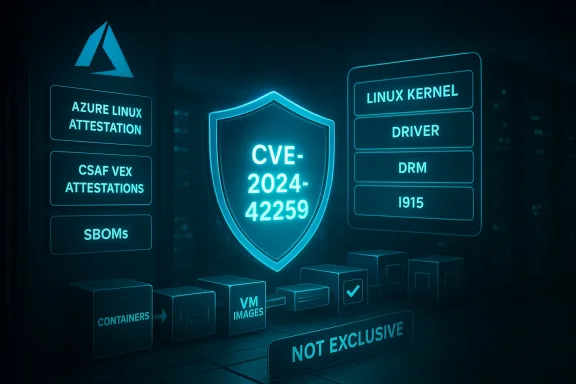
Microsoft’s short answer — that “Azure Linux includes this open‑source library and is therefore potentially affected” — is accurate as a product-level attestation, but it is not a technical guarantee that only Azure Linux can include the vulnerable drm/i915/gem code; any Microsoft artifact that ships a Linux kernel build containing the same code path could also be a carrier until it has been explicitly inventoried and attested.
CVE‑2024‑42259 is a Linux kernel vulnerability that affects the DRM/i915/GEM graphics path. The upstream description explains the root cause clearly: a miscalculation of virtual memory mapping boundaries when creating a user mmap of a framebuffer or GEM object, which failed to account for a partial mapping offset and therefore could allow a page‑fault access outside the intended window. The fix rewrites the start/end calculation and ensures the mapped size is derived from the difference between validated end and start addresses.
The vulnerability is scored as Medium by many trackers and appears with a CVSS v3.1 vector that places it in the local‑attack/availability impact space rather than a remote code‑execution vector: exploitation requires local access to the relevant device interfaces (the DRM device nodes) or a scenario where untrusted code is given direct device access. Distribution advisories and vendor trackers that compiled CVE metadata have converged on that classification.
Why this matters: the DRM/i915 driver is part of the in‑tree Linux kernel; whether a particular product is affected depends on three concrete, verifiable facts:
Important nuance: the MSRC attestation is an inventory statement for a named product. It is not an exclusive or universal denial that other Microsoft products might contain the same upstream component. Microsoft explicitg CVE/VEX mappings if additional Microsoft artifacts are later identified as carriers. Stated differently: if you run Azure Linux images, Microsoft’s attestation tells you with high confidence that those images were found to contain the vulnerable code and should be remediated; but you must not infer from that wording alone that other Microsoft artifacts are safe.
This distinction — attested affected versus exclusive affected — is the core of the confusion many administrators face when they read short vendor CVE FAQ lines without the broader context.
However, that attestation is a product‑scoped inventory statement, not an exclusivity certificate. Do not assume other Microsoft artifacts are safe simply because they are not named in the MSRC entry. Any Microsoft product or image that ships a Linux kernel (WSL2 kernels, Azure‑tuned kernels, Marketplace images, AKS nodes, etc.) is a potential carrier until you verify the kernel version, configuration, and vendor package mapping to the upstream fix.
Action plan summary:
Source: MSRC Security Update Guide - Microsoft Security Response Center
 Background / Overview
CVE‑2024‑42259 is a Linux kernel vulnerability that affects the DRM/i915/GEM graphics path. The upstream description explains the root cause clearly: a miscalculation of virtual memory mapping boundaries when creating a user mmap of a framebuffer or GEM object, which failed to account for a partial mapping offset and therefore could allow a page‑fault access outside the intended window. The fix rewrites the start/end calculation and ensures the mapped size is derived from the difference between validated end and start addresses.The vulnerability is scored as Medium by many trackers and appears with a CVSS v3.1 vector that places it in the local‑attack/availability impact space rather than a remote code‑execution vector: exploitation requires local access to the relevant device interfaces (the DRM device nodes) or a scenario where untrusted code is given direct device access. Distribution advisories and vendor trackers that compiled CVE metadata have converged on that classification.
Why this matters: the DRM/i915 driver is part of the in‑tree Linux kernel; whether a particular product is affected depends on three concrete, verifiable facts:
- The shipped kernel version and patch level (did it include the upstream commit or a backport of the fix?).
- The kernel configuration (was the i915/DRM code compiled in or packaged as a module?).
- The runtime exposure model (does the product give local, unprivileged processes access to /dev/dri or similar device nodes?).
What Microsoft actually said — and what that wording means
Microsoft’s MSRC entries for several Linux kernel CVEs have recently adopted a concise inventory‑style phrasing: “Azure Linux includes this open‑source library and is therefore potentially affected by this vulnerability.” That sentence is an authoritative product attestation for Microsoft’s Azure Linux distribution: it confirms Microsoft has inspected that product’s builds and found the implicated upstream code. Microsoft has also publicly deut of machine‑readable CSAF/VEX attestations (announced as a program beginning in October 2025) so that such inventory claims can be consumed automatically and updated as Microsoft expands its coverage.Important nuance: the MSRC attestation is an inventory statement for a named product. It is not an exclusive or universal denial that other Microsoft products might contain the same upstream component. Microsoft explicitg CVE/VEX mappings if additional Microsoft artifacts are later identified as carriers. Stated differently: if you run Azure Linux images, Microsoft’s attestation tells you with high confidence that those images were found to contain the vulnerable code and should be remediated; but you must not infer from that wording alone that other Microsoft artifacts are safe.
This distinction — attested affected versus exclusive affected — is the core of the confusion many administrators face when they read short vendor CVE FAQ lines without the broader context.
Technical reasons Microsoft’s Azure Linux attestation doesn’t imply exclusivity
There are several practical, technical reasons the presence of attested code in Azure Linux doesn’t automatically exclude other Microsoft products:- Microsoft builds and distributes multiple Lin. Examples include WSL2 kernels (the Microsoft‑maintained WSL kernel), Azure‑tuned kernels for VM images, curated Marketplace VM images, AKS node images, and container base images. Each of those artifacts is a separately built kernel image or packaging artifact; inclusion of an upstream driver or code path is a build‑time configuration choice.
- Kernel configuration is per‑build. Two kernels compiled from the same un have wildly different feature sets depending on CONFIG_* flags. A kernel that ships with CONFIG_DRM_I915 built in (or as a module) will carry the i915 code; another kernel from the same vendor might disable it entirely. You cannot infer from a single product attestation that the bit was never enabled in other artifacts.
- Microsoft’s attestation process is phased and artifact‑specific. The VEX/CSAF program announced by Microsoft started with Azure Linux and will be expanded; absence of a VEX attestation for an artifact is absence of attestation, not proof of absence. Microsoft has said it will update CVE entries as it verifies other products.
 //www.microsoft.com/en-us/msrc/blog/2025/10/toward-greater-transparency-machine-readable-vulnerability-exploitability-xchange-for-azure-linux)
 - The same upstream code can live in many places across the software supply chain. Cloud VM images, Marketplace appliances, WSL kernels, or even internal build systems can each carry a kernel build that includes the drm/i915 code until patched. That’s why a central, per‑artifact inventory is essential.
What the evidence says for CVE‑2024‑42259 right now
At the time this article was written, independent vulnerability trackers and vendor advisories confirm:- The upstream fix and commit metadata for the drm/i915/GEM boundary calculation bug are recorded in public CVE/NVD entries and distribution trackers.
- Several distributions Linux in public advisories) have mapped the CVE into their kernel packages and published fixed package versions and errata. That confirms the fix was cherry‑picked or merged into stable branches and distributed.
- Mfor the CVE — reflected in the short attestation language quoted by many readers — deterministically identifies Azure Linux as an attested carrier. That attestation is an actionable prompt for Azure Linux customers to apply vendor updates.
Practical verification steps — how to treat Microsoft artiff you operate in an environment that uses Microsoft‑distributed artifacts (Azure images, WSL2, AKS nodes, Marketplace appliances), treat Microsoft’s Azure Linux attestation as the immediate, prioritized action item — but also verify other artifacts individually.
Follow these steps in order:- Prioritize Azure Linux images
- Apply Microsoft’s Azure Linux kernel updates or image updates as soon as they are available for your region and SKU. Azure Linux is an attested affected product; patching it should be first priority.
- Inventory other Microsoft kernel artifacts
- Enumerate all Microsoft‑supplied Linux kernels you run: WSL2 kernels on Windows hosts, AKS node images, curated VM images, Marketplace appliances, and any Microsoft‑published container/VM base images.
- For each artifact, record the kernel version string (uname -a or kernel image metpackage release ID.
- Confirm whether the kernel build contains the i915 DRM code
- If you have shell access to the host, check for the i915 module: lsmod | grep i915 or modinfo i915. If the module is present or built in, the artifact carries the driver. For in‑kernel builds, check /boot/config‑$(uname -r) for CONFIG_DRM_I915 or related flags. These commands give a per‑artifact, per‑host confirmation. (If you cannot run these commands, extract the kernel config from deployed images or ask the vendor.)
- Map kernel versions to upstream fixes
- Cross‑reference your kernel version against NVD, distribution advisories, and vendor changelogs to see whether the i915 fix was applied or backported into that kernel. If a kernel package indicates the upstream commit ID or lists the CVE, you have high confidence it is fixed; otherwise treat the artifact as unverified and remediate or mitigate.
- When immediate patching is impossible, apply containment mitigations
- Restrict access to DRM device nodes (e.g., /dev/dri/*) so only trusted accounts can access them.
- Use kernel module blacklisting to prevent loading of the i915 driver where display functionality is not required, understanding that this disables GPU acceleration and may impact function.
- For virtualized/container environments, ensure containers are not given direct device access unless explicitly required.
- Demand artifact attestations and SBOMs
- Request CSAF/VEX attestations, SBOMs, or kernel package mappings from Microsoft for the specific artifacts you consume. Microsoft’s rollout of machine‑readable VEX/CSAF attestations is meant to make this easier; where vendors have not yet attested, ask for direct confirmation or package changelogs. ([microsoft.com](Toward greater transparency: Introducing Machine-readable Vulnerability Exploitability Xchange (VEX) for Azure Linux and beyond Short, pragmatic answers to common questions
- Is Azure Linux the only Microsoft product that includes the vulnerable drm/i915/gem code?
Short: No in the technical sense; yes in the attestation sense. Azure Linux is the only Microsoft product Microtested (so far) to include the implicated upstream component for this CVE; that’s an authoritative product‑level statement. But that wording is not an exclusive technical guarantee that no other Microsoft artifact (WSL kernels, Azure‑tuned kernels, Marketplace images, AKS nodes, etc.) could also contain or have previously contained the same code — any such artifact is unverified until proven otherwise*. - If I run WSL2 or Azure Marketplace images, should I care?
Yes. Any product that ships a Linux kernel might carry the vulnerableernel version and build config. You must inventory and verify those artifacts. - Is there evidence of active exploitation?
Public trackers and distribution advisories indicate the bug was found through code review and fixed upstream; widespread in‑the‑wild exploitation for this specific CVE has not been documented in major trackers at the time of writing. That said, local flaws that are trivial to trigger merit rapid patching because of the low barrier to reproduce.
Operational impact and prioritized remediation checklist
For operators, the following prioritized checklist converts the above into action:- Immediate (within 24–72 hours)
- Apply Azure Linux updates for affected images (Microsoft has attested Azure Linux as potentially affected).
- If you manage shared systems or multi‑user workstations with GPU access, restrict /dev/dri access to trusted accounts and processes.
- Short term (1–2 weeks)
- Inventory other Microsoft artifacts that include Linux kernels (WSL2 hosts, Azure Marketplace images, AKS node pools).
- For each artifact, confirm kernel package version and whether the CVE is referenced in vendor changelogs or VEX/CSAF attestations.
- Medium term (2–8 weeks)
- Update or replace kernel images that are unverified or known to be vulnerable.
- Where patching is slow or impossible, harden device access and apply module blacklists in a staged nctional impact.
- Continuous (Ongoing)
- Incorporate SBOM and automated VEX consumption into your patch‑orchestration pipelines so that future vendor attestations reduce guesswork. Ask vendors to publish machine‑readable attestations for any artifact you consume.
Strengths and risks: a critical assessment of Microsoft’s approach
Strengths:- Transparent attestation model. Microsoft’s new CSAF/VEX ce of making explicit product‑level inventory statements are positive developments that reduce time to remediation for large customers. The Azure Linux attestation gives operators a clear, immediate action item rather than an ambiguous vendor statement.
- Pragmatic phased rollout. Beginning with Azure Linux is defensible: it lets Microsoft prove the tooling and processes for mations before scaling to millions of artifacts. This reduces early errors and increases the quality of the data published.
- Per‑artifact fragmentation. Microsoft and other large vendors ship many artifacts; unless each artifact is inventoried and attested, customers are left with manual verification burdens. The presence of a single product-level attestation does not remove those blind spots.
- Operational inertia. Many organizations assume vendor statements like the Azure Linux attestation mean theicrosoft everywhere.” That assumption can delay verification and remediation of W images, and other non‑attested artifacts.
- Tooling and automation gaps. The usefulness of VEX/CSAF depends orate environments; organizations that have not integrated VEX consumption into their patching pipelines will still face manual follow‑up.
Conclusion — precise takeaways for defenders
Microsoft’s MSRC attestation that Azure Linux includes the implicated open‑source library and ily affected is factual and actionable for Azure Linux customers: treat Azure Linux images as in‑scope and apply vendor updates immediately.However, that attestation is a product‑scoped inventory statement, not an exclusivity certificate. Do not assume other Microsoft artifacts are safe simply because they are not named in the MSRC entry. Any Microsoft product or image that ships a Linux kernel (WSL2 kernels, Azure‑tuned kernels, Marketplace images, AKS nodes, etc.) is a potential carrier until you verify the kernel version, configuration, and vendor package mapping to the upstream fix.
Action plan summary:
- Patch Azure Linux now.
- Inventory and verify every Microsoft‑supplied kernel artifact in your estate.
- Where patching cannot be immediate, restrict device access and consider module blacklisting for the short term.
- Demand and consume SBOM / VEX / CSAF attestations and integrate them into your remediation pipelines going forward.
Source: MSRC Security Update Guide - Microsoft Security Response Center
