

Microsoft’s short advisory that “Azure Linux includes this open‑source library and is therefore potentially affected” is accurate — but it is a scoped inventory attestation, not a technical guarantee that no other Microsoft product can contain the same vulnerable component.
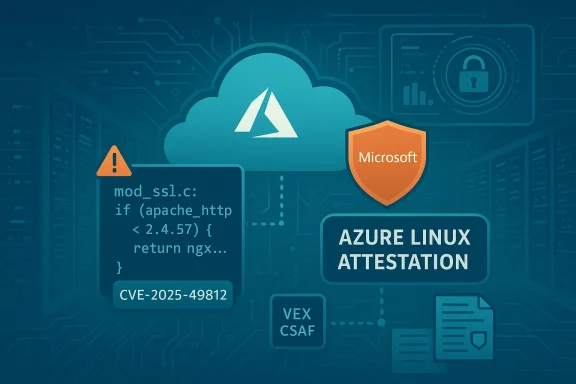
The discovery of a vulnerability in Apache HTTP Server’s mod_ssl (a TLS session-resumption / SNI-binding issue) has prompted a standard but important question from defenders: when a vendor names one product as “potentially affected,” does that mean it is the only product at risk? Microsoft’s MSRC advisory language for CVE-2025-49812 (and similar Linux/open-source CVEs) follows a consistent pattern: call out a specific Microsoft-managed artifact — in this case, Azure Linux — as a confirmed carrier of the implicated upstream component, and pledge to publish machine‑readable attestations (CSAF/VEX) and to update CVE mappings if other Microsoft products are later found to include the same code.
That phrasing is operationally helpful: it gives Azure customers a clear, authoritative signal to prioritize remediation for Azure Linux images. But it also creates a common misunderstanding: that naming one product equals exclusivity. It does not. Treat the attestation as a high‑confidence, product-scoped fact — and treat everything else as unverified until proven otherwise.
What this sentence does not say is “no other Microsoft product contains the library.” Microsoft explicitly described its VEX/CSAF rollout as phased, beginning with Azure Linux in October 2025, and committed to updating mappings as further inventory checks are completed. The absence of a VEX entry for a product is absence of attestation, not evidence of absence.
Operationally, that matters because naive scanning for package versions alone is useful but insufficient: you must also verify vhost configuration and TLS resumption settings to determine true exposure.
Operationally, the right posture is straightforward: prioritize and patch Azure Linux instances now, inventory and scan other Microsoft‑distributed artifacts you run, apply pragmatic mitigations for high‑risk vhosts, and rebuild any vendor‑vended binaries that contain the vulnerable code. Integrate Microsoft’s VEX/CSAF data when available, but do not outsource verification entirely to a single attestation — where you run critical workloads, perform the artifact‑level checks that remove doubt.
The vendor attestation is a significant step forward for transparency and automation — but it is one step in an ongoing operational process: discovery, verification, mitigation, rebuild, and verification again. Stay pragmatic: assume uncertainty for un‑attested artifacts, act decisively on confirmed attestations, and bake artifact‑level verification into your supply‑chain hygiene going forward.
Source: MSRC Security Update Guide - Microsoft Security Response Center
 Background / Overview
The discovery of a vulnerability in Apache HTTP Server’s mod_ssl (a TLS session-resumption / SNI-binding issue) has prompted a standard but important question from defenders: when a vendor names one product as “potentially affected,” does that mean it is the only product at risk? Microsoft’s MSRC advisory language for CVE-2025-49812 (and similar Linux/open-source CVEs) follows a consistent pattern: call out a specific Microsoft-managed artifact — in this case, Azure Linux — as a confirmed carrier of the implicated upstream component, and pledge to publish machine‑readable attestations (CSAF/VEX) and to update CVE mappings if other Microsoft products are later found to include the same code.That phrasing is operationally helpful: it gives Azure customers a clear, authoritative signal to prioritize remediation for Azure Linux images. But it also creates a common misunderstanding: that naming one product equals exclusivity. It does not. Treat the attestation as a high‑confidence, product-scoped fact — and treat everything else as unverified until proven otherwise.
What Microsoft’s wording actually means
Product‑scoped attestation vs. exclusivity
When MSRC says “Azure Linux includes this open‑source library and is therefore potentially affected,” it is performing a product‑level inventory for Azure Linux and declaring the presence of the upstream component in Microsoft‑published builds. This is deliberately narrow and machine‑readable: it is a VEX/CSAF attestation designed to feed automated triage and patch orchestration. That attestation is authoritative for Azure Linux — if you run Azure Linux images, treat them as in‑scope and apply Microsoft’s fixes immediately.What this sentence does not say is “no other Microsoft product contains the library.” Microsoft explicitly described its VEX/CSAF rollout as phased, beginning with Azure Linux in October 2025, and committed to updating mappings as further inventory checks are completed. The absence of a VEX entry for a product is absence of attestation, not evidence of absence.
Why Microsoft started with Azure Linux
Azure Linux (the CBL‑Mariner‑derived distribution Microsoft maintains for specific Azure images and platform tooling) is a practical starting point: it is a discrete, Microsoft‑managed product that appears across many Azure images and services, which makes it a manageable early target for VEX attestation. Publishing attestations for one product converts ambiguity into machine‑actionable certainty for a large slice of Azure customer workloads. But it is a phased program, not a blanket inventory of all Microsoft artifacts.Technical implications of the vulnerability (brief)
The core mod_ssl issue at the heart of CVE-2025-49812 is configuration- and feature-dependent: it requires name‑based virtual hosting, differing per‑vhost trust configuration (different SSLCACertificate* settings), TLS 1.3 session resumption (session tickets or caches), and SSLStrictSNIVHostCheck not set to On. In other words, the vulnerability is real and exploitable in many practical hosting scenarios, but it is not a universal exploit across every Apache installation — you must have the combination of version and configuration that creates the trust boundary bypass. Apache upstream identified the affected version range and published fixed releases (upstream fix landed in the next minor release).Operationally, that matters because naive scanning for package versions alone is useful but insufficient: you must also verify vhost configuration and TLS resumption settings to determine true exposure.
Is Azure Linux the only Microsoft product that could be affected?
Short answer: No — Azure Linux is the only Microsoft product that Microsoft has publicly attested so far to include the vulnerable Apache/mod_ssl build, but that attestation is not a technical proof that other Microsoft products cannot contain the same vulnerable component. Treat Azure Linux as confirmed in‑scope and everything else as unverified until you either (a) see a Microsoft VEX/CSAF attestation for that product, or (b) perform artifact‑level verification yourself.Why the distinction matters
Large vendors like Microsoft produce thousands of distinct artifacts — VM images, marketplace appliances, container images, SDKs, telemetry agents, WSL kernels, and curated platform stacks. Whether a vulnerable library appears in any given artifact is a build‑time property determined by:- The exact package set and versions used at build time.
- Build flags and feature toggles (which Apache modules were enabled).
- Whether code was vendored or statically linked into a binary (binaries built with a vulnerable library remain vulnerable until rebuilt).
- Vendor backports or local patches that may have fixed the issue independent of upstream version numbers.
Where else inside Microsoft to look (plausible carriers)
If you run Microsoft‑supplied artifacts, the following are realistic places to inspect for the vulnerable component:- Azure Marketplace VM images and curated base images — images often bundle platform stacks (PHP/WordPress stacks, web server appliances) that can include Apache. The build time package set determines exposure.
- App Service built‑in stacks and platform runtime images — Microsoft hosts stack images for languages and frameworks that sometimes include web server components. These platform artifacts are separate from Azure Linux and should be inventoried.
- Managed container host images or node images (AKS) — while containers do not ship a host kernel, curated node images, agent images, or images used to build marketplace appliances can embed vulnerable userland packages.
- WSL2 kernels and Windows-distributed Linux binaries — Microsoft publishes WSL kernels and some distribution images; kernel or packaged userland differences may carry vulnerable code depending on the build.
- Third‑party Marketplace images or partner appliances distributed via Azure — these are published by external vendors but distributed by Microsoft through the Marketplace; they must be treated as independent artifacts.
How to verify exposure across your estate
Practical verification steps, prioritized:- Inventory Microsoft‑published artifacts you run:
- Azure Linux images (high priority; attested).
- Azure VM images and Marketplace images.
- AKS node/pool images and curated base images.
- WSL2 instances on developer desktops.
- Any Microsoft-distributed container images or appliances.
- For each artifact, obtain exact package lists and binary versions:
- On Linux systems: use package manager queries (dpkg -l, rpm -qa, tdnf list installed) to enumerate installed apache2/httpd packages and their versions.
- For containers: inspect image layers or run a shell in the image and query packages; use SBOMs if available.
- For binaries: check apachectl -v or httpd -v and binary build metadata to confirm versions and module builds.
- Scan for vulnerable version ranges and configuration patterns:
- Treat Apache HTTP Server upstream versions 2.4.35 through 2.4.63 as potentially vulnerable and assume 2.4.64+ contains the upstream fix (vendor packaging may differ). Validate against your distro’s advisory when available.
- Where package versions are ambiguous, verify vhost configurations for:
- Multiple name‑based vhosts with different SSLCACertificateFile / SSLCACertificatePath.
- SSLStrictSNIVHostCheck set to Off (the default).
- TLS 1.3 enabled with session resumption (session tickets or caches) enabled.
- Use automated image and SBOM scanning where possible:
- Ingest Microsoft’s published CSAF/VEX data for Azure Linux and other attested products into your vulnerability management pipeline to automate triage for attested artifacts.
- For un‑attested artifacts, run static image scanners (Trivy, Clair, commercial scanners) and SBOM processors to detect vulnerable package versions and vendor-supplied binaries.
- If you find vendor‑vended or statically linked binaries, rebuild:
- Upgrading a system package is insufficient if the vulnerable code was compiled into a binary present in the image; you must rebuild the binary with fixed upstream libraries or use a vendor-supplied patched binary.
Short‑term mitigations you can apply immediately
When you cannot patch every affected artifact immediately, apply mitigations to reduce exposure until you can rebuild/redeploy patched images.- Enable SSLStrictSNIVHostCheck On for vhosts that perform certificate-based authentication. This instructs mod_ssl to reject resumed sessions whose SNI host would not match the expected vhost configuration and closes the resumption trust boundary gap.
- Disable TLS session tickets / session resumption temporarily for sensitive vhosts:
- Add SSLSessionTickets Off in server/vhost configuration. This reduces the attack surface at the cost of session-resumption performance.
- Isolate high-sensitivity vhosts to separate IP
 ort bindings or dedicated instances until patched. Shared name‑based hosting is the common risky pattern here.
 - Increase logging and monitoring for unusual session‑resumption behavior, cross‑vhost access after resumption, and anomalies in TLS session lifecycles. Prepare a test harness to reproduce the resumption scenario for verification.
Long‑term remediation and hygiene
- Apply vendor patches / upgrade to fixed versions: upstream Apache fixed the problematic mod_ssl behavior in a subsequent 2.4.x release (2.4.64+ for the reported range). Use your distro vendors’ patched packages where available rather than relying solely on upstream tarballs. Rebuild and redeploy images that contained the vulnerable binaries.
- Rebuild container images and VM templates with updated packages — do not assume runtime package upgrades inside a running container will fully remediate an image-based exposure. Reproducible CI/CD rebuilds are the correct path.
- Ingest SBOMs and VEX/CSAF into automated tooling: when vendors publish machine‑readable attestations, feed those into your vulnerability management to reduce noisy triage and to automate remediation for attested artifacts. Request VEX coverage from vendors for products you rely on if you need explicit attestations.
- Harden TLS configuration and management: centralize TLS configuration standards, enforce strict SNI checking where appropriate, and review session-ticket policies globally in your environment.
- Embed artifact‑level verification in procurement and DevOps: require SBOMs for third‑party images and appliances, and reject or quarantine unverified marketplace images until you confirm their package sets and CVE posture.
Critical analysis — strengths, limits, and risk tradeoffs
Notable strengths
- Microsoft’s VEX/CSAF rollout is a material improvement: publishing machine‑readable attestations (starting with Azure Linux) gives customers a clear automation-friendly path for triage and remediation, reducing ambiguity for the attested products. This is a positive development for supply‑chain transparency.
- Upstream fixes exist and downstream vendors act quickly: when upstream projects release patches, major distributions and vendors generally produce fixed packages or backports promptly; this system works in practice for this class of issue.
Remaining gaps and risks
- Inventory uncertainty remains the largest operational hazard. An attestation for one product does not mean all related artifacts are safe. Many enterprises run Microsoft‑distributed artifacts outside of Azure Linux (Marketplace images, WSL, agent images), and those must be verified independently.
- Configuration dependence complicates detection. The vulnerability’s exploitability depends not just on version but on vhost/TLS configuration. Automated package scanning can over-report or under-report true exposure if it ignores configuration checks.
- Rebuild burden for vendor‑bundled or statically linked binaries. If vendors ship binaries compiled with vulnerable libraries, patching requires rebuild-and-redeploy cycles — not just package upgrades — which increases operational cost and coordination complexity.
- Mitigation tradeoffs have performance cost. Disabling session resumption or session tickets is effective but imposes latency and CPU overhead at scale; organizations must weigh risk and cost.
Unverifiable or caveated claims
- Any public statement that implies “only Azure Linux is affected” is misleading if read as exhaustive. Microsoft has made no such universal claim; the correct reading is product‑scoped attestation with a commitment to expand coverage. Where independent scans or vendor attestations are lacking, assume uncertainty and verify.
Actionable checklist for defenders (priority order)
- If you run Azure Linux images: treat them as confirmed in‑scope and apply Microsoft’s patches immediately.
- Inventory all Microsoft‑distributed images and artifacts you run (Marketplaces, AKS node images, WSL, App Service stacks).
- Scan images and SBOMs for vulnerable Apache/httpd versions and for vendor‑vended binaries.
- Apply short‑term config mitigations for high‑risk vhosts (SSLStrictSNIVHostCheck On; SSLSessionTickets Off).
- Rebuild images and redeploy with patched packages for any artifact that statically links or vendors the vulnerable code.
- Ingest Microsoft’s CSAF/VEX attestations into your pipeline and monitor for updates; request attestation for any Microsoft artifact you require as a matter of compliance.
Conclusion
Microsoft’s MSRC advisory that names Azure Linux as including the implicated open‑source library is a clear and authoritative product attestation: Azure Linux images should be treated as in‑scope and remediated per Microsoft’s guidance. However, that attestation is deliberately scoped — it documents what Microsoft has checked, not what it has not. The presence of a vulnerable Apache/mod_ssl build in Azure Linux does not technically preclude the same vulnerable component from appearing in other Microsoft images, appliances, or binaries; until Microsoft publishes additional VEX/CSAF attestations or until you verify artifact contents yourself, treat un‑attested Microsoft artifacts as unverified rather than safe.Operationally, the right posture is straightforward: prioritize and patch Azure Linux instances now, inventory and scan other Microsoft‑distributed artifacts you run, apply pragmatic mitigations for high‑risk vhosts, and rebuild any vendor‑vended binaries that contain the vulnerable code. Integrate Microsoft’s VEX/CSAF data when available, but do not outsource verification entirely to a single attestation — where you run critical workloads, perform the artifact‑level checks that remove doubt.
The vendor attestation is a significant step forward for transparency and automation — but it is one step in an ongoing operational process: discovery, verification, mitigation, rebuild, and verification again. Stay pragmatic: assume uncertainty for un‑attested artifacts, act decisively on confirmed attestations, and bake artifact‑level verification into your supply‑chain hygiene going forward.
Source: MSRC Security Update Guide - Microsoft Security Response Center
